
Understand your Ontario Small Claims Court response, protect your deadline, and prepare the records that support your position.
Being served with an Ontario Small Claims Court claim can feel overwhelming. You may disagree with the story, the amount, or both. Start by recording when and how you received the papers. Then read the full claim and plan your response.
The general deadline is 20 calendar days after service. You must serve your defence on the other parties and file it with proof of service. Preparing a draft or calling the plaintiff does not complete those steps.
This guide explains the wider response process, including evidence, payment options, separate claims, and default. It provides general legal information, not advice about your case. Procedures and filing systems can change. Check the current rules and court directions before acting.
Start With the Claim and Your Case Details
The plaintiff is the person or business suing you. The defendant is the person or business being sued. A claim states what the plaintiff wants and why.
In an Ontario Small Claims Court case, start a folder containing the claim and every attachment. Keep the envelope, delivery record, or message that came with it.
Record these details on one page:
- Court location and file number.
- Names of all plaintiffs and defendants.
- Date and method of service.
- Total amount requested, including separate interest and cost requests.
- Main events and dates described in the claim.
- Contact details shown for each party or representative.
Check who is actually named. An individual, a corporation, and a business trade name may raise different issues. Do not assume that a claim against your company is also a claim against you personally.
If your name or address is wrong, identify the problem clearly. Keep the case connected to the names used in the claim. Explain a naming error rather than silently changing the parties. Seek advice if the wrong legal person appears to have been sued.
Calculate the Ontario Small Claims Court Defence Deadline
The normal response period is 20 calendar days after service. Calendar days include weekends during the count. The rules exclude the first day and include the last. When the last day is a rule-defined holiday, the period ends on the next non-holiday.

An Ontario Small Claims Court Deadline Example
Assume you were personally handed the claim on October 15, 2026. Assume service was effective that day and no order changes the deadline. Start counting on October 16. The twentieth day is November 4, 2026.
This example explains the count. It does not decide whether service in another situation was legally effective.
Keep three dates separate: when a document was sent, when it arrived, and when service took legal effect. Those dates may differ. Check the rule for the actual method used.
Do not wait until the last day to arrange service, commissioning, and filing. An affidavit of service requires an oath or affirmation. A rejected filing may need correction.
If you dispute service, preserve the facts and get advice promptly. Do not assume that a service objection removes the need to act. Likewise, a conversation about settlement does not itself extend a deadline.
Choose Your Ontario Small Claims Court Response
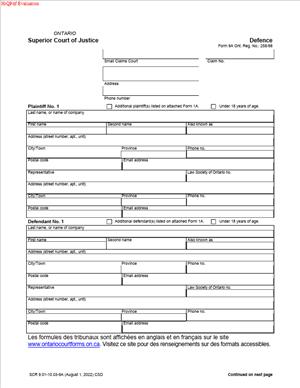
The response should reflect what you honestly dispute and what you accept. The official Defence form allows you to dispute the claim, admit it with proposed payment terms, or admit part.
This Ontario Small Claims Court response table helps separate those options.
Table description: Ontario Small Claims Court response options for disputed claims, admitted amounts, and separate claims.
| Your position | What to consider |
|---|---|
| You dispute the whole claim | Explain the facts supporting your denial. |
| You accept only part | Identify the admitted amount and explain the disputed balance. |
| You accept the amount but need time | Consider a realistic proposal for payment terms. |
| You want an order against the plaintiff or another person | Assess whether a separate defendant’s claim is needed. |
Disputing Responsibility or the Amount
You may disagree about whether money is owed, how much, or who is responsible. Separate those questions.
For example, a supplier claims $6,000. You have records showing a $2,000 payment. That payment may affect the balance even if the underlying purchase is not disputed.
In another example, you accept that the work occurred but say it didn’t meet the agreement. Explain the agreed work, the specific problem, and the records supporting your position.
Avoid making every disagreement sound identical. A payment dispute needs a payment record. A complaint about defective work needs facts about the work and the alleged defect.
Admitting an Amount and Proposing Payments
An Ontario Small Claims Court payment proposal requires careful thought. State the amount, payment dates, and instalments clearly. Check that the final payment clears the admitted balance.
Ontario’s guide says you must make proposed payments as though the proposal were a court order. The plaintiff may dispute the terms by requesting a payment hearing. The official form gives the plaintiff 20 calendar days after service of the defence to do so. Missing proposed payments can lead to judgment for the unpaid admitted balance.
Do not admit an amount merely to gain time. An admission addresses what you owe. A settlement discussion explores whether the parties can agree to resolve the dispute.
Build a Clear Defence From Facts and Documents
Your Ontario Small Claims Court defence should give a clear account of the disputed events. Plain language works well. Long legal phrases will not fill gaps in the facts.
Use Form 9A — Defence to organize the response. Compare the completed document with the official form and current court requirements.
Answer the Main Allegations
Read each numbered paragraph in the claim. Note whether you agree, disagree, or lack enough knowledge to accept it. Explain the important disagreements using dates, events, and amounts.
A useful preparation method is to write three short notes for each issue:
- What the plaintiff says happened.
- What you say happened.
- Which record or witness may support your account.
For example, a contractor alleges that an extra charge was approved. Your records may show that you asked for a price first and did not approve the work. Identify the relevant exchange and explain the sequence.
Avoid unrelated complaints or guesses about motives. A sentence such as “the company always cheats people” does not explain your transaction. Describe the work, payment, delivery, or communication at issue.
Attach Documents You Rely On
The official form expressly requires copies of documents relied on in the defence. If a document is lost or unavailable, explain why it is missing. Do not treat attachments as optional when your defence relies on them.
For your Ontario Small Claims Court records, preserve complete originals separately. Make clear copies for the filing package. Check that scans include all pages and that small print is readable.
Potentially useful records include contracts, invoices, payment confirmations, photographs, and relevant messages. Their value depends on the issues. A large bundle of unrelated material can make the important records harder to find.
If you describe an attachment in your defence, use the same name throughout. For instance, identify the invoice by its date and number. Avoid calling the same document “the bill” in one place and “the estimate” elsewhere.

Ontario Small Claims Court Trial: Evidence, Witnesses, and a Practical Preparation Checklist
Organize Evidence Before Memories Fade
An Ontario Small Claims Court response benefits from a simple, reliable evidence file. Start collecting records while events are still clear. Preserve records that appear to hurt your position as well as those that support it.
Create a Timeline and Payment Record
Write events in date order. Beside each event, note the supporting record and where the original is stored. Mark uncertain dates as uncertain.
For a payment dispute, list the original amount, each payment, refunds or credits, and the balance you calculate. Compare your figures with the claim. Check for duplicate charges or payments applied to a different invoice.
For example, two transfers on the same day may cover different jobs. A bank statement alone might not show which job was paid. Keep the accompanying message or receipt that explains the transfer.
Preserve Messages and Photographs
Keep full email threads and message exports where possible. A screenshot should show enough context to identify who wrote it and when. Preserve the original file rather than editing it to strengthen your argument.
For photographs, note the date, location, and person who took them. Keep an untouched copy before adding arrows or making a working crop. Record what the photograph shows and what it cannot establish.
Do not describe a later photograph as proof of an earlier condition without explaining the timing. Likewise, keep an estimate separate from proof that repair work was completed and paid for.
Identify People With First-Hand Knowledge
List people who saw the delivery, attended the meeting, performed the work, or handled the payment. Write a short note about what each person actually knows.
Someone who heard your account afterward may have different evidence from someone who witnessed the event. Avoid asking a witness to adopt your wording. Preserve their contact details and discuss the proper next steps when preparing for court.
Serve the Defence and Prove Service
Service means giving documents to the other parties using a permitted method. Filing means placing documents with the court. Your Ontario Small Claims Court response generally requires both.
The defence must go to every other party. Check the party list and current representative details before sending it. Use the same completed defence and attachments that you plan to file.
A defence may be served by several methods, including email, mail, courier, or personal service, subject to the applicable rules and any court order. Confirm the correct address and requirements for the method. Do not assume the rules for serving a defence also apply to a new claim.
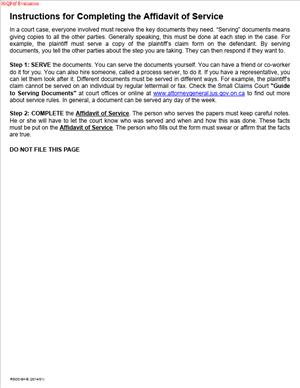
Use Form 8A — Affidavit of Service to record the service facts. The server swears or affirms the affidavit before an authorized commissioner. A separate affidavit is required for each party served. Licensed representatives may use Form 8B where permitted.
Keep sent emails, attachment lists, delivery records, and accurate notes. Mailing on the last day may not complete service that day. Leave enough time for the chosen method to take effect.
File Through the Correct Court Channel
For an Ontario Small Claims Court case outside Toronto, the court directs users to Small Claims Court Submissions Online for a defence. Toronto online filings use the Ontario Courts Public Portal. Check the case location, not just where you live.
The ministry says the online portals cannot be used when a legal or court deadline is three business days or less away. If time is short, contact the courthouse promptly and follow the applicable urgent filing directions. Do not assume ordinary email is always accepted.
An on-screen submission receipt does not by itself show that documents were accepted for filing. Monitor the court’s response and correct any rejection promptly. Keep the accepted documents and filing confirmation. Check applicable fees and fee-waiver options before submitting.
Make a final package check: correct file number, complete pages, signatures, attachments, and proof of service. Open the files after saving them. A file that looks complete in your editor may export with missing pages.
Decide Whether You Need a Defendant’s Claim
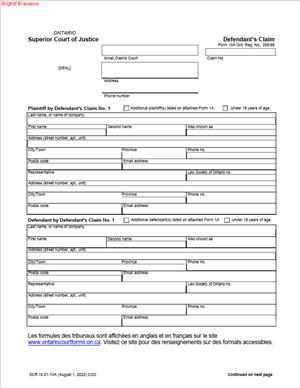
An Ontario Small Claims Court defence answers the case against you. A defendant’s claim asks for relief against the plaintiff or another person. One does not replace the other.
For example, a customer sues a repair business. The business may also allege that a supplier caused the loss. Whether that supports a claim against the supplier depends on the facts and legal basis.
The court says a defendant’s claim must generally be issued within 20 calendar days after filing the defence. It must then be served within six months after issuance. These are separate stages and separate deadlines.
Review Form 10A — Defendant’s Claim if you may need this route. Identify who owes what, why, and how the amount was calculated. Check limitation periods and any need for permission if you are late.
Get advice about the difference between reducing the plaintiff’s recovery and seeking your own judgment. Writing “they owe me too” in a defence does not complete a separate claim.
Act Quickly if You Missed an Ontario Small Claims Court Deadline
Missing the Ontario Small Claims Court defence deadline creates a risk of default. Being noted in default is a formal step. It can allow the plaintiff to seek judgment without your participation.
First, contact the court office to confirm the file’s status. Ask whether a default request, noting in default, judgment, or enforcement step appears on the record. Those stages can require different responses.
If no default request has been filed, the official defence instructions say a late defence may still be filed. Act promptly rather than waiting for the plaintiff’s next move. If you have been noted in default, additional steps are required.
Court guidance explains that you may seek consent or bring a motion to set aside default proceedings. Completed enforcement steps raise further limits. Relief is not guaranteed.
Gather your proposed defence, service history, reasons for delay, and the orders already made. The Notice of Motion and Supporting Affidavit may be relevant. Check scheduling and notice requirements. A motion is a request for an order; it does not automatically erase a judgment or stop enforcement.

Keep Preparing After the Defence Is Filed
A filed Ontario Small Claims Court defence starts the next stage of a disputed case. It does not mean the dispute is over. Continue checking correspondence and preserving records.
The court schedules a settlement conference when a timely defence disputes some or all of the claim. At least 14 days beforehand, parties must serve and file their proposed witness list and trial documents not already attached to the claim or defence. Follow any additional order.
Use the settlement conference preparation guide when that stage approaches. Keep settlement proposals separate from your ordinary evidence file, and seek advice before disclosing confidential negotiations.
If you reach an agreement in your Ontario Small Claims Court case, record the amount, dates, costs, interest treatment, and steps needed to resolve the case. Keep payment records. Do not assume a phone call settles every issue or ends every claim.
Conclusion
Responding to an Ontario Small Claims Court claim starts with the service date and a clear plan. Identify your position, gather supporting records, serve the other parties, and complete filing within the applicable deadline.
Track any separate defendant’s claim and later court dates. If default, uncertain service, or legal responsibility is involved, seek help promptly. RunSensible Forms can help you find and prepare relevant documents. It is not a law firm, court, or official filing service.
Frequently Asked Questions
Does calling the plaintiff count as a defence?
No. A phone call does not complete the required Ontario Small Claims Court defence, service, and filing steps. Keep a note of the discussion and continue tracking the deadline. Confirm any procedural agreement in writing and check its legal effect.
Do I have to pay everything claimed to avoid default?
You can dispute a claim through the proper response process. Default concerns failure to respond as required. Whether money is owed is a separate issue. Carefully distinguish any admitted amount from the part you contest.
Can I file a defence if the 20 days have passed?
Possibly. The file’s status matters. Check immediately whether a default request has been filed or you have been noted in default. The official instructions describe when a late filing remains possible and when further steps are needed.
Should I attach every message I have?
Attach documents you rely on as required by the official form. Preserve other relevant records for later disclosure and preparation. Avoid adding unrelated messages simply to make the package longer. Explain any relied-on document that is unavailable.
Does another defendant’s response protect me?
Do not assume that it does. Check whose names appear as the defendants filing the response. Your position may differ from theirs. A case can continue with one defending party while another faces default consequences.
Where can I get help with an Ontario Small Claims Court response?
The court lists the Law Society Referral Service, Pro Bono Ontario, and CLEO resources. Ask about current service scope and eligibility. A lawyer or licensed paralegal can assess your legal position; court staff can explain administrative procedures.
Resources
- Ontario Superior Court of Justice — How to respond to a case: https://www.ontariocourts.ca/scj/areas-of-law/small-claims-court/how-to-respond-to-a-case/
- Ontario — Rules of the Small Claims Court, O. Reg. 258/98: https://www.ontario.ca/laws/regulation/980258
- Ontario — Replying to a claim: https://www.ontario.ca/document/guide-procedures-small-claims-court/replying-claim
- Ontario Court Services — Current Small Claims Court forms and version dates: https://ontariocourtforms.on.ca/en/rules-of-the-small-claims-court-forms/
- Ontario Court Services — Official Form 9A and filing instructions: https://ontariocourtforms.on.ca/static/media/uploads/courtforms/scc/09a/scr-9a-aug22-en-fil.pdf
- Ontario Court Services — Official Form 8A and service instructions: https://ontariocourtforms.on.ca/static/media/uploads/courtforms/scc/08a/scr-8a-aug22-en-fil.pdf
- Ontario — Serving documents: https://www.ontario.ca/document/guide-procedures-small-claims-court/serving-documents
- Ontario — File small claims court documents online: https://www.ontario.ca/page/file-small-claims-court-documents-online
- Ontario Superior Court of Justice — Toronto Small Claims Court cases: https://www.ontariocourts.ca/scj/areas-of-law/small-claims-court/toronto-small-claims-court-case-center/
- Ontario Superior Court of Justice — Defendant’s claim: https://www.ontariocourts.ca/scj/areas-of-law/small-claims-court/defendants-claim/
- Ontario Superior Court of Justice — Default proceedings: https://www.ontariocourts.ca/scj/areas-of-law/small-claims-court/default-proceedings/
- Ontario Superior Court of Justice — Motions: https://www.ontariocourts.ca/scj/areas-of-law/small-claims-court/motions/
- Ontario Superior Court of Justice — Settlement conferences and trial management conferences: https://www.ontariocourts.ca/scj/areas-of-law/small-claims-court/settlement-conference-trial-management-conferences/
- Ontario Superior Court of Justice — Finding legal help: https://www.ontariocourts.ca/scj/areas-of-law/small-claims-court/finding-legal-help/
Disclaimer: The content provided on this blog is for informational purposes only and does not constitute legal, financial, or professional advice.
Contents