
An Ontario Small Claims Court trial is your chance to prove your case with facts, documents, and witnesses. Good preparation helps the deputy judge follow your story. It also helps you avoid late evidence, missing witnesses, and unclear damage calculations.
This guide explains the process in plain language. It covers what to do after a settlement conference, how to build your evidence, how to prepare witnesses, and what to expect on trial day. It provides general legal information, not legal advice. Court rules, forms, and local directions can change, so check the current official sources before you act.
Understand What the Trial Must Decide
An Ontario Small Claims Court trial is not a new negotiation meeting. It is a hearing where each party presents evidence. A deputy judge then decides the claim.
The plaintiff is the person who started the claim. The defendant is the person responding to it. If the defendant filed a Defendant’s Claim, each side may have something to prove.
Identify the issues in your Ontario Small Claims Court trial
Start with the filed Plaintiff’s Claim, Defence, and any Defendant’s Claim. Read each statement of fact. Mark what both sides agree on. Then list what remains disputed.
Most disputes can be divided into a few questions:
- Did the parties have an agreement or legal duty?
- What did each party promise or need to do?
- Did someone fail to meet that duty?
- Did that failure cause a loss?
- What amount or remedy can the evidence support?
- Did the person claiming a loss take reasonable steps to limit it?
These questions form the structure of your case. Each important fact should connect to a document, a witness, or both.
That issue-by-issue structure keeps an Ontario Small Claims Court trial focused on facts that can change the result.
For example, a contractor claims an unpaid balance. The signed quote may prove the agreed price. Photos and messages may show that the work was completed. Invoices and payment records may show the unpaid amount. The homeowner may rely on inspection photos, repair estimates, and messages about defects.
Know who must prove what
The person making a claim normally has the burden of proving it. In a civil case, the usual standard is the balance of probabilities. In simple terms, the judge must find that a fact is more likely true than not true.
You do not meet that standard by repeating a conclusion. “The work was bad” is a conclusion. Clear photos, dates, messages, repair invoices, and witness evidence may prove what was wrong and what it cost.
Create a short proof chart for your own use. Put each issue in the first column, the fact you must prove in the second, and your evidence in the third. This chart is a planning tool, not a court form.

Move the Case From Conference to Trial
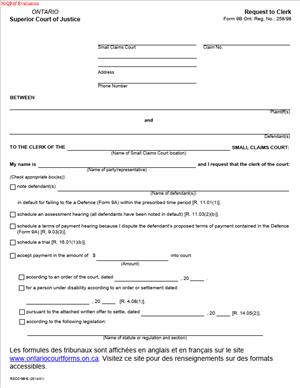
The court’s trial page says a party may ask for a trial date by filing a Request to Clerk, Form 9B, and paying the required fee at least 30 days after the settlement conference. Check your settlement conference endorsement and the current court instructions before filing. A judge may have made directions that apply to your case.
Review every direction and deadline
After the settlement conference, read the endorsement or order carefully. It may identify the issues, require documents to be exchanged, set deadlines, or estimate the time needed for trial.
Create one calendar that includes:
- the trial date, time, place, and hearing method;
- every deadline in an endorsement or order;
- the deadline for serving trial evidence;
- witness-summons dates;
- dates for any hearing-method request;
- time to prepare, copy, and check your materials.
Do not rely on memory. Missing a direction may limit what you can use at the Ontario Small Claims Court trial.
A simple deadline calendar can prevent an Ontario Small Claims Court trial from being disrupted by an avoidable late step.
Confirm how the hearing will take place
Ontario’s current guideline says Small Claims Court trials are held in person unless the court directs otherwise. A remote trial is normally by videoconference.
If you need a different hearing method, the court guideline directs you to complete Form 1B, serve it, and file it with an affidavit of service at least 30 days before the hearing. The court decides the request. Another party may respond using Form 1C.
Always follow the notice you received. It tells you what the court has scheduled. If the hearing is remote, test your device, internet, camera, microphone, and document access before the trial.
Build a Clear Evidence Plan
Evidence is information the court may use to decide facts. It can include oral testimony, contracts, invoices, receipts, photographs, messages, business records, expert reports, and audio or video files.
An Ontario Small Claims Court trial works best when every item has a clear purpose. Do not add a document only because it mentions the dispute. Ask: “Which fact does this prove?”
Treat the evidence file as the working record for your Ontario Small Claims Court trial, not as a storage place for every paper you have.
Gather the complete record
Collect records from all likely sources:
- contracts, quotes, estimates, and change orders;
- invoices, receipts, bank records, and payment confirmations;
- emails, letters, text messages, and app messages;
- dated photographs and videos;
- repair, inspection, or expert reports;
- delivery records and work logs;
- notices and proof of service;
- notes made at the time of important events.
Keep the original electronic files. Printed screenshots can hide dates, sender details, or parts of a conversation. Export a full thread when possible. Do not edit an image or message in a way that changes its meaning.
Check whether private information must be removed or protected. Bank records, medical records, and identity documents may contain details that the case does not need. Follow the court’s rules and any order about confidential material.
Serve documents on time
Rule 18.02 of the Rules of the Small Claims Court addresses written statements, documents, and audio or visual records. In general, material served on all parties at least 30 days before the trial is received in evidence unless the trial judge orders otherwise.
The rule also covers signed witness statements and expert reports. It requires identifying information for a witness or author. Expert material must include a summary of the expert’s qualifications.
Do not treat the 30-day rule as permission to wait until the last moment. You may need time to correct an incomplete statement, arrange service, and prove when service occurred. An endorsement or local direction may also require an earlier step.
Use the proper method of service. Keep delivery records. Complete the correct affidavit of service when proof is required. The RunSensible Form 8A page can help you organize the details of service, but the filed form and method must match the current court rules.
Organize your trial materials
Prepare a clean, numbered set of documents. Use the same order for every copy. A useful sequence is:
- A short index.
- The filed claim, defence, and any defendant’s claim.
- Important orders or endorsements.
- The key agreement or transaction records.
- Documents arranged by date or issue.
- Damage records and calculations.
- Witness statements or reports.
- Proof of service where needed.
Number every page. Use bookmarks or tabs if the format allows. Give each photo a short neutral description and date. For an audio or video file, confirm how the court expects it to be provided and played.
Do not assume that bringing a phone is enough. The deputy judge and other party need a practical way to review the evidence. Check the notice of trial, local court instructions, and any directions about paper or electronic copies.
Good page numbering saves time during an Ontario Small Claims Court trial because everyone can find the same item quickly.
Prepare Witnesses Properly
A witness gives evidence about facts they saw, heard, did, or recorded. A witness should tell the truth in their own words. You may help a witness understand the process, but you must not tell them what answer to give.
Witness preparation for an Ontario Small Claims Court trial should improve clarity without changing the witness’s honest memory.
Decide who really needs to testify
For each possible witness, write the facts that person can prove. Avoid calling several people to repeat the same point. Choose witnesses with direct knowledge.
Examples include:
- the person who signed or negotiated an agreement;
- a worker who completed or inspected the job;
- a person who saw an incident;
- the author of a key business record or report;
- an expert whose opinion is needed to explain a technical issue.
Ask whether a document can establish the fact under Rule 18.02 or whether live evidence is important. The other party may summon the author of a served statement or document for cross-examination.
Use a summons when attendance is uncertain
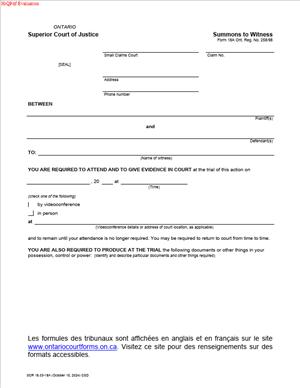
Form 18A is the Summons to Witness. It can require a person in Ontario to attend and may require them to bring listed documents or things.
The current official form states that it must be personally served at least 10 days before trial with the required attendance money. Rule 18.03 governs the summons. Because fees and form versions can change, confirm the current amount and current form before service.
Service and payment or tender of attendance money may be proved with Form 8A. If the witness needs an interpreter, review Rule 18.03 and arrange the required service early. English–French interpretation follows a different court process than other languages.
Do not use a summons to pressure or punish someone. Call a witness because their evidence is relevant to a real issue in the Ontario Small Claims Court trial.
Plan summons service early so the Ontario Small Claims Court trial does not depend on a last-minute delivery attempt.
Prepare questions, not a script
For your own witness, use short, open questions:
- What was your role?
- What happened next?
- What did you observe?
- How do you recognize this document?
- What did you do after receiving the message?
Avoid questions that suggest the answer. Let the witness explain what happened.
For the other side’s witness, prepare focused cross-examination questions. A leading question may be useful, such as: “You did not send a written complaint before June 12, correct?” Ask only questions that help prove your case or test the witness’s account. Do not argue with the witness.
Explain the Money Clearly
Winning on responsibility does not automatically prove the amount. Your Ontario Small Claims Court trial plan should include a clear calculation of every dollar requested.
The deputy judge should be able to compare the Ontario Small Claims Court trial evidence with your calculation line by line.
Separate each part of the claim
Create a one-page calculation. List each amount, the reason for it, and the supporting record.
For example:
- unpaid invoice: $4,200, supported by the contract and invoice;
- reasonable repair cost: $1,150, supported by a paid receipt;
- returned deposit: $800, supported by the payment record and agreement.
Do not combine unrelated amounts into one total. If you claim interest, identify the legal or contractual basis and show the calculation. If you claim costs, keep filing, service, and other allowed receipts separate from the main loss.
Show reasonable steps to limit loss
A person who suffers a loss may need to take reasonable steps to reduce it. This is often called mitigation.
Suppose damaged equipment could be repaired for $600, but the owner buys a $3,000 replacement without checking repair options. The court may ask whether that response was reasonable. Keep estimates, messages, and notes showing what options you considered.
Be realistic. A precise, supported request is stronger than a large amount based on guesses.

Landlord Tenant Dispute Resolution Guide for Canada: ON and BC
Prepare What You Will Say
You do not need to memorize a speech. You need a short roadmap and organized questions.
A clear speaking plan helps an Ontario Small Claims Court trial move from one issue to the next without needless repetition.
Plan a short opening
Your opening should tell the deputy judge:
- what the dispute is about;
- the main facts you will prove;
- the key evidence and witnesses;
- the result you ask the court to order.
Do not argue every detail. Do not describe evidence that you cannot present. Keep the opening brief enough that the judge can see the structure of the case.
Put your evidence in a logical order
Usually, the plaintiff presents evidence first. The defendant may cross-examine each plaintiff witness. The defendant then presents evidence, and the plaintiff may cross-examine those witnesses. The judge may ask questions at any time.
Use a witness plan for your Ontario Small Claims Court trial. For each witness, list the points they can prove and the documents you want them to identify. Put the questions in a natural order.
When using a document, be ready to explain:
- what it is;
- who made or received it;
- when it was created;
- whether it is complete and unchanged;
- why it matters.
Prepare a focused closing
The closing comes after the evidence. Connect the proven facts to the result you seek. A simple structure is:
- State the issues the judge must decide.
- Identify the strongest evidence on each issue.
- Address a serious weakness or conflict directly.
- Review the amount and remedy requested.
- State the order you want.
Your closing is not new evidence. Do not add facts that no witness or admitted document established.
Keep Settlement Open Without Weakening Preparation
Many cases settle before the Ontario Small Claims Court trial begins. Trial preparation often improves settlement because both sides can see the evidence and risk more clearly.
Form 14A can be used to make a formal offer to settle. Form 14B records acceptance. Form 14C withdraws an open offer. Form 14D records terms of settlement. Read the current rules before using these forms because wording, service, timing, and costs consequences matter.
Make sure a settlement deals with the whole dispute. State payment dates, dismissal or withdrawal steps, releases if used, and what happens if someone does not perform. Do not tell the trial judge about a protected settlement offer while the judge is deciding the merits of the claim.
Continue preparing until the case is formally resolved or the court tells you the trial will not proceed. A promising discussion is not the same as a completed settlement.
Keep every Ontario Small Claims Court trial deadline in place while settlement talks remain unfinished.
Get Ready for the Hearing Format
For an in-person Ontario Small Claims Court trial, confirm the courthouse address, courtroom instructions, entry rules, and travel time. Arrive early enough to pass security and check in. Bring photo identification, your organized materials, original documents when available, and a way to take notes.
For a remote trial, use a quiet room with stable internet and a charged device. Join with the name shown on the case. Keep your camera on if directed. Do not record the hearing unless the court permits it. Have the same document set open and easy to search.
In either format:
- address the judicial officer respectfully;
- speak slowly and clearly;
- do not interrupt;
- listen to each question before answering;
- take notes when another person speaks;
- ask for clarification if you do not understand an instruction.
The same evidence and conduct rules apply to an Ontario Small Claims Court trial whether it proceeds in person or by video.
If you need disability-related help, contact the courthouse accessibility coordinator as early as possible. If you need an interpreter, check the official court process instead of waiting until trial day.
Avoid Common Trial Preparation Mistakes
Serving evidence late
Late material can cause an objection, delay, costs, or an order that limits its use. Work backward from the trial date and respect both Rule 18.02 and any case-specific direction.
Bringing too much without a clear purpose
A large file is not automatically a strong case. Remove duplicates. Highlight the records that prove the disputed facts. Keep background material available, but make the core story easy to follow.
The best Ontario Small Claims Court trial file is complete, but it also makes the important proof easy to find.
Depending on hearsay alone
Hearsay is a statement made outside court that is offered to prove its truth. Small Claims Court has a practical evidence rule, but the judge still decides what is reliable and what weight to give it. Use first-hand witnesses and complete records where possible.
Failing to prove the amount
Bring a clear calculation and supporting records. The judge may accept that something went wrong but award less than requested if the loss is not proven.
Assuming a witness will appear
A friendly promise is not a court order. If the witness is important and attendance is uncertain, consider a Form 18A summons early enough to complete all required steps.
Ignoring the weak part of your case
The other side will likely focus on it. Review conflicting documents and prepare an honest explanation. Do not hide, alter, or destroy evidence.
Ontario Small Claims Court Trial Checklist
Four to eight weeks before the hearing
- Read the notice of trial, conference endorsement, orders, and local directions.
- List the legal and factual issues.
- Match each issue to evidence.
- Confirm witness availability.
- Arrange any Form 18A summons and attendance money.
- Serve written statements, reports, documents, audio, and video within the required time.
- Make or review any settlement offer.
- Request a different hearing method promptly if needed.

One to two weeks before the hearing
- Confirm that required service is complete and documented.
- Build identical, numbered document sets as directed by the court.
- Prepare the damages calculation.
- Write questions for each witness.
- Draft a short opening and closing outline.
- Check whether witnesses need accessibility help or an interpreter.
- Confirm the courthouse or video instructions.
The day before
Use this final Ontario Small Claims Court trial check to catch missing materials before the hearing day begins.
- Pack or open every document set.
- Confirm witness attendance.
- Charge devices and test remote-hearing equipment if applicable.
- Put the notice of trial and contact details at the front of your file.
- Review your issues list, not every page of the case.
- Plan to arrive or connect early.
Conclusion
An Ontario Small Claims Court trial becomes more manageable when you reduce the case to issues, facts, and proof. Start with the filed claims and defence. Serve useful evidence on time. Choose witnesses with direct knowledge. Explain every dollar. Organize the material so another person can follow it.
Preparation cannot guarantee a result. It can help the deputy judge understand the strongest version of your case. Before filing or serving anything, check the current Rules of the Small Claims Court, official forms, court notice, and local directions.
Frequently Asked Questions
What happens at an Ontario Small Claims Court trial?
Each party presents evidence and questions witnesses. The plaintiff usually presents first. The defendant may cross-examine. The defendant then presents evidence, and the plaintiff may cross-examine. The deputy judge may ask questions and will decide the claim based on the evidence and law.
How early must I serve documents for trial?
Rule 18.02 generally addresses documents, written statements, and audio or visual records served at least 30 days before trial. A court order or direction may set another requirement. Check the current rule and your case documents.
Do I need to bring original documents?
Bring originals when they are available, along with the copies or electronic materials required by the court. An original may help if authenticity is disputed. Follow the notice of trial and local directions about the number and format of copies.
Can I use text messages, emails, photos, or video?
These records may be evidence if they are relevant and reliable. Preserve the complete files and identifying details. Serve them on time and confirm how the court wants electronic evidence delivered and played.
How do I make a witness attend?
You may use Form 18A, Summons to Witness, for a witness in Ontario. The current form requires personal service at least 10 days before trial with attendance money. Verify the latest form, fee amount, and Rule 18.03 before acting.
Are Ontario Small Claims Court trials in person or online?
The current court guideline says trials are in person unless the court specifies otherwise. Remote trials are normally by videoconference. Read your notice. Form 1B may be used to request a change, and the court decides.
Can the case still settle before trial?
Yes. Parties can keep discussing settlement. The Small Claims Court rules provide formal offer and settlement forms. Continue preparing until the settlement is complete and the court confirms that the trial will not proceed.
What if I cannot attend the trial date?
Contact the court and review the rules immediately. Only the court can adjourn a trial. Do not assume the date changed because the other party agrees. A failure to attend can lead to the case proceeding without you or other serious results.
Resources
- Ontario Superior Court of Justice — Trial: https://www.ontariocourts.ca/scj/areas-of-law/small-claims-court/trial/
- Ontario Superior Court of Justice — Guide to Small Claims Court Process: https://www.ontariocourts.ca/scj/areas-of-law/small-claims-court/guide-to-small-claims-court-process/
- Ontario Superior Court of Justice — Guidelines to Determine Hearing Method: https://www.ontariocourts.ca/scj/areas-of-law/small-claims-court/guidelines-to-determine-hearing-method-in-the-small-claims-court/
- Ontario — Getting Ready for Court: https://www.ontario.ca/document/guide-procedures-small-claims-court/getting-ready-court
- Ontario — Rules of the Small Claims Court, O. Reg. 258/98: https://www.ontario.ca/laws/regulation/980258
- Ontario Court Services — Form 18A, Summons to Witness: https://ontariocourtforms.on.ca/en/rules-of-the-small-claims-court-forms/18a-1/
- Ontario — Going to Court: Accessibility: https://www.ontario.ca/page/going-court-accessibility
- Ontario — Get a Court Interpreter: https://www.ontario.ca/page/get-court-interpreter
Disclaimer: The content provided on this blog is for informational purposes only and does not constitute legal, financial, or professional advice.
Contents