Legal separation in Washington State creates a court case that can settle property, debt, maintenance, parenting, child support, and safety issues while the spouses remain legally married. It is not the same as moving into separate homes, and it does not free either spouse to remarry. For some couples, that continuing marital status matters for personal, religious, immigration, insurance, or financial reasons. Those consequences can be complex, however, so confirm them with the relevant professional before choosing separation over divorce.
This guide explains the statewide framework and the forms commonly used in a marriage case. It is general legal information, not legal advice. Forms, filing methods, fees, hearing practices, and local cover sheets can change. Before filing, check the current Washington Courts legal-separation forms page, the Superior Court rules for your county, and any standing family-law orders.
What legal separation in Washington State does
A decree of legal separation is a final family-law order, but it does not dissolve the marriage. Under Washington law, the court can address many of the same subjects it would address in a divorce: marital status, property and liabilities, maintenance, parenting, child support, tax exemptions, restraints, and a requested name change. The difference is that the marriage continues.
Choosing legal separation in Washington State therefore requires more than comparing filing labels. It means deciding whether continuing marital status fits the spouses’ goals after considering the court orders and outside consequences that may follow.
That continuing status has practical effects. Neither spouse can marry someone else unless the legal separation is later converted to a dissolution. A separation decree may also affect health coverage, taxes, retirement benefits, estate planning, beneficiary designations, debt exposure, and immigration matters. A court order cannot force an insurer or plan administrator to keep a spouse enrolled, so check the actual plan documents before relying on continued coverage.
Physical separation alone does not create a court order. If spouses simply live apart, they may still make private arrangements, but those arrangements do not automatically become enforceable family-law orders. Legal separation in Washington State uses a Superior Court case to establish enforceable terms.
Legal separation versus divorce
The central question is whether the marriage should continue as a legal status. Divorce ends it; legal separation does not. Both processes can involve service, financial information, temporary motions, parenting plans, child support, property allocation, and a final hearing or presentation.
Washington has a 90-day statutory waiting period for a divorce after filing and service, but Washington LawHelp explains that there is no comparable 90-day wait to finalize a legal separation. That does not make every separation case fast. The respondent needs time to answer, disputed facts may require motions or trial, and county calendars can add delay. If the spouse is personally served in Washington, Washington LawHelp says the response period is generally 20 days. Different service methods or locations can change the deadline, so read the summons and rules that apply to the actual service.
If one spouse requests legal separation but the other objects and petitions for dissolution or invalidity, Washington law directs the court toward the requested dissolution or invalidity case rather than forcing legal separation. This is an important planning issue: one spouse cannot always guarantee that the case will remain a separation.
Before filing for legal separation in Washington State
Preparation can prevent rejected papers and requests that do not match the evidence. Start by identifying the correct court, the issues the judge must decide, and any immediate risks.
Before starting legal separation in Washington State, also check for an existing divorce, parentage, protection-order, or child-support case that may affect where and how new requests should be made.

Confirm Superior Court jurisdiction and county venue
Washington family-law cases are filed in Superior Court. The petition must establish an allowed connection to Washington, such as residence in the state or another statutory jurisdictional basis. County venue is a separate question. Confirm where the case should be filed under state law and local practice, especially if spouses live in different counties, recently moved, or a child has lived outside Washington.
Child-custody jurisdiction can be more complicated than adult residency. If a child recently moved, another state has an order, or a case is already pending elsewhere, get legal advice before filing competing parenting requests.
Define the orders you need
List the topics that must be resolved now and at finalization:
- who will live in the family home;
- who will pay the mortgage, rent, utilities, loans, and insurance;
- how bank accounts, vehicles, personal property, and business assets will be handled;
- whether either spouse requests maintenance;
- what parenting schedule and decision-making terms are needed;
- how child support, health coverage, and child expenses should be allocated;
- whether restraints involving property, contact, harassment, or relocation are necessary; and
- whether either spouse seeks restoration of a former name.
Washington courts divide property and liabilities in a manner that is just and equitable after considering factors such as the nature and extent of community and separate property, the marriage’s duration, and each spouse’s economic circumstances. “Just and equitable” does not automatically mean a mathematically equal split. Property characterization, valuation, taxes, retirement plans, and secured debt can justify professional advice.
Gather records before completing forms
Create a reliable snapshot of income, expenses, assets, liabilities, and parenting facts. Useful records may include recent pay statements, tax returns, bank and retirement statements, mortgage and loan balances, insurance information, property records, business records, childcare costs, school calendars, health expenses, and existing court orders.
Keep private source documents separate from documents intended for the public file. Washington uses sealed cover sheets for certain financial records. Follow the form instructions and local e-filing categories carefully; filing protected information in the wrong category can expose sensitive data.
How to file for legal separation in Washington State
The statewide sequence is straightforward, but the exact packet depends on whether the spouses agree, have children, need temporary relief, or face safety concerns.
Step 1: Complete the opening forms
The main pleading for legal separation in Washington State involving a married couple is FL Divorce 203, Petition for Legal Separation (Marriage). It identifies the spouses, jurisdictional facts, children, property and debts, and the relief requested. The requests in the petition matter because a final order generally needs to fit within the issues properly raised in the case.
The Washington Courts packet also lists FL Divorce 200, Summons: Notice About a Marriage or Domestic Partnership, the confidential-information form FL All Family 001, and FL All Family 002 if additional confidential information is needed. The state forms page also identifies a Department of Health certificate. Use the latest revision and check whether the county requires a case-information cover sheet, local schedule, or proposed-order format.
Complete captions consistently. Use the same party names on every document, leave the case number blank until the clerk assigns it, and distinguish information that belongs in the public petition from information that belongs in a confidential form.
Step 2: File with the correct Superior Court
File the original documents using the county’s accepted method—at the clerk’s office or through an authorized electronic system where available. Pay the filing fee or ask the clerk about the county’s current fee-waiver procedure if payment is a hardship. Fees vary, so verify the amount directly with the filing county rather than relying on an old statewide estimate.
Ask how to obtain conformed copies and how the county schedules family-law hearings. Preserve a complete copy of everything filed and the clerk’s filing confirmation.
Step 3: Serve the other spouse correctly
Starting legal separation in Washington State ordinarily requires formal service of the summons, petition, and other required starting documents on the respondent. The petitioner generally should not personally serve the papers. Use a qualified adult who is not a party, a professional process server, or another method authorized by court rule.
After service, the server completes FL All Family 101, Proof of Personal Service. File the proof so the court can confirm notice. If personal service cannot be completed, do not improvise by mailing or posting documents unless a rule or court order authorizes that method. Alternative service often requires a motion, evidence of diligent efforts, and specific publication or mailing steps.
The service record in legal separation in Washington State should identify every starting document delivered. Compare the completed proof against the filed packet before submitting it.
Service drives the response deadline. For in-state personal service, the general response period is 20 days, but the summons governs, and other circumstances can change it.
Step 4: Handle the response or joinder
A respondent who disagrees or wants different relief can file FL Divorce 211, Response to Petition about a Marriage. A spouse who agrees with the petition may be able to use a joinder or acceptance-of-service procedure, but signing a joinder can have important consequences. Agreement about accepting papers is not always agreement about every requested order.
If no response is filed on time, the petitioner may request default using Washington’s default motion and order forms. Default is not automatic. The petitioner must still prove proper service and present legally sufficient final papers. The court also cannot grant relief beyond what the petition and notice fairly requested.
Temporary orders during legal separation in Washington State
A case can take months even without a statutory waiting period. Temporary orders create enforceable rules while legal separation in Washington State is pending. They can stabilize housing, cash flow, parenting, and access to property until agreement or final decision.
What temporary orders can cover
Washington statutes permit temporary maintenance and child support in a legal-separation proceeding. Depending on the facts and requested relief, the court may also issue temporary parenting terms, allocate use of the home or vehicles, direct payment of recurring expenses, require financial conduct, and enter restraints.
Temporary restraining provisions may limit transferring or disposing of property outside ordinary life or business, disturbing another party’s peace, entering specified places, or removing a child from the court’s jurisdiction. Emergency relief without advance notice has additional legal and evidentiary requirements. If immediate safety is at risk, contact emergency services or a qualified domestic-violence resource; a family-law temporary-order motion is not always a substitute for a protection-order process.
Forms used to request temporary relief
For legal separation in Washington State, the statewide packet lists FL Divorce 223, Motion for Temporary Family Law Order, and FL Divorce 224, Temporary Family Law Order. Financial requests commonly require FL All Family 131, Financial Declaration, with supporting source documents submitted under FL All Family 011, Sealed Financial Source Documents. Hearing and service paperwork can include FL All Family 185, Notice of Hearing, and FL All Family 112, Proof of Mailing or Hand Delivery.
If children are involved, temporary child support generally requires the current Washington State Child Support Schedule and Worksheets, and parenting requests may require a proposed parenting plan. County rules may require working papers, confirmation, mediation, a family-law calendar note, or deadlines earlier than the hearing date.
Building a useful temporary-order record
Temporary motions are decided on specific facts, financial figures, declarations, exhibits, and the governing law. Explain what order is requested, why it is necessary now, and how the evidence supports the proposed terms. A request such as “make the other spouse pay everything” is difficult to evaluate. A clearer request identifies the bill, amount, due date, current payer, available income, and proposed duration.
Evidence supporting legal separation in Washington State should stay focused on the requested order. Organize exhibits, cite them accurately, and follow county page limits and delivery deadlines.
Use declarations for firsthand facts. Include dates, amounts, communications, and observed events. Avoid insults and legal conclusions that the evidence does not establish. Redact protected identifiers and use the sealed-document process for pay statements, tax returns, and other designated financial records.
Temporary orders do not decide the final merits. Under Washington law, they can be modified before the final decree and generally terminate when the final decree is entered or the case is dismissed. Treat them as binding while effective; do not assume “temporary” means optional.

Washington State Child Support Schedule 2026: Complete Guide to Definitions, Standards, and Calculations
Parenting and child support forms
When spouses have dependent children, legal separation in Washington State must address child-related issues with the same care as a divorce case. The final packet may include FL All Family 140, Parenting Plan, FL All Family 130, Child Support Order, the Washington State Child Support Schedule and Worksheets, and FL Divorce 243, Residential Time Summary Report.
A parenting plan should provide workable residential time, holiday and vacation schedules, transportation, decision-making, and dispute-resolution terms. Safety limitations require facts and legally appropriate findings. Child support calculations start with verified income and the statewide schedule, but deviations, health-care costs, childcare, tax treatment, and extraordinary expenses can affect the final order.
Child-related orders in legal separation in Washington State remain enforceable even though the parents stay married. Draft them for daily use, not merely for approval on the presentation date.
Parents cannot trade away a child’s support rights simply because both adults agree. The court reviews child support and parenting terms under Washington law. If parentage, relocation, domestic violence, substance misuse, or interstate jurisdiction is disputed, personalized legal advice is especially valuable.
Finalizing legal separation in Washington State
Finalization depends on whether the case is agreed, defaulted, or contested. An agreed case may be presented with signed proposed orders. A default requires proof that notice and default procedures were satisfied. A contested case may require settlement procedures, discovery, motions, pretrial filings, and trial.
Finalizing legal separation in Washington State also requires every proposed document to tell a consistent story. Names, dates, asset descriptions, support figures, and parenting terms should match across findings, schedules, and orders.
Prepare the final documents
The Washington Courts page lists FL Divorce 231, Findings and Conclusions about a Marriage, and FL Divorce 241, Final Divorce or Legal Separation Order. Other final forms may include a parenting plan, child support order and worksheets, residential-time summary, restraining order, qualified retirement order, or documents needed to carry out transfers.
Read every proposed order as an enforceable instruction. Property terms should identify accounts, vehicles, real estate, debts, deadlines, and responsibility for refinancing or sale. Parenting terms should be specific enough to follow. Support terms should state amount, start date, payment method, and required attachments. If an agreement depends on a deed, title change, retirement order, or beneficiary update, identify who must act and when.
Washington LawHelp states that legal separation does not have the divorce statute’s 90-day waiting period. Still, the court must have jurisdiction, proper service, completed required forms, and a legally sufficient basis to enter final orders. The county may require a hearing, presentation calendar, confirmation, or review by a facilitator.
What the final decree changes
Once entered, a legal-separation decree is final. The spouses remain married, but the decree’s financial, parenting, support, and restraint provisions are enforceable. Obtain certified copies if an employer, bank, plan administrator, title company, school, or agency needs proof.
Review related documents after entry. A decree does not automatically update every deed, vehicle title, retirement plan, insurance designation, power of attorney, will, or payable-on-death account. Coordinate follow-through carefully and obtain tax, benefits, or estate-planning advice where necessary.
Converting the separation to divorce—or ending the case another way
Washington law allows either spouse to move to convert a final legal-separation decree to a dissolution no earlier than six months after the decree was entered. RCW 26.09.150 states that the court shall convert the decree upon a proper motion. The statewide forms page lists FL Divorce 251, Motion to Convert Legal Separation Order to Final Divorce Order, and FL Divorce 253, Order Converting Legal Separation Order to Final Divorce Order.
Conversion changes marital status; it does not ordinarily erase the existing parenting, child-support, or property provisions. Read the current motion, arrange notice, and follow the local hearing or presentation procedure. If major terms also need modification, separate legal standards and forms may apply.
After legal separation in Washington State becomes final, preserve the signed decree and all incorporated orders so a later conversion request accurately identifies the controlling documents.
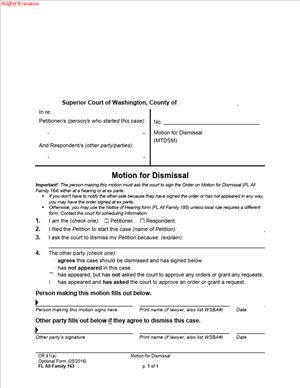
Before a final decree, a party may seek to amend the case or dismiss it. Washington LawHelp notes that amending a pending separation case to divorce triggers the divorce waiting-period framework. A dismissal may require FL All Family 163, Motion for Dismissal, notice, and a signed order, depending on the case posture. Do not assume that stopping participation closes the case.
Common mistakes to avoid
Treating separation as an informal status
Living apart may be personally significant, but it does not produce a legal-separation decree. If enforceable property, support, parenting, or restraint terms are needed, use the court process or obtain advice about another enforceable arrangement.
Using an outdated or incomplete packet
Washington forms are revised. Download the current packet when you are ready to file, not months earlier. Check both statewide and county-specific requirements.
Confusing the divorce waiting period with separation procedure
Legal separation in Washington State has no automatic 90-day finalization wait, but response, service, hearing, and case-preparation time still matter. Do not schedule final presentation before procedural requirements are satisfied.
Filing confidential records publicly
Use the designated confidential-information and sealed-financial-source-document procedures. Redact account numbers and identifiers as the rules require.
Asking for vague temporary relief
Give the judge proposed terms that can be understood and enforced. Match each request to declarations, financial data, or other admissible support.
Assuming legal separation preserves every benefit
Insurance, taxes, public benefits, immigration status, retirement rights, and estate consequences are controlled by more than the family-law decree. Confirm the effect with the plan administrator, agency, tax professional, or lawyer before filing.
Practical filing checklist
Use this checklist to keep legal separation in Washington State organized from intake through final orders.
- Confirm Washington jurisdiction, county venue, and any interstate child-custody issue.
- Decide whether continuing the marriage is an intentional and informed choice.
- Download the current statewide legal-separation packet and county forms.
- Complete FL Divorce 203 and the required summons, confidential information, and health-record forms.
- Identify all requested final relief in the petition.
- File, pay the current county fee, or submit the proper fee-waiver request.
- Arrange valid service and file proof; calendar the response deadline from the summons.
- If temporary relief is needed, prepare the motion, declaration, financial materials, proposed order, hearing notice, and service proof.
- If children are involved, prepare the required parenting and child-support documents.
- Resolve the case by agreement, default, or contested hearing and submit complete final orders.
- Obtain entered copies and carry out transfers, payments, account changes, and other deadlines.
- If conversion is later desired, wait at least six months after entry of the separation decree and use the current conversion forms.
Conclusion: planning legal separation in Washington State
Legal separation in Washington State is a formal court process, not simply a decision to live apart. The case begins with a petition, requires proper notice, can include temporary orders, and ends with detailed enforceable findings and orders while the marriage remains intact. The best preparation is procedural and practical: use current forms, follow county rules, disclose finances carefully, make specific requests, and plan how each final term will be implemented.
RunSensible can help you locate and prepare available forms, but the court’s current instructions control. For disputed property, retirement assets, safety concerns, complex parenting facts, immigration consequences, or uncertain benefits, consider advice from a qualified Washington professional before signing or filing.

Frequently asked questions
Is legal separation in Washington State the same as living apart?
No. Living in different homes does not by itself create a legal-separation decree. A decree is entered in a Superior Court case and can contain enforceable property, debt, support, parenting, and restraint terms.
Do I have to wait 90 days to finalize a Washington legal separation?
No automatic 90-day waiting period applies to legal separation, according to Washington LawHelp. The case still must satisfy service, response, documentation, hearing, and local procedural requirements. A contested case can take much longer.
Can my spouse force a divorce instead?
Potentially. RCW 26.09.030 provides that when legal separation is requested, the court enters that decree unless the other party objects and petitions for dissolution or invalidity. Get advice if the spouses disagree about marital status.
Can temporary orders award maintenance or child support?
Yes. Washington law authorizes temporary maintenance and child support in legal-separation proceedings. Courts may also address parenting, property use, expenses, and restraints when properly requested and supported.
Which form starts legal separation in Washington State?
For a marriage, the principal starting form is FL Divorce 203, Petition for Legal Separation (Marriage). It is filed with other required starting documents, including the summons and confidential-information forms listed by Washington Courts.
Can I convert a legal separation to divorce later?
Yes. No earlier than six months after entry of the legal-separation decree, either spouse may file a motion to convert it to a dissolution. The statewide forms are FL Divorce 251 and FL Divorce 253, subject to current local procedure.
Does the court divide property equally?
Not automatically. RCW 26.09.080 requires a just and equitable disposition after considering relevant statutory factors. The result may be equal or unequal depending on the property, debts, marriage, and economic circumstances.
Do I need a lawyer?
Washington permits self-representation, but legal advice can be especially important when there is domestic violence, complex property, a business, retirement assets, disputed parentage, interstate custody, immigration issues, or uncertainty about insurance and taxes.
Even in an agreed legal separation in Washington State, limited-scope review can help identify missing implementation terms before the judge signs the final papers.
Resources
- Washington Courts: Legal Separation Forms — current statewide form list for starting, temporary, final, child-related, and conversion stages.
- Washington LawHelp: Legal Separation Basics — plain-language explanation of status, response timing, finalization, and conversion.
- RCW 26.09.030 — petition requirements and the effect of an objection requesting dissolution or invalidity.
- RCW 26.09.050 — subjects addressed in final decrees.
- RCW 26.09.060 — temporary maintenance, support, restraining orders, modification, and termination.
- RCW 26.09.080 — just-and-equitable property and debt disposition.
- RCW 26.09.150 — finality and six-month conversion rule.
Disclaimer: The content provided on this blog is for informational purposes only and does not constitute legal, financial, or professional advice.
Contents