Life changes after a custody order. A child starts school. A parent moves. A work schedule shifts. A safety issue may arise. When the old plan no longer works, you may need to modify child custody in California.
A verbal deal does not replace a signed court order. Both parents may agree. Even then, put the new plan in writing. Ask the judge to sign it. If the parents disagree, one parent can ask the court for a new order.
This guide explains the general process. It is legal information, not advice for your case. Rules, fees, local forms, and filing methods can change. Check your county court before you file.
When You Can Modify Child Custody in California
You can ask to modify child custody in California when an existing order no longer meets the child’s needs. The reason should connect to the child’s health, safety, welfare, or daily care.
Common changes include:
- a new school or school schedule.
- a parent’s move or planned move.
- a major change in work hours.
- new medical, learning, or child-care needs.
- repeated missed visits or failed exchanges.
- unsafe conduct, abuse, neglect, or substance misuse.
- a child’s mature preference.
- a plan that is unclear and causes repeated conflict.
A court does not change custody to reward one parent or punish the other. The focus is the child. Your request should explain what changed and why your proposed plan works better now.
Check Whether Your Order Is Temporary or Final
This question matters before you modify child custody in California. California courts always focus on the child’s best interests. Yet a final custody order also carries a strong interest in stability.
A final custody decision gets more weight. A parent who seeks a major change generally must show a significant change in circumstances. The new facts must show that a new plan serves the child’s best interests. The California Supreme Court explained this rule in Montenegro v. Diaz. It also warned that not every detailed or agreed order is final. The wording and the parents’ clear intent matter.
Read your most recent filed order. Look for words such as “final,” “permanent,” or “judgment.” Check whether the order says it is temporary or stays in place until another hearing. If you are unsure, ask a family-law facilitator or lawyer to review it.
Decide Whether the Change Is Major or Limited
Some requests affect the child’s main home. Others adjust pickup time, holidays, transport, or decision-making details. A limited schedule fix may need less evidence than a request to change primary physical custody.
Be exact. “I want more time” is vague. “I ask for alternate weekends from Friday after school to Monday school drop-off” gives the court a usable proposal.
A clear goal also makes it easier to modify child custody in California without asking for terms you do not need.

What a Judge Considers in a California Custody Change
California Family Code section 3011 tells courts to consider the child’s health, safety, and welfare. The court may also look at past abuse. It may review the child’s contact with each parent. The facts differ in every case.
When you ask to modify child custody in California, connect each requested change to the child. Avoid long attacks on the other parent. State what happened and when. Explain the effect on the child. Then state the order you want.
Best Interests and Changed Circumstances
“Best interests” means the plan should support the child’s safety, care, stability, and healthy relationships. “Changed circumstances” means an important fact is different from when the final order was made.
The changed-circumstances rule does not replace the best-interests test. It protects stable final arrangements from repeated court fights. A judge still asks whether the proposed change would serve the child.
Examples may include a long-distance move, a new safety risk, or a major shift in the child’s needs. A small disagreement may not support a major custody change. Do not assume any fact guarantees a result.
A Child’s Wishes
A child does not simply choose the result. Family Code section 3042 covers a child’s wishes. The court must weigh those wishes when the child can form a sound view.
A child who is 14 or older may ask to address the court. The judge will usually allow it. The judge may refuse if speaking would not serve the child’s best interests. Younger children may also provide input when appropriate. The court controls how it receives that input.
Do not coach a child or ask the child to carry messages. Tell the mediator or court that the child wishes to be heard. Follow the court’s process.
Safety and Domestic Violence
Safety concerns need clear facts. List dates, conduct, witnesses, reports, orders, messages, or medical records that support the concern. Do not attach private records unless court rules allow it and the record is needed.
If there is immediate danger, an ordinary hearing may not be fast enough. California courts have separate emergency and domestic-violence procedures. Contact emergency services when someone is in immediate danger. A legal-aid office, family-law facilitator, or lawyer can help identify the correct filing path.
Forms to Modify Child Custody in California
The exact packet depends on your case and county. The table below shows common statewide forms. Your court may require local forms too.
Table alt text: Common forms used to modify child custody in California, with each form’s role and typical user.
| Form | Purpose | Typical use |
|---|---|---|
| FL-300, Request for Order | Asks the judge to make or change family-law orders. | Filed by the parent requesting a change. |
| FL-311, Child Custody and Visitation Application Attachment | Gives a detailed proposed parenting plan. | Attached when more schedule detail is needed. |
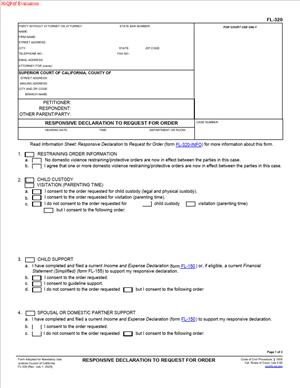
| FL-320, Responsive Declaration to Request for Order | Answers the other parent’s request. | Filed by the responding parent. |
| FL-330, Proof of Personal Service | Proves papers were handed to the other party. | Used when personal service is required. |
| FL-341, Child Custody and Visitation Order Attachment | Records detailed custody and parenting-time terms. | Attached to the court’s order. |
| FL-150, Income and Expense Declaration | Reports income, expenses, and support facts. | May be needed when support or fees are requested. |
To modify child custody in California, start with your most recent order and the instructions for FL-300. Do not use a form only because its title sounds close. Read the form and local packet first.
The Core Request: FL-300 and FL-311
FL-300 identifies the orders you want. It also gives space for facts that support the request. FL-311 can turn a general request into a clear weekly, holiday, vacation, transport, and exchange plan.
Keep your proposal practical. Include start and end times. State who transports the child. Address school breaks and special days. If you request supervised visits, explain the safety basis and propose workable terms.
The Response: FL-320
The other parent may agree, disagree, or suggest a different order on FL-320. A response should address the actual request. It should also state a clear alternative when the parent objects.
The hearing notice and court instructions control filing and service dates. Act early. A late response may not give the judge enough time to review your evidence.
Step by Step: How to Modify Child Custody in California
The process below is a statewide overview. Counties may use different filing systems, mediation models, or local forms.
1. Get the Current Order and Case Number
Before you modify child custody in California, get a complete copy of the latest custody order. Use the same party names and case number on every new form.
Read all attachments. A minute order may not contain the full schedule. The detailed terms may be in FL-341, a judgment, or a signed agreement attached to an order.
2. Define the Exact New Order
Write the result you want before you draft your declaration. Cover normal weeks, holidays, school breaks, exchanges, transport, calls, and decision-making as needed.
Make the plan specific enough to follow. A judge should be able to copy useful terms into an order. A clear proposal also helps mediation.
3. Match Facts to the Legal Reason
Create a short timeline. Start with the date of the current order. Then list the important events that happened later.
For each event, ask three questions:
- What changed?
- How did it affect the child?
- How would the requested order help?
This structure keeps the declaration focused. It also helps the court see why you seek to modify child custody in California now.
4. Complete and File the Forms
Complete FL-300 and any needed attachments. Add FL-311 when you need more space for the parenting plan. Include other forms only when they fit the issues in your request.
File in the court handling the existing family-law case unless a court rule says otherwise. The clerk may give you a hearing date and return filed copies. Pay the current filing fee or ask about a fee waiver if you qualify. Confirm whether the county accepts e-filing, in-person filing, or both.
5. Serve the Other Parent
Filing tells the court. Service gives formal notice to the other parent. These are different steps.

How to Get a Divorce in California: The Complete Step-by-Step Guide (2026)
Follow the filed papers and local instructions. The right method depends on your request. It can also depend on whether the other parent has appeared in the case. A qualified adult who is not a party usually serves the papers. That person then fills out the correct proof-of-service form.
Do not guess about timing. Count backward from the hearing date using the instructions that apply to your packet. Keep a filed copy of the proof.
6. Attend Custody Mediation
When custody or parenting time is contested, California law generally sends the dispute to mediation. Family Code section 3170 addresses mediation for contested requests to obtain or modify custody or visitation orders.
The local program may be called Family Court Services, child custody recommending counseling, or another name. Some counties allow the counselor to make recommendations to the judge. Others use confidential mediation. Read your county’s notice so you know which model applies.
Bring a calm, child-focused proposal. Know where you can compromise and where a safety need makes compromise unsuitable.
7. Prepare for the Hearing
Organize a short hearing file:
- the current custody order.
- your filed request or response.
- your proposed parenting schedule.
- proof of service.
- key evidence, labeled and in date order.
- notes for three or four main points.
- any mediation report the court allows you to review.
Follow local rules for exhibits, page limits, and advance submission. Do not surprise the other parent with documents if the rules require earlier service.
8. Get the Written Order
A ruling in the courtroom must become a written order. The judge may sign an order at the hearing. The judge may also tell one side to draft it. Some courts use FL-340 with FL-341 attachments.
Read the final filed order. Make sure the schedule, exchange terms, and start date match what the judge decided. Store the full signed packet. The new order controls until the court changes it again.
How to Build Useful Evidence
Good evidence is relevant, dated, and easy to understand. Volume is not the goal. A small set of clear records can be stronger than hundreds of pages.
To modify child custody in California, use evidence that supports the change you describe. Examples may include:
- school attendance or schedule records.
- medical or therapy records that the court may lawfully review.
- work schedules.
- written exchange logs.
- messages about missed visits or agreed changes.
- travel records tied to a move.
- police reports, restraining orders, or agency records.
- photos with dates and context.
- neutral witness declarations when allowed.
Protect private information. Redact Social Security numbers, financial account numbers, and other protected data as court rules require. Avoid filing a child’s private record unless it is relevant and permitted.
Use a Fact–Proof–Request Map
A simple map makes your evidence easier to use:
- Fact: The child changed schools on August 20.
- Proof: Enrollment notice and new bell schedule.
- Effect: The old exchange time now conflicts with class.
- Request: Move the weekday exchange to school pickup.
Repeat that pattern for each important point. It helps you modify child custody in California with a concrete plan instead of a general complaint.
Keep Communication Child-Focused
Assume a judge may read every message. Be brief, polite, and specific. Confirm schedule issues in writing. Do not threaten, insult, or argue through the child.
If the other parent refuses a reasonable request, record the date and response. Do not create conflict to produce evidence.
When Both Parents Agree
Parents do not always need a contested hearing to modify child custody in California. They can write a complete stipulation, sign it, and submit it for judicial approval. The agreement should state the new legal-custody and physical-custody terms, schedule, start date, and any replaced provisions.
Parents can modify child custody in California through agreement or a contested court request.
The judge must sign the agreement. The court must then enter it. Only then does it become the new custody order. Until that point, follow the old order.
Even friendly parents should avoid vague terms such as “reasonable visitation.” A detailed plan reduces future conflict. If support changes with parenting time, check whether separate support forms are needed.
Mediation and the Court Hearing
Mediation focuses on a workable parenting plan. It is not the place to relive every conflict. Prepare two versions: your preferred plan and a fallback plan you could accept.
Many parents who modify child custody in California resolve at least part of the dispute in mediation.
When trying to modify child custody in California, be ready to explain:
- the child’s present routine.
- the problem with the current order.
- the change since that order.
- your proposed weekly and holiday schedule.
- transport and exchange details.
- how the plan supports school and health needs.
- any safety limits you believe are necessary.

At the hearing, the judge may ask direct questions. Answer the question first. Use dates and documents. Avoid labels such as “bad parent” when facts can explain the concern.
The other parent has a right to respond. A judge may grant or deny the request. The judge may make a different order. The judge may also ask for more facts.
Common Mistakes to Avoid
These errors often weaken a request to modify child custody in California:
- filing without reading the current order.
- asking for a result without a detailed schedule.
- describing conflict but not its effect on the child.
- relying on old facts that the prior order already addressed.
- attaching too many unrelated messages.
- using the wrong service method or missing proof of service.
- missing mediation or the hearing.
- ignoring local forms and filing rules.
- coaching the child.
- treating a private agreement as if it were already a court order.
Review names, dates, case numbers, and attachments before filing. Keep one complete copy of every filed and served packet.
Conclusion
To modify child custody in California, start with the current order. Identify what changed, connect that change to the child’s best interests, and propose exact new terms. Then use the correct request, attachment, service, response, mediation, and order documents for your case.
The strongest request is clear and child-focused. It gives the court a short timeline. It has useful proof. It also offers a plan that can work each day. Get help if the order is unclear or the change is major. A family-law facilitator, legal-aid office, or lawyer may help. Seek help at once when safety is at risk.
Frequently Asked Questions
What form starts a request to modify child custody in California?
FL-300, Request for Order, is the common statewide form used in an existing family-law case. FL-311 may provide the detailed parenting plan. Your county may require local forms.
Do I need to show changed circumstances?
It depends on the order. A major change to a final custody decision generally needs a significant change in circumstances. The new facts must tie to the child’s best interests. Temporary or nonfinal orders may be treated in a different way. Read the exact words in your order.
Can parents change the schedule without going to court?
Parents can agree informally, but the old court order stays enforceable until a judge signs a new one. Submit a complete written stipulation if you want the agreement to become the new order.
Does a child choose which parent to live with?
No. The child’s wishes can matter, but the judge decides. California law gives more weight to input from a child who is 14 or older. The judge must still protect the child’s best interests.
Is mediation required before a custody hearing?
Contested custody and parenting-time requests generally go through court-connected mediation. Local programs differ. Read your county notice to learn whether the process is confidential or may lead to recommendations.
Can I ask for child support changes at the same time?
Sometimes. Parenting-time and income changes may affect support. A support request can require added forms, including current financial information. Check the issues listed on FL-300 and your county packet.
What if the other parent does not follow the current order?
Keep a clear record of violations. A modification request changes future terms. Enforcement asks the court to address a failure to follow an existing order. The right path depends on the facts and relief you need.
How long does a custody modification take?
There is no single statewide timeline. Court calendars, service, mediation, evidence needs, and local practice all affect timing. The filed hearing notice will give the next key dates.
Resources
- California Courts Self-Help, “How to get an order in a family law case”: https://selfhelp.courts.ca.gov/request-for-order
- California Courts Self-Help, “Request for Orders (FL-300)”: https://selfhelp.courts.ca.gov/request-orders-fl-300
- California Courts Self-Help, “Serve your Request for Order”: https://selfhelp.courts.ca.gov/request-for-order/serve-request-mail
- California Courts Self-Help, “What to expect from family court mediation”: https://selfhelp.courts.ca.gov/child-custody/what-to-expect-mediation
- California Rules of Court, rule 5.92: https://courts.ca.gov/cms/rules/index/five/rule5_92
- California Family Code section 3011: https://leginfo.legislature.ca.gov/faces/codes_displaySection.xhtml?lawCode=FAM§ionNum=3011.
- California Family Code section 3042: https://leginfo.legislature.ca.gov/faces/codes_displaySection.xhtml?lawCode=FAM§ionNum=3042.
- California Family Code section 3170: https://leginfo.legislature.ca.gov/faces/codes_displaySection.xhtml?lawCode=FAM§ionNum=3170.
- Montenegro v. Diaz (2001), California Supreme Court: https://law.justia.com/cases/california/supreme-court/4th/26/249.html
Disclaimer: The content provided on this blog is for informational purposes only and does not constitute legal, financial, or professional advice.
Contents