FL-320 – Responsive Declaration to Request for Order
Fill out nowJurisdiction: Country: United States | Province or State: California
If you have been served with a Request for Order in a family law case, the FL-320 – Responsive Declaration to Request for Order is the document you use to reply. It is your written response to what the other party is asking the court to decide.
This form gives you a structured way to tell the judge what you agree with, what you disagree with, and what you are asking for instead. It becomes part of the official court file and is considered before and during the hearing.
You typically use this form in ongoing family law cases, such as divorce, legal separation, parentage, or post-judgment matters. It allows you to present your position on issues like custody, visitation, child support, spousal support, or attorney’s fees.
Filling it out carefully matters. The information you include can affect temporary or long-term court orders. Judges often rely heavily on written declarations when making decisions.
This guide explains what the form is, when it is used, and how to complete it in a clear and organized way.
What is FL-320 – Responsive Declaration to Request for Order?
Clear definition
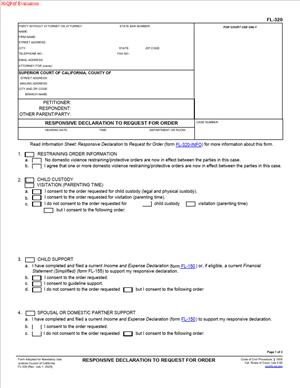
FL-320 – Responsive Declaration to Request for Order is a court form used in California family law cases. It is filed by the responding party after the other side files a Request for Order.
A Request for Order asks the court to make specific rulings. The responsive declaration is your formal answer to that request. It allows you to address each issue raised and provide your own facts and arguments.
The form includes checkboxes and space for written explanations. You can also attach additional pages if you need more room to explain your position.
Once completed and filed, this document becomes part of the case record. The judge reviews it before or at the hearing on the request.
Who typically uses this form?
This form is usually completed by a person who has been served with a Request for Order in a family law case. That person is often called the “responding party.”
In a divorce case, either spouse may use this form, depending on who filed the request. In a parentage case, either parent may file it. In post-judgment cases, a former spouse or co-parent may use it to respond to a request to change existing orders.
Self-represented individuals commonly use this form. It is designed to be accessible to people without attorneys, although lawyers also prepare and file it on behalf of clients.
You use it only if there is already an active family law case with a case number. It is not used to start a case.
Why might you need this form?
You need this form if you want the court to consider your side of the story. If you do not respond in writing, the judge may rely mainly on the other party’s request and supporting declaration.
This form lets you agree with some parts of the request and oppose others. For example, you might agree that child support needs to be updated, but disagree with the amount proposed.
It also gives you a chance to ask for related orders. If the other party requests custody changes, you can state your preferred custody arrangement and explain why it serves the child’s best interests.
The responsive declaration helps clarify disputes before the hearing. It can narrow the issues and focus the court’s attention on specific points of disagreement.
Typical real-life scenarios
- One common scenario involves child custody. A parent files a Request for Order seeking sole legal and physical custody. The other parent uses the responsive declaration to explain why joint custody is more appropriate and to describe their involvement in the child’s life.
- Another situation involves child support. One party asks the court to increase support due to a change in income. The responding party uses the form to provide updated financial information and to explain why the requested amount is inaccurate.
- In some cases, a spouse requests temporary spousal support during a divorce. The other spouse files this form to describe their own financial obligations and to argue for a different amount or duration.
- The form is also used in requests for attorneys’ fees. If one party asks the court to order the other to pay legal fees, the responding party can use the declaration to explain their financial circumstances and respond to the request.
- Post-judgment modifications are another example. If an existing order for visitation is no longer workable, one parent may ask for changes. The other parent uses the responsive declaration to explain their perspective and suggest an alternative schedule.
When would you use FL-320 – Responsive Declaration to Request for Order?
You use this form after you have been served with a filed Request for Order and a hearing date has been set. It is part of the same case and uses the same case number.
It is typically filed before the scheduled hearing so the judge has time to review your response. The court may have timelines for filing and service that apply to this document.
You may use it in cases involving marriage dissolution, legal separation, nullity, parentage, or domestic violence–related family law matters when financial or custody orders are at issue.
Both petitioners and respondents can use this form. The title of “petitioner” or “respondent” does not determine who files it. What matters is who is responding to the current Request for Order.
You would not use this form to respond to a Summons and Petition at the beginning of a case. That requires a different response form. This document is specific to responding to a Request for Order within an existing case.
Legal characteristics of FL-320 – Responsive Declaration to Request for Order
This form is part of the official California Superior Court family law system. It must include accurate case information, including the court name, case number, and the names of the parties as they appear in the case.
For the form to be effective, it generally must be completed clearly, signed, filed with the court clerk, and properly served on the other party. Incomplete sections, missing signatures, or incorrect case numbers can delay processing.
The declaration portion is made under penalty of perjury. This means you are stating that the information you provide is true to the best of your knowledge. False statements can have serious consequences.
Courts expect factual statements rather than emotional arguments. Statements that are vague or unsupported may carry less weight. Specific dates, amounts, and events are usually more helpful to the court.
Procedural rules, such as filing deadlines and service requirements, may vary slightly by county within California. Local rules can affect formatting, attachments, or additional forms that must be included.
This form does not create an agreement by itself. It does not automatically change custody, support, or other orders. It simply communicates your position to the court in response to the other party’s request.
Is it legally binding?
The form itself is not an order. It does not become legally binding simply because you file it.
However, it is a sworn statement. When you sign it, you are declaring under penalty of perjury that the information is true. That declaration has legal significance.
The judge may rely on the statements in the form when issuing temporary or permanent orders. Once the court makes an order after the hearing, that order becomes legally binding.
If both parties reach an agreement and present it to the court, the judge may issue orders based on that agreement. In that situation, your responsive declaration may reflect your consent to certain terms, but the binding effect comes from the court’s signed order, not from the form alone.
How to fill out FL-320 – Responsive Declaration to Request for Order
Step 1 – Complete the caption
At the top of the first page, fill in your name, address, phone number, and email if required. Indicate whether you are self-represented or represented by an attorney. Enter the court name, branch address, case number, and the full names of the petitioner and respondent exactly as they appear in the case file.
Step 2 – Identify the hearing details
Locate the section that references the hearing. Enter the date, time, and department or room number listed in the Request for Order. This connects your response to the correct hearing.
Step 3 – Review the issues listed in the Request for Order
Carefully read the other party’s Request for Order. The form allows you to respond to specific issues such as custody, visitation, child support, spousal support, property control, attorney’s fees, or other relief. Make sure you understand what is being requested before marking your responses.
Step 4 – Indicate agreement or disagreement
For each issue, check the box that shows whether you agree or disagree with the request. If you agree in part, explain clearly which parts you accept and which parts you oppose. Use the space provided to state your position in a direct and factual way.
Step 5 – Provide your factual explanation
In the declaration section, explain the facts that support your position. Focus on relevant details. Include dates, financial figures, schedules, or specific events that relate to the request. If you need more space, attach additional pages and label them clearly.
Step 6 – Address financial information if required
If the issues involve child support, spousal support, or attorney’s fees, additional financial disclosure forms may be required in the case. Refer to the hearing notice or related documents to determine whether updated income and expense information must accompany your response.
Step 7 – Attach supporting documents if appropriate
You may attach documents that support your statements, such as pay stubs, school schedules, or written agreements. Clearly reference each attachment in your declaration so the judge understands its purpose. Keep copies organized and legible.
Step 8 – Review for accuracy and completeness
Read through the entire form before signing. Confirm that all sections are complete, the case number is correct, and your explanations are clear. Make sure any attachments are included and properly labeled.
Step 9 – Sign and date the declaration
Sign and date the form where indicated. By signing, you are declaring under penalty of perjury that the information is true and correct. Do not leave the signature line blank.
Step 10 – File and arrange for service
Submit the completed form to the court clerk for filing in your case. Arrange for a copy to be properly served on the other party or their attorney, and ensure proof of service is completed and filed as required for the hearing.
Legal terms you might encounter in FL-320 – Responsive Declaration to Request for Order
- Responsive Declaration: This is your written response to the other party’s Request for Order. In this document, you tell the court what you agree with, what you oppose, and what orders you want instead. It becomes part of the court file and is reviewed before the hearing.
- Request for Order (RFO): This is the document the other party filed asking the court to make or change orders. Your response addresses each issue raised in that request. You should read the RFO carefully so your answers in this form match the exact requests being made.
- Declaration: A declaration is a written statement made under penalty of perjury. When you sign this form, you are confirming that everything you wrote is true and correct to the best of your knowledge. False statements can damage your credibility and may have legal consequences.
- Service: Service means delivering a copy of your completed form to the other party or their attorney. Proper service ensures everyone has notice of what you filed. The court usually requires proof that service was completed before or at the hearing.
- Proof of Service: This is a separate document showing when, how, and to whom your papers were delivered. The person who serves your papers completes and signs it. Without a proper proof of service, the court may refuse to consider your response.
- Temporary Orders: These are short-term court orders that stay in effect until a future hearing or trial. Your response may address requests for temporary child custody, visitation, support, or other issues. What the judge orders at this stage can affect your situation for months.
- Custody and Visitation (Parenting Time): Custody refers to decision-making authority for a child, and visitation refers to the schedule of time each parent spends with the child. If these issues are raised in the request, your form should clearly state what arrangement you believe serves the child’s best interests.
- Child Support and Spousal Support: These are financial payments ordered by the court. Child support is for the child’s care. Spousal support is financial assistance paid to a spouse or former spouse. If support is requested, your response should include accurate financial details.
- Income and Expense Declaration: In many cases involving support, you must also file a separate financial form. The court uses this information to calculate support. Your answers in this document should align with the financial information you provide there.
- Attorney’s Fees and Costs: Sometimes the requesting party asks the court to order you to pay their legal fees. You can agree, oppose, or propose a different arrangement in your response. Be clear about your financial ability to pay.
FAQs
Do I have to respond to every issue listed in the other party’s Request for Order?
Yes. Review each item requested and indicate whether you agree, partially agree, or disagree. If you skip an issue, the judge may assume you do not oppose it. Even if you generally disagree, address each specific request so the court understands your position on every point.
What happens if I miss the deadline to file FL-320 – Responsive Declaration to Request for Order?
If you file late or not at all, the judge may still hear the other party’s request and could grant orders without considering your written response. You can still attend the hearing and speak, but the court may give less weight to arguments that were not submitted in writing. Filing on time helps ensure your position is fully reviewed before the hearing date.
Do I need to attach evidence to this form?
You may attach documents that support your statements, such as pay stubs, school records, or written communications. Label your attachments clearly and refer to them in your explanation. Do not overwhelm the court with unnecessary documents. Only include items that directly support the issues raised in the request.
Do I have to file an Income and Expense Declaration with this document?
If the request involves child support, spousal support, or attorney’s fees based on financial need, you generally must file a current Income and Expense Declaration. Make sure the financial figures in both documents match. Inconsistent numbers can raise questions about accuracy and credibility.
Who can serve my completed response to the other party?
You cannot serve the papers yourself. Another adult who is not a party to the case must complete service, either by mail or personal delivery, depending on the situation. That person must complete and sign a Proof of Service form confirming the details of delivery.
What if I agree with some parts of the request but not others?
You can partially agree. Clearly check or mark agreement for the items you accept and explain your disagreement with the others. The FL-320 – Responsive Declaration to Request for Order allows you to provide detailed explanations so the judge understands your position on each issue separately.
Will the judge read my entire explanation before the hearing?
Judges typically review filed documents before or at the hearing. Keep your statements organized and focused on relevant facts. Clear, concise writing increases the likelihood that your main points are understood and considered.
Can I change what I wrote in this form after filing it?
If circumstances change before the hearing, you may be able to file updated information or bring new evidence to court, depending on timing and procedural rules. Make sure any new information is also properly served on the other party. Do not assume the court will consider verbal changes if they are not documented appropriately.
Checklist: Before, During, and After FL-320 – Responsive Declaration to Request for Order
Before
- Read the entire Request for Order carefully and highlight each issue raised.
- Note the hearing date, time, and department listed in the court papers.
- Gather documents that support your position, such as financial records or child-related information.
- Complete any required financial forms if support or fees are involved.
- Draft clear, factual explanations for each point of disagreement.
- Review prior court orders so your response is consistent with existing rulings.
- Confirm filing deadlines and service requirements.
- Prepare copies of everything for filing and service.
During
- Complete the caption exactly as it appears on other court documents.
- Check the boxes that accurately reflect agreement, disagreement, or partial agreement.
- Provide specific facts instead of emotional statements.
- Refer to attachments clearly if you include supporting documents.
- Ensure financial figures match your Income and Expense Declaration.
- Review each page for completeness and missing signatures.
- Sign and date the declaration under penalty of perjury.
- Organize pages in the correct order before making copies.
After
- Make at least one copy for your records and one for service.
- Arrange for proper service by a qualified adult.
- File the original documents with the court before the deadline.
- Confirm that the court accepted your filing.
- Keep your filed-stamped copy in a safe place.
- Calendar the hearing date and any related deadlines.
- Prepare notes for what you plan to say at the hearing.
- Bring copies of all filed documents to court.
Common mistakes to avoid with FL-320 – Responsive Declaration to Request for Order
- Mistake: Ignoring parts of the Request for Order because you think they are minor, which happens when you skim the paperwork; this can lead the judge to grant unopposed requests, so do not forget to respond to every single issue listed.
- Mistake: Writing emotional arguments instead of clear facts, often caused by frustration; this can weaken your credibility in court, so do not forget to focus on specific dates, events, and financial details.
- Mistake: Failing to attach required financial forms when support is requested, usually because you assume they were already filed; this can delay the hearing or result in incomplete consideration, so do not forget to include updated financial information if required.
- Mistake: Serving the papers yourself, which happens when you are unaware of service rules; this can invalidate service and postpone your case, so do not forget that another adult must complete service and sign the Proof of Service.
- Mistake: Submitting inconsistent financial numbers across documents, often due to rushed preparation; this can raise doubts about accuracy, so do not forget to double-check that all figures match before filing.
- Mistake: Missing the filing deadline because you focus only on the hearing date; this can limit the judge’s review of your written response, so do not forget to confirm and calendar the response deadline separately.
What to do after filling out FL-320 – Responsive Declaration to Request for Order
Once you complete the form, slow down and review it carefully. This document represents your official position. Small errors can create confusion or delay.
- Step 1: Review every page for accuracy, including names, case number, and hearing details.
- Step 2: Confirm that all required attachments are included and clearly labeled.
- Step 3: Sign and date the form under penalty of perjury.
- Step 4: Make the required copies for yourself and for service on the other party.
- Step 5: Have a qualified adult serve the documents and complete a Proof of Service.
- Step 6: File the original signed form and the Proof of Service with the court clerk.
- Step 7: Obtain confirmation that the filing was accepted, such as a filed-stamped copy.
- Step 8: Store your copies in a dedicated folder for your case.
- Step 9: Update your personal calendar with the hearing date and any preparation deadlines.
- Step 10: Prepare a short outline of the key points you want to emphasize at the hearing.
After filing, stay organized. Keep all court documents together in date order. Bring your filed copies and supporting documents to the hearing. Arrive early so you have time to check in and organize your materials.
If your situation changes before the hearing, gather updated information and follow proper procedures to ensure the court and the other party receive it. Clear preparation and timely filing help the judge understand your position and make informed decisions.
Disclaimer: This guide is provided for informational purposes only and is not intended as legal advice. You should consult a legal professional.