
Rent reduction (abatement), repairs, and maintenance disputes are formal landlord-tenant enforcement mechanisms through which a tenant or, in limited structures like non-profit housing co-operatives, a housing provider invokes statutory or regulatory authority to compel necessary repairs, address violations affecting habitability, and seek financial remedies for reduced use and enjoyment of the rental unit. These proceedings are structured legal processes that can result in binding orders requiring landlords to complete repairs, compensate tenants, or reduce rent to reflect the condition of the property.
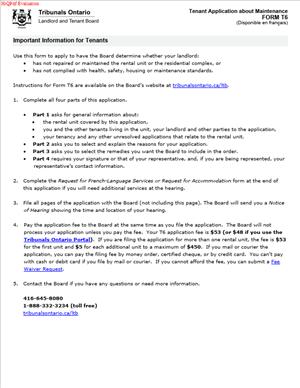
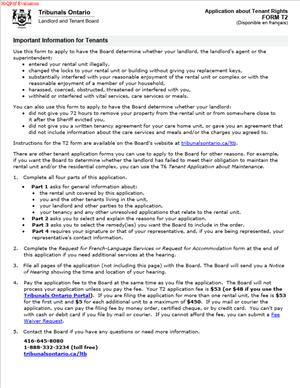
In jurisdictions that rely on specialized housing tribunals or courts, these rights are exercised through prescribed applications or filings that define the scope of the dispute, the relevant timeframe, and the remedies requested. The legal pathway is typically form-driven, meaning that the choice of application determines how the case is categorized, what evidence is required, and how the tribunal or court will assess the claim. Tenants commonly use Form T6 for maintenance-related claims and Form T2 for tenant rights violations, while in non-profit housing co-operatives, enforcement may involve forms like Form C1 for housing charge arrears.
The terminology, procedures, and available remedies vary significantly depending on the governing jurisdiction or regulatory framework. These differences affect how a claim is filed, which authority hears the matter, and what outcomes are available:
- Ontario, Canada: Disputes are divided into distinct application pathways before the Landlord and Tenant Board, where maintenance failures and tenant rights violations must be filed separately and are subject to defined limitation periods
- British Columbia: Enforcement begins with written repair requests and progresses to a formal dispute resolution system that requires specific applications and documented service before the Residential Tenancy Branch
- New York City: Tenants initiate Housing Court proceedings through formal petitions and must complete service on both the landlord and municipal authorities before the case can proceed
- Ontario non-profit housing co-operatives, members generally cannot access the tribunal system for personal claims and must follow internal dispute mechanisms, while the co-operative itself uses a separate enforcement framework and form set
Because the same underlying issues, like mold, lack of heat, unlawful entry, or ongoing disrepair, can trigger entirely different legal processes depending on the jurisdiction, selecting the correct procedural pathway at the outset is the most critical decision. That choice determines the applicable deadlines, notice requirements, evidentiary standards, hearing process, and enforcement options.
Get access to structured, jurisdiction-specific legal forms designed to match the exact pathway your case requires. Explore a comprehensive library of repair, tenant rights, and enforcement documents at RunSensible Forms Finder today.
What You Will Learn:
- What these legal mechanisms can require or accomplish, including repair orders, rent reduction (abatement), and compensation
- How the process typically unfolds from initial filing through final determination
- Which documents and forms control the outcome, including primary applications, compliance filings, and proof of service
- How each procedural step connects to ensure enforceability and legal validity
- What happens after a decision is issued, including enforcement, compliance obligations, and appeal options
- Common mistakes and best practices with a focus on procedural accuracy and strong documentation

What Tenants Can Legally Demand and Key Legal Outcomes
Across jurisdictions, repairs and maintenance, enforcement, and rent reduction (abatement) mechanisms serve a consistent legal function. They convert a private dispute about housing conditions into a structured legal proceeding, require a tribunal or court to determine whether a legal obligation has been breached, and authorize enforceable remedies that either compel corrective action or provide financial relief to the tenant.
At a foundational level, these mechanisms can:
- Require landlords or housing providers to complete repairs or bring a unit into compliance with health, safety, or housing standards
- Grant rent reduction (abatement) where the tenant’s use or enjoyment of the unit has been reduced
- Award compensation for losses tied directly to the condition of the unit or the conduct of the landlord
- Create binding orders that can be enforced through tribunal or court processes if not followed
In form-based systems, the application itself defines the legal pathway and determines which remedies are available. The structure of each form guides how facts are presented and how decision makers assess the claim.
Form T6 Maintenance Applications
Form T6 addresses failures related to repair and maintenance obligations by linking specific deficiencies to defined remedies. The structure of the form requires a clear connection between each maintenance issue and the remedy sought, making organized evidence essential. Through this form, applicants may request:
- Orders requiring the landlord to complete repairs
- Rent reduction (abatement) for reduced use or enjoyment
- Reimbursement for damaged property or out-of-pocket expenses
- Authorization to complete repairs and recover costs
- Restrictions on rent increases until work is completed
- Termination of the tenancy in serious cases
Form T2 Tenant Rights Applications
Form T2 applies to conduct-based violations involving interference with tenant rights. Each claim must align with a recognized category of rights violation, reinforcing the need for precise legal framing. It organizes claims by type of misconduct and allows applicants to seek:
- Rent reduction (abatement) for interference or loss of use
- Orders requiring the landlord to stop unlawful conduct
- Administrative fines
- Compensation for financial losses or property damage
- Reimbursement of expenses and, in some cases, relocation-related costs
- Termination in more serious situations
Form C1 Co-Operative Enforcement Applications
Form C1 is used by non-profit housing co-operatives to enforce payment obligations and pursue eviction for non-payment of housing charges. It is not a tenant-initiated repair or rights application. Its relevance is procedural. When occupants respond to repair issues by withholding payment instead of using formal legal channels, Form C1 becomes the primary enforcement tool. The process focuses on:
- Accurate financial records and housing charge ledgers
- Formal responses by the occupant
- Mandatory hearing participation
- Resolution through payment, consent orders, or eviction
Beyond the primary remedies in application forms, many jurisdictions provide additional procedural tools that expand the effectiveness of these claims. Interim or urgent orders may allow faster decisions in high-risk situations, payment into tribunal mechanisms can reduce exposure to non-payment enforcement during a dispute, and external inspection reports or regulatory findings can strengthen evidence by showing non-compliance.
Together, these tools allow the process to manage risk during proceedings and improve the enforceability of the final decision. The specific structure, filing requirements, and evidentiary expectations for these forms are addressed in detail in the Forms and Documents section.
How Repairs and Rent Reduction (Abatement) Claims Move Through the Legal Process
Repairs and rent reduction (abatement) claims follow a structured procedural sequence where each stage builds on the previous one. The process requires correct classification, timely filing, proper notice, and disciplined evidence handling. Mistakes at any stage can delay proceedings, limit remedies, or result in dismissal.
Step 1: Issue Classification and Forum Selection
The first step is to correctly classify the issue and identify the proper legal forum. The distinction between maintenance failures and tenant rights violations determines which form is used, how the claim is structured, and what remedies are available. In Ontario, Form T6 applies to repair and standards issues, while Form T2 applies to conduct-based violations. In New York City, similar issues may instead be brought as an HP proceeding in Housing Court.
- Clearly define the issue and align it with the correct legal category
- Confirm the correct tribunal or court has jurisdiction
- Ensure the claim contains enough detail for the respondent to respond
Misclassification or vague claims can result in dismissal, amendment requests, or loss of remedies.
Step 2: Notice and Record Building
The second step is to establish a clear record of the problem and provide notice to the landlord. This stage supports both liability and the calculation of rent reduction (abatement).
- Record when the issue started and how it developed
- Document all communication with the landlord
- Keep copies of written notices, photos, invoices, and inspection reports
In Ontario, Form T6 requires detailed timelines and communication history. In British Columbia, written repair requests and documented follow-up are expected. Failure to document properly can weaken the claim.
Step 3: Form Selection and Filing
The third step is to select the correct form, choose appropriate remedies, and file within the required limitation period. This formally starts the proceeding.
- Use the correct and most current version of the form
- Complete all required sections with clear supporting details
- File within statutory deadlines, often within one year of the breach
- Select remedies that match the facts of the case
Filing errors or missed deadlines can result in rejection or delay.
Step 4: Service and Evidence Exchange
The fourth step is to complete the service and exchange evidence so the matter can proceed properly.
- Serve documents using approved methods
- Complete and retain proof of service where required
- Deliver evidence directly to the opposing party within the required timelines
In Ontario, a Certificate of Service may be required. In British Columbia, formal proof of service documents are used. Failure to comply may result in evidence being excluded.
Step 5: Decision and Enforcement
The final step is to obtain a decision and ensure compliance or enforcement.
- Attend hearings and follow all procedural directions
- Review the decision and understand the obligations imposed
- Take additional steps to enforce monetary or possession-related orders if needed
Failure to attend or enforce orders within required timeframes can reduce the effectiveness of the outcome.
Streamline your filing, evidence, and service process with professionally structured legal templates tailored to your jurisdiction. Access ready-to-use forms and step-by-step guidance at RunSensible Forms today.
The Documents And Forms That Drive The Process
Repairs and rent reduction (abatement) claims are document-driven proceedings. Each form and supporting record serves a specific legal function. The outcome depends on how clearly the claim is structured, how well compliance is documented, and whether notice requirements are properly completed.
The Foundational Filing or Primary Application
The foundational filing creates the legal case. It defines the facts, establishes the legal grounds, and determines the remedies being requested. In form-driven systems, this document controls how the decision maker interprets the dispute and what issues are considered.
In Ontario, the primary filings include Form T6 for maintenance failures and Form T2 for tenant rights violations. Form T6 requires detailed descriptions of repair issues, timelines, and notice to the landlord, while Form T2 organizes claims by specific categories of misconduct. Form C1 operates in a different context, used by non-profit housing co-operatives to enforce payment and seek eviction, supported by financial records and housing charge ledgers.
Other jurisdictions rely on different but functionally similar filings. In British Columbia, disputes are initiated through Residential Tenancy Branch applications. In New York City, repair enforcement begins with an Order to Show Cause and a Verified Petition filed in Housing Court.
- The filing must clearly connect facts to legal grounds and selected remedies
- Supporting materials must be organized, readable, and complete
Structural requirements are not optional. Poorly prepared filings can lead to rejection, delay, or reduced evidentiary weight.

Registration, Compliance, or Reporting Documents
Compliance and supporting records often determine whether a claim succeeds. These documents establish the applicable standards, confirm notice, and provide objective evidence of non-compliance.
In Ontario, applicants frequently rely on municipal property standards and may need to file copies of bylaws or official work orders. Inspection reports and notices of violation can significantly strengthen a claim. In co-operative matters, compliance documentation is essential to prove that internal statutory steps were completed before filing Form C1. In British Columbia, written repair requests and retained communication records form the foundation of the claim.
- External records, such as inspection reports and work orders, can strengthen credibility
- Early documentation of notice and conditions improves the likelihood of success
These materials also support enforceability by demonstrating that legal thresholds and procedural expectations were met. In some jurisdictions, filed information may become part of the public record unless confidentiality is formally requested.
Proof of Notice, Delivery, or Procedural Confirmation
Proper notice is a core legal requirement. A claim cannot proceed effectively unless all parties receive documents in accordance with prescribed rules and timelines.
In Ontario, service must follow approved methods and may require a Certificate of Service filed within a defined period. The rules also establish deemed service timelines, which affect deadlines and procedural rights. A key distinction exists between serving the application and serving evidence. While tribunals may handle service of the application, parties are generally responsible for delivering their own evidence.
In British Columbia, proof of service is documented through specific forms used in dispute resolution proceedings. In New York City, petitioners must follow court-directed service instructions and complete an Affirmation of Service.
- Service must be completed using approved methods and within required timelines
- Evidence must be delivered separately and cannot rely solely on portal uploads without consent
Failure to properly document notice can result in dismissal, exclusion of evidence, adjournments, or limitations on available remedies. Proper service is a condition of validity and enforceability.
Aftermath: Enforcement, Compliance, and Ongoing Obligations
After a decision is issued, its practical value depends on enforceability, compliance, and continued procedural discipline. A successful order does not resolve the matter on its own. It must be followed, enforced where necessary, and supported by proper records.
The authority of the decision depends on the forum. In Ontario, Landlord and Tenant Board orders are binding and may become publicly available unless confidentiality is requested. In British Columbia, dispute resolution decisions can impose repair obligations or monetary awards and may follow a staged enforcement path tied to earlier written requests and findings.
Enforcement is remedy-specific and often requires additional steps. Eviction-related orders must typically be enforced through court or sheriff mechanisms rather than direct action. In Ontario, co-operative matters, only the sheriff can enforce an eviction order after filing with the appropriate enforcement office. Monetary awards often require filing the order with a court, such as Small Claims Court, before collection steps can begin.
Compliance obligations may continue after the decision. Repair orders and standards-based findings can remain active if conditions persist, and ongoing non-compliance may generate further evidence or additional proceedings. External inspection reports or work orders may continue to play a role even after an order is issued.
Review, appeal, and modification options are available but strictly time-limited. In Ontario, requests to review an order must generally be filed within a defined period, and appeals to higher courts are also subject to fixed deadlines. Some procedural remedies, including motions to set aside certain orders, require even shorter response windows.
Non-compliance carries real consequences. Orders may include administrative fines, compensation requirements, or enforcement actions that increase financial or legal exposure. Ignoring an order can escalate the matter rather than resolve it.
Effective recordkeeping remains essential. A complete file should include:
- Initial repair requests and communication records
- Photographs, videos, and inspection reports
- Receipts and financial records
- Rent ledgers and payment history
- Proof of service and procedural documents
Well-maintained records support enforcement, protect against future disputes, and ensure that any follow-up action can proceed without delay.
Common Mistakes and Best Practices
Procedural precision is critical because these processes are only enforceable when the correct forum, form, notice, and evidence rules are followed. Even strong claims can fail if they are not properly structured.
Common Mistakes
Several recurring errors weaken repairs and rent reduction (abatement) claims:
- Filing in the wrong forum or using the wrong legal pathway, particularly in systems where certain applicants are excluded from specific tribunals
- Using the wrong form or forcing facts into the wrong category, leading to misaligned claims and remedies
- Submitting incomplete or vague information without dates, timelines, or a clear notice to the landlord
- Failing to provide or document notice, including missing proof of service or not following consent rules for electronic delivery
- Missing filing, disclosure, or review deadlines, which can limit or eliminate available remedies
- Failing to properly calculate or support rent reduction (abatement), resulting in reduced or denied awards

Best Practices
Strong cases follow a structured and disciplined approach:
- Start with the correct pathway and form, then align the facts to the required elements of that form
- Build documentation early, including written notices, dated photos, inspection records, and receipts
- Organize evidence clearly, using pagination and structured exhibit formatting where required
- Treat service and evidence disclosure as separate steps, ensuring both are completed properly and on time
- Approach rent reduction (abatement) as a calculation based on duration, severity, and loss of use, supported by evidence
Consistent structure, clear documentation, and strict adherence to procedural rules significantly improve both credibility and outcomes.
Ensure your claim is properly structured from start to finish with jurisdiction-specific forms, checklists, and compliance tools. Visit RunSensible Forms to access complete legal templates and identify the exact documents required for your situation.
Final Thoughts
Repairs and rent reduction (abatement) claims are structured legal processes where outcomes depend less on abstract fault and more on procedural correctness. The most critical starting point is selecting the correct legal pathway and form, since this determines jurisdiction, remedies, timelines, and how the case will be evaluated. In Ontario, this includes properly distinguishing between Form T6 for maintenance issues and Form T2 for tenant rights violations, while also recognizing that in non-profit housing co-operatives, Form C1 is an enforcement tool used by the co-operative, and members typically cannot file standard tenant applications.
The process is document-driven. A strong case requires a properly completed foundational application that clearly establishes the facts and legal basis, supported by compliance and standards documents that strengthen enforceability, and proof of service that activates procedural validity. Evidence must be timely, organized, and properly delivered. Even well-founded claims can fail if documents are unclear, incomplete, or not served according to procedural rules.
Each stage must be followed in sequence with discipline. This includes documenting the issue, notifying the landlord, filing within limitation periods, selecting the correct remedies, and meeting strict service and evidence disclosure requirements. Across jurisdictions, the same core pillars apply: the application establishes eligibility and facts, compliance records support the claim, and notice and disclosure ensure the case can proceed and be enforced.
Outcomes depend on both proof and structure. Rent reduction (abatement) must be supported by evidence showing duration, severity, and loss of use. After a decision, procedural obligations continue. Parties must understand review and appeal deadlines, enforce monetary awards through the appropriate court channels when necessary, and maintain a complete record so that any future non-compliance can be proven with evidence rather than asserted.
FAQs
What is rent reduction (abatement) in a repairs or tenant rights case?
Rent reduction (abatement) is a compensatory remedy that reduces or refunds rent for a defined period where the tenant’s use or enjoyment of the unit was impaired. It is not a penalty but an evidence-based calculation tied to duration, severity, and loss of use. In Ontario, adjudicators may award up to 100 percent of rent for the affected period where justified.
When should I use Ontario Form T6 instead of Form T2?
Use Form T6 when the issue relates to physical conditions or maintenance obligations, including failure to repair or comply with housing or safety standards. Use Form T2 when the issue involves landlord conduct that interferes with tenant rights, including illegal entry, harassment, lock changes, or interference with services or reasonable enjoyment. Selecting the correct form is essential because each follows a different legal framework and remedy structure.
Can I file both T2 and T6 together?
Yes. In Ontario, tenants may file a combined application against the same landlord when both maintenance issues and tenant rights violations arise from the same tenancy. The claims must still be clearly separated within the application, but they can be heard together and may involve a single filing fee.
What is Form C1, and why does it matter in these disputes?
Form C1 is used by non-profit housing co-operatives to seek eviction and recover unpaid housing charges. It is not a tenant-initiated claim. It becomes relevant when occupants withhold payment in response to repair issues, as the cooperative may pursue enforcement through C1. This creates a parallel process where payment obligations are enforced regardless of the repair dispute.
How long do I have to file a repair or tenant rights claim?
In Ontario, most tenant applications must be filed within one year of the alleged breach. For ongoing issues, the limitation period may run from the last occurrence of the problem. Missing this deadline can prevent the claim from being heard, even if the facts are strong.
Do I have to send evidence to the other party, or does the tribunal do it?
You are responsible for serving your own evidence. While the tribunal may serve the application and Notice of Hearing, it does not distribute evidence. Evidence must be delivered to the other party and submitted in advance of the hearing, typically at least 7 days before the hearing or 5 days for responding evidence. Uploading to a portal does not replace service unless there is written consent.
What happens if I miss an evidence deadline?
If you miss an evidence deadline, the adjudicator may refuse to consider your materials. This can significantly weaken your case, especially if key evidence is excluded. While discretion may be applied in limited circumstances, late or undisclosed evidence is commonly rejected.
What options exist if I disagree with the order or cannot participate in the hearing?
Ontario provides several post decision options with strict timelines, including requests to review an order generally within 30 days, motions to set aside certain orders typically within 10 days, and appeals to higher courts within prescribed deadlines. Failing to act within these timelines can make the order final and limit further legal remedies.
Resources
- LTB Rules of Procedure – Tribunals Ontario
https://tribunalsontario.ca/documents/ltb/Rules/LTB-Rules_of_Procedure.html - Interpretation Guideline: Breach of Maintenance Obligations – Tribunals Ontario
https://tribunalsontario.ca/documents/ltb/Interpretation%20Guidelines/05%20-%20Breach%20of%20Maintenance%20Obligations.html - Interpretation Guideline: Tenant Rights – Tribunals Ontario
https://tribunalsontario.ca/documents/ltb/Interpretation%20Guidelines/06%20-%20Tenants%20Rights.html - Practice Direction on Evidence – Tribunals Ontario
https://tribunalsontario.ca/documents/ltb/Practice%20Directions/Practice%20Direction%20on%20Evidence.html - Non-profit Co-op Evictions – Tribunals Ontario
https://tribunalsontario.ca/ltb/non-profit-co-op-evictions/ - Repairs and Maintenance – Province of British Columbia
https://www2.gov.bc.ca/gov/content/housing-tenancy/residential-tenancies/during-a-tenancy/repairs-maintenance - Starting a HP Proceeding to Obtain Repairs – NYC Housing Court
https://ww2.nycourts.gov/courts/nyc/housing/startinghp.shtml - Filing for Small Claims Court – Ontario Superior Court of Justice
https://www.ontariocourts.ca/scj/filing-procedures/filing/filing-for-small-claims/ - Tenancy Forms (RTB Forms Library) – Province of British Columbia
https://www2.gov.bc.ca/gov/content/housing-tenancy/residential-tenancies/calculators-and-resources/tenancy-forms - Housing Court Forms – NYC Housing Court
https://ww2.nycourts.gov/courts/nyc/housing/forms.shtml - Request to Review an Order Instructions – Tribunals Ontario
https://tribunalsontario.ca/documents/ltb/Other%20Forms/Request_to_Review_an_Order_Instructions.html
Disclaimer: The content provided on this blog is for informational purposes only and does not constitute legal, financial, or professional advice.
Contents