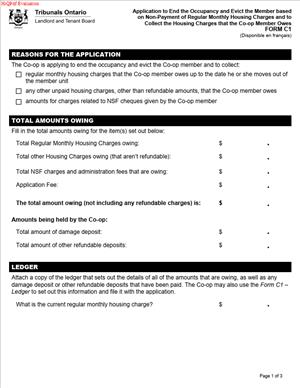
Form C1 – Application to End the Occupancy and Evict the Member based on Non-Payment of Regular Monthly Housing Charges and to Collect the Housing Charges that the Co-op Member Owes
Fill out nowJurisdiction: Country: Canada | Province or State: Ontario
Form C1 – Application to End the Occupancy and Evict the Member based on Non-Payment of Regular Monthly Housing Charges and to Collect the Housing Charges that the Co-op Member Owes is a formal application used by a housing co‑operative in Ontario. It is part of the legal process a co‑op follows when a member has not paid the required monthly housing charges.
This form is not used by private landlords. It applies specifically to co‑operative housing, where members occupy units under a membership and occupancy agreement rather than a standard lease.
If you are filling out this document, you are likely acting on behalf of a housing co‑operative. You may be a board member, property manager, or another authorized representative.
The form matters because it starts a formal request to end a member’s right to occupy their unit and to recover unpaid housing charges. Errors or missing details can delay the process or result in the application being rejected.
Understanding what the form asks for helps you present clear, complete information and avoid common mistakes during submission.
What is Form C1 – Application to End the Occupancy and Evict the Member based on Non-Payment of Regular Monthly Housing Charges and to Collect the Housing Charges that the Co-op Member Owes?
Clear definition
Form C1 – Application to End the Occupancy and Evict the Member based on Non-Payment of Regular Monthly Housing Charges and to Collect the Housing Charges that the Co-op Member Owes is a written application to the appropriate decision‑making body that handles co‑operative housing disputes in Ontario.
Through this document, the co‑operative asks for two main outcomes. First, it seeks an order ending the member’s occupancy rights. Second, it asks for an order requiring the member to pay the outstanding housing charges owed to the co‑op.
The form sets out details about the member, the unit, the amount of arrears, and the history of non‑payment. It becomes part of the official record once filed.
Who typically uses this form?
This form is typically used by non‑profit housing co‑operatives. The person completing it is often a board officer, property manager, or another individual authorized by the co‑op to act on its behalf.
The co‑operative must have the authority under its bylaws and occupancy agreement to take steps to end a membership for non‑payment. The person signing the form usually confirms that they have this authority.
Members themselves do not use this form to resolve payment disputes. It is initiated by the co‑op when it decides to move forward with formal enforcement.
Why might you need this form?
You may need this form when a member has failed to pay regular monthly housing charges and the arrears have not been resolved through reminders or internal processes.
Co‑operatives often attempt informal collection first. If payment arrangements break down or no payment is made, the co‑op may move to a formal application.
The form allows the co‑op to request both eviction and payment of arrears in one proceeding. This can streamline the process instead of starting separate claims.
It also creates a clear record of the amount claimed and the time period covered. That record can be important if there is a dispute about what is owed.
Typical real-life scenarios
- A member falls behind on monthly housing charges for several months. Despite written notices and meetings, no payment is made. The arrears continue to grow. The co‑op decides to file the application to recover the unpaid amounts and end the occupancy.
- A member makes partial payments but never pays the full monthly charge. Over time, a significant balance accumulates. The co‑op determines that informal repayment plans have failed and proceeds with a formal filing.
- A member’s subsidy changes, and they disagree with the recalculated housing charge. They stop paying the full amount. The co‑op treats the unpaid portion as arrears and may use this form if the balance remains unpaid.
- A member moves out without paying the final months of housing charges. If the occupancy has not been formally ended or arrears remain, the co‑op may file to obtain an order confirming the amount owed.
When would you use Form C1 – Application to End the Occupancy and Evict the Member based on Non-Payment of Regular Monthly Housing Charges and to Collect the Housing Charges that the Co-op Member Owes?
You would use this form after the co‑op has decided to take formal action for non‑payment of regular monthly housing charges. It is generally used when the member is still in possession of the unit and arrears remain outstanding.
The application is typically filed after the required internal steps have been taken. In many co‑ops, this includes board decisions, written notices, and an opportunity for the member to respond or appeal within the co‑op’s structure.
This form is not used for other types of disputes, such as damage to the unit or rule violations unrelated to payment. Different procedures may apply in those situations.
The form is also not used for market rent tenants in private rental housing. It is specific to the co‑operative housing context, where occupancy is linked to membership.
You may also use this form when the co‑op wants a formal order confirming the amount of arrears. Even if the member intends to move out, the co‑op may seek a written order to support collection efforts.
Timing matters. Filing too early, before internal requirements are met, can lead to delays. Filing too late can allow arrears to increase significantly. The form fits into a broader process that balances internal governance and external enforcement.
Legal characteristics of Form C1 – Application to End the Occupancy and Evict the Member based on Non-Payment of Regular Monthly Housing Charges and to Collect the Housing Charges that the Co-op Member Owes
This form is a procedural document. It does not, by itself, end a membership or evict a member. It asks a decision‑maker to make an order after reviewing the evidence.
For the application to be effective, it must be complete and accurate. Names must match the occupancy agreement. The unit address must be correct. The amount of arrears must be clearly calculated and supported by records.
Applications are commonly delayed or dismissed when there are calculation errors, missing signatures, or inconsistent dates. If the amount claimed does not match the supporting documents, questions may arise at the hearing.
Service of the application to the member is also a key procedural step. If service is not carried out properly, the matter may not proceed as expected.
In Ontario, co‑operative housing has distinct rules compared to private tenancies. The process may involve internal decisions before the external application is filed. This structure reflects the membership model of co‑ops.
The form does not automatically authorize the co‑op to remove a member from the unit. Enforcement typically requires an order and, if necessary, further steps through the proper enforcement channels.
The document also does not settle unrelated disputes. It focuses on non‑payment of regular monthly housing charges and the related request for arrears.
Is it legally binding?
The form itself is not legally binding simply because it is filled out and signed. It becomes legally significant once it is properly filed and an order is made in response to it.
If the decision‑maker grants the application, the resulting order can be legally binding. That order may require the member to pay arrears and may terminate occupancy rights.
The binding effect depends on the proper procedure. If required steps are skipped or information is inaccurate, the outcome may be affected. Accuracy and compliance with procedural requirements are central to the form’s legal impact.
How to fill out Form C1 – Application to End the Occupancy and Evict the Member based on Non-Payment of Regular Monthly Housing Charges and to Collect the Housing Charges that the Co-op Member Owes
Step 1 – Identify the co‑operative and the member
Start by entering the full legal name of the housing co‑operative as it appears in official records. Include complete contact information, including mailing address and any required file or reference numbers.
Next, enter the full name of the member whose occupancy the co‑op seeks to end. Use the name exactly as it appears on the membership or occupancy agreement. Include the full address of the unit in question.
Accurate identification avoids confusion and ensures that notices and orders relate to the correct parties and unit.
Step 2 – Provide details of the unit and occupancy agreement
State the address of the rental unit clearly, including the unit number if applicable. Confirm that the member occupies the unit under a co‑operative occupancy agreement.
Include relevant dates, such as when the occupancy began. This establishes the relationship between the co‑op and the member and shows that regular monthly housing charges are required under that agreement.
If the form asks about the type of housing charge or subsidy, provide clear and consistent information that matches your internal records.
Step 3 – Set out the amount of housing charges owed
List the monthly housing charge and specify the months for which payment has not been received. Break down the arrears by month rather than providing only a lump sum.
Show how you calculated the total amount owing. If there are additional amounts permitted under the agreement, such as administrative charges, identify them separately and clearly.
Ensure the total claimed matches the sum of the individual amounts listed. Simple math errors can create problems at the hearing.
Step 4 – Confirm notices and internal decisions
Indicate whether required notices were given to the member before filing the application. Provide dates and brief details where requested.
If the co‑op’s bylaws require a board decision to terminate membership for non‑payment, record that this decision was made and the date it occurred.
This section demonstrates that the co‑op followed its internal governance process before seeking an external order.
Step 5 – Request the orders sought
In the section asking what you are requesting, clearly indicate that the co‑op seeks an order ending the member’s occupancy and an order requiring payment of the arrears.
If the form allows you to request additional relief related to ongoing charges until the date of termination, complete that section carefully and ensure it aligns with your calculations.
Be precise about what you are asking for. The decision‑maker relies on this section to understand the outcome the co‑op is seeking.
Step 6 – Review, sign, and date the form
Before signing, review every section of the form. Check names, dates, amounts, and contact information for accuracy and consistency.
The authorized representative of the co‑operative should sign in the designated space. Print the signer’s name and position within the co‑op, if requested.
Enter the date of signing. The signature confirms that the information provided is true to the best of the signer’s knowledge and that the co‑op is formally making the application.
Legal terms you might encounter in Form C1 – Application to End the Occupancy and Evict the Member based on Non-Payment of Regular Monthly Housing Charges and to Collect the Housing Charges that the Co-op Member Owes
- Regular Monthly Housing Charges: This refers to the standard amount a co‑op member must pay each month to occupy their unit. It may include base housing charges and other approved monthly fees. On this form, you must clearly state the exact amount owed and the time period it covers.
- Arrears: Arrears are unpaid amounts that are past due. In this document, arrears usually mean missed monthly housing charges. You need to calculate the total arrears up to a specific date and show how you arrived at that number.
- Occupancy Agreement: This is the written agreement between the housing co‑operative and the member. It sets out the member’s right to occupy the unit and their obligation to pay housing charges. The form asks you to confirm that such an agreement exists and that it has been breached due to non‑payment.
- Notice of Default: This is a written notice telling the member they have failed to pay what is owed. Before filing this form, the co‑op typically sends a notice giving the member an opportunity to correct the default. The application may require you to confirm that proper notice was given.
- Board Resolution: A board resolution is a formal decision made by the co‑op’s board of directors. The board usually must approve starting eviction proceedings. You may need to indicate that the board passed a resolution authorizing the application.
- Termination of Occupancy: This means ending the member’s legal right to live in the unit. The form asks the decision‑maker to order that the occupancy be terminated because of unpaid charges. Termination is separate from physically removing someone from the unit.
- Eviction Order: An eviction order is a formal order requiring the member to leave the unit. It follows the termination of occupancy. This document requests such an order if the arrears are not paid.
- Order for Payment: This is a request that the decision‑maker order the member to pay the outstanding housing charges. It may include the arrears plus ongoing charges up to the hearing date. The form often allows you to specify the total amount claimed.
- Service: Service means formally delivering the application and supporting documents to the member. The rules may set out acceptable methods of service. You may need to confirm how and when the service was completed.
- Hearing Date: This is the scheduled date when the application will be reviewed. After filing, you will receive notice of the hearing. You must ensure the member receives this information within the required time frame.
FAQs
What exact amount do I enter as arrears on this form?
You should enter the total unpaid regular monthly housing charges up to a specific cut‑off date. Use your accounting records to calculate each missed payment, then add them together. Do not estimate. Attach or prepare a detailed rent ledger or statement showing how the total was calculated so the numbers on this document match your records.
Do I need to attach a copy of the occupancy agreement when filing Form C1?
You should check the filing instructions carefully. In many cases, you are expected to provide a copy of the signed occupancy agreement and any relevant bylaws or schedules that show the member’s obligation to pay. Make sure the names and unit number on the agreement match what you entered on the application.
Who is allowed to sign this document on behalf of the co‑op?
The signer must have proper authority. This is usually a board member or officer authorized by a board resolution. Before signing, confirm that the board approved starting the application and that the person signing is clearly identified with their title.
What happens if I make a mistake in the member’s name or unit number?
Errors in names or unit numbers can cause delays or even dismissal. Always copy the member’s legal name exactly as it appears on the occupancy agreement and co‑op records. Double‑check spelling, middle initials, and hyphenated names before filing this form.
How do I show that proper notice was given before filing?
You should keep a copy of the notice sent to the member and proof of how it was delivered. Enter the date the notice was given and the method of delivery exactly as required. If the rules require a waiting period, make sure that enough time passed before you complete this document.
Can I include charges other than regular monthly housing charges?
This document is specifically for unpaid regular monthly housing charges. If you are claiming additional amounts, confirm they are permitted under the occupancy agreement and clearly separate them from the base monthly charges. Make sure your total matches the supporting ledger.
What changes in the public record once the application is filed?
When you file this form, a formal case file is opened. The member’s name, unit address, and the amount claimed become part of the official record of the proceeding. You should ensure all details are accurate because they will appear on notices and any resulting order.
What if the member pays everything after I file but before the hearing?
If full payment is made, you may need to update the record or withdraw the application, depending on the circumstances. Keep written proof of payment and confirm the exact amount received. Do not assume the case is closed until you receive confirmation from the decision‑making body handling the application.
Checklist: Before, During, and After Form C1 – Application to End the Occupancy and Evict the Member based on Non-Payment of Regular Monthly Housing Charges and to Collect the Housing Charges that the Co-op Member Owes
Before
- Confirm the member is in arrears for regular monthly housing charges only.
- Update the rent ledger to the most recent date.
- Review the signed occupancy agreement for accuracy of names and unit details.
- Send any required notice of default and track the delivery date.
- Verify that any required waiting period has passed.
- Obtain a board resolution authorizing the application.
- Gather supporting documents, including account statements and notices.
- Confirm the correct legal name of the co‑op.
During
- Enter the co‑op’s full legal name exactly as registered.
- Write the member’s full legal name as shown on the occupancy agreement.
- Specify the unit number and full address clearly.
- Calculate arrears carefully and double‑check the total.
- State the period covered by the unpaid charges.
- Identify the orders you are requesting, including termination and payment.
- Sign and date the form with the authorized person’s title.
- Make complete copies of everything before filing.
After
- File the application using the approved method.
- Pay any required filing fee and keep the receipt.
- Serve the member with the filed documents as required.
- Complete and file proof of service if required.
- Calendar the hearing date and deadlines.
- Prepare an updated arrears statement for the hearing.
- Keep all documents organized in a single file.
- Update internal records to reflect that proceedings have started.
Common mistakes to avoid with Form C1 – Application to End the Occupancy and Evict the Member based on Non-Payment of Regular Monthly Housing Charges and to Collect the Housing Charges that the Co-op Member Owes
- Mistake: Listing an estimated arrears amount because records are incomplete, which happens when bookkeeping is behind; this can undermine credibility and lead to adjournments, so do not forget to reconcile the ledger before filing.
- Mistake: Using a nickname or shortened version of the member’s name because that is how staff refer to them; this can create identification issues and delay the case, so do not forget to use the exact legal name from the agreement.
- Mistake: Filing before the required notice period has expired due to urgency or pressure; this can result in dismissal of the application, so do not forget to count the days carefully.
- Mistake: Failing to obtain formal board authorization because it seems routine; this can raise questions about authority, so do not forget to record and keep the resolution.
- Mistake: Forgetting to sign or date the form because multiple drafts were prepared; this can cause rejection at filing, so do not forget to review the signature section before submission.
- Mistake: Not keeping proof of service because delivery seemed straightforward; this can prevent the matter from proceeding, so do not forget to document how and when the member was served.
- Mistake: Combining unrelated charges with regular monthly housing charges without a clear breakdown, which happens when accounts are bundled; this can confuse the claim and reduce recoverable amounts, so do not forget to itemize clearly.
What to do after filling out Form C1 – Application to End the Occupancy and Evict the Member based on Non-Payment of Regular Monthly Housing Charges and to Collect the Housing Charges that the Co-op Member Owes
Once you complete the form, slow down and review every page. Check names, dates, amounts, and signatures. Make sure the numbers on the application match your internal ledger exactly.
- Step 1: Make at least two complete copies of the signed form and all attachments.
- Step 2: Organize the original and copies in the order required for filing.
- Step 3: Submit the application using the approved filing method and pay any required fee.
- Step 4: Obtain confirmation that the application has been accepted and note any assigned file number.
- Step 5: Record the hearing date, time, and location as soon as you receive them.
- Step 6: Serve the member with the filed application and hearing notice within the required timeframe.
- Step 7: Complete any required proof of service document and file it promptly.
- Step 8: Update your arrears statement to include any additional unpaid housing charges up to the hearing date.
- Step 9: Prepare a clear package for the hearing that includes the occupancy agreement, ledger, notices, board resolution, and proof of service.
- Step 10: Update your internal records to reflect payments received, communication with the member, and key deadlines.
Keep all documents together in one physical or digital file. Label it with the member’s name and unit number. Track every payment received after filing and issue receipts promptly.
Before the hearing, review your calculations again. Be ready to explain how you calculated the arrears and confirm the exact amount outstanding on the hearing date. If the member makes partial payments, update your figures and keep written proof.
After the decision, follow the terms of any order carefully. If payment is ordered, track compliance. If eviction is ordered, ensure the next steps are handled according to the instructions provided in the order.
Good recordkeeping protects the co‑op and keeps the process organized. Treat each step as part of a clear timeline, and document everything as you go.
Disclaimer: This guide is provided for informational purposes only and is not intended as legal advice. You should consult a legal professional.