Winning your case is a major step. It does not always put money in your bank account. If the other party does not pay, you may need to enforce the judgment through a court process.
The person owed money is the judgment creditor. The person who must pay is the judgment debtor. The court does not usually collect the award for the creditor. The creditor must choose and start the proper enforcement step.
Ontario provides several options. You may seek a payment agreement, examine the debtor’s finances, garnish money, seize property, or recover specific goods. The right choice depends on what you know about the debtor.
This guide explains those choices in plain language. It provides general legal information, not legal advice. Court rules, forms, fees, and procedures can change. Check the current official sources before you act.
What It Means to Enforce the Judgment
A judgment is a binding court decision. It may require someone to pay money, return property, or take another stated action. An enforcement process uses the court’s legal authority to carry out that decision when the debtor does not comply voluntarily.
To enforce the judgment, start with the exact wording of the signed order. Do not rely only on what was said in court. Confirm:
- the full legal names of every creditor and debtor;
- the amount awarded for damages or debt;
- any costs awarded;
- the interest terms shown in the judgment;
- any payment schedule or deadline;
- whether the order requires delivery of specific property; and
- whether the court has made a later order that changes or pauses enforcement.
The Ontario Superior Court of Justice identifies four main enforcement options: garnishment, seizure and sale of personal property, seizure and sale of land, and delivery of goods. It also explains that an examination hearing can help a creditor learn about the debtor’s finances before choosing a method.
Enforce the judgment, not the original claim
The trial is over. Enforcement is not a second chance to increase the award or add a new claim. Your documents must match the judgment.
For example, suppose the court awarded a contractor $8,000 plus stated costs and interest. The contractor cannot use an enforcement form to add another disputed invoice. The creditor must collect only what the judgment and applicable rules allow.
Keep a running statement of account. Show the original award, allowed interest, allowed enforcement costs, and every payment received. An accurate balance helps you enforce the judgment without seeking too much.
Start With a Written Payment Request
Before you enforce the judgment through a formal filing, consider a written payment request. The court recommends trying to reach an agreement because it may be the simplest and least costly option.
Send the debtor a short written demand. Include:
- the court file number;
- the judgment date;
- the total amount currently owing;
- a simple breakdown of principal, costs, interest, and payments;
- where and how payment can be made;
- a reasonable response date; and
- your contact information.
Keep the tone factual. Do not threaten steps you cannot lawfully take. Keep a copy and proof of delivery.
Consider a realistic payment plan
A payment plan may make sense when the debtor accepts the debt but cannot pay at once. Put every term in writing. State the amount of each payment, due dates, payment method, interest treatment, and what happens after a missed payment.
Do not treat a private promise as payment. Record each amount when it clears. Update the balance after every payment.
A plan may save time and fees. It can also delay collection if the debtor is not honest about their finances. Ask for enough information to decide whether the proposal is realistic. If the debtor misses a payment required by a court order or filed settlement, specific default procedures may apply.

Find Information Before Choosing an Enforcement Method
To enforce the judgment efficiently, target a real source of money or property. Filing several forms without knowing what the debtor owns can waste time and fees.
Gather information you obtained during the case. Review contracts, invoices, cheques, emails, public business records, and evidence filed at trial. You may already know:
- the debtor’s employer;
- a bank and branch used by the debtor;
- a customer who owes the debtor money;
- a business address;
- vehicles, equipment, or inventory owned by the debtor;
- land owned by the debtor; or
- the location of goods the court ordered returned.
Use lawful sources. Do not impersonate the debtor, access private accounts, trespass, or pressure unrelated people.
Use an examination hearing when key facts are missing
If you cannot enforce the judgment because key facts are missing, consider an examination hearing. It is a private hearing under oath where the creditor asks questions related to enforcement. The court says the questions may cover income, debts, property, past transactions, money owed to the debtor, and the reason for non-payment.
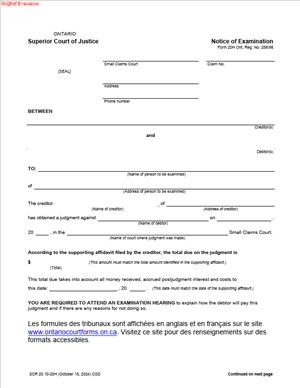
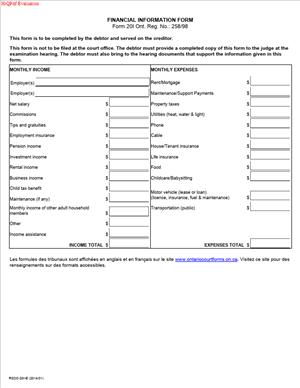
Ask court staff to issue a Notice of Examination, Form 20H. Serve it on each person you intend to examine. When examining the debtor, also serve a blank Financial Information Form, Form 20I.
The debtor completes Form 20I and gives it to the creditor. The Ontario court specifically says the debtor should not file that form with the court. At the hearing, the court may make an order about payment.
Prepare focused questions
Your questions should help you decide how to enforce the judgment. Useful topics may include:
- current employers and pay dates;
- bank accounts and financial institutions;
- accounts receivable for a business;
- vehicles, tools, equipment, or inventory;
- land ownership;
- transfers or sales of property; and
- other judgments or support deductions affecting available money.
Bring the judgment, your payment ledger, and documents supporting your questions. Do not use the hearing to embarrass the debtor or repeat the trial.
How to Enforce the Judgment Through Garnishment
You may enforce the judgment through garnishment when a third party owes money to the debtor. Garnishment directs that third party to pay money into court instead. That third party is called the garnishee. An employer or bank is a common example, but the process can also reach another person or business that owes money to the debtor.
Garnishment can be effective when you have reliable information. A wrong employer name, an old bank branch, or a legal-name error can cause delay.
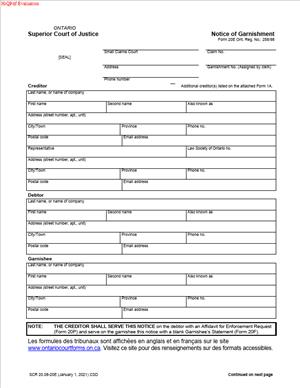
The main document is the Notice of Garnishment, Form 20E. Related documents may include an affidavit supporting the enforcement request and proof that required parties were served.
Check the garnishee’s legal identity
Before filing, confirm the garnishee’s full legal name and service address. A trade name may differ from the corporation’s legal name. Payroll may be handled by a separate office. A bank account may be tied to a particular institution or branch.
The Garnishee’s Statement, Form 20F allows the garnishee to state whether money is owed to the debtor and whether another person claims an interest in it. If a debt is co-owned, Form 20G provides notice to the co-owner.
Know the limits of garnishment
Not every payment or source of income can be taken. Exemptions, priority claims, support deductions, and other rules may affect the result. A garnishment can also produce nothing if no money is payable when the process reaches the garnishee.
If a garnishee disputes liability or does not follow the process, the matter may require a garnishment hearing. Form 20Q is the Notice of Garnishment Hearing. Do not assume that serving a bank or employer guarantees payment.
Track all money received through the court and all direct payments. Stop or terminate the process when the judgment has been paid in full. Continuing to collect after full payment can create serious problems.
Use a Writ When Property Is the Better Target
A creditor may enforce the judgment with a writ, which is a formal court document authorizing an enforcement step. Ontario’s Small Claims Court process includes writs for personal property, land, and delivery of specific goods.
Writ enforcement often requires the sheriff or enforcement office. It may involve deposits, searches, transportation, storage, sale expenses, or other practical costs. Ask the correct enforcement office about its current requirements before spending money.
Writ of seizure and sale of personal property
Form 20C, Writ of Seizure and Sale of Personal Property, may be used to pursue non-exempt personal property. This can include certain vehicles, equipment, or inventory.
The fact that the debtor uses an item does not prove it is available for seizure. Ownership, liens, exemptions, value, location, and sale costs matter. A sheriff controls the enforcement process. The creditor must not take property personally.
Form 20O gives the direction to enforce a writ against personal property. Form 20P is the affidavit used for an enforcement request. Check the current rule, form version, and enforcement-office instructions before filing.
Writ of seizure and sale of land
A writ against land can affect a debtor’s real property. This route is more technical. The location of the land, ownership records, mortgages, other writs, equity, registration, renewal, and sale procedures can all matter.
Do not assume a writ creates a quick sale. It may instead protect or support collection over time. Get legal help when land has joint owners, several secured debts, little equity, or disputed ownership.

Ontario Small Claims Settlement Conference: A Practical Preparation Guide
Writ of delivery for specific goods
Use a Writ of Delivery, Form 20B, when the judgment orders the return of identified goods. This is different from collecting a money award.
Describe the goods exactly as the order does. Include useful identifying details, such as a make, model, serial number, or vehicle identification number, when applicable. The sheriff may need the creditor to arrange practical support such as transport or storage.
Compare the Main Enforcement Choices
Before you enforce the judgment, use verified information to select a focused first step.
| What you know | Possible route | Main practical concern |
|---|---|---|
| The debtor may cooperate | Written request or payment plan | Terms must be clear, and payments tracked |
| You do not know the debtor’s assets or income | Examination hearing | Proper service and focused financial questions |
| You know an employer, bank, or other person who owes the debtor money | Garnishment | Correct garnishee identity, service, and exemptions |
| You know the debtor owns valuable non-exempt goods | Seizure and sale of personal property | Ownership, value, exemptions, and enforcement costs |
| The debtor owns land | Seizure and sale of land | Registration, other claims, equity, cost, and delay |
| The judgment orders specific goods returned | Writ of delivery | Precise description, location, and recovery logistics |
No method guarantees recovery. A debtor may have little income, exempt funds, secured property, or no useful assets. Compare the likely recovery with filing and enforcement costs.
A Practical Plan to Enforce the Judgment
Use this sequence to enforce the judgment while keeping the file controlled and accurate.
Step 1: Review the court record
Read the judgment and every later endorsement or order. Confirm the amount, interest terms, costs, property description, and payment terms. Check whether enforcement has been stayed or changed.
Step 2: Calculate the current balance
Create a ledger showing the award, allowed interest, allowed costs, credits, and payments. Date each entry. Keep receipts for enforcement expenses.
Step 3: Ask for voluntary payment
Send a written request and statement of account. If you offer a plan, state every due date and the result of default. Keep communications professional.
Step 4: Make an information map
List what you know about employment, banks, customers, property, land, and locations. Accurate facts help you enforce the judgment against a real source. Mark each fact as verified or unverified. Do not file based only on a guess.
Step 5: Choose one useful route
Use an examination when information is missing. Consider garnishment when you know a reliable source of money. Consider a writ when identifiable property is likely to justify the cost.
Step 6: Use current forms
Ontario’s official forms page warns users to check version and effective dates. Download the current court form and compare its title and number with the applicable rule. RunSensible Forms can help you find and prepare relevant documents, but it is not the court or an official filing service.
Step 7: Confirm filing and service requirements
The place and method of filing can depend on the document. Service rules also vary by document and recipient. Review the Rules of the Small Claims Court, the official procedural guide, and instructions from the court or enforcement office.
Step 8: Record every result
Keep filed copies, issued documents, proof of service, payment receipts, sheriff communications, and court notices. Update the balance after every payment.
Step 9: Reassess before spending more
If one method produces no money, ask why. The debtor may have changed jobs, closed an account, moved property, or claimed an exemption. New facts may support a different step. Do not repeat an ineffective filing without a reason.
Step 10: Close the enforcement file properly
When fully paid, calculate the final balance and stop active collection steps. Complete any required notice or termination process. Give the debtor a clear receipt and keep the closed ledger.
Common Mistakes That Delay Collection
You can enforce the judgment more effectively by avoiding these common problems:
- using a party name that does not match the judgment;
- filing an outdated or incorrect form;
- guessing an employer, bank, or asset location;
- serving the wrong legal entity or address;
- failing to keep proof of service;
- asking for more than the current lawful balance;
- overlooking payments made directly by the debtor;
- treating exempt money or property as available;
- paying large enforcement costs without checking likely value;
- trying to seize goods without the sheriff;
- ignoring a stay, appeal-related order, or later court direction; and
- continuing enforcement after full payment.
A well-organized file reduces these risks. Use the same party names and court number on every document. Keep one current ledger rather than several conflicting calculations.

When Legal Help May Be Worth the Cost
Many creditors handle routine steps themselves. Legal advice may be useful when:
- the debtor has moved property between people or companies;
- land or jointly owned property is involved;
- another creditor claims priority;
- the debtor raises an exemption;
- the garnishee disputes owing money;
- the judgment or interest calculation is unclear;
- the debtor seeks to suspend or change enforcement;
- bankruptcy or insolvency affects collection; or
- expected enforcement costs are high.
A lawyer or licensed paralegal can assess the judgment, available information, and likely recovery. They can help you enforce the judgment when ownership, priority, or procedure is disputed. A short review before filing may prevent a costly mistake.
Conclusion
Winning a case gives you a legal right to payment or property. Collection still requires a careful plan. Start with the judgment, calculate the balance, request payment, and identify reliable information about the debtor.
Use an examination when you need financial details. Use garnishment when a known third party owes money to the debtor. Consider a writ when identifiable property may support recovery. Follow current rules for filing, service, and enforcement.
The best way to enforce the judgment is usually the most focused one. Match the process to verified facts, track every dollar, and stop collection when the order is satisfied.
Frequently Asked Questions
Does the Ontario Small Claims Court collect the money for me?
No. The court makes the judgment, but the successful party generally takes steps to enforce the judgment. The court and enforcement offices handle processes authorized by the rules after the creditor files the correct documents.
Can I enforce the judgment immediately?
The Ontario court says a successful party can start collection steps after judgment. Before acting, read the signed judgment and any later order. Confirm whether payment terms, a stay, or another direction affects timing.
What if I do not know where the debtor works or banks?
Consider an examination hearing. Form 20H starts the request, and a blank Form 20I is served when the debtor will be examined. The hearing can address income, debts, property, transactions, and money owed to the debtor.
Can I garnish the debtor’s wages or bank account?
Garnishment may reach money that a third party owes the debtor. Employers and banks are common examples. The process requires correct information, issued documents, and proper service. Exemptions and priority claims may limit collection.
Can I take the debtor’s car or equipment myself?
No. Do not seize property yourself. A writ may authorize the sheriff or enforcement officer to act. Ownership, liens, exemptions, value, and enforcement costs must be considered.
What if the debtor offers monthly payments?
You may accept a reasonable plan, but you do not have to accept unclear terms. Put the amount, dates, method, interest treatment, and result of default in writing. Track every payment against one current balance.
Can I recover the property instead of money?
If the judgment orders delivery of specific goods, a Writ of Delivery may be available. The order and writ must identify the goods clearly. This process is different from enforcing a money-only judgment.
What if my first enforcement attempt does not work?
Review why it failed before trying again. The source may be wrong, the money may be exempt, or the property may have little value. An examination hearing or new verified information may point to a better method.
What happens after the judgment is fully paid?
Stop active enforcement and complete any required termination or satisfaction steps. Update the ledger to zero, notify affected parties where required, and keep proof that the judgment was satisfied.
Resources
- Ontario Superior Court of Justice — Small Claims Court Enforcement
https://www.ontariocourts.ca/scj/areas-of-law/small-claims-court/enforcement/ - Ontario Ministry of the Attorney General — After Judgment
https://www.ontario.ca/document/guide-procedures-small-claims-court/after-judgment - Rules of the Small Claims Court, O. Reg. 258/98
https://www.ontario.ca/laws/regulation/980258 - Ontario Court Services — Rules of the Small Claims Court Forms
https://ontariocourtforms.on.ca/en/rules-of-the-small-claims-court-forms/ - Small Claims Court Fees and Allowances, O. Reg. 332/16
https://www.ontario.ca/laws/regulation/160332
Disclaimer: The content provided on this blog is for informational purposes only and does not constitute legal, financial, or professional advice.
Contents