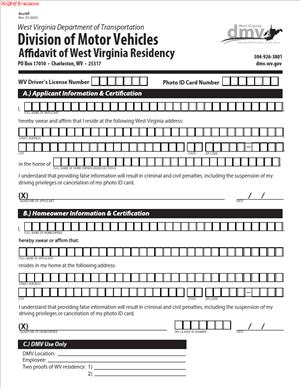
Res-Aff – Division of Motor Vehicles – Affidavit of West Virginia Residency
Fill out nowJurisdiction: Country: United States | Province or State: West Virginia
The Res-Aff – Division of Motor Vehicles – Affidavit of West Virginia Residency is a document used to confirm that you live in West Virginia. It is typically filed with the state’s motor vehicle agency when you need to prove your residential address.
If you are applying for a driver’s license, renewing one, or updating your address, you may be asked to show proof of residency. In some cases, standard documents are not available. This affidavit can help fill that gap.
This form is a written statement made under oath. By signing it, you declare that the information about your residence is true. Because it is an affidavit, false statements can carry serious consequences.
Understanding how this form works can help you complete it accurately. When you know what it does and what it does not do, you can avoid delays in your application or filing.
What is the Res-Aff – Division of Motor Vehicles – Affidavit of West Virginia Residency?
Clear definition
The Res-Aff – Division of Motor Vehicles – Affidavit of West Virginia Residency is a sworn statement used to confirm that you are a resident of West Virginia. It is submitted to the Division of Motor Vehicles as part of a licensing or identification process.
An affidavit is a written statement made under oath. When you sign this document, you are formally declaring that the address you list is your true place of residence. The agency relies on this statement when reviewing your application.
This form does not replace every other requirement. It is usually used alongside other documents. Its purpose is to provide formal confirmation when standard proof of address is limited or unavailable.
Who typically uses this form?
You may use this form if you are applying for a West Virginia driver’s license or state identification card and cannot provide the usual documents that show your address. This can happen if you recently moved or if utility bills are not in your name.
Parents or guardians sometimes use this affidavit when helping a minor obtain a learner’s permit or license. In that situation, the adult may confirm the minor’s residence.
Individuals who live with relatives or friends may also rely on this form. If your name does not appear on a lease or utility account, the affidavit can help establish where you live.
In some cases, a homeowner or primary leaseholder may complete part of the statement to confirm that you reside at their address. The exact structure of the form determines who signs and how.
Why might you need this form?
Proof of residency is often required when you apply for a driver’s license, identification card, or vehicle registration. If you cannot present standard documents, this affidavit may serve as supporting evidence.
You may need it after moving from another state to West Virginia. When you apply for a new license, the agency must confirm that you now reside in West Virginia.
You might also use it when updating your address with the motor vehicle agency. If your records do not match your current living situation, this document helps clarify your new residence.
In certain personal situations, such as staying temporarily with family after a move, the affidavit can provide formal confirmation of your address until you have bills or other records in your own name.
Typical real-life scenarios
- You recently moved to West Virginia for work. You are staying with a relative while looking for permanent housing. Your name is not on the lease or utility bills. The affidavit allows you to declare that you live at that address while your living situation is still settling.
- You are a college student living off campus. The rental agreement is in your parents’ name, or the utilities are handled by a roommate. You need to apply for a state ID and must show proof of your West Virginia residence.
- You are a minor applying for a learner’s permit. Your parent or guardian completes part of the affidavit to confirm that you live at the listed address. This supports your application with the Division of Motor Vehicles.
- You recently separated from a spouse and moved into a new residence. You do not yet have updated documents in your own name. The affidavit provides a sworn statement of your current address while you update other records.
When would you use Res-Aff – Division of Motor Vehicles – Affidavit of West Virginia Residency?
You would use Res-Aff – Division of Motor Vehicles – Affidavit of West Virginia Residency during a licensing or identification process that requires proof of residence. This commonly includes first-time applications, renewals, duplicate licenses, or address changes.
If you are transferring your driver’s license from another state, you may be asked to confirm that you now reside in West Virginia. The affidavit may be part of that submission if other documents do not fully establish your address.
You might also use it when helping a family member complete their application. For example, a parent, guardian, or homeowner may need to confirm that another person lives at the address. In that case, more than one signature may be required.
The form can also be relevant if your housing situation is informal. Living with friends, staying with extended family, or residing in temporary housing can make it harder to produce standard proof, such as a lease or utility bill. The affidavit provides a structured way to document your residency in these situations.
This document is typically submitted directly to the motor vehicle agency as part of a broader application. It is not usually filed with a court. Instead, it supports an administrative process related to driving privileges or identification.
Legal characteristics of Res-Aff – Division of Motor Vehicles – Affidavit of West Virginia Residency
This affidavit is a sworn statement. That means you are declaring under penalty of perjury that the information is accurate. The legal effect comes from your sworn signature, often made in front of a notary or authorized official.
For the document to be effective, it must be completed fully and accurately. Missing information, unreadable writing, or inconsistent details can cause delays or rejection. Names and addresses typically need to match the information provided in your main application.
Signatures are critical. If the form requires a notary, the notarization must be properly completed. An unsigned or improperly witnessed affidavit may not be accepted.
This document confirms residency for motor vehicle purposes. It does not automatically update your address with other government agencies. It also does not change property rights, lease terms, or tax status.
Requirements may vary slightly depending on the type of transaction you are completing. For example, first-time applicants may face different documentation standards than those updating an existing license. The affidavit functions within those broader administrative rules.
The form does not guarantee approval of your application. The agency may still review other documents and verify the information you provide. If discrepancies appear, you may be asked for additional proof.
Is it legally binding?
Yes, in the sense that it is a sworn statement. When you sign an affidavit, you are making a formal declaration that the contents are true to the best of your knowledge. False statements can carry legal consequences because the statement is made under oath.
The binding nature comes from the oath and your signature. If the affidavit includes a notary section, the notary confirms your identity and that you signed voluntarily. This adds a layer of formality and authenticity.
However, the document is not a contract between you and the agency. It does not create mutual obligations like a private agreement would. Instead, it serves as evidence of a specific fact, which is your residency in West Virginia.
Its legal force is limited to the purpose for which it is submitted. It supports your licensing or identification process. It does not replace other required documents or override eligibility rules.
How to fill out Res-Aff – Division of Motor Vehicles – Affidavit of West Virginia Residency
Step 1 – Review the entire form before writing
Start by reading the full Res-Aff – Division of Motor Vehicles – Affidavit of West Virginia Residency from top to bottom. This helps you understand what information is required and whether another person must complete a portion. Look for sections that require notarization or additional signatures.
Step 2 – Enter your full legal name
Write your full legal name exactly as it appears on your identification or application. Avoid nicknames. Consistency matters because the agency compares this information with other records you submit.
Step 3 – Provide your complete residential address
List your physical residential address in West Virginia. Include the street number, street name, apartment or unit number if applicable, city, state, and ZIP code. This should be the place where you actually live, not a mailing address unless the form allows it.
Step 4 – Confirm the residency statement
Read the sworn statement carefully. This section usually states that you affirm you reside at the address listed. Make sure the wording accurately reflects your situation before you sign.
Step 5 – Complete any additional declarant section
If the form includes a section for a homeowner, parent, guardian, or leaseholder, that person must fill in their information. They may need to confirm that you live at the address and provide their own identifying details.
Step 6 – Sign the affidavit in the proper place
Sign your name in the designated signature line. Use your usual legal signature. Do not sign in the wrong section, as this can invalidate the document.
Step 7 – Have the form notarized if required
If the form includes a notary block, wait to sign until you are in front of the notary. The notary will verify your identity and witness your signature. They will then complete their portion, including their seal or stamp.
Step 8 – Review for accuracy and completeness
Before submission, check every field. Make sure there are no blank required sections. Confirm that names, addresses, and dates are correct and consistent with your other documents.
Step 9 – Submit the form with your application
Attach the completed affidavit to your driver’s license, identification card, or address change application. Ensure it is included with any other required documents so the agency can process your submission without unnecessary delay.
Legal terms you might encounter in Res-Aff – Division of Motor Vehicles – Affidavit of West Virginia Residency
- Affidavit: An affidavit is a written statement that you swear or affirm is true. In this document, you are formally declaring that you live at the address listed. Because it is sworn, false information can carry legal consequences.
- Declarant: The declarant is the person making the sworn statement. In most cases, that is you, the applicant claiming West Virginia residency. Your printed name and signature identify you as the declarant.
- Principal Residence: This refers to your main home, where you actually live and intend to remain. It is not a temporary stop or mailing-only address. The address you list should reflect your true, physical living location.
- Physical Address: A physical address is the street location where you reside. It must be a real, locatable place, not just a post office box. If you receive mail somewhere else, that does not replace your physical residence for this form.
- Mailing Address: This is where you receive mail, if different from your residence. Some forms allow you to list both. Make sure you understand which address the form is asking for in each field.
- Notary Public: A notary public is an authorized official who verifies your identity and witnesses your signature. If notarization is required, you must sign in front of the notary. The notary will complete a section confirming that you appeared and signed voluntarily.
- Oath or Affirmation: This is your formal promise that the information is true. An oath typically references a religious promise, while an affirmation is a non-religious equivalent. Both carry the same legal weight on this document.
- Penalty of Perjury: This means you can face legal consequences if you knowingly provide false information. When you sign, you confirm that your statements are accurate to the best of your knowledge. You should double-check all details before signing.
- Supporting Documentation: These are additional documents that may be required to prove residency. Examples may include utility bills, lease agreements, or other records showing your name and address. The affidavit may be used when standard documents are unavailable or insufficient.
- Signature Block: This is the section where you sign and date the form. It may also include spaces for a notary’s signature and seal. Do not sign outside the designated area.
FAQs
Do I have to sign the Res-Aff – Division of Motor Vehicles – Affidavit of West Virginia Residency in front of a notary?
Check the signature section carefully. If there is a notary block with space for a seal and commission expiration date, you must sign in front of a notary. Do not sign it in advance. Bring identification so the notary can verify your identity before witnessing your signature.
What address should I list if I recently moved?
List the address where you currently live at the time you complete this form. Use the full street address, including apartment or unit number if applicable. If your move is very recent, make sure the address matches what you are providing on any related application.
Can I use a P.O. Box as my residence?
No. A P.O. Box is a mailing address, not a physical residence. This document requires the location where you actually live. If there is a separate field for mailing address, you can list your P.O. Box there.
What happens if the address on my identification is different from the one on this form?
The agency will compare the address on this document with the address in your application and identification records. If they do not match, you may be asked for clarification or additional proof. Make sure all paperwork reflects your current residence or be prepared to explain the difference.
Does this form change my address in all government records?
No. This form supports a specific transaction. It does not automatically update your address everywhere. You may need to update your address separately with other offices or on other records.
What should I bring with me when submitting the Res-Aff – Division of Motor Vehicles – Affidavit of West Virginia Residency?
Bring a valid government-issued photo ID and any documents that support your residency, such as a lease or utility statement if requested. Also, bring the completed and signed form. If notarization is required, ensure that section is fully completed before submission.
Can someone else complete or sign this form for me?
In most cases, you must sign it yourself because you are swearing to your own residency. If you cannot sign due to a legal disability or other serious limitation, additional legal documentation may be required. The signature must reflect proper authority and be clearly indicated on the form.
What if I make a mistake while filling it out?
Do not use correction fluid or scribble over errors. If the mistake is minor and the form allows corrections, neatly cross out the error and initial it. If the error is significant, it is usually safer to complete a new copy to avoid rejection.
Checklist: Before, During, and After Res-Aff – Division of Motor Vehicles – Affidavit of West Virginia Residency
Before
- Confirm that this affidavit is the correct document for your situation.
- Gather your current physical address details, including apartment or unit number.
- Collect any supporting documents that show your name and address.
- Check whether notarization is required.
- Have a valid photo ID available.
- Review your other application materials to ensure consistent information.
- Print a clean copy if completing the form by hand.
During
- Write your full legal name exactly as it appears on your identification.
- Enter your complete physical address without abbreviations that create confusion.
- Fill in every required field; do not leave blanks unless instructed.
- Read the residency statement carefully before signing.
- Sign only in the designated signature block.
- Date the form accurately on the day you sign it.
- If required, sign in front of a notary and confirm that the notary completes their section.
After
- Make a copy of the signed affidavit for your records.
- Attach any required supporting documentation.
- Submit the form using the method required for your application.
- Verify that all related forms list the same address.
- Monitor for confirmation or acceptance of your submission.
- Keep your copy in a safe place for future reference.
- Update your address separately with other agencies if needed.
Common mistakes to avoid with Res-Aff – Division of Motor Vehicles – Affidavit of West Virginia Residency
- Mistake: Listing a mailing address instead of your physical residence because you receive mail there, which can lead to rejection; do not forget that the form asks where you actually live.
- Mistake: Signing the document before meeting with a notary when notarization is required, which can invalidate the affidavit; do not forget to wait and sign in the notary’s presence.
- Mistake: Using a nickname or shortened name instead of your full legal name, which creates inconsistencies with your ID; do not forget to match your identification exactly.
- Mistake: Leaving required fields blank because you assume they are optional, which can delay processing; do not forget to review every line before submission.
- Mistake: Providing outdated address information after a recent move, which can cause record conflicts; do not forget to confirm that all documents reflect your current residence.
- Mistake: Failing to keep a copy of the signed affidavit, which makes it difficult to prove what you submitted; do not forget to make and store a complete copy.
What to do after filling out Res-Aff – Division of Motor Vehicles – Affidavit of West Virginia Residency
Once you complete and sign the affidavit, pause before submitting it. A final review can prevent delays. Compare the address and name on this form with the information on your related application. They should match exactly.
- Step 1: Re-read every line you filled in to confirm accuracy and spelling.
- Step 2: Confirm that your signature and date are present and legible.
- Step 3: Verify that the notary section is complete if notarization was required.
- Step 4: Make at least one clear copy of the fully signed document for your records.
- Step 5: Attach any supporting documents that were requested with your application.
- Step 6: Organize your paperwork in the order required for submission.
- Step 7: Submit the affidavit using the same method as your main application, whether in person or by another accepted method.
- Step 8: Request confirmation that your paperwork was received and accepted, if that option is available.
- Step 9: Keep your copy in a safe place with your important identification records.
- Step 10: Monitor your mail or application status for any follow-up requests for additional information.
After submission, stay alert for communication. If the agency needs clarification about your residency statement, respond promptly. Quick follow-up helps prevent delays in processing your driver’s license, identification card, or related transaction.
Also, review your other records. If you recently moved, consider whether your address needs updating on vehicle registrations, insurance records, voter registration, or other official documents. Keeping your information consistent across records reduces confusion in the future.
Finally, store your copy of the signed affidavit with your important papers. If questions arise later about when you declared residency, you will have a clear record of what you submitted and the date you signed it.
Disclaimer: This guide is provided for informational purposes only and is not intended as legal advice. You should consult a legal professional.