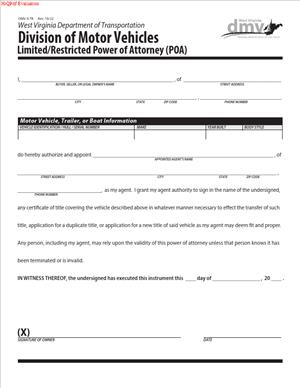
DMV-9-TR- Division of Motor Vehicles – Limited or Restricted Power of Attorney
Fill out nowJurisdiction: Country: United States | Province or State: West Virginia
The DMV-9-TR- Division of Motor Vehicles – Limited or Restricted Power of Attorney is a form used to give someone limited authority to handle specific motor vehicle matters on your behalf. It is designed for use with the West Virginia Division of Motor Vehicles.
This document allows you to appoint another person to act for you in clearly defined vehicle-related transactions. The authority is not broad or unlimited. It applies only to the tasks you describe in the form.
You might use this form if you cannot appear in person at a DMV office or if someone else is managing a vehicle transaction for you. It helps ensure the DMV can process paperwork without delay.
Understanding what this form does—and does not do—makes the completion process smoother. When you know the scope and limits, you can fill it out confidently and avoid common errors.
What is DMV-9-TR- Division of Motor Vehicles – Limited or Restricted Power of Attorney?
Clear definition
The DMV-9-TR- Division of Motor Vehicles – Limited or Restricted Power of Attorney is a written authorization. It allows one person, called the principal, to give another person, called the agent or attorney-in-fact, the power to handle certain motor vehicle matters.
“Limited” or “restricted” means the authority is narrow. The agent can only do what the document specifically allows. This often includes signing title documents, completing registration paperwork, or handling transfer forms for a particular vehicle.
The form is tied to vehicle-related transactions. It does not grant general financial or personal authority. It focuses only on matters within the scope described in the document.
Who typically uses this form?
Vehicle owners commonly use this form when they cannot personally complete DMV paperwork. This may include individuals who are out of state, deployed, hospitalized, or otherwise unavailable.
Dealers, family members, and trusted friends may also be involved. For example, a seller might authorize a dealership employee to complete title transfer documents. A parent might authorize an adult child to register a vehicle.
Businesses that own fleet vehicles may use a similar approach. An authorized representative may sign DMV documents on behalf of the company under a limited power of attorney.
Why might you need this form?
You may need this form if you are selling a vehicle but cannot attend the title transfer in person. The DMV may require an original signature from the vehicle owner. A properly completed power of attorney allows someone else to sign in your place.
It can also help when a vehicle is being registered in West Virginia, but the owner is not physically present. The appointed agent can submit the paperwork and sign the required documents.
In some cases, financial institutions or lienholders may require a designated person to handle title corrections or duplicate title requests. This form creates a clear record of who has authority to act.
Without this document, the DMV may refuse to process certain transactions completed by someone other than the registered owner.
Typical real-life scenarios
- You sell your car while living temporarily in another state. The buyer needs to complete the title transfer quickly. You sign this form so a trusted person can finalize the paperwork at the DMV.
- You purchase a vehicle for an elderly parent. Your parent is the legal owner but cannot travel to the DMV office. With this document, you can sign and submit registration documents on their behalf.
- You are deployed or working overseas. A family member handles your vehicle registration renewal or title correction using a limited authorization.
- A dealership handles the paperwork after you trade in a vehicle. The dealership employee uses the power of attorney to sign certain DMV documents necessary to process the transfer.
- Each of these situations involves a specific, limited task. The form supports that task without giving broad control over all your affairs.
When would you use DMV-9-TR- Division of Motor Vehicles – Limited or Restricted Power of Attorney?
You would use this form when a motor vehicle transaction must be completed, but you cannot personally sign or appear before the DMV. The document allows a designated agent to step into your role for that defined purpose.
It is commonly used during vehicle sales, title transfers, duplicate title requests, and certain registration actions. The key factor is that the DMV requires the owner’s signature, and the owner is not available.
You might also use it if you prefer someone experienced, such as a dealership representative, to manage paperwork. In that case, the document confirms the agent’s authority to sign and submit documents related to the vehicle identified in the form.
The form is typically transaction-specific. It is not meant for long-term financial planning or broad legal representation. Its purpose is practical and focused on DMV-related filings.
Legal characteristics of DMV-9-TR- Division of Motor Vehicles – Limited or Restricted Power of Attorney
This document must generally be completed clearly and signed by the person granting authority. The principal’s name should match the name on the vehicle title or registration records.
Accurate vehicle information is critical. Details such as the vehicle identification number, make, and model must match official records. Errors in these fields often lead to rejection or delay.
The authority granted must be specific. If the form limits the agent’s power to a certain transaction, the agent cannot go beyond that scope. If the language is unclear, the DMV may question whether the agent has proper authority.
Signatures must be legible. If the form requires notarization, the notary section must be properly completed. Missing notary seals or incomplete acknowledgment sections commonly cause problems.
This document does not transfer ownership by itself. It only authorizes someone to act. The actual transfer occurs through properly completed title and registration documents submitted to the DMV.
Different states may have variations in power of attorney requirements. Even though this form is used in West Virginia, other states may not accept it for their own DMV processes.
Is it legally binding?
In general, a properly completed and signed limited power of attorney is legally binding for the purposes stated in the document. It creates an official relationship between the principal and the agent for those specific tasks.
The authority becomes effective once the form is executed according to its requirements. If notarization is required and properly completed, that helps confirm the authenticity of the signature.
The document remains binding within its stated limits. If the agent acts outside the granted authority, those actions may not be recognized as valid. Similarly, if required information is missing, the DMV may refuse to rely on the document.
Its binding effect applies only to the matters described. It does not create general decision-making power beyond DMV-related vehicle transactions.
How to fill out DMV-9-TR- Division of Motor Vehicles – Limited or Restricted Power of Attorney
Step 1 – Identify the principal
Enter your full legal name exactly as it appears on the vehicle title or DMV records. Include your current address as requested. Make sure the spelling matches official documents to avoid processing delays.
Step 2 – Identify the agent
Write the full legal name of the person you are authorizing. Provide any additional identifying information required, such as address. This person will be allowed to act only within the limits described in the form.
Step 3 – Describe the vehicle
Fill in the vehicle details carefully. This typically includes the vehicle identification number, year, make, and model. Double-check each character of the VIN. Even a small error can result in rejection.
Step 4 – Specify the limited authority
Indicate what actions the agent is permitted to take. This may include signing title documents, applying for registration, or requesting a duplicate title. Keep the description consistent with the intended transaction.
Step 5 – Review restrictions
Confirm that the authority is limited to the vehicle and transaction described. Read the form to understand any built-in limitations. Ensure that no sections are left blank if they require a response.
Step 6 – Sign and date the form
Sign your name as the principal in the designated area. Enter the date of signing. Your signature should match the name printed earlier in the form and the name on the vehicle records.
Step 7 – Complete notarization if required
If the form includes a notary section, appear before a notary public and sign in their presence. The notary will complete their portion, including seal and signature. Ensure all required fields in the acknowledgment are filled in before submission.
Step 8 – Provide the form for submission
Give the completed original form to your agent so they can present it with the related DMV paperwork. Confirm that all attached documents are consistent with the information provided in this form.
Legal terms you might encounter in DMV-9-TR- Division of Motor Vehicles – Limited or Restricted Power of Attorney
- Principal: The principal is you, the vehicle owner, or the person with legal authority over the vehicle. Your name must appear exactly as it is shown on the vehicle title or registration record. If the name does not match, the motor vehicle office may reject the submission.
- Agent (Attorney-in-Fact): The agent is the person you authorize to act on your behalf. This could be a family member, employee, dealership representative, or another trusted individual. The agent can only perform the tasks you specifically list in this document.
- Limited Authority: Limited authority means the powers you grant are restricted to certain actions. For example, you may allow your agent to sign a title for transfer but not to apply for duplicate plates. The limits must be clearly described in the space provided.
- Restricted Power of Attorney: This phrase emphasizes that the authorization is narrow in scope. It does not give broad financial or legal powers. It applies only to the vehicle-related matters identified in the document.
- Vehicle Identification Number (VIN): The VIN is the unique 17-character code assigned to your vehicle. You must enter it exactly as it appears on the title or registration. Even one incorrect character can delay processing.
- Title Transfer: A title transfer is the legal process of changing ownership of a vehicle. If you are authorizing someone to sign title documents for you, this must be clearly stated in the authority section. The DMV will use this document to confirm that your agent can sign in your place.
- Notarization: Notarization means a notary public verifies your identity and witnesses your signature. The notary then applies a seal or stamp. Many motor vehicle forms require notarization to prevent fraud.
- Effective Date: The effective date is when the authority begins. In many cases, the authority starts when you sign the document. If you write a future date, the agent cannot act until that date arrives.
- Revocation: Revocation is the act of canceling the authority you granted. You can usually revoke a limited power of attorney at any time before it is used. To avoid confusion, you should notify the agent and any office where the document was submitted.
- Signature Authority: Signature authority refers to the legal ability of your agent to sign documents in your name. When your agent signs, they typically write your name followed by their own name as attorney-in-fact. This shows they are signing on your behalf, not as the owner.
FAQs
Does the DMV-9-TR- Division of Motor Vehicles – Limited or Restricted Power of Attorney let someone sell my vehicle without me being there?
It can, but only if you clearly grant that authority. You must check the section that allows the agent to sign title transfer documents and confirm the vehicle details are correct. If you leave that section blank or limit the authority to registration only, the agent cannot legally complete a sale for you.
Do I need to use the exact name that appears on my vehicle title?
Yes. The name you write as principal must match the name printed on the current title or registration record. If your middle initial, suffix, or spelling is different, the office may reject the paperwork until the names are corrected.
What information about the vehicle do I have to enter?
You must provide the year, make, model, and full VIN. Copy the VIN directly from the title or registration to avoid errors. Do not rely on memory. An incorrect VIN can cause delays or require you to complete a new document.
When does this document become effective?
In most cases, it becomes effective on the date you sign it. Check whether there is a space to list an effective date. If you write a future date, the agent cannot act before that date, even if they already have the signed form.
Does this form need to be notarized?
Look for a notary section at the bottom of the document. If there is a space for a notary seal or certificate, you must sign in front of a notary. Signing before you meet the notary can invalidate the form.
Can I limit the agent to only one specific task?
Yes. In the section that describes authority, you can write detailed limits. For example, you can authorize the agent to apply for a duplicate title but not to transfer ownership. Be clear and specific so the motor vehicle office understands exactly what is allowed.
What happens if the motor vehicle office rejects my submission?
If there is an error, such as a missing signature, incomplete vehicle information, or a name mismatch, the office will not process the transaction. You may need to correct the issue and submit a new DMV-9-TR- Division of Motor Vehicles – Limited or Restricted Power of Attorney, especially if the original was notarized incorrectly.
Does this document stay on my public vehicle record permanently?
This document is usually used to support a specific transaction. Once the transaction is complete, the authority has served its purpose. However, the paperwork connected to the transaction becomes part of the official record, so make sure the information you provide is accurate and complete.
Checklist: Before, During, and After DMV-9-TR- Division of Motor Vehicles – Limited or Restricted Power of Attorney
Before
- Confirm your name matches exactly what appears on the vehicle title.
- Locate the current title or registration to copy the VIN accurately.
- Decide precisely what tasks you want the agent to handle.
- Verify the full legal name and contact details of your agent.
- Check whether notarization is required.
- Make sure the vehicle information is current and not already transferred.
- Confirm there are no existing liens that require separate authorization.
During
- Write legibly in blue or black ink.
- Enter the full year, make, model, and VIN without abbreviations.
- Clearly describe the limited powers you are granting.
- Review the restrictions to ensure you are not granting broader authority than intended.
- Leave no required fields blank.
- Sign only in the designated signature area.
- If notarization is required, sign in front of the notary.
- Verify that the notary completes all required fields and applies a seal.
After
- Make at least one copy for your records.
- Provide the original document to your agent if they will submit it.
- Confirm when and how the form will be delivered to the motor vehicle office.
- Follow up to ensure the authorized task was completed.
- Store your copy with your vehicle records.
- Revoke the authority in writing if you no longer want the agent to act.
- Update your personal records to reflect any completed transactions.
- Check that the title or registration has been updated if ownership has changed.
Common mistakes to avoid with DMV-9-TR- Division of Motor Vehicles – Limited or Restricted Power of Attorney
- Mistake: Writing a nickname or shortened version of your name, which happens out of habit, can cause rejection because the record does not match, so do not forget to copy your name exactly as shown on the title.
- Mistake: Entering an incorrect VIN due to copying it from memory, which leads to processing delays or denial, so do not forget to verify all 17 characters directly from the official document.
- Mistake: Leaving the authority section vague, which happens when you assume standard powers apply, can allow broader action than you intended or cause confusion, so do not forget to clearly describe each permitted task.
- Mistake: Signing before meeting the notary, which often occurs when you try to save time, can invalidate the notarization, so do not forget to wait and sign in the notary’s presence.
- Mistake: Forgetting to make a copy before handing over the original, which can leave you without proof of what you authorized, so do not forget to keep a complete copy for your records.
- Mistake: Giving the form to the wrong person or office due to a misunderstanding of submission procedures, which can delay your transaction, so do not forget to confirm where and by whom it must be filed.
- Mistake: Failing to revoke unused authority, which happens when plans change, can allow unintended action later, so do not forget to notify the agent in writing if you cancel the authorization.
- Mistake: Omitting lienholder information when required, which can block title processing, so do not forget to confirm whether additional signatures or documents are needed.
What to do after filling out DMV-9-TR- Division of Motor Vehicles – Limited or Restricted Power of Attorney
Once you complete and sign the document, slow down and review it one more time. Small errors create big delays in vehicle transactions. Confirm every field is filled in and every required signature is present.
- Step 1: Make a clear copy of the signed and notarized document for your personal records.
- Step 2: Verify that the notary section is fully completed, including signature, seal, and commission details.
- Step 3: Confirm the agent understands exactly what authority they have and what limits apply.
- Step 4: Deliver the original document to the agent or directly to the appropriate motor vehicle office, depending on how the transaction will be handled.
- Step 5: Attach any supporting documents required for the transaction, such as the original title, lien release, or identification documents.
- Step 6: Ask for confirmation that the paperwork was received and accepted for processing.
- Step 7: Follow up within a reasonable timeframe to ensure the authorized action, such as title transfer or duplicate title issuance, has been completed.
- Step 8: Obtain updated documentation, such as a new title or registration, if ownership or registration status has changed.
- Step 9: Store your copy of the power of attorney with your vehicle records in a secure place.
- Step 10: If circumstances change before the agent uses the authority, prepare a written revocation and notify the agent immediately.
Keep your records organized. If the transaction results in a change of ownership, update your insurance and any internal logs you maintain. If you granted authority for a limited purpose and that purpose is complete, confirm that no further action is pending. Staying proactive protects you from confusion and future disputes.
Disclaimer: This guide is provided for informational purposes only and is not intended as legal advice. You should consult a legal professional.