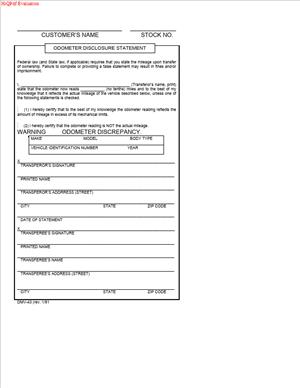
DMV-43 – Odometer Disclosure Statement
Fill out nowJurisdiction: Country: United States | Province or State: West Virginia
The DMV-43 – Odometer Disclosure Statement is a required document used during certain vehicle transfers in West Virginia. It records the vehicle’s mileage at the time of sale or transfer. If you are buying or selling a car, this form is often part of the paperwork.
You complete this form when ownership changes, and mileage must be officially disclosed. It creates a written record of what the odometer shows. That record follows the vehicle’s title history.
This document helps prevent odometer fraud. It protects both buyers and sellers by putting the mileage in writing. Once signed, it becomes part of the transaction record.
If you are about to fill it out, you need to understand what information is required, who signs it, and how mistakes can affect the transfer. Small errors can delay processing. Clear and accurate completion matters.
What is DMV-43 – Odometer Disclosure Statement?
Clear definition
The DMV-43 – Odometer Disclosure Statement is a mileage disclosure form used when transferring ownership of a motor vehicle. It documents the exact mileage shown on the odometer at the time of sale or transfer.
This form is separate from the title itself, although mileage may also appear on the title. It focuses specifically on the odometer reading. The information becomes part of the vehicle’s official record.
In simple terms, it answers one key question: What did the odometer show when the vehicle changed hands?
Who typically uses this form?
Private sellers use this form when selling a vehicle to another individual. Buyers complete and sign their portion as part of the transfer process.
Dealers may also use this form when purchasing or selling certain vehicles. In some transactions, a dealership representative signs on behalf of the business.
Anyone transferring ownership of a vehicle that requires mileage disclosure may encounter this form. This often includes passenger cars, light trucks, and other titled motor vehicles.
Why might you need this form?
You may need this form when selling a vehicle privately. The state requires a written mileage disclosure in many ownership transfers.
You may also need it if you are buying a vehicle and the title does not include a compliant odometer disclosure section. The separate document fills that gap.
This form creates a clear record that helps prevent disputes. If questions arise later about the vehicle’s mileage, the signed disclosure shows what was reported at the time of transfer.
In some cases, a lender, insurer, or agency may request proof of mileage disclosure as part of processing the title or registration. Having this form properly completed avoids delays.
Typical real-life scenarios
- You sell your car to a neighbor. At the time of sale, you write down the mileage shown on the dashboard. Both of you sign the form to confirm the reading. The buyer submits it with the title transfer paperwork.
- You purchase a used truck from a private seller. The seller provides the mileage disclosure form showing the current odometer reading. You review it, confirm it matches the vehicle, and sign as the buyer.
- A family member transfers a vehicle to you as a gift. Even though no money changes hands, the mileage at the time of transfer is still recorded on the form.
- A dealership buys your trade-in vehicle. A representative completes and signs the disclosure to confirm the mileage shown when they acquired it.
When would you use DMV-43 – Odometer Disclosure Statement?
You use this form during a change of ownership when mileage disclosure is required. This commonly happens in private sales between individuals.
It may also be used when a vehicle is transferred between family members. Even if the transfer is a gift, the mileage at the time of transfer can still need documentation.
You might encounter this form when replacing a title that does not contain a compliant odometer section. In that case, the separate document serves as the official mileage statement.
Dealers and businesses may use it when acquiring vehicles for resale. The person signing on behalf of the business confirms the mileage reading as part of the acquisition record.
In some situations, the form may be required even if the vehicle is older or exempt from certain federal mileage rules. Requirements can vary depending on the vehicle’s age and classification.
Legal characteristics of DMV-43 – Odometer Disclosure Statement
This form becomes effective when it is completed accurately and signed by the required parties. It typically includes the vehicle identification number, the make and model, the year, and the odometer reading. Signatures confirm that the information is true to the best of the signer’s knowledge.
Accuracy is critical. Common problems include incorrect vehicle identification numbers, mismatched mileage, missing signatures, or unclear handwriting. These errors can lead to rejection of the paperwork or delays in title processing.
The odometer reading must reflect what appears on the vehicle at the time of transfer. If the odometer has exceeded its mechanical limits or is not the actual mileage, that fact is usually indicated on the form. Selecting the correct statement matters.
Mileage disclosure laws are influenced by federal standards, but states may have their own procedures. In West Virginia, this form is used as part of the title transfer process through the state’s transportation authority.
This document does not transfer ownership by itself. It works alongside the vehicle title and other required documents. It also does not guarantee the condition of the vehicle. It only addresses mileage disclosure.
Is it legally binding?
When properly completed and signed, the form becomes a binding written statement of the vehicle’s mileage at the time of transfer. The signatures indicate that the seller is certifying the odometer reading and that the buyer acknowledges it.
Providing false information on an odometer disclosure can carry serious consequences. Mileage misrepresentation is treated as a significant issue under federal and state law.
The form’s legal effect depends on accurate completion and proper submission with the title paperwork. If it is incomplete or unsigned, it may not satisfy disclosure requirements, which can affect the processing of the ownership transfer.
How to fill out DMV-43 – Odometer Disclosure Statement
Step 1 – Enter the vehicle information
Write the full vehicle identification number exactly as it appears on the vehicle and the title. Include the year, make, and model. Double-check each character in the Vehicle Identification Number to avoid processing delays.
Step 2 – Record the odometer reading
Enter the exact mileage shown on the odometer at the time of transfer. Do not round up or down. If the form requires tenths of a mile, include them as displayed.
If the odometer reading exceeds its mechanical limits or does not reflect the vehicle’s actual mileage, select the statement that accurately describes the situation. Read each option carefully before marking your choice.
Step 3 – Complete the seller information
Print the seller’s full legal name as it appears on the title. Provide the seller’s address if requested. Ensure the information matches the ownership details on the title document.
If there are multiple owners listed on the title, each required owner may need to sign. Review the title to see how names are connected, as that can affect who signs.
Step 4 – Sign and date as the seller
The seller signs and dates the form in the designated area. The date should match the actual date of transfer. Signing confirms that the mileage disclosure is accurate to the best of the seller’s knowledge.
Use a consistent signature that matches the name on the title. Avoid signing outside the designated space.
Step 5 – Complete the buyer information
The buyer prints their full legal name and address as requested. This information should match the name that will appear on the new title application.
If there is more than one buyer, include each name as required by the form. Make sure spelling is correct to prevent issues with the new title issuance.
Step 6 – Buyer acknowledgment and signature
The buyer signs and dates the form to acknowledge the mileage disclosure. This signature confirms receipt of the odometer information at the time of transfer.
Check that all fields are complete before signing. Once signed, changes can require a new form.
Step 7 – Review the entire document
Before submitting, review every section of the form. Confirm that the VIN matches the vehicle, the mileage is correct, and all required signatures and dates are present.
Ensure there are no erasures or alterations that could raise questions. If a significant mistake appears, completing a new form is often cleaner than making corrections on the existing one.
After review, include the completed form with the rest of the title transfer paperwork for submission as part of the ownership change process.
Legal terms you might encounter in DMV-43 – Odometer Disclosure Statement
- Odometer Reading: This is the exact mileage shown on the vehicle’s odometer at the time of transfer. You must record the numbers exactly as they appear, without rounding. The form relies on this number to document the vehicle’s usage at the moment ownership changes.
- Actual Mileage: This term means the odometer reading reflects the true miles the vehicle has traveled. When you select or confirm actual mileage, you are stating that, to the best of your knowledge, the number shown is accurate.
- Mileage Discrepancy: A mileage discrepancy exists when the odometer reading does not match the vehicle’s true mileage. This can happen if the odometer was replaced, reset, or tampered with. The form may require you to disclose this if you know the reading is not correct.
- Odometer Not Actual (Exceeds Mechanical Limits): Older vehicles may have odometers that only display a limited number of digits. If the vehicle has traveled more miles than the odometer can show, you must indicate that the reading exceeds mechanical limits.
- Transferor: The transferor is the seller or current owner giving up ownership. In this document, the transferor must provide their name, address, and signature to certify the mileage disclosure.
- Transferee: The transferee is the buyer receiving ownership. The transferee confirms the mileage information and signs to acknowledge receipt of the disclosure.
- Vehicle Identification Number (VIN): The Vehicle Identification Number is a unique 17-character code assigned to the vehicle. You must enter it exactly as it appears on the vehicle and title. Even one incorrect character can cause processing delays.
- Certification: Certification is your formal statement that the information you provided is true and complete. By signing, you certify that the odometer reading and related disclosures are accurate to the best of your knowledge.
- Assignment of Title: This refers to the section of a vehicle title where ownership is transferred. Sometimes the odometer disclosure appears directly on the title. If a separate statement like this one is required, it supports the assignment of the title.
- Federal Odometer Law Compliance: Odometer disclosures are required under federal law for many vehicle transfers. This document helps ensure compliance by creating a written record of mileage at the time of sale.
FAQs
Do I always need to complete the DMV-43 – Odometer Disclosure Statement when selling a vehicle?
You generally need to complete this document when transferring ownership of a vehicle that requires a mileage disclosure. Whether it is required depends on the vehicle’s age and type. Before you skip it, check the title and transfer instructions to see if a separate odometer statement is required in addition to the title assignment.
What if the odometer reading is wrong, or I am unsure about it?
If you know the reading is not accurate, you must indicate that it is not actual mileage. Look for the section where you select whether the mileage is actual, exceeds mechanical limits, or is not actual. Do not guess or leave it blank. Your selection changes what the buyer understands about the vehicle’s history.
Can I estimate the mileage if the odometer is broken?
You should not estimate and enter a number as if it were exact. Instead, disclose that the odometer reading is not actual if it cannot display the correct mileage. The form records the reading shown and your certification about its accuracy, so an estimate could create problems later.
Whose name must match the seller’s name on this form?
The seller’s name on this document must match the name listed on the current vehicle title. Check spelling, middle initials, and suffixes. If the title shows multiple owners, each required owner must complete or sign as instructed so the transfer is accepted.
What happens if the VIN is entered incorrectly?
An incorrect VIN can cause the transfer paperwork to be rejected or delayed. The Vehicle Identification Number connects this document to the specific vehicle record. Double-check each character against the title and the vehicle itself before signing.
Does the buyer have to sign this document?
Yes, the buyer typically signs to acknowledge the mileage disclosure. The buyer’s signature confirms they received the information before completing the transfer. Make sure the buyer signs in the correct space and includes the date if required.
What date should I put on the form?
Use the actual date you sign the certification as the seller. The date should reflect when the odometer reading was disclosed to the buyer. This date may need to align with the date on the title assignment or bill of sale.
What changes in the vehicle record after this form is submitted?
Once processed, the mileage disclosure becomes part of the vehicle’s ownership history. It documents the mileage at the time of transfer. This record can be referenced in future sales, inspections, or title transactions.
Checklist: Before, During, and After DMV-43 – Odometer Disclosure Statement
Before
- Confirm the vehicle requires a separate odometer disclosure.
- Locate the current title and verify the seller’s name.
- Write down the VIN directly from the vehicle and compare it to the title.
- Check that the odometer is working and readable.
- Review whether the mileage is actual, exceeds limits, or is not actual.
- Gather full legal names and addresses for both seller and buyer.
- Make sure you understand who must sign if there are multiple owners.
During
- Enter the VIN carefully, one character at a time.
- Record the odometer reading exactly as shown, without rounding.
- Select the correct mileage certification statement.
- Print names clearly as required.
- Sign your legal name exactly as it appears on the title.
- Have the buyer review the mileage disclosure before signing.
- Date the document on the day it is signed.
- Recheck all entries for blanks or crossed-out information.
After
- Make a clear copy or photo of the completed document.
- Attach it to the title or other transfer paperwork if required.
- Provide the original to the appropriate party as part of the transfer.
- Confirm the buyer has received their copy.
- Store your copy with the bill of sale and related records.
- Monitor the status of the title transfer if tracking is available.
- Keep records for future reference in case of disputes.
Common mistakes to avoid with DMV-43 – Odometer Disclosure Statement
- Mistake: Rounding the mileage to the nearest hundred or thousand because it seems cleaner, which happens out of habit, but it creates an inaccurate record and may delay processing; do not forget to write the exact number shown.
- Mistake: Leaving the mileage certification box blank because you are unsure which option applies, which often happens when the odometer has issues, but this can invalidate the disclosure; do not forget to select the statement that matches the vehicle’s condition.
- Mistake: Misspelling a name or using a nickname instead of the legal name, which happens when people copy from memory, but it can cause rejection of transfer documents; do not forget to match the title exactly.
- Mistake: Entering the wrong VIN due to transposed characters, which is common when copying long numbers, but it ties the disclosure to the wrong vehicle record; do not forget to verify each character against the vehicle and title.
- Mistake: Signing before the buyer reviews the mileage, which happens when paperwork is rushed, but it can lead to disputes about whether disclosure was made; do not forget to complete the process together.
- Mistake: Forgetting to date the form, which often occurs during quick transactions, but missing dates can raise questions about timing; do not forget to include the correct signing date.
- Mistake: Using correction fluid or heavily crossing out errors, which happens when trying to fix small mistakes, but may cause the document to be rejected; do not forget to start over with a clean form if errors are significant.
- Mistake: Failing to keep a copy, which happens when you hand over all paperwork at once, but leaves you without proof of disclosure; do not forget to retain a clear copy for your records.
What to do after filling out DMV-43 – Odometer Disclosure Statement
Once you complete the form, your job is not quite finished. You need to make sure the disclosure becomes part of the official ownership transfer and that you protect yourself with proper records.
- Step 1: Review the entire document one more time for accuracy. Check the VIN, mileage, names, signatures, and date.
- Step 2: Make at least one clear copy or digital scan for your personal records before handing over the original.
- Step 3: Attach the completed statement to the vehicle title if a separate submission is required as part of the transfer paperwork.
- Step 4: Provide the original document to the appropriate party handling the title transfer, whether that is the buyer or the processing office.
- Step 5: Confirm with the buyer that they understand the mileage disclosure and have received any copies they need.
- Step 6: Keep your copy with related documents, such as the bill of sale and a copy of the signed title.
- Step 7: Note the date of transfer in your personal records in case questions arise later about when ownership changed.
- Step 8: Follow up, if necessary, to ensure the title transfer is completed and the vehicle is no longer listed under your name in official records.
- Step 9: Store your records in a safe place for several years. Odometer disclosures can become important if there is a later dispute about mileage accuracy.
- Step 10: Update any internal logs or financial records you keep to reflect the sale and the recorded mileage at transfer.
Taking these steps helps you close the transaction properly. It creates a clear paper trail. Most importantly, it shows that you made a full and accurate mileage disclosure at the time of sale.
Disclaimer: This guide is provided for informational purposes only and is not intended as legal advice. You should consult a legal professional.