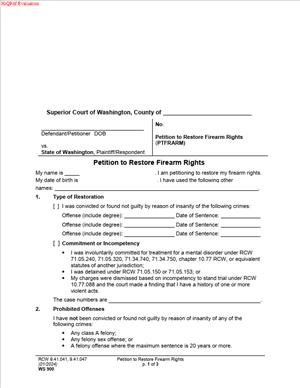
WS 900 – Petition to Restore Firearm Rights
Fill out nowJurisdiction: Country: United States | Province or State: Washington
If you are preparing to file WS 900 – Petition to Restore Firearm Rights, you are asking a Washington Superior Court to reinstate your legal right to possess firearms. This form starts a formal court process. It is not automatic, and it is not administrative.
WS 900 – Petition to Restore Firearm Rights is used after your firearm rights were lost because of a conviction or certain court findings. The document explains who you are, what happened in your past case, and why you believe you now qualify for restoration.
This form matters because firearm rights in Washington are controlled by both state and federal law. A court order restoring those rights can affect your ability to legally possess or purchase a firearm under state law. The order becomes part of your official court record.
If you are filling this out yourself, you need to understand what the court is reviewing. The judge will look at your criminal history, your compliance with past sentences, and whether you meet statutory requirements. The form is your structured way to present that information clearly and accurately.
What is WS 900 – Petition to Restore Firearm Rights?
Clear definition
WS 900 – Petition to Restore Firearm Rights is a formal written request filed in a Washington Superior Court. By filing it, you ask the court to enter an order restoring your right to possess firearms under Washington law.
The document identifies you as the petitioner. It references the convictions or findings that caused the loss of your firearm rights. It also states that you meet the legal conditions for restoration.
This is not a motion within an active criminal case. It is usually filed as a separate civil-type proceeding, even though it relates to past criminal matters. The court opens a file, assigns a case number, and reviews the petition before making a decision.
Who typically uses this form?
People who previously lost their firearm rights due to felony convictions often use this form. Some misdemeanor convictions, especially those involving domestic violence, can also result in loss of firearm rights.
Individuals who completed their sentence years ago and have had no further disqualifying offenses may file this petition. In many cases, the person has already served any prison time, completed probation, and paid financial obligations.
You might also use this form if you received a prior court order prohibiting firearm possession and now believe the legal basis for that prohibition no longer applies.
Why might you need this form?
You may need this form if you want to lawfully possess a firearm again and your rights were previously removed by law. Without a restoration order, possessing a firearm can expose you to new criminal charges.
A background check for a firearm purchase will typically show prior disqualifying convictions. Even if many years have passed, the prohibition can remain in effect unless a court restores your rights.
In Washington, firearm rights are not automatically restored in many situations. Completing your sentence alone may not be enough. The court’s order is often required to change your legal status.
Typical real-life scenarios
- You were convicted of a nonviolent felony more than five years ago. You completed your sentence, paid all fines, and have had no new criminal convictions. You now want to hunt or participate in sport shooting. You file this petition to ask the court to restore your firearm rights.
- You were convicted of a felony in another state, but now live in Washington. Your firearm rights were lost as a result of that conviction. You seek restoration through a Washington Superior Court if you meet the applicable criteria.
- You had a domestic violence–related conviction that resulted in a prohibition on firearm possession. After the required waiting period and compliance with all conditions, you file a request that the court review your eligibility.
- You were subject to a court order that restricted firearm possession. The order has expired, or the underlying case has been resolved. You use the petition to clarify your legal status and seek a formal restoration order.
When would you use WS 900 – Petition to Restore Firearm Rights?
You use this form when you believe you meet Washington’s legal requirements for restoration of firearm rights. Timing matters. In many situations, a specific number of years must have passed since completion of all sentencing conditions.
Completion of sentencing typically includes incarceration, community custody, probation, and payment of all legal financial obligations. Courts often review whether every part of the sentence was satisfied before considering restoration.
You might file after confirming that you have not been convicted of new disqualifying offenses. Certain new convictions can restart waiting periods or permanently bar restoration.
This form is generally used by individuals acting on their own behalf. In some cases, an attorney prepares and files it. The petitioner is the person whose rights were lost. The prosecuting authority is usually notified and may respond.
You would not use this form to challenge the validity of your original conviction. It is not an appeal. It does not reopen the criminal case to argue that the conviction was wrong.
You also would not use this form if your rights were never lost under Washington law. The court will look at whether there was a qualifying prohibition in the first place.
Legal Characteristics of WS 900 – Petition to Restore Firearm Rights
This petition becomes effective only if the court signs an order granting restoration. Filing the document alone does not change your legal status. The judge must review the petition and determine eligibility under state law.
For the petition to move forward, it typically must include accurate identifying information. This can include your full legal name, date of birth, and details of the conviction or convictions involved. Errors in case numbers, dates, or offense descriptions can delay the process.
Courts often require proof that you completed all sentencing conditions. Missing documentation or unclear information can result in continuances or denial. Accuracy and completeness are important.
Another common issue is filing in the wrong court. Restoration is often sought in the county where the original conviction occurred or where you currently reside, depending on the circumstances. Filing in an incorrect venue can lead to dismissal or transfer.
The petition does not erase your criminal record. It does not vacate or seal the conviction. It addresses only your eligibility to possess firearms under state law.
There can also be differences between state and federal law. Even if a Washington court restores firearm rights under state law, federal law may still apply depending on the type of conviction. The court’s order focuses on Washington law.
The judge has the authority to review your criminal history and confirm that statutory requirements are met. The court does not rely solely on your statements. Background checks and record reviews are common parts of the process.
Is it legally binding?
Yes, if the court grants the petition and signs an order restoring your firearm rights, that order is legally binding under Washington law. It changes your status regarding firearm possession within the scope of state law.
The binding effect comes from the court’s authority. A signed order entered into the court record has legal force. Law enforcement agencies and background check systems may rely on that order when determining eligibility.
If the petition is denied, the denial is also legally significant. It means the court determined that the legal requirements were not met at that time. You may need to wait or address specific issues before filing again, depending on the circumstances.
The order does not create broader rights beyond what the law allows. It restores rights only to the extent permitted by statute. It does not override other court orders that may still be in effect.
How to fill out WS 900 – Petition to Restore Firearm Rights
Step 1 – Caption and Court Information
At the top of the form, enter the name of the Superior Court of Washington in the correct county. This is the court where the petition is being filed. Include the county name exactly as required in court documents.
Fill in your full legal name as the petitioner. Use the same name that appears on your prior conviction records unless you have legally changed your name. Consistency helps the court match your petition to existing records.
If a case number is assigned at filing, it may be added by the clerk. Leave any section for the case number blank if you do not yet have one, unless local practice requires otherwise.
Step 2 – Petitioner Identification Information
Provide your identifying details as requested in the form. This often includes your date of birth and possibly your Washington State identification number or similar identifying information.
Ensure that all information matches official records. Differences in spelling, initials, or dates can create confusion. The court uses this data to confirm your criminal history and eligibility.
Do not omit prior names if the form asks for them. If you have used other legal names, list them clearly to avoid delays in background checks.
Step 3 – Information About the Disqualifying Conviction
Enter details about the conviction or convictions that led to the loss of firearm rights. This usually includes the case number, the court where the conviction occurred, the offense title, and the date of conviction.
Be precise. Copy the information from official court documents if possible. Incorrect case numbers or offense names can cause the court to question the accuracy of the petition.
If you have more than one relevant conviction, the form may require listing each one. Make sure each conviction is identified separately and clearly.
Step 4 – Completion of Sentence
State that you have completed all terms and conditions of your sentence for each listed conviction. This can include confinement, probation, community custody, treatment requirements, and payment of legal financial obligations.
If the form asks for dates, provide the date you completed the final condition of your sentence. That date is often important for calculating waiting periods.
Confirm that there are no outstanding warrants, unpaid obligations, or unresolved conditions related to the case. Courts typically verify this information before ruling on the petition.
Step 5 – Eligibility Statements
The form may include statements that you must check or affirm, indicating that you meet statutory eligibility criteria. Read each statement carefully before marking it.
These statements often relate to the absence of new convictions within a required period. They may also address whether you are currently under any court order prohibiting firearm possession.
Answer truthfully and completely. Providing inaccurate information can lead to denial and may have additional legal consequences.
Step 6 – Notice to Prosecuting Authority
The petition process generally requires notice to the prosecuting authority in the relevant county. The form may include a section indicating that a copy will be served on the prosecutor.
Follow the procedural requirements for service as described by the court’s rules. Proper notice allows the prosecutor an opportunity to respond or object.
Keep a record of when and how service was completed. The court may require proof before setting a hearing or issuing a decision.
Step 7 – Signature and Date
At the end of the form, sign your name exactly as it appears in the caption. Print your name if the form requests it, and enter the date of signing.
By signing, you are confirming that the information provided is true to the best of your knowledge. The signature gives the petition formal effect.
Some courts require signatures to be made under penalty of perjury. Read the certification language carefully before signing.
Step 8 – Filing With the Court
Submit the completed petition to the clerk of the Superior Court in the appropriate county. The clerk will file-stamp the document and assign a case number if one has not already been assigned.
Pay any required filing fee or submit a fee waiver request if applicable. The clerk can inform you of the current filing requirements.
After filing, monitor the case for scheduling information. The court may set a hearing date or decide the matter based on the written submission, depending on local practice and whether any objection is filed.
Legal terms you might encounter in WS 900 – Petition to Restore Firearm Rights
- Petitioner: This is you, the person asking the court to restore your firearm rights. Your full legal name must match the name on your prior court case and identification. If you have changed your name, you may need to list former names so the court can connect your records.
- Respondent: In many court matters, the respondent is the opposing party. In this type of case, the prosecuting authority (often the county prosecutor) is typically served with notice and may respond. The form may not label them as a traditional respondent, but they are the party entitled to receive notice.
- Disqualifying Offense: This refers to the conviction that caused you to lose your firearm rights. You must identify the specific offense, the court where it occurred, and the date of conviction. The court uses this information to confirm whether the offense qualifies for restoration.
- Completion of Sentence: This means you have fully satisfied all parts of your sentence. It includes jail or prison time, probation, community custody, fines, restitution, and any treatment requirements. The court will not consider restoration unless your sentence is fully completed.
- Superior Court: This is the trial-level court with authority to hear certain types of cases, including petitions to restore firearm rights. You must file in a court that has legal authority over your matter. Filing in the wrong court can delay your case.
- Jurisdiction: Jurisdiction means the court’s legal power to decide your case. The form requires you to state facts showing the court has authority. If jurisdiction is missing, the judge cannot grant your request.
- Order Restoring Firearm Rights: This is the separate document the judge signs if your petition is granted. The petition asks for relief. The order actually restores your rights. You may need to prepare a proposed order for the judge to sign.
- Service: Service means formally delivering a copy of your filed petition to the prosecuting authority. You must follow the required method of delivery. Proof of service shows the court that you gave proper notice.
- Hearing: A hearing is a scheduled court appearance where a judge reviews your petition. Some courts require a hearing. At the hearing, the judge may ask questions about your eligibility and background.
- Clerk of Court: The clerk’s office receives and processes your paperwork. The clerk assigns a case number, collects filing fees, and enters documents into the official record. The clerk cannot give you legal advice, but can explain filing procedures.
FAQs
How do I know if I am eligible to file this form?
You must confirm that you have completed all parts of your sentence and that enough time has passed, if a waiting period applies. Review your judgment and sentence to verify the conviction date and the date you completed supervision. This document requires you to state that you meet all eligibility conditions, so you need accurate dates before you file.
Where do I file the WS 900 – Petition to Restore Firearm Rights?
You file it in a Superior Court that has authority over your case. This is usually the court connected to your conviction or where you currently reside, depending on the circumstances. Check your old court paperwork to confirm the correct county and case details before submitting anything.
What information about my conviction do I need to include?
You need the exact name of the offense, the case number, the court where you were convicted, and the date of conviction. You also need to confirm that the conviction is the one that caused the loss of firearm rights. Use your judgment and sentence paperwork to avoid guessing.
Do I need to attach proof that I completed my sentence?
In many cases, yes. Courts often expect documentation showing that probation, community custody, fines, and restitution are fully paid and completed. This can include payment receipts or a letter from a supervising agency confirming discharge. Attaching proof reduces delays and questions from the judge.
What happens after I file this form?
The clerk assigns a case number and schedules the matter according to local procedure. You must make sure the prosecuting authority receives a copy. The court may set a hearing date, or it may review the paperwork first to confirm that it is complete.
Do I have to attend a hearing?
Many courts require you to appear so the judge can ask questions about your background and eligibility. Bring identification and copies of all supporting documents. If you miss the hearing, the court can deny or dismiss your petition.
What if my name is different now than it was at the time of conviction?
You should list any former names used in the prior case so the court can match your records. If you legally changed your name, bring documentation showing the change. Consistency between this form and your prior case record helps prevent administrative rejection.
When do my rights actually change?
Your rights are not restored when you file this document. They are restored only if a judge signs an order granting your petition. Keep a certified copy of the signed order as proof, because agencies rely on the signed court order, not just the filed WS 900 – Petition to Restore Firearm Rights.
Checklist: Before, During, and After WS 900 – Petition to Restore Firearm Rights
Before
- Review your judgment and sentence to confirm the exact offense, case number, and conviction date.
- Confirm you have completed all jail, probation, community custody, fines, restitution, and treatment requirements.
- Obtain written proof of discharge or completion from the supervising agency, if applicable.
- Verify that you are filing in the correct Superior Court.
- Check whether there is a filing fee and how it must be paid.
- Gather government-issued identification that matches your legal name.
- Prepare a proposed order restoring firearm rights if required by the court.
During
- Fill in your full legal name exactly as it appears in court records.
- Accurately list the disqualifying conviction and related case information.
- State clearly that you have completed all sentencing conditions.
- Sign and date the petition where required.
- Make at least two copies of everything before filing.
- File the original documents with the clerk and obtain a stamped copy.
- Arrange proper service of the filed petition on the prosecuting authority.
- Calendar any hearing date provided by the clerk.
After
- Confirm that proof of service has been filed with the court.
- Prepare for the hearing by organizing your documents in a folder.
- Arrive early on your hearing date and check in with the courtroom staff.
- Answer the judge’s questions clearly and directly.
- If the petition is granted, obtain a signed and filed copy of the order.
- Request certified copies of the signed order for your records.
- Store copies of the order in a safe place.
- Follow up with the clerk if you do not receive notice of a decision.
Common mistakes to avoid with WS 900 – Petition to Restore Firearm Rights
- Mistake: Listing the wrong case number because you rely on memory instead of your judgment and sentence; this happens when records are old, and it can lead to delays or dismissal, so do not forget to verify the exact number from official documents.
- Mistake: Filing before fully completing probation or paying restitution because you assume supervision ended automatically; this can result in denial, so do not forget to obtain written confirmation of completion.
- Mistake: Failing to serve the prosecuting authority due to a misunderstanding of service rules; this often leads to postponed hearings or rejection, so do not forget to file proof that service was completed properly.
- Mistake: Bringing no documentation to the hearing because you believe the court already has everything; judges may require proof on the spot, so do not forget to carry copies of all supporting records.
- Mistake: Using a different name than the one on your conviction without explanation; this creates confusion in court records and may delay the case, so do not forget to list former names or provide name-change documents.
- Mistake: Assuming your rights are restored immediately after filing; this misunderstanding can cause legal trouble, so do not forget that only a signed court order changes your status.
- Mistake: Not requesting certified copies of the signed order because you think a regular copy is enough; agencies may require certified proof, so do not forget to ask the clerk for certified copies before leaving.
What to do after filling out WS 900 – Petition to Restore Firearm Rights
Once you complete the form, pause and review every section. Make sure names, dates, and case numbers match your official court records. Small inconsistencies can slow down processing.
- Step 1: Make at least two copies of the completed petition and any attachments for your records.
- Step 2: File the original documents with the Superior Court clerk in the correct county.
- Step 3: Pay the required filing fee or submit any approved fee waiver paperwork.
- Step 4: Ask the clerk how the court schedules hearings for this type of petition.
- Step 5: Serve a filed copy of the petition on the prosecuting authority using the approved method.
- Step 6: File proof of service with the court so the judge knows notice was given.
- Step 7: Prepare a proposed order restoring firearm rights for the judge to review and sign.
- Step 8: Organize all supporting documents in a folder for the hearing.
- Step 9: Attend the hearing on time and answer questions clearly and honestly.
- Step 10: If the judge grants your petition, obtain a signed and filed copy of the order before you leave or as soon as it becomes available.
- Step 11: Request certified copies of the signed order for your records and future use.
After the order is signed, keep certified copies in a secure place. You may need to present them as official proof that your rights have been restored. Update your personal records to reflect the court’s decision. If you move, keep the order accessible in case you need it later. Careful recordkeeping protects you from confusion or disputes about your status.
Disclaimer: This guide is provided for informational purposes only and is not intended as legal advice. You should consult a legal professional.