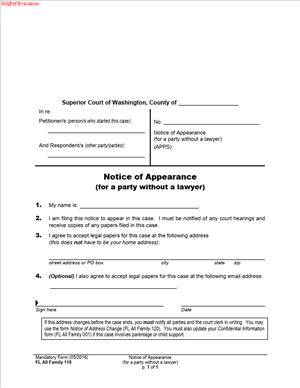
FL All Family 118 – Notice of Appearance (for a party without a lawyer)
Fill out nowJurisdiction: Country: United States | Province or State: Washington
The FL All Family 118 – Notice of Appearance (for a party without a lawyer) is a court form used in Washington family law cases. It tells the court and the other side that you are taking part in the case without an attorney. It also provides your contact information for future court papers.
If you are representing yourself, this form helps make your role clear. It ensures that you receive copies of filings, motions, and other documents. Without it, you may miss important updates.
This document does not start a case. It does not respond to claims in detail. Instead, it formally notifies everyone involved that you are appearing in the case on your own behalf.
You usually file this form after a family law case has already been opened. It becomes part of the court record and affects how future papers are delivered to you.
Understanding how and when to use this form can prevent confusion. It can also help you stay informed throughout your case.
What is FL All Family 118 – Notice of Appearance (for a party without a lawyer)?
Clear definition
FL All Family 118 – Notice of Appearance (for a party without a lawyer) is a written notice filed in a Washington Superior Court family law case. It states that you are appearing in the case and that you do not have a lawyer representing you.
When you file this document, you are telling the court and the other party that you want to receive copies of all future filings. You provide your mailing address and sometimes other contact details. This becomes the official address for service of documents in the case.
The form is procedural. It does not argue your position. It does not admit or deny allegations. It simply establishes your participation and contact information in the case record.
Who typically uses this form?
This form is commonly used by respondents in family law cases. For example, if someone files for divorce, parentage, or a parenting plan against you, you may file this form to appear in the case.
Petitioners may also use it in certain situations. If a case has already been opened and the court needs clear notice that a party is self-represented, this form can clarify that status.
People who previously had a lawyer but are now representing themselves may also use this document. It signals that future court papers should be sent directly to them, not to a former attorney.
In general, anyone in a Washington family law case who does not have legal representation and wants to formally appear may use this form.
Why might you need this form?
You may need this form to make sure you receive all future documents in the case. Courts typically send notices and orders based on the information provided in the case file. If your address is not clearly listed as the address for service, you might miss important filings.
This form can also prevent misunderstandings about whether you are participating in the case. Filing it shows that you are aware of the case and are choosing to take part.
In some situations, filing a Notice of Appearance can affect default procedures. When a party does not appear, the other side may request a default order. By appearing, you signal that you intend to be involved in the process.
It can also help keep communication organized. Once filed, the other party knows where and how to send documents related to the case.
Typical real-life scenarios
- You are served with divorce papers and want to take part in the case, but you do not plan to hire a lawyer. Filing this form lets the court know you are appearing on your own behalf.
- You were served with a petition to modify a parenting plan. You need time to prepare your response. Filing this form informs the court that you are participating and want to receive all updates.
- You had an attorney at the start of the case, but that attorney has withdrawn. You now represent yourself. This form updates the court so that future documents are sent directly to you.
- You learn about a family law case involving you through court papers delivered to your home. Before filing other documents, you submit this notice to clearly establish your role and contact details.
- You are involved in a child support case and want to make sure you receive notice of hearings and motions. Filing this form places your address on record for service.
When would you use FL All Family 118 – Notice of Appearance (for a party without a lawyer)?
You typically use this form after a family law case has already been filed in Washington Superior Court. The case might involve divorce, legal separation, parentage, child custody, child support, or modification of existing orders.
A common situation is when you are the respondent. After being served with a summons and petition, you may file a Notice of Appearance to confirm that you are part of the case. This is often done before or at the same time as filing a formal response.
You might also use this form if you become involved later in the case. For example, if someone files a motion that affects you and you have not yet formally appeared, filing this notice can clarify your involvement.
If you are replacing a lawyer with self-representation, this form helps transition the case. Once your attorney withdraws, the court needs clear direction on where to send documents. Filing the notice updates your contact information.
In cases with multiple parties, such as parentage actions, each party who is self-represented may file their own Notice of Appearance. This helps ensure proper service and communication among all participants.
This form is generally used early in your participation. It sets the foundation for how you will receive documents going forward.
Legal characteristics of FL All Family 118 – Notice of Appearance (for a party without a lawyer)
This document is procedural in nature. Its primary function is to establish your appearance and contact information in a family law case. Once filed, it becomes part of the official court record.
For the form to be effective, it must be properly completed and filed with the correct Superior Court. It must include accurate case information, including the case number and the names of the parties. Incomplete or incorrect information can cause confusion or delays.
The form must also be served on the other party or parties. Filing with the court alone may not be enough. Service ensures that everyone knows you have appeared and where to send future documents.
Common problems include listing the wrong case number, failing to sign the form, or providing outdated contact information. Errors in these areas can lead to missed notices or disputes about service.
Family law procedures can vary slightly by county, especially regarding filing methods and local rules. While the form itself is standardized for Washington family law cases, the method of submission or service may differ in practice.
It is important to understand what this form does not do. It does not replace a response to a petition. It does not present evidence. It does not request specific orders from the court. It simply places your appearance and contact details on record.
Is it legally binding?
FL All Family 118 – Notice of Appearance (for a party without a lawyer) is legally effective once properly filed and served. It formally establishes that you are appearing in the case without an attorney.
By signing and filing the form, you confirm that the contact information listed is accurate. The court and the other party may rely on that information for service of documents. If the information is incorrect, you may still be responsible for documents sent to the listed address.
The form does not bind you to a settlement or agreement. It does not admit any claims made by the other party. Its legal effect is limited to notice and participation.
In many situations, filing a Notice of Appearance affects how the case proceeds. For example, if you have appeared, the other party may be required to give you notice before requesting certain orders. This reflects the principle that parties who appear in a case are entitled to notice of future actions.
How to fill out FL All Family 118 – Notice of Appearance (for a party without a lawyer)
Step 1 – Fill in the court caption
At the top of the form, enter the name of the Superior Court handling your case. Include the county. Then fill in the names of the petitioner and respondent exactly as they appear on earlier court documents. Add the case number in the space provided. Accuracy here is essential because it links your notice to the correct case file.
Step 2 – Identify yourself as the appearing party
In the body of the form, indicate which party you are. You may be the petitioner, respondent, or another party in the case. Clearly mark your role so the court and the other side understand who is filing the notice.
Step 3 – State that you are appearing without a lawyer
The form includes language confirming that you are appearing in the case without an attorney. Review this section carefully. By completing it, you are stating that you are representing yourself and that future documents should be sent directly to you.
Step 4 – Provide your contact information
Enter your mailing address clearly. This is the address where you will receive legal documents related to the case. Some versions of the form may also include spaces for a phone number or email address. Provide information you check regularly, since court notices and filings may be sent there.
Step 5 – Review the service section
The form typically includes a section indicating that copies will be provided to the other party or their lawyer. Confirm that the names and addresses listed for service are correct. This ensures that everyone involved receives notice of your appearance.
Step 6 – Sign and date the form
Sign your name where indicated and enter the date. Your signature confirms that the information provided is true and accurate to the best of your knowledge. Unsigned forms may be rejected or considered incomplete.
Step 7 – Make copies
Before filing, make copies of the completed document. You will generally need one for yourself and one for each other party in the case. Keeping a copy for your records helps you track what was filed and when.
Step 8 – File the form with the court
Submit the completed form to the clerk of the Superior Court where your case is pending. Filing methods may include in-person submission or other accepted procedures in that court. Once filed, the document becomes part of the official case record.
Step 9 – Serve the other party
After filing, ensure that a copy is delivered to the other party or their attorney. Service may be done in a manner generally allowed for family law documents. Proper service confirms that the other side has notice of your appearance and your contact information.
Step 10 – Keep proof of filing and service
Retain any confirmation provided by the court showing that the document was filed. Also, keep records showing that you delivered a copy to the other party. These records can be important if questions arise about whether proper notice was given.
Legal terms you might encounter in FL All Family 118 – Notice of Appearance (for a party without a lawyer)
- Caption: The caption is the heading at the top of the first page. It lists the court name, the parties’ names, and the case number. On this form, the caption must match exactly what appears on other court documents in your case so the clerk can place your filing in the correct file.
- Case Number: This is the unique number assigned to your family law case. You copy it from the Petition or other court papers you received. If the number is wrong or missing, your document may not be filed correctly.
- Party: A party is a person involved in the lawsuit. On this form, you identify whether you are the Petitioner or the Respondent. You must select the correct role because it determines how the court and the other side refer to you.
- Self-Represented (Pro Se): This means you are acting as your own lawyer. By filing this form, you are telling the court you do not currently have an attorney and that you will receive documents directly. The court will send notices to the contact information you provide.
- Service: Service is the formal delivery of court papers to the other party. When you file a notice of appearance, it tells the other side to serve you with all future documents in the case. Proper service ensures you receive updates and hearing notices.
- Contact Information: This includes your mailing address, phone number, and sometimes email. The court uses this information to send official notices. You must keep it current throughout your case.
- Signature: Your signature confirms that the information you entered is true and that you are officially appearing in the case. Unsigned forms are typically rejected by the clerk.
- Filing: Filing means submitting your completed form to the court clerk so it becomes part of the official court record. The date the clerk accepts your filing can affect deadlines and notice requirements.
- Certificate of Service: Some documents include a section where you confirm you delivered a copy to the other party. If included or required, you must complete it accurately to show you provided notice.
- Court Record: This is the official file maintained by the court. Once your notice of appearance is filed, your name and contact details become part of that record. This allows the court and the other party to rely on it for communication.
FAQs
Does filing FL All Family 118 – Notice of Appearance (for a party without a lawyer) mean I agree with the other party’s claims?
No. This document only tells the court that you are participating in the case and where to send future papers. It does not admit fault, agree to requests, or respond to the allegations in the Petition. If you need to respond to the claims, you must file a separate response document within the required deadline.
What information must match exactly with other court papers?
The caption details must be identical to prior filings. Check the spelling of each party’s name and the full case number. Even small differences can cause confusion or delay. Make sure you list yourself as Petitioner or Respondent exactly as shown in the case.
When does my appearance become effective?
Your appearance is generally effective when the clerk accepts and files the document. The filing date stamped by the clerk is what matters. From that point forward, other parties should send you copies of all new filings and notices.
Do I need to attach anything to this form?
In most situations, you do not attach evidence or additional documents. This form stands alone as a notice. However, review the instructions on the page to see if a certificate of service or additional page is required for your contact information.
What happens if my contact information changes after I file?
You must update the court and the other party promptly. The court will continue using the last address on file until you provide a written update. If you move and do not update your information, you may miss important deadlines or hearings.
Will the court send me confirmation that my filing was accepted?
After you submit this document, the clerk usually stamps it with the filing date. If you file in person, you can ask for a stamped copy immediately. If you file by mail or electronically, look for confirmation through the method you used. Keep proof showing the filing date for your records.
Do I still have to file a response after submitting this form?
Yes, if a response is required in your case. This form does not replace your formal answer to the Petition. It simply ensures you receive copies of everything filed. Check your summons to confirm the deadline for your response.
Can I file this document if I plan to hire a lawyer later?
Yes. You may appear on your own now and later substitute an attorney. If a lawyer begins representing you, a separate notice is typically filed to inform the court of the change. Until that happens, you remain responsible for monitoring the case and complying with all deadlines.
Checklist: Before, During, and After FL All Family 118 – Notice of Appearance (for a party without a lawyer)
Before
- Review the Petition or most recent court document to copy the exact case caption.
- Confirm your correct role in the case (Petitioner or Respondent).
- Gather your current mailing address, phone number, and email.
- Check whether any response deadline is approaching.
- Read the entire form once before writing anything.
- Make sure you have the correct county and court name.
- Prepare a method to make copies after completion.
During
- Print clearly or type your information.
- Enter the case number exactly as it appears on prior filings.
- Mark your party status correctly.
- Provide complete and accurate contact details.
- Review each section before signing.
- Sign and date the form in the designated space.
- Double-check that no required fields are left blank.
After
- Make at least two copies of the signed form.
- File the original with the court clerk.
- Obtain a stamped copy showing the filing date.
- Deliver a copy to the other party as required.
- Keep one copy in a safe, organized file.
- Calendar any upcoming deadlines mentioned in your case paperwork.
- Monitor your mail and email for court notices.
Common mistakes to avoid with FL All Family 118 – Notice of Appearance (for a party without a lawyer)
- Mistake: Using the wrong case number because you rely on memory instead of copying it directly, which can cause the clerk to misfile your document; do not forget to verify the number against the latest court papers.
- Mistake: Selecting the wrong party status due to confusion about who filed first, which may create record inconsistencies; do not forget to confirm whether you are listed as Petitioner or Respondent in the caption.
- Mistake: Leaving contact information incomplete because you assume the court already has it, which can result in missed notices; do not forget to provide your full current mailing address and other required details.
- Mistake: Forgetting to sign and date the form because you focus only on the top portion, which may lead to rejection by the clerk; do not forget that your signature makes the filing valid.
- Mistake: Failing to serve the other party because you think filing with the court is enough, which can delay the case; do not forget to provide a copy as required.
- Mistake: Assuming this form replaces your formal response, which can cause you to miss your response deadline; do not forget to review your summons and file any required answer separately.
- Mistake: Not keeping a stamped copy for your records because you are in a hurry at the clerk’s office, which leaves you without proof of filing; do not forget to obtain and store a dated copy.
- Mistake: Ignoring future mail after filing because you believe nothing will happen soon, which can result in default or missed hearings; do not forget to check your mail consistently.
What to do after filling out FL All Family 118 – Notice of Appearance (for a party without a lawyer)
Once you complete the form, your next steps focus on proper filing and staying organized. This document works only if it is officially filed and shared as required.
- Step 1: Make at least two copies of the signed form. One copy is for you. One copy is for the other party. If your case is complex, keep an extra copy for a working file.
- Step 2: File the original with the Superior Court clerk in the county where your case is pending. You may file in person, by mail, or electronically if the court allows it. Confirm the accepted filing methods before you go.
- Step 3: Obtain confirmation that the document was filed. If filing in person, ask the clerk to stamp your copies. If filing electronically, save the confirmation notice. If filing by mail, include a self-addressed stamped envelope so you can receive a stamped copy back.
- Step 4: Deliver a copy to the other party. Follow the required service method stated in your case documents. Keep proof that you delivered it.
- Step 5: Create a simple case file at home. Use a folder or binder. Place your stamped notice of appearance at the front so you can easily confirm your filing date.
- Step 6: Review your summons and calendar any response deadline. Filing this notice does not extend your time to answer the Petition.
- Step 7: Monitor all communication from the court. Check your mail regularly. Open every envelope from the court immediately. Note hearing dates and deadlines on a calendar.
- Step 8: Update your contact information promptly if anything changes. File a written notice with the court and send a copy to the other party so the court record stays accurate.
- Step 9: Track every document you send or receive. Write down the date you filed or received each paper. This helps you stay organized and prepared for hearings.
- Step 10: Prepare for the next stage of your case. Review what issues are being disputed. Gather relevant documents and information early so you are not rushed later.
Staying organized after filing this form helps you avoid missed deadlines and confusion. Treat every court notice as important. Keep copies, track dates, and respond promptly to protect your position in the case.
Disclaimer: This guide is provided for informational purposes only and is not intended as legal advice. You should consult a legal professional.