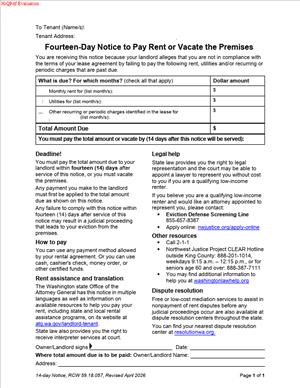
Fourteen-Day Notice to Pay Rent or Vacate the Premises
Fill out nowJurisdiction: Country: United States | Province or State: Washington
A Fourteen-Day Notice to Pay Rent or Vacate the Premises is a written notice a landlord gives to a tenant when rent has not been paid. It tells the tenant the exact amount owed and gives them a specific time to either pay the rent or move out.
This document is part of the Washington landlord and tenant process. It is often the first formal step in addressing unpaid rent. If you are filling it out, you are likely dealing with missed or late rent payments.
The form is direct and time-sensitive. Once delivered, it starts a countdown. During that period, the tenant has an opportunity to resolve the unpaid balance.
Understanding how this notice works helps you complete it accurately. Small errors can create delays or complications. Knowing what each section means allows you to prepare a clear and effective document.
What is a Fourteen-Day Notice to Pay Rent or Vacate the Premises?
Clear definition
A Fourteen-Day Notice to Pay Rent or Vacate the Premises is a written demand for unpaid rent. It informs the tenant that they have fourteen days to either pay the amount listed or leave the rental property.
It is not a court order. It is a notice that may come before a court filing if the issue is not resolved. The document typically states the rental address, the amount of rent owed, and the deadline to act.
In Washington, this notice relates specifically to unpaid rent. It does not generally cover other lease violations, such as property damage or unauthorized occupants.
Who typically uses this form?
Landlords most often use this form. This includes property owners, property managers, and authorized agents who collect rent on behalf of an owner.
The person completing the form is usually the party listed as the landlord in the rental agreement. If a management company handles the property, an authorized representative may sign and serve the notice.
Tenants receive the form. They do not complete it, but they need to read it carefully to understand the amount claimed and the timeline provided.
Why might you need this form?
You may need this form if rent is overdue. In many rental agreements, rent is due on a specific date each month. If that date passes and payment is not made, the landlord may begin the notice process.
The notice creates a formal record. It shows that the tenant was informed of the unpaid rent and given a defined period to respond.
This form may also be required before filing an eviction case for nonpayment of rent. In many situations, courts expect that proper notice was given before a landlord seeks further action.
Typical real-life scenarios
- A tenant misses a monthly rent payment due to temporary financial hardship. After the due date passes and no payment is received, the landlord prepares this notice to formally request payment.
- A tenant makes a partial payment but still owes a remaining balance. The landlord uses the form to demand the specific unpaid portion and provides a fourteen-day period to resolve it.
- A tenant repeatedly pays late. After another missed deadline, the landlord decides to issue a formal notice rather than relying on informal reminders.
- A property manager reviews accounts at the end of the month and identifies several unpaid units. For each affected tenant, the manager prepares a separate notice listing the correct amount owed and the property address.
When would you use a Fourteen-Day Notice to Pay Rent or Vacate the Premises?
You would use this notice when rent is unpaid after the agreed-upon due date. The timing depends on the rental agreement and when payment is considered late.
Landlords often issue the notice shortly after confirming that rent has not been received. Some rental agreements include a grace period. Others state that rent is late immediately after the due date. The notice is typically prepared once the rent is officially overdue under the agreement.
This form is used specifically for nonpayment of rent. If the issue involves something else, such as lease violations or end of tenancy without cause, a different notice may apply.
Property owners, landlords, and authorized agents commonly use this document as part of their standard rent collection process. It can be used for month-to-month tenancies and for longer-term leases when rent remains unpaid.
The notice may also be used when there is a written lease agreement or when the tenancy is based on an oral agreement. What matters is that there is a rental relationship and unpaid rent.
Legal Characteristics of Fourteen-Day Notice to Pay Rent or Vacate the Premises
This notice has specific legal features. It must clearly state the total amount of rent owed. The amount listed generally reflects only rent, not other charges, unless the form allows them to be included.
The notice must identify the rental property. This usually includes the full address and, if applicable, a unit number. Clear identification avoids confusion and supports accurate recordkeeping.
The deadline must be clear. The fourteen-day period is central to the document. The language typically explains that the tenant has fourteen days from service of the notice to pay the full amount or vacate.
Proper delivery is important. Many jurisdictions outline acceptable methods of serving the notice, such as personal delivery, posting, and mailing. If the service is not handled correctly, the notice may be challenged.
Common problems include incorrect amounts, missing information, or unclear dates. Listing fees or charges that are not considered rent can create disputes. Inaccurate property details or failure to sign the document can also cause issues.
This notice does not immediately remove a tenant. It does not transfer possession of the property. It is a preliminary step that may allow further action if the tenant does not comply.
In different states, the required notice period for unpaid rent can vary. Some require shorter or longer periods. Washington uses a fourteen-day period for this specific type of notice.
Is it legally binding?
A Fourteen-Day Notice to Pay Rent or Vacate the Premises carries legal weight when it meets the required elements and is properly delivered. It creates a formal demand for payment and establishes a timeline.
It is not a contract between landlord and tenant. Instead, it enforces rights that already exist under the rental agreement. The tenant’s obligation to pay rent comes from the lease or rental agreement, not from the notice itself.
If the tenant pays the full amount within the stated time, the matter may end without further action. If the tenant does not pay or vacate, the notice may be used as part of a court filing process. In that context, the document can become an important piece of evidence.
Its effectiveness depends on accuracy and compliance with procedural rules. An incomplete or improperly served notice may limit its practical effect.
How to fill out Fourteen-Day Notice to Pay Rent or Vacate the Premises
Step 1 – Identify the parties
Enter the full legal name of each tenant listed on the rental agreement. Include all adult occupants who signed the lease. Use complete names rather than nicknames to match the agreement.
Also include the name of the landlord or the authorized agent issuing the notice. The name should match the name used in the lease or management records.
Step 2 – Provide the rental property address
Write the full address of the rental property. Include the street number, street name, city, state, and ZIP code. If the property is part of a multi-unit building, include the unit or apartment number.
Accuracy here is essential. The address should match the lease and any prior communications about the tenancy.
Step 3 – State the amount of rent owed
List the total amount of unpaid rent. Break down the amount by rental period if the form provides space. For example, identify which months are unpaid and the amount due for each.
Ensure the total reflects rent only, unless the form clearly allows additional charges. Double-check your math before finalizing the document.
Step 4 – Specify the deadline period
The form will reference the fourteen-day period. Confirm that the language states the tenant has fourteen days from the date of service to pay the full amount or vacate the premises.
Do not alter the standard deadline language unless the form specifically allows it. The timing is a core part of the notice.
Step 5 – Include payment instructions
Provide clear information about how and where the tenant can pay. This may include a mailing address, office location, or other accepted payment method.
Be consistent with the payment terms in the rental agreement. The goal is to make it clear how the tenant can satisfy the amount due within the stated period.
Step 6 – Add the date of the notice
Write the date the notice is prepared. This helps establish the timeline and supports recordkeeping. The service date may be documented separately depending on how the notice is delivered.
Make sure the date is accurate and legible.
Step 7 – Sign the document
The landlord or authorized agent signs the notice. Print the name clearly beneath the signature if the form includes a signature line.
By signing, you confirm that the information in the notice is accurate to the best of your knowledge and reflects the rent owed under the rental agreement.
Step 8 – Prepare for service
After completing the form, make copies for your records. Keep one copy for yourself and prepare the required number of copies for delivery to the tenant.
Organize any supporting documents, such as a rent ledger, so you have a clear record of how the amount was calculated. Once everything is ready, the notice can be served in accordance with the applicable service method.
Legal terms you might encounter in Fourteen-Day Notice to Pay Rent or Vacate the Premises
- Unlawful Detainer: This is the court process a landlord may use to remove a tenant who stays without paying rent or without legal right. Your notice is often the first required step before filing an unlawful detainer case. If the tenant does not pay or move out within the stated time, this term becomes relevant in the next phase.
- Service of Notice: This refers to how the notice is delivered to the tenant. The method of service matters because it affects whether the deadline is valid. The form may require you to state how and when the service occurred.
- Past-Due Rent: This is the total amount of unpaid rent owed as of the date of the notice. It does not usually include future rent. You must calculate this carefully and list the exact dollar amount.
- Cure: To cure means to fix the problem. In this context, the tenant can cure the default by paying the full amount of rent owed within the fourteen-day period. If they cure on time, the tenancy continues.
- Forfeiture: This term refers to losing the right to continue the tenancy. If the tenant does not pay or vacate within the notice period, they risk forfeiting their right to remain in the rental unit.
- Premises: The premises mean the rental property itself. The form requires a clear address, including the unit number if applicable, so there is no confusion about which property is involved.
- Default: A default occurs when a tenant fails to meet a lease obligation, such as paying rent. The notice identifies nonpayment as the specific default that must be corrected.
- Declaration of Service: This is a written statement confirming how, when, and to whom the notice was delivered. It may be attached to the notice or completed as a separate document and can become important evidence later.
- Rental Agreement: This is the lease or month-to-month agreement between you and the tenant. The notice is based on the tenant’s obligations under this agreement, especially the duty to pay rent on time.
FAQs
When does the fourteen-day period start?
The fourteen-day period starts the day after the notice is properly served. It does not usually start on the date written at the top unless that is also the date of service. You should record the exact date and method of delivery because that date controls the deadline.
Do I have to list every month of unpaid rent separately?
You should clearly state the total amount owed and, if possible, break it down by month in an attachment or in the body of this document. This helps avoid confusion about how you calculated the balance. Make sure the numbers match your rent ledger and the rental agreement.
Can I include late fees or other charges in the amount due?
This form is generally focused on unpaid rent. Before adding late fees, utilities, or other charges, confirm that they are authorized in the rental agreement and properly documented. If you include extra amounts, clearly label them and avoid inflating the total, since overstating the balance can cause problems later.
What happens if the tenant pays part of the amount within the deadline?
If the tenant makes a partial payment, you must decide whether to accept it. Accepting partial payment without a written agreement could affect your next steps. If you accept it, give a written receipt and clearly state the remaining balance so your records stay accurate.
Who should sign this document?
The person with legal authority over the property should sign. That may be the landlord, property owner, or an authorized agent. The name on the signature line should match the name listed as the landlord in the rental agreement or clearly show that the signer is acting on the landlord’s behalf.
Do I need to file the Fourteen-Day Notice to Pay Rent or Vacate the Premises with the court right away?
No, this document is typically served on the tenant first and kept in your records. It becomes relevant in court only if you later file an eviction case. At that point, you may need to show a copy along with proof of service.
What if the tenant says they never received the notice?
That is why documenting service is critical. Complete a declaration of service immediately after delivery and keep a copy. If there is a dispute, the court will look at whether this form was served according to the required method and timeline.
Does the Fourteen-Day Notice to Pay Rent or Vacate the Premises change the public record?
Serving this form does not usually create a public record by itself. It becomes part of the public record only if you later file a court case and submit it as part of your filings. Keep your copy organized in case you need to attach it to a complaint.
Checklist: Before, During, and After Fourteen-Day Notice to Pay Rent or Vacate the Premises
Before
- Review the rental agreement to confirm the monthly rent amount and due date.
- Update your rent ledger to calculate the exact unpaid balance.
- Confirm the tenant’s full legal name as written in the lease.
- Verify the complete rental property address, including unit number.
- Check that the rent is actually past due and not within any grace period.
- Decide who will sign the notice and confirm their authority.
- Prepare a declaration of service form if required.
- Make at least two copies of the completed notice for your records.
During
- Fill in the tenant’s name exactly as it appears on the lease.
- Enter the full property address without abbreviations that could cause confusion.
- State the total amount of unpaid rent clearly and accurately.
- Double-check all math before finalizing the amount due.
- Date the notice correctly on the day you intend to serve it.
- Sign the notice in ink if using a paper copy.
- Serve the notice using an accepted delivery method.
- Complete the declaration of service immediately after delivery.
After
- Store a signed copy of the notice in the tenant’s file.
- Record the date and method of service in your internal records.
- Mark the deadline date on your calendar.
- Monitor whether payment is received within the fourteen-day period.
- Provide a written receipt for any payment received.
- Update your rent ledger to reflect payments or balances.
- Avoid taking further action until the deadline has passed.
- Prepare documentation in case you need to file a court case.
Common mistakes to avoid with Fourteen-Day Notice to Pay Rent or Vacate the Premises
- Mistake: Listing the wrong amount of rent owed because you relied on memory instead of your rent ledger, which can lead to disputes or dismissal later, and forgetting to double-check your math before serving the notice.
- Mistake: Including charges not clearly defined as rent in the lease, often because you want to recover all money owed at once, which can complicate enforcement, and forgetting to separate rent from other fees.
- Mistake: Serving the notice improperly due to rushing the process, which may invalidate the timeline, and forgetting to complete and keep a declaration of service.
- Mistake: Using a nickname or misspelling the tenant’s legal name, which happens when copying from informal records, and forgetting to match the name exactly to the rental agreement.
- Mistake: Dating the notice on a different day than it was served, which creates confusion about the deadline, and forgetting to calculate the fourteen-day period from the correct start date.
- Mistake: Accepting partial payment without documenting the remaining balance, which can blur your position later, and forgetting to issue a written receipt that states the unpaid amount still due.
- Mistake: Failing to keep copies of the signed notice and proof of service, often because you assume payment will be made, and forgetting that you may need those documents in court.
- Mistake: Threatening lockout or utility shutoff in the notice out of frustration, which can violate tenant rights, and forgetting that only lawful court procedures can remove a tenant.
What to do after filling out the Fourteen-Day Notice to Pay Rent or Vacate the Premises
Once you complete the form, your next focus is proper delivery and documentation. The notice only works if it is served correctly and you can prove it. Slow down and handle this step carefully.
- Step 1: Make at least two copies of the signed notice, one for the tenant and one for your records.
- Step 2: Serve the notice using an accepted method, such as personal delivery or another permitted form of service.
- Step 3: Immediately complete a declaration of service stating the date, time, method, and name of the person served.
- Step 4: Calculate the exact deadline by counting fourteen days from the day after service.
- Step 5: Mark the deadline on your calendar and set reminders a few days before it expires.
- Step 6: Keep communication with the tenant professional and in writing whenever possible.
- Step 7: If full payment is received within the deadline, provide a written receipt and confirm that the tenancy continues.
- Step 8: Update your accounting records to reflect any payments received or balances remaining.
- Step 9: If no payment or move-out occurs by the deadline, gather your documents, including the lease, rent ledger, copy of the notice, and proof of service.
- Step 10: Review your records for accuracy and consistency before taking any further formal action.
Keep everything organized in one file. If you later need to start a court case, you will rely heavily on these documents. Clear records, accurate dates, and consistent amounts will make the next steps smoother and reduce the chance of delay.
Disclaimer: This guide is provided for informational purposes only and is not intended as legal advice. You should consult a legal professional.