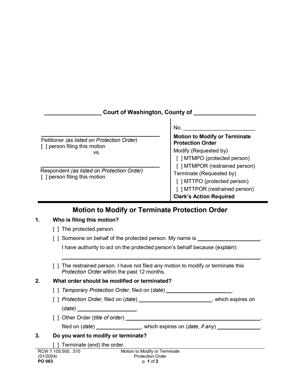
PO 063 – Motion to Modify or Terminate Protection Order
Fill out nowJurisdiction: Country: United States | Province or State: Washington
The PO 063 – Motion to Modify or Terminate Protection Order is a court form used in Washington when someone wants to change or end an existing protection order. You use it to formally ask the court to review the current order and make updates based on new circumstances.
Protection orders can affect where you live, who you can contact, and even your ability to possess firearms. If your situation has changed since the order was issued, this form is the starting point for asking the court to reconsider the terms.
This document is not a new protection order. It is a request to adjust or cancel an order that already exists. The court will review the request and decide whether to grant or deny it.
If you are filling out this form, you are likely preparing to file it with the same court that issued the original protection order. Understanding what the form asks for and why it matters can help you complete it clearly and accurately.
What is PO 063 – Motion to Modify or Terminate Protection Order?
Clear definition
PO 063 – Motion to Modify or Terminate Protection Order is a written request filed with a Washington court asking a judge to change specific terms of a protection order or to end the order entirely. It is part of the protection order case and uses the same case number as the original order.
A motion is a formal request for a court decision. In this context, the motion explains what changes you are asking for and why. The court then schedules a hearing or reviews the request according to its procedures.
This form does not automatically change the order. It simply begins the legal process for review.
Who typically uses this form?
This form is often used by the person who is restrained by the protection order and wants fewer restrictions or an early termination. For example, that person may want contact with a child restored or certain location restrictions lifted.
It may also be used by the protected person who wants to change the order’s terms. In some situations, the protected person may feel the order is no longer necessary or may want to adjust conditions such as communication limits.
Both parties in a protection order case have defined roles. The person protected by the order is often called the petitioner. The person the order restricts is often called the respondent. Either role may be relevant when completing this form, depending on who is requesting the change.
Why might you need this form?
You might need this form if your life circumstances have changed in a meaningful way since the court issued the order. Courts generally expect a clear reason for any requested modification or termination.
Common reasons include changes in housing, employment, or family arrangements. For example, if you share children, you may need to address parenting time or communication related to school or medical decisions.
You may also need this form if the protection order is interfering with other court orders, such as a parenting plan, and the situation requires clarification or adjustment.
In some cases, time has passed, and the conditions that led to the original order no longer exist. The form allows you to present that information to the court for consideration.
Typical real-life scenarios
- A respondent may complete this form after finishing a treatment program that the court considered important when issuing the original order. They may ask the court to reconsider certain restrictions based on documented progress.
- A petitioner may decide that limited communication is now appropriate for co-parenting purposes. They may request a modification that allows specific, structured contact related to the children while keeping other protections in place.
- A protection order may prevent someone from entering a shared workplace or residential building. If one party moves or changes jobs, the restriction might no longer be necessary. A motion can ask the court to update the order to reflect the new situation.
- Sometimes, the order includes provisions that are no longer practical. For example, an address listed in the order may be outdated. The form provides a way to formally request corrections or adjustments so the written order matches current reality.
- In other cases, a respondent may seek early termination of a long-term order. They may explain why they believe the order is no longer needed and ask the court to end it before its scheduled expiration date.
When would you use PO 063 – Motion to Modify or Terminate Protection Order?
You would use PO 063 – Motion to Modify or Terminate Protection Order after a protection order has already been issued, and you want the court to change it. It is not used to respond to a newly filed petition or to appeal the original decision.
This form is commonly used when the original order is still active. If the order has already expired, termination may not be necessary because it is no longer in effect. However, modification requests generally apply only while the order is active.
A respondent may use this form when seeking to reduce restrictions, such as distance requirements or communication limits. A petitioner may use it when seeking to strengthen certain terms or clarify conditions that are unclear.
You may also use this form if there are related cases in family court, such as divorce or custody matters, and you need the protection order to align with those proceedings. The motion gives the judge an opportunity to consider how different court orders interact.
Timing matters. Some protection orders have specific rules about when a motion to modify or terminate can be filed. The form itself does not guarantee a hearing date or outcome. It simply initiates the process within the existing case.
Legal characteristics of PO 063 – Motion to Modify or Terminate Protection Order
This form is part of an existing court case. It must include the same case caption and case number as the original protection order. Accuracy in these details is essential because the court uses them to locate your file.
For the motion to be effective, it generally must be properly completed, filed with the court clerk, and served on the other party according to court rules. If required information is missing, the court may delay the hearing or reject the filing for correction.
Clarity is important. The court expects you to state exactly what parts of the protection order you want changed or terminated. Vague requests can create confusion and may make it harder for the judge to understand what you are asking.
Common problems include failing to sign the form, not providing a current address where required, or not explaining the reasons for the requested change. Incomplete sections can result in processing delays.
Courts in Washington follow statewide rules for protection orders, but local courts may have additional procedural requirements, such as scheduling practices or supplemental forms. The motion itself does not replace those procedures.
It is also important to understand what this form does not do. Filing the motion does not pause or cancel the existing order. The current protection order remains fully in effect until a judge signs a new order modifying or terminating it.
Is it legally binding?
The PO 063 – Motion to Modify or Terminate Protection Order itself is not legally binding in the way a protection order is. It is a request for a court decision. It does not change anyone’s rights or obligations on its own.
The existing protection order remains legally binding until the court issues a new order. If the judge grants your request, the signed modification or termination order becomes the controlling document.
Once the court signs an order modifying or terminating the protection order, that new order is legally binding. All parties must follow its terms. Violating an active protection order, even after a motion has been filed, can lead to serious legal consequences.
How to fill out PO 063 – Motion to Modify or Terminate Protection Order
Step 1 – Complete the case caption
At the top of the form, fill in the county and court where the original protection order was issued. Enter the full names of the petitioner and respondent exactly as they appear on the existing order. Include the correct case number. This information links your motion to the correct file.
Step 2 – Identify your role in the case
Indicate whether you are the petitioner or the respondent. This clarifies your position in the case and helps the court understand who is requesting the change. Make sure the designation matches the original order.
Step 3 – State what you are asking the court to do
Clearly indicate whether you are asking to modify the protection order, terminate it, or both in the alternative. If you are requesting a modification, describe the specific terms you want changed. Refer to sections of the current order when possible to avoid confusion.
Step 4 – Explain the reasons for your request
Provide a clear and factual explanation of why you are seeking the change or termination. Focus on events or circumstances that have occurred since the original order was issued. Include relevant dates and describe how the situation has changed.
Step 5 – Address safety and compliance issues
If the form includes questions about compliance with the current order, answer them carefully. Be truthful about whether the order has been followed. The court may consider compliance history when deciding whether to grant your request.
Step 6 – Review related cases or orders
If there are other court cases involving the same parties, such as family law or criminal matters, list them if the form asks for that information. This helps the court understand the broader legal context of your request.
Step 7 – Provide contact information as required
Fill in your mailing address and other contact details where requested. Some forms allow you to keep your address confidential under certain circumstances. Use the space provided on the form for this information.
Step 8 – Sign and date the form
Read the completed document carefully before signing. When you sign, you confirm that the information is true to the best of your knowledge. Add the date of signing in the space provided.
Step 9 – Prepare the form for filing and service
After completing the form, make the necessary copies for filing and for service on the other party, if required. Keep a copy for your records. Ensure the form is ready to submit to the court according to its filing procedures.
Legal terms you might encounter in PO 063 – Motion to Modify or Terminate Protection Order
- Petitioner: The person who originally asked the court for the protection order. On this form, the petitioner is listed in the case caption at the top. You must use the exact same name as it appears in the existing order.
- Respondent: The person the protection order applies to. This is the individual who must follow the restrictions in order. If you are the respondent, you must clearly indicate that role when completing this document.
- Protected Person: The individual protected by the order. Sometimes this is the same as the petitioner. In some cases, it may include children or other household members, which you must identify correctly.
- Motion: A written request asking the court to take a specific action. In this document, the motion asks the court to change or end an existing protection order. The court will not act unless a motion is properly filed.
- Modification: A change to specific terms of the existing protection order. This might include adjusting contact provisions, visitation rules, or distance restrictions. You must clearly state what you want changed and what should stay the same.
- Termination: The complete ending of the protection order before its expiration date. If granted, the order is no longer in effect. You must clearly request termination if that is your goal.
- Hearing: A scheduled court proceeding where a judge reviews your request. The court may require both parties to attend. The date, time, and location are critical details you must track.
- Service: The formal delivery of court documents to the other party. You usually cannot serve the papers yourself. Proper service ensures the other party knows about the hearing and has a chance to respond.
- Declaration: A written statement of facts signed under penalty of perjury. You may attach a declaration to explain why you want the order modified or terminated. Be factual and specific.
- Relief Requested: The exact action you want the court to take. This section must be precise. The judge relies on this wording to understand your request.
FAQs
Do I need to use the exact case number from my original protection order?
Yes. You must copy the case number exactly as it appears on your existing order. Even a small typo can cause filing delays or misfiled documents. Check the top of your current order and match it character for character, including letters and hyphens.
Can I ask to change only part of the order instead of ending it completely?
Yes. This document allows you to request a modification instead of termination. You must clearly describe which specific sections you want changed, such as contact terms or distance restrictions, and leave the rest unchanged. If you do not clearly identify the sections, the court may not understand what you are asking to modify.
What reasons should I include when completing PO 063 – Motion to Modify or Terminate Protection Order?
Focus on facts that explain why the current order should change or end. Describe changes in circumstances, compliance with the order, or other relevant developments. Keep your explanation organized and tied to specific terms of the existing order so the judge can compare your request to the current restrictions.
Do both parties have to agree before the court will approve this form?
No. You can file this document even if the other party disagrees. However, the court may schedule a hearing to allow both sides to speak. If the other party supports the request, you should still complete all required sections and ensure proper service unless the court instructs otherwise.
When does the change become effective if the judge approves it?
The change does not take effect when you file the motion. It becomes effective only when the judge signs a new order granting modification or termination. Check the signed order for the effective date and keep a copy for your records.
Do I need to attach evidence or supporting documents?
If your request depends on specific facts, you should attach a declaration or other relevant documents. Label attachments clearly and reference them in the appropriate section of this form. Make sure any attachments include the correct case number and names to avoid confusion in the court record.
What happens if I miss the hearing date listed after filing?
If you fail to attend the hearing, the judge may deny your request. The existing protection order will remain in effect unless the court orders otherwise. Always confirm the hearing date, time, and location, and plan to arrive early with your documents.
Will filing PO 063 – Motion to Modify or Terminate Protection Order automatically update law enforcement records?
No. Filing this form alone does not change enforcement records. Only a signed court order modifying or terminating the protection order updates official records. After approval, confirm that you receive a copy of the signed order and verify that it has been processed.
Checklist: Before, During, and After PO 063 – Motion to Modify or Terminate Protection Order
Before
- Review your current protection order and highlight the sections you want changed or ended.
- Confirm the correct case number, court name, and party names.
- Decide whether you are requesting modification or full termination.
- Draft a clear explanation of changed circumstances or supporting facts.
- Gather supporting documents or prepare a written declaration if needed.
- Check whether a hearing is required in your situation.
- Arrange for a qualified adult to complete the service if required.
- Make multiple copies of everything for filing and service.
- Verify filing deadlines or timing requirements related to the existing order.
During
- Complete every required field on the form without leaving blanks unless instructed.
- Clearly mark whether you are the petitioner or respondent.
- Specify exactly which provisions you want modified.
- Attach labeled supporting documents if referenced.
- Sign and date the form where required.
- File the original with the court clerk.
- Obtain a hearing date if the clerk schedules one.
- Ensure the other party is properly served.
- Keep stamped copies for your records.
After
- Confirm that the service was completed and documented.
- Calendar the hearing date and set reminders.
- Prepare organized copies of all documents for the court.
- Attend the hearing and present your request clearly.
- Obtain a copy of any signed order issued by the judge.
- Review the signed order carefully for accuracy.
- Distribute copies as required for enforcement purposes.
- Store your documents in a safe, accessible place.
- Update personal records to reflect any changes in restrictions.
Common mistakes to avoid with PO 063 – Motion to Modify or Terminate Protection Order
- Mistake: Using the wrong case number because you rely on memory instead of checking the original order, which can cause filing rejection or delays; do not forget to copy the full number exactly as printed.
- Mistake: Requesting a change without clearly identifying the exact section to modify, which leaves the judge unsure what you want altered; do not forget to reference specific provisions.
- Mistake: Failing to arrange proper service because you assume filing is enough, which can result in the hearing being postponed or your motion being denied; do not forget that the other party must receive formal notice.
- Mistake: Skipping the explanation section because you think the reason is obvious, which weakens your request; do not forget to describe changed circumstances clearly and factually.
- Mistake: Missing the hearing date due to poor calendar tracking, which may lead to automatic denial; do not forget to confirm the time, date, and courtroom details.
- Mistake: Assuming the order changes immediately after filing, which can cause accidental violations; do not forget that only a signed court order modifies or ends the protection order.
- Mistake: Attaching documents without labeling them or including the case number, which creates confusion in the court file; do not forget to identify each attachment clearly.
- Mistake: Forgetting to review the signed order for errors, which can leave incorrect terms in effect; do not forget to read the final document carefully before leaving the courthouse.
What to do after filling out PO 063 – Motion to Modify or Terminate Protection Order
Once you complete the form, your next steps matter just as much as the content you wrote. Accuracy and follow-through will determine whether the court considers your request.
- Step 1: Make at least two copies of the completed form and any attachments. Keep one copy for yourself and one for service on the other party.
- Step 2: File the original documents with the court clerk in the same court that issued the current protection order.
- Step 3: Ask the clerk how you will receive notice of the hearing date, if one is required.
- Step 4: Arrange for proper service of the filed documents on the other party, following court rules about who can serve.
- Step 5: Obtain proof of service and file it with the court if required.
- Step 6: Prepare for the hearing by organizing your documents in the order you plan to discuss them.
- Step 7: Attend the hearing on time and bring extra copies of everything, including the existing protection order.
- Step 8: After the judge makes a decision, request a certified copy of the signed order if available.
- Step 9: Review the signed order immediately to confirm it reflects what the judge said in court.
- Step 10: Provide copies to appropriate parties as required and keep your copy in a secure location.
If the judge grants your request, read every line of the new order. Make sure you understand what has changed and what remains in effect. If the request is denied, the original protection order stays in place until it expires or is modified by a future court order.
Keep all paperwork together in a dedicated folder. You may need it for future court proceedings, law enforcement verification, or personal records. Staying organized protects you from misunderstandings and helps you respond quickly if questions arise.
Disclaimer: This guide is provided for informational purposes only and is not intended as legal advice. You should consult a legal professional.