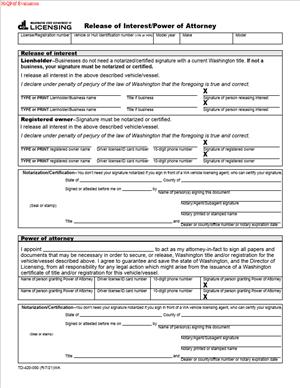
TD-420-050 – Release of Interest or Power of Attorney
Fill out nowJurisdiction: Country: United States | Province or State: Washington
The TD-420-050 – Release of Interest or Power of Attorney is a form used in Washington State to formally give up a legal interest in a vehicle or to cancel a previously granted power of attorney related to a vehicle. If you are transferring ownership, correcting a title issue, or withdrawing authority you gave someone else, this document may be part of your paperwork.
You are likely looking at this form because a vehicle title shows your name, but you no longer want any legal connection to that vehicle. This could happen after a sale, a gift, a divorce, or a business change. The form creates a clear written record that you are releasing your rights.
This document matters because vehicle ownership is tied to legal responsibility. If your name stays on a title, you may continue to appear connected to the vehicle in official records. That can affect registration, licensing, and other transactions.
Before you complete the form, it helps to understand what it does, when it is used, and how to fill it out correctly. Small errors can delay processing or require you to start over.
What is TD-420-050 – Release of Interest or Power of Attorney?
Clear definition
TD-420-050 – Release of Interest or Power of Attorney is a written statement that removes your legal interest in a specific vehicle or cancels a power of attorney related to that vehicle. It is typically filed as part of a vehicle title transaction in Washington.
A “release of interest” means you are giving up your ownership claim or financial interest in the vehicle. A “power of attorney” in this context usually refers to the authority you gave another person to sign vehicle documents on your behalf. This form can address either situation.
The document identifies the vehicle, the person releasing the interest or authority, and confirms that the release is intentional. Once processed, the state’s vehicle records can be updated accordingly.
Who typically uses this form?
This form is commonly used by vehicle owners whose names still appear on a title but who no longer want to be associated with the vehicle. That can include co-owners, former spouses, business partners, or individuals who helped finance a vehicle informally.
It may also be used by someone who previously granted a power of attorney for vehicle-related matters and now wants to revoke that authority. For example, you may have authorized a family member to sign title documents during a move or deployment.
In business settings, companies sometimes use this form when ownership structures change. If a vehicle was titled in multiple names and one party is stepping away, a release of interest helps clarify the record.
Lenders or other secured parties generally use different documents for lien releases. However, individuals who are not formal lienholders but are listed on the title may use this form to remove their name.
Why might you need this form?
You might need this form if you sold a vehicle, but your name still appears on the title. Without a clear release, the title cannot be properly transferred into the buyer’s name.
You may also need it after a divorce or separation. If both spouses were listed as owners, one person may need to release their interest so the other can hold the title alone.
Another common reason is correcting a mistake. If someone was added to a title in error, a release of interest helps remove that name from the record.
If you granted power of attorney for a specific vehicle transaction and that authority is no longer appropriate, this form can document that the authorization has ended.
Typical real-life scenarios
- You and a friend purchased a vehicle together. Later, you agreed that your friend would keep it. Even if you are not using the vehicle anymore, your name on the title still shows ownership. A release of interest allows your friend to retitle the vehicle in their name only.
- After a divorce, a court order may assign the vehicle to one spouse. The other spouse may need to sign a release of interest to align the title with the agreement. This helps prevent confusion during future registration or sale.
- You moved out of state and gave a relative power of attorney to handle vehicle paperwork while you were gone. Once the transaction is complete, you may want to formally revoke that authority to prevent further use.
- A small business owned a vehicle jointly by two partners. One partner leaves the business. To update the title to reflect the new ownership structure, the departing partner signs a release of interest.
When would you use TD-420-050 – Release of Interest or Power of Attorney?
You would typically use this form during a vehicle title transaction when one party needs to step away from ownership. It is often part of a larger submission that includes a title application, bill of sale, or other transfer documents.
If a title lists multiple owners and only one will remain, the person leaving ownership uses this form to confirm that change. This avoids the need for both parties to sign every future transaction involving the vehicle.
You might also use it when there is a dispute or uncertainty about who holds authority. By submitting a written release or revocation, you create a clear record in the state’s files.
In some cases, the form is used to resolve administrative issues. For example, if a previous transaction was not completed properly and a name remains on record, a release can help correct that.
The typical roles involved include the current registered owner, a co-owner, or the person who granted a power of attorney. The person signing the form is the one giving up rights or authority.
Legal characteristics of TD-420-050 – Release of Interest or Power of Attorney
This document is a formal written declaration. For it to be effective, it generally must clearly identify the vehicle and the person releasing the interest or authority. The information must match existing vehicle records.
Accurate details are essential. Vehicle identification numbers, names, and signatures must be consistent with official records. Differences in spelling or missing information commonly lead to delays or rejection.
Signatures are a key element. The form must be signed by the person whose name is currently on the title or who granted the power of attorney. In many vehicle-related documents, signatures may need to meet specific standards, such as being notarized or witnessed, depending on the circumstances.
Timing also matters. If the release is submitted long after a sale or transfer, additional documents may be required to clarify the chain of ownership. The form itself does not replace other required title transfer paperwork.
This document does not transfer ownership by itself. It only removes a person’s interest or authority. The remaining owner or new owner must still complete the appropriate title application and registration steps.
It also does not settle financial disputes. If there are disagreements about payment, debts, or property division, those issues are separate from the administrative act of releasing a name from the title.
Is it legally binding?
When properly completed and signed, this form is generally treated as a binding declaration that you are giving up your stated interest or authority. It becomes part of the official vehicle record.
Its binding effect depends on accurate information and a valid signature. If someone signs under duress, uses false information, or lacks authority to sign, the document’s validity could be challenged.
Once processed, the release typically allows the vehicle record to be updated. After that change, you are no longer listed as an owner or authorized agent for that vehicle in state records.
However, the form only addresses the specific vehicle and the specific interest described. It does not affect other vehicles, contracts, or powers of attorney unless separately documented.
How to fill out TD-420-050 – Release of Interest or Power of Attorney
Step 1 – Identify the vehicle
Start by entering the vehicle details exactly as they appear on the title or registration. This usually includes the vehicle identification number, year, make, and model. Double-check each character of the VIN. Even a small error can prevent the record from matching.
Step 2 – Provide your full legal name
Write your full legal name as it appears on the current vehicle title. If your name is listed with a middle initial or suffix, include it the same way. Consistency with the title record is important for processing.
Step 3 – Indicate the type of release
Specify whether you are releasing your ownership interest or revoking a previously granted power of attorney. Read the wording carefully so your selection matches your situation. The form’s language should clearly reflect what you are giving up.
Step 4 – Confirm your intent
Review the statement on the form that explains the effect of signing. By signing, you confirm that you understand you are giving up your rights or authority related to the identified vehicle. Make sure the vehicle and names listed are correct before you continue.
Step 5 – Sign and date the form
Sign your name in the designated signature area. Use your usual legal signature. Enter the date you sign the document. If the form requires notarization or witnessing in your situation, complete that step as directed on the form before submission.
Step 6 – Submit with related vehicle documents
Provide the completed TD-420-050 – Release of Interest or Power of Attorney, along with any other required title or registration paperwork. The release is typically part of a larger submission to update the vehicle record. Ensure all documents are complete and consistent before filing.
Legal terms you might encounter in TD-420-050 – Release of Interest or Power of Attorney
- Registered Owner: This is the person or business currently listed on the vehicle record as having legal ownership. In this document, the registered owner is the party releasing their interest or granting authority. The name you enter must match the name on the title or vehicle record exactly.
- Legal Owner: A legal owner is typically a lender or lienholder with a financial interest in the vehicle. If a loan exists, the legal owner’s name appears on the title. Releasing interest as a legal owner confirms that the secured interest has been satisfied or transferred.
- Power of Attorney (POA): A power of attorney gives someone else authority to act on your behalf for specific vehicle-related tasks. In this context, it allows another person to sign documents, transfer title, or complete registration steps for you. The authority is limited to what is described in the document.
- Release of Interest: This means you are formally giving up your ownership or financial claim in the vehicle. Once processed, you no longer have rights to the vehicle. The public record will reflect that you are no longer associated with ownership.
- Vehicle Identification Number (VIN): The VIN is the unique 17-character number assigned to the vehicle. It identifies the exact vehicle connected to this document. Entering the VIN correctly ensures the release or authority applies to the right vehicle record.
- Signature of Record: This refers to the signature of the person whose name appears on the current vehicle record. The signature must match the name listed as owner or legal owner. If you sign differently from how your name appears, the form may be rejected.
- Authorized Representative: An authorized representative is someone legally allowed to sign on behalf of a business or organization. If a company owns the vehicle, the person signing must have authority to bind the business. Their title or position may need to be included.
- Effective Date: The effective date is when the release or authority becomes valid. In many cases, this is the date you sign the document. The effective date can affect when your responsibility for the vehicle ends in official records.
- Odometer Disclosure: While not always required in this document, odometer disclosure refers to reporting the vehicle’s mileage at transfer. If combined with a title transfer, mileage information may need to match other submitted documents.
- Notarization: Notarization is the process by which a notary public verifies your identity and witnesses your signature. Some vehicle documents require notarization to prevent fraud. If required, you must sign in the notary’s presence.
FAQs
Do I need to use TD-420-050 – Release of Interest or Power of Attorney if I am already signing the vehicle title?
If your name appears on the title and there is a designated space for release, signing the title may be enough. However, if there is no space for all required signatures, or if a separate legal owner must release interest, this form provides a clear written record. You should confirm whether the title alone shows your full release or if an additional document is needed to update the vehicle record.
What name should I enter if my name has changed since the vehicle was registered?
You must enter your name exactly as it appears on the current vehicle record. If your name has changed, you may need to provide documentation linking your old and new names. This document does not automatically update your name in the record; it only releases interest or grants authority.
Can I limit what the person with power of attorney is allowed to do?
Yes. You should clearly describe the specific actions you are authorizing, such as signing a title application or transferring ownership. Avoid broad or vague language if you want the authority to apply only to one vehicle or one transaction. This document records the scope of authority you grant.
When does my responsibility for the vehicle end?
Your responsibility generally ends once the release is processed and reflected in the official vehicle record. Signing alone does not always update the record immediately. Make sure the completed document is properly submitted so your name is removed from the record.
Does this form need to be notarized?
Whether notarization is required depends on how the form will be used and current processing rules. If notarization is required, you must sign in front of a notary who verifies your identity. If you sign before meeting the notary, the document may be rejected.
What happens if I make a mistake while completing this form?
If you cross out information or use correction fluid, the document may not be accepted. It is usually better to complete a new copy to avoid questions about authenticity. Clear, legible entries help ensure that the vehicle record is updated without delay.
Can a business use this document to release its interest in a vehicle?
Yes, but the person signing must be authorized to act for the business. The signature should include the signer’s name and title. The information must match the business name shown on the vehicle record.
How do I know if the filing office accepted my submission?
After submission, you should receive confirmation through updated vehicle records or a receipt from the processing office. Check that your name no longer appears as owner or legal owner if you released interest. Keep copies of the completed TD-420-050 – Release of Interest or Power of Attorney and any confirmation for your records.
Checklist: Before, During, and After TD-420-050 – Release of Interest or Power of Attorney
Before
- Confirm your name appears on the vehicle title or record.
- Verify the full 17-character VIN directly from the vehicle or title.
- Determine whether you are releasing ownership or granting power of attorney.
- Check if notarization or witness signatures are required.
- Gather supporting documents, such as the title or loan payoff proof.
- Confirm the exact legal name of any business involved.
- Make sure you understand the scope of authority you are granting.
- Review the title to see if multiple signatures are required.
During
- Print clearly in black or blue ink.
- Enter the VIN exactly as shown on the vehicle.
- Write your full legal name as it appears on the record.
- Clearly indicate whether you are releasing interest or granting authority.
- Specify any limits if granting power of attorney.
- Double-check dates for accuracy.
- Sign your name consistently with the record.
- Complete notarization, if required, without pre-signing.
After
- Make a clear copy of the signed document for your records.
- Attach the form to the vehicle title or related paperwork.
- Submit all documents together to avoid delays.
- Confirm that the vehicle record has been updated.
- Keep proof of submission or receipt.
- Store copies in a secure place.
- Notify any co-owners that the release has been completed.
- Follow up if confirmation is not received within a reasonable time.
Common mistakes to avoid with TD-420-050 – Release of Interest or Power of Attorney
- Mistake: Entering the wrong VIN because you copied it from memory instead of the title, which can cause the release to apply to the wrong vehicle or be rejected, so always verify all 17 characters directly from the document or vehicle.
- Mistake: Signing with a nickname or shortened name because it feels natural, which leads to processing delays when the name does not match the vehicle record, so do not forget to sign exactly as listed.
- Mistake: Forgetting to indicate whether you are releasing interest or granting power of attorney, which creates confusion about your intent and may invalidate the submission, so clearly mark the correct option.
- Mistake: Allowing an unauthorized employee to sign for a business because it seems convenient, which can result in rejection or legal disputes, so confirm and document the signer’s authority and title.
- Mistake: Submitting the form without the required notarization because you assumed it was optional, which causes delays and additional appointments, so verify notarization requirements before signing.
- Mistake: Failing to keep a copy because you expect the record update to be automatic, which leaves you without proof if questions arise later, so always retain a complete copy of the signed document.
- Mistake: Leaving sections blank because they seem minor, which can make the document incomplete and unprocessable, so review every field and fill in all required information.
- Mistake: Waiting too long to submit the form after signing, which can leave you listed as the owner during tickets or incidents, so promptly deliver the completed document for processing.
What to do after filling out TD-420-050 – Release of Interest or Power of Attorney
Once you finish completing the form, your next steps matter. A signed document does not change the vehicle record until it is properly submitted and processed. You need to make sure the release or authority is reflected in official records.
Start by reviewing the entire form one more time. Check the VIN, names, dates, and signatures. Make sure any required notarization is complete and properly stamped or sealed.
- Step 1: Make at least one clear copy of the fully signed document for your personal records.
- Step 2: Attach the form to the related vehicle title or registration paperwork.
- Step 3: Confirm that all required supporting documents are included, such as payoff confirmation if a lien was satisfied.
- Step 4: Submit the complete packet to the appropriate vehicle licensing office or processing center.
- Step 5: Request a receipt or written confirmation showing that your documents were received.
- Step 6: Monitor the vehicle record to ensure your name has been removed if you released your interest.
- Step 7: If you granted power of attorney, confirm that the authorized person completed the intended transaction.
- Step 8: Store your copy and any confirmation in a secure place with your other vehicle records.
- Step 9: Update your personal records to reflect that you no longer own or control the vehicle.
- Step 10: Follow up promptly if the record does not update within the expected processing time.
If you released ownership, check that your name no longer appears as registered or legal owner. This protects you from future liability, such as tickets or fees linked to the vehicle.
If you granted power of attorney, communicate with the person you authorized. Confirm that they used the authority only for the purpose you described. Once the transaction is complete, keep documentation showing what was done.
Taking these final steps ensures that your intent is properly recorded and that your responsibilities are clearly ended or transferred.
Disclaimer: This guide is provided for informational purposes only and is not intended as legal advice. You should consult a legal professional.