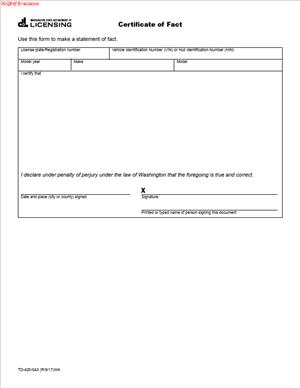
TD-420-043 – Certificate of Fact
Fill out nowJurisdiction: Country: United States | Province or State: Washington
The TD-420-043 – Certificate of Fact is a written statement used to explain or confirm specific facts related to a vehicle or vessel record in Washington. It allows you to provide additional details that are not fully captured by standard title or registration forms.
You use this form when the Department of Licensing needs clarification about ownership, a transaction, or an error. It serves as a formal way to put your explanation in writing.
This document matters because vehicle and vessel records must be accurate. If something is missing, inconsistent, or unclear, your application may be delayed or rejected. A clear Certificate of Fact can help resolve those issues.
If you are completing a title transfer, correcting a name, or explaining a unique situation, this form may be part of your filing. It is often used alongside other documents, not on its own.
Understanding how and when to use it will help you avoid delays and reduce back-and-forth with the agency.
What is TD-420-043 – Certificate of Fact?
Clear definition
The TD-420-043 – Certificate of Fact is a sworn written statement used to declare specific facts about a vehicle or vessel record. You complete it to explain circumstances that are not fully addressed by other required forms.
It is not a title application or a registration form. Instead, it supplements those documents. You use it to clarify details that affect ownership, transfer, or record accuracy.
When you sign it, you are certifying that the information is true to the best of your knowledge. Because it is a factual declaration, accuracy is critical.
Who typically uses this form?
Individuals commonly use this form when buying or selling a vehicle or vessel, and a detail needs explanation. This may include private sellers, buyers, family members, or legal representatives.
Business owners may use it if a vehicle is owned by a company and there is confusion about authority or ownership details. Estate representatives sometimes use it when transferring a vehicle after someone’s death.
In general, anyone involved in a transaction that requires clarification may be asked to complete this document.
Why might you need this form?
You may need this form if there is a discrepancy in names, dates, or signatures. It can help explain why information on one document does not match another.
You might also need it if a title was lost and certain transaction details cannot be verified through standard paperwork. In some cases, it is used to confirm that a sale occurred under specific conditions.
The form can also be used to document facts about a gift, inheritance, or correction of an error. It creates a written record that becomes part of the official file.
Typical real-life scenarios
- You purchase a vehicle from a private seller, but the seller signed their name slightly differently from how it appears on the title. A Certificate of Fact may be used to explain that both signatures belong to the same person.
- You are transferring a vehicle between family members, and the sale price is listed as zero. You may use the form to clarify that the transfer was a gift rather than a sale.
- A previous owner made a mistake when filling out the title, such as writing the wrong date. Instead of discarding the entire document, a Certificate of Fact may explain the correction.
- You are handling a vehicle as part of an estate, and the title does not clearly show how ownership passed after the owner’s death. The form may be used to state the relevant facts surrounding that transfer.
When would you use TD-420-043 – Certificate of Fact?
You would use this form when a standard application does not fully explain your situation. It often comes into play during title transfers, registration updates, or corrections to existing records.
If the agency reviewing your paperwork identifies missing information, you may be asked to provide a written statement. This form gives you a structured way to do that.
You might also use it proactively. If you know there is an unusual detail in your transaction, adding a Certificate of Fact at the time of submission can help prevent delays.
Typical roles involved include buyers, sellers, co-owners, estate administrators, and business representatives. The person with direct knowledge of the facts usually completes and signs the form.
The document is especially useful when there is no other official record to confirm what happened. In those cases, your written statement becomes part of the file supporting the transaction.
Legal characteristics of TD-420-043 – Certificate of Fact
The TD-420-043 – Certificate of Fact functions as a sworn declaration. When you sign it, you affirm that the information is accurate. This gives the statement formal weight in an administrative review.
For the form to be effective, it must be complete and consistent with other submitted documents. Names, dates, vehicle identification numbers, and other details should match across all paperwork.
Common reasons for rejection include missing signatures, unclear handwriting, incomplete explanations, or statements that conflict with other records. If your explanation raises new questions instead of resolving them, additional documentation may be required.
In general, the form must be legible and specific. Vague statements such as “there was a mistake” without details may not be enough. Clear facts, including dates and relationships, are usually more helpful.
While the format is specific to Washington, similar certificates or affidavits exist in other states. The exact requirements and acceptance standards may vary by jurisdiction.
It is important to understand what this document does not do. It does not replace a required title application. It does not automatically correct an error without review. It also does not transfer ownership by itself. It supports other filings.
Is it legally binding?
Yes, in the sense that you are making a formal declaration of fact. When you sign the form, you are attesting that the information is true.
Because it is a sworn statement, providing false information can have serious consequences. The form carries legal significance as part of an official record.
However, the document does not create a contract between the parties. It does not, by itself, complete a sale or establish ownership. Its binding nature relates to the truthfulness of your statement, not to the transaction itself.
The form becomes part of the administrative file. Decisions about title or registration may rely on the facts you certify. That is why accuracy and clarity matter.
How to fill out TD-420-043 – Certificate of Fact
Step 1 – Provide identifying information
Enter the vehicle or vessel details exactly as they appear on the title or registration. This typically includes the identification number, year, make, and model. Double-check each character for accuracy.
Step 2 – Identify the parties involved
Write the full legal names of all individuals or entities connected to the statement. Use the same spelling and format shown on existing records. If more than one person is involved, clearly indicate each person’s role.
Step 3 – State the facts clearly
Describe the situation in plain language. Focus on specific facts, such as dates, locations, and actions taken. Keep your explanation organized and limited to relevant details.
Avoid opinions or unnecessary background. The goal is to clarify a record, not to tell a story. Each sentence should help explain the issue at hand.
Step 4 – Explain discrepancies or corrections
If you are correcting an error, clearly identify what was incorrect and what the correct information is. For example, state the incorrect date as written and then provide the correct date.
Make sure your explanation matches any supporting documents you are submitting. Consistency across all forms is important.
Step 5 – Review for completeness and accuracy
Read the entire form before signing. Confirm that names, numbers, and dates match other documents in your submission.
Check that your explanation fully addresses the issue. If a reviewer reads only this statement, it should make sense on its own.
Step 6 – Sign and date the form
Sign your name exactly as required in the signature section. Include the date of signing. By signing, you are certifying that the statement is true.
If the form requires additional signatures, ensure each person signs in the appropriate place. An unsigned or partially signed document may not be accepted.
Step 7 – Submit with related documents
Attach the completed Certificate of Fact to the other required forms for your transaction. Keep a copy for your records so you can refer to what you submitted if questions arise.
Legal terms you might encounter in TD-420-043 – Certificate of Fact
- Declarant: The declarant is the person making the statement in this document. You are the declarant if you are the one explaining the facts. Your name appears near the signature line, and you are confirming that the information you provide is true.
- Affirmation: An affirmation is a formal promise that the information you provide is true. You make this promise when you sign the form. It carries legal weight similar to an oath, even if you do not swear before a notary.
- Material Fact: A material fact is an important detail that affects a decision about a vehicle or title record. On this form, you must focus on facts that directly explain an error, correction, or missing information. Minor details that do not affect ownership or title status are not considered material.
- Vehicle Identification Number (VIN): The VIN is the unique 17-character number assigned to a vehicle. You must enter it exactly as it appears on the vehicle and related documents. A single incorrect character can cause processing delays or rejection.
- Registered Owner: The registered owner is the person or entity listed in official records as the owner of the vehicle. This name must match the state’s records unless you are using this document to explain a discrepancy. Always use the full legal name.
- Lienholder: A lienholder is a lender or party with a financial interest in the vehicle. If a lien exists, their name may appear on the title. Your statement should not ignore a lien if it affects the facts you are explaining.
- Clerical Error: A clerical error is a simple mistake, such as a misspelled name, wrong date, or transposed number. This document is often used to explain or correct these errors. Be specific about what was wrong and what the correct information should be.
- Supporting Documentation: These are additional papers that back up your statement. Examples include copies of titles, bills of sale, release letters, or identification. You may need to attach these to show that your explanation is accurate.
- Signature Certification: This refers to the act of signing to confirm the truth of your statement. Your signature tells the agency that you stand behind the facts you provided. An unsigned form is incomplete and will not be processed.
FAQs
What is the main purpose of TD-420-043 – Certificate of Fact?
This document lets you explain a specific issue related to a vehicle record, such as a mistake on a title or missing information in a transfer. You use it to clearly state what happened and what the correct information should be. It becomes part of the official record reviewed by the licensing agency.
Do I need to have this document notarized?
In most situations, you only need to sign the form as the declarant. Review the signature section carefully to see whether notarization is required in your specific case. If a notary block is present and marked as required, you must sign in front of a notary and ensure the notary completes their section.
What kind of facts should I include in my statement?
Include only facts that directly relate to the correction or issue you are addressing. State dates, names, VIN, and transaction details exactly as they appear on other documents. Avoid opinions or long background stories, and focus on what the agency needs to correct or clarify the record.
How detailed should my explanation be?
Your explanation should be detailed enough that a reviewer can understand the problem without contacting you for clarification. Identify what was incorrect, why it was incorrect, and what the correct information is. If there are multiple errors, address each one clearly in separate sentences.
Can I use this document to change ownership of a vehicle?
This document does not replace required ownership transfer documents. It supports or clarifies information connected to a transfer. You must still complete any required title or transfer forms separately.
What if the name on the title does not match my current legal name?
You should explain the discrepancy clearly in your statement and provide the correct legal name. Attach documentation that shows the name change, such as a court order or other official record. Make sure the name you write matches your current legal identification.
Will the information I provide change the public vehicle record immediately?
The agency reviews your statement along with any attachments before updating a record. If the explanation is clear and supported by documents, the record may be corrected. If information is missing or inconsistent, you may be asked to provide more details before any change is made.
What happens if I make a mistake while completing this form?
If you notice an error before submitting, complete a new, clean copy to avoid confusion. Do not rely on crossed-out sections unless the form instructions clearly allow corrections. If you already submitted it, you may need to file another statement explaining the new correction.
Checklist: Before, During, and After TD-420-043 – Certificate of Fact
Before
- Review the vehicle title and related paperwork to identify the exact issue.
- Confirm the correct VIN directly from the vehicle or official records.
- Gather supporting documents that prove the correct information.
- Verify the full legal names of all parties involved.
- Check whether a lienholder is listed on the title.
- Read the form instructions carefully from start to finish.
- Make sure you understand the specific correction or explanation needed.
- Confirm whether notarization is required for your situation.
During
- Print clearly or type to avoid legibility issues.
- Enter the VIN exactly as shown, character by character.
- Use full legal names without abbreviations unless officially part of the name.
- State the incorrect information first, then provide the correct information.
- Keep your explanation focused on relevant facts.
- Avoid leaving required fields blank.
- Review dates for accuracy and proper format.
- Sign only after confirming all information is complete.
After
- Make a complete copy of the signed document for your records.
- Attach all required supporting documentation.
- Submit the form using the accepted method for your situation.
- Confirm that any related title or transfer forms are also submitted.
- Keep proof of submission if available.
- Monitor for confirmation or follow-up communication.
- Respond promptly if additional information is requested.
- Store copies with your vehicle records in a safe place.
Common mistakes to avoid with TD-420-043 – Certificate of Fact
- Mistake: Entering an incorrect VIN because you copied it from memory, which leads to rejection or misfiled records; do not forget to verify the VIN directly from the vehicle or official paperwork.
- Mistake: Providing vague explanations due to rushing, which forces the agency to request clarification and delays processing; do not forget to clearly state what was wrong and what the correct information is.
- Mistake: Forgetting to sign the form because you focused only on the written statement, which makes the document invalid; do not forget to complete the signature section.
- Mistake: Leaving out supporting documents because you assumed your statement was enough, which can result in denial or delay; do not forget to attach copies that prove your claim.
- Mistake: Using nicknames or shortened names out of habit, which creates mismatches in official records; do not forget to use full legal names exactly as shown on identification.
- Mistake: Attempting to use this document as a substitute for required title transfer forms, which can stall your transaction; do not forget to complete all other necessary ownership documents.
- Mistake: Submitting the form with cross-outs and handwritten corrections that are hard to read, which may cause rejection; do not forget to start over with a clean copy if you make errors.
- Mistake: Ignoring an existing lien because you believe it is unrelated, which can create legal and financial complications; do not forget to review the title for lienholder information.
What to do after filling out TD-420-043 – Certificate of Fact
Once you complete and sign the form, slow down and review everything one more time. Small errors can cause big delays. Check names, VIN, and dates against your supporting documents.
- Step 1: Make at least one clear copy of the signed form for your personal records.
- Step 2: Attach copies of all supporting documents that confirm the facts you stated.
- Step 3: Confirm whether other related forms must be submitted at the same time.
- Step 4: Organize the paperwork in a logical order, with this form on top if it explains an issue.
- Step 5: Submit the documents using the appropriate submission method available to you.
- Step 6: If you submit in person, ask for confirmation that your paperwork was received.
- Step 7: If you submit by mail or another delivery method, keep proof of mailing or tracking details.
- Step 8: Mark your calendar to follow up if you do not receive confirmation within a reasonable time.
- Step 9: Review any updated title or registration documents you receive to ensure the correction was made accurately.
- Step 10: Store the updated documents and a copy of your statement together for future reference.
After submission, stay alert for communication. If the agency contacts you for clarification, respond promptly and provide any additional documents requested. Delays often happen when follow-up requests go unanswered.
If your correction affects other records, such as insurance or internal business documents, update those records once the official change is confirmed. Keep everything consistent. That prevents future discrepancies and saves you time if you sell the vehicle or transfer ownership later.
Disclaimer: This guide is provided for informational purposes only and is not intended as legal advice. You should consult a legal professional.