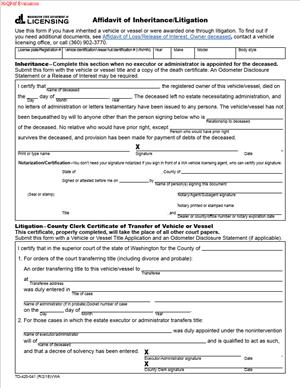
TD-420-041 – Affidavit of Inheritance or Litigation
Fill out nowJurisdiction: Country: United States | Province or State: Washington
The TD-420-041 – Affidavit of Inheritance or Litigation is a sworn statement used in Washington State in connection with vehicle or vessel ownership. You complete it when ownership is being transferred due to inheritance or because of a legal dispute.
If you are filling out this form, you are likely trying to update a title after someone has died or while a court case is pending. The form helps the state understand who has the legal right to transfer or claim ownership.
This document is not just a routine application. It is an affidavit, which means you are swearing that the information you provide is true. False statements can create serious legal consequences.
You may be using this form as an heir, a surviving spouse, or someone involved in litigation over a vehicle or vessel. It is often part of a larger process involving probate, estate administration, or a court case.
Understanding what this form does will help you complete it accurately and avoid delays in processing your title or registration.
What is TD-420-041 – Affidavit of Inheritance or Litigation?
Clear definition
TD-420-041 – Affidavit of Inheritance or Litigation is a sworn written statement used to explain how ownership of a vehicle or vessel is being claimed due to inheritance or ongoing litigation. It provides official notice that the transfer of ownership is connected to a death or a legal dispute.
The form typically includes details about the deceased person or the lawsuit, the vehicle or vessel involved, and the person claiming rights. By signing it, you are declaring under oath that your statements are accurate.
This affidavit becomes part of the ownership record. It supports a title transfer or places the state on notice that the property is subject to litigation.
Who typically uses this form?
You may use this form if you are an heir inheriting a vehicle or vessel from someone who has passed away. This can include a spouse, child, or other relative named in a will or recognized under state inheritance rules.
Personal representatives of estates often complete this document when handling property that must be transferred out of the deceased person’s name. In some cases, a surviving joint owner may also use it to clarify their rights.
The form is also used when there is a legal dispute involving the vehicle or vessel. For example, if ownership is being contested in court, the person asserting a claim may file this affidavit as part of the title process.
Attorneys or court-appointed representatives may assist with completion, but the person signing the affidavit is the one making the sworn statement.
Why might you need this form?
You might need TD-420-041 – Affidavit of Inheritance or Litigation if the registered owner has died and the title cannot be transferred through a simple sale. The state may require a sworn explanation before issuing a new title.
If there is no immediate probate order available, this form can help clarify the basis for your claim. It may be used alongside other estate documents.
You may also need it if the vehicle or vessel is involved in a lawsuit. For example, if two parties claim ownership, the affidavit informs the state that the property is subject to litigation.
Without this document, the title transfer process could be delayed. The agency may not process the application until the inheritance or legal dispute is clearly documented.
Typical real-life scenarios
- A common situation involves a spouse who has passed away and left a car titled only in their name. The surviving spouse wants to transfer the title into their own name. The affidavit helps explain that the transfer is based on inheritance.
- Another scenario involves a parent who died without a will. An adult child is handling the estate and needs to transfer a boat into their name before selling it. The form provides a sworn statement of inheritance.
- In some cases, siblings disagree about who owns a vehicle that belonged to their late parent. While the dispute is being resolved in court, one party files this document to inform the state that litigation is pending.
- You might also see this form used when a court has issued an order affecting ownership, but additional clarification is required for the title record. The affidavit supports the documentation already provided.
- In each of these examples, the key issue is that ownership is not changing through a simple purchase. It is changing because of death or a legal claim.
When would you use TD-420-041 – Affidavit of Inheritance or Litigation?
You use this form when ownership of a vehicle or vessel cannot be transferred through a standard sale transaction. The most common trigger is the death of the registered owner.
If you are presenting a death certificate and requesting a title change, the agency may require this affidavit to confirm your relationship to the deceased and your legal basis for claiming the property.
You may also use it when probate is open or when estate administration is underway. In those cases, the affidavit works together with court documents to clarify the situation.
When litigation is involved, this form is used to notify the state that the vehicle or vessel is subject to a legal dispute. This can help prevent improper transfers while a case is pending.
The typical roles involved include heirs, beneficiaries, surviving spouses, estate representatives, and individuals who have filed or are responding to a lawsuit concerning ownership. The person signing the form is stating their personal knowledge of the facts.
This document is usually submitted along with a title application and other required paperwork. It does not replace those documents but supports them.
Legal characteristics of TD-420-041 – Affidavit of Inheritance or Litigation
This form is an affidavit. That means it is a sworn statement made under penalty of perjury. Its legal weight comes from the oath you take when signing.
For the document to be effective, it must be completed fully and accurately. Required sections must not be left blank. Identifying information, such as vehicle identification numbers and names, must match official records.
Signatures are critical. If the form requires notarization or certification, missing that step can lead to rejection. Inconsistent dates or unclear handwriting can also delay processing.
High-level differences may arise depending on whether the matter involves a small estate, a formally probated estate, or active litigation. In some situations, additional court orders or certified copies may be required alongside the affidavit.
It is important to understand what this form does not do. It does not decide who legally owns the vehicle or vessel. It does not replace a court order. It does not resolve disputes between heirs. Instead, it documents your claim or the existence of litigation for title purposes.
If there is a dispute, the final determination of ownership usually comes from a court. The affidavit simply places relevant information into the title record.
Is it legally binding?
Yes, the affidavit is legally binding in the sense that you are swearing the information is true. By signing, you are making a declaration under penalty of perjury.
If the statements are false, there may be legal consequences. This is because the form relies on your sworn representation rather than immediate court findings.
However, the form itself does not create ownership rights. It reflects and asserts rights that arise from inheritance law or court proceedings. Its binding effect relates to the truthfulness of your statements, not to granting you ownership automatically.
In practice, the affidavit becomes part of the official file. Agencies rely on it when processing a title or registration change. That reliance is what gives the sworn statement practical importance.
How to fill out TD-420-041 – Affidavit of Inheritance or Litigation
Step 1 – Identify the vehicle or vessel
Begin by entering the full description of the vehicle or vessel. This typically includes the make, model, year, and vehicle or hull identification number. Check the current title or registration for exact details. The information on this form should match those records exactly to avoid delays.
Step 2 – Provide the name of the deceased owner or party involved in litigation
If the transfer is due to inheritance, enter the full legal name of the deceased person as it appears on the title. If the matter involves litigation, provide the name of the person whose ownership is being disputed. Accuracy here connects the affidavit to the correct ownership record.
Step 3 – State the basis of your claim
In the section explaining inheritance or litigation, clearly describe your relationship to the deceased or your role in the legal case. For inheritance, this may involve stating that you are a surviving spouse, child, or personal representative. For litigation, include a brief description of the dispute and, if applicable, the court involved. Keep your explanation factual and concise.
Step 4 – Provide supporting details about the estate or court case
If the estate is being probated, include relevant information such as the county where the estate is filed or the name of the personal representative. If there is a lawsuit, provide the case number if requested. This information helps link the affidavit to official proceedings.
Step 5 – Review all entries for consistency
Before signing, read the entire form carefully. Confirm that names, dates, and identification numbers match other documents you are submitting. Small errors, such as a misspelled name or an incorrect digit in a vehicle identification number, can result in rejection.
Step 6 – Sign the affidavit under oath
Sign the form in the designated signature area. Because this is an affidavit, you may need to sign in the presence of a notary or authorized official, depending on the form’s instructions. Do not sign until you are in the proper setting if notarization is required.
Step 7 – Submit the form with your title application
Attach the completed affidavit to your title transfer or registration paperwork. Make sure all required supporting documents are included. Once submitted, the affidavit becomes part of the official record supporting the change in ownership.
Legal terms you might encounter in TD-420-041 – Affidavit of Inheritance or Litigation
- Affidavit: A written statement you swear or affirm is true. In this document, you sign under penalty of perjury. That means you are legally responsible for the accuracy of every detail you provide.
- Decedent: The person who has died. You must enter the decedent’s full legal name exactly as it appears on the vehicle or vessel record. Spelling and name order matter because the agency matches your entry to existing title records.
- Heir: A person entitled to inherit property when someone dies. This form asks you to identify your relationship to the decedent. You may need to confirm whether you are the sole heir or one of several heirs.
- Estate: All property owned by the decedent at death. The vehicle or vessel listed on this document is part of that estate. You are declaring how ownership passes from the estate to you or another person.
- Probate: A court process that oversees the distribution of a deceased person’s estate. If probate is open, you may need to provide case details. If there is no probate, this document may be used instead to support a title transfer.
- Litigation: A legal dispute being handled in court. If the vehicle or vessel is involved in a lawsuit, you must disclose that status. The agency uses this information to understand whether ownership is contested.
- Case Number: The identifying number assigned by a court to a lawsuit or probate case. If applicable, you must enter it exactly as shown on court paperwork. Incorrect numbers can delay processing.
- Perjury: Making a false statement under oath. When you sign this document, you are declaring that the information is true. False statements can lead to penalties and may invalidate the title transfer.
- Legal Owner: A person or entity with a secured interest in the vehicle, such as a lender. Even if you inherit the vehicle, a legal owner’s interest may remain until released. You must not ignore any listed security interest.
- Transfer of Ownership: The legal change of title from one person to another. This document supports that transfer by explaining why you have the right to claim the vehicle or vessel. The agency relies on your sworn statements to update the record.
FAQs
Do I need to use TD-420-041 – Affidavit of Inheritance or Litigation if there was no will?
If there was no will, you may still use this document to explain how you are entitled to the vehicle or vessel. You must clearly state your relationship to the deceased and whether you are the sole heir or one of several. Make sure the name of the deceased matches the title record exactly. If other heirs exist, confirm whether they must also sign or provide written consent.
What names must match exactly on this form?
The deceased owner’s name must match the title record character for character, including middle initials and suffixes. Your own name must match your identification and the new title application. If there are multiple heirs, each person’s name should be written consistently across all documents. Even small differences can cause the agency to reject the paperwork.
Do I have to provide a court case number?
You only provide a case number if there is an open or completed probate or lawsuit involving the vehicle or vessel. Enter the number exactly as shown on court documents. If there is no court case, state that clearly in the appropriate section. Do not leave the space blank if the form asks you to confirm whether litigation exists.
What if there are multiple heirs?
You must identify all known heirs and clarify whether they agree to the transfer. If you are not the only heir, the agency may require signatures from the others or additional documentation showing you have the authority to act. Make sure you read the section that asks about other interested parties. Missing a required signature is a common reason for delay.
When does the transfer become effective?
The transfer generally becomes effective when the agency accepts and processes your complete submission. Signing the affidavit alone does not update the public record. You must submit it with the title application and any required supporting documents. Check that all sections are complete before filing.
Does this document change the public ownership record by itself?
No. This form supports a title application, but it does not update the record on its own. The ownership record changes only after the agency reviews and accepts your full packet. Keep a copy so you can confirm what information you provided if questions arise later.
What attachments should I include with this document?
You may need to include a copy of the death certificate, any court order, or documents showing your authority as personal representative if applicable. Review each section of this form and confirm whether it asks for supporting proof. Attach clear copies, not originals, unless specifically required. Make sure all attachments show names and dates clearly.
What happens if the agency rejects my submission?
If your paperwork is incomplete or inconsistent, the agency may return it or request corrections. Review the reason for rejection carefully. Compare your entries on TD-420-041 – Affidavit of Inheritance or Litigation to the title and supporting documents to find mismatches. Correct the errors fully, not partially, before resubmitting.
Checklist: Before, During, and After TD-420-041 – Affidavit of Inheritance or Litigation
Before
- Confirm the exact legal name of the deceased as shown on the title.
- Determine whether there is an open probate or lawsuit involving the vehicle.
- Identify all heirs and confirm their agreement or required signatures.
- Gather a certified copy of the death certificate if required.
- Locate the current title and verify vehicle or vessel details.
- Check for any listed legal owner or lienholder.
- Review your identification to ensure your name matches your application.
- Collect any court documents if litigation exists.
During
- Enter the vehicle or vessel identification number carefully and double-check each character.
- Write the deceased owner’s name exactly as it appears on the record.
- Clearly state your relationship to the deceased.
- Indicate whether probate is open, closed, or not applicable.
- Provide any required case number without altering its format.
- Disclose any known disputes or claims related to the property.
- Read each declaration before signing under oath.
- Sign and date the document in the correct location.
After
- Make a complete copy of the signed affidavit for your records.
- Attach all required supporting documents to your title application.
- Verify that all heirs have signed if required.
- Submit the packet using the accepted filing method.
- Track submission if you mail it or request a receipt if filing in person.
- Monitor for confirmation or requests for additional information.
- Respond promptly to any agency follow-up.
- Store the processed documents with your permanent records.
Common mistakes to avoid with TD-420-041 – Affidavit of Inheritance or Litigation
- Mistake: Misspelling the deceased owner’s name because you rely on memory instead of the title; this happens often and can lead to rejection, so do not forget to copy the name exactly as shown.
- Mistake: Leaving sections blank when they require a “yes,” “no,” or “not applicable”; people skip boxes by accident, which delays processing, so do not forget to complete every required field.
- Mistake: Failing to disclose other heirs because you assume they do not need to be listed; this can invalidate the transfer, so do not forget to identify all interested parties.
- Mistake: Ignoring an existing lien or legal owner; this happens when heirs focus only on inheritance, which can block title issuance, so do not forget to address any security interests.
- Mistake: Providing an incorrect or incomplete court case number; this often results from copying errors and can cause verification problems, so do not forget to match the number exactly to the court paperwork.
- Mistake: Signing without reviewing the sworn statements; people rush to finish and overlook errors, which exposes them to penalties, so do not forget to read every declaration before signing.
- Mistake: Submitting the affidavit without attaching required proof, such as a death certificate; this leads to rejection, so do not forget to assemble all supporting documents first.
- Mistake: Assuming the title changes immediately upon signing; this misunderstanding can create disputes, so do not forget that the record updates only after agency acceptance.
What to do after filling out TD-420-041 – Affidavit of Inheritance or Litigation
Once you complete and sign the affidavit, pause before submitting it. Review every entry against the title, court papers, and identification. Small inconsistencies can delay processing.
- Step 1: Make at least one full copy of the signed document for your records.
- Step 2: Assemble your supporting documents, such as the death certificate or court paperwork, and confirm names and dates are readable.
- Step 3: Complete the related title application form that requests the ownership change.
- Step 4: Verify whether all heirs or authorized parties have signed where required.
- Step 5: Check for any lien release or legal owner documentation if a secured interest exists.
- Step 6: Confirm the submission method, whether in person or by mail, and prepare payment for any required fees.
- Step 7: Submit the full packet together so nothing is separated or lost.
- Step 8: Request confirmation of receipt if filing in person, or use a trackable mailing option if sending by mail.
- Step 9: Monitor for written confirmation that the title has been processed.
- Step 10: Review the updated title once issued to ensure your name and details are correct.
- Step 11: Store the new title and a copy of the affidavit in a secure location.
- Step 12: Update your personal records, insurance information, and any internal documents to reflect the new ownership.
Stay organized throughout the process. Keep a simple file with copies of everything you submitted and any correspondence you receive. If questions come up months later, you will be able to show exactly what you declared and when.
Disclaimer: This guide is provided for informational purposes only and is not intended as legal advice. You should consult a legal professional.