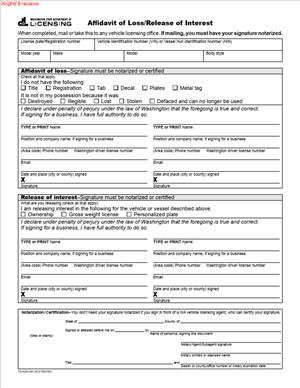
TD-420-040 – Affidavit of Loss or Release of Interest
Fill out nowJurisdiction: Country: United States | Province or State: Washington
The TD-420-040 – Affidavit of Loss or Release of Interest is a written statement used in Washington to address ownership issues involving a vehicle or vessel. You use it when a title is lost, or when someone named on a title wants to formally give up their interest.
This form helps clarify who has a legal claim to a vehicle or boat. It supports title corrections, transfers, or replacements. If you are filling it out, you are usually trying to resolve a problem that is blocking a sale, transfer, or registration.
The document is commonly used during private sales. It can also come up after a breakup, inheritance, or business closure. In each case, it serves as a formal declaration about ownership rights.
Because this is an affidavit, you are making a sworn statement. The information you provide must be accurate and complete. Even small errors can delay processing.
Understanding how this form works will help you avoid delays and confusion. It also helps you know what this document does and what it does not do.
What is TD-420-040 – Affidavit of Loss or Release of Interest?
Clear definition
The TD-420-040 – Affidavit of Loss or Release of Interest is a written declaration used to either report a lost title or confirm that a person listed on a title gives up their ownership interest. It is used for vehicles and vessels in Washington.
An affidavit is a sworn statement of fact. By signing this form, you confirm that the information you provide is true. This statement becomes part of the ownership record.
The form is not a bill of sale. It does not transfer ownership by itself. Instead, it supports other title documents when ownership needs to be clarified.
Who typically uses this form?
You may use this form if you are listed on a vehicle or vessel title and want to release your interest. This often happens when co-owners separate or when one owner agrees to let the other keep the property.
You may also use the form if the physical title has been lost, destroyed, or stolen. In that case, the affidavit explains why the original title cannot be submitted.
Buyers sometimes encounter this form during a private purchase. If the seller cannot locate the title, this document may be part of the replacement process.
Heirs or estate representatives may use it when sorting out ownership after someone dies. It can help document that certain individuals no longer claim an interest.
Why might you need this form?
You might need this form to complete a title transfer. If someone listed on the title does not sign off correctly, the transfer can be rejected.
You may also need it to apply for a replacement title. If the original document is missing, this affidavit helps explain the situation.
In some cases, financial institutions or lienholders require clear documentation before releasing their interest. The affidavit may help clarify that no ownership claim remains, or that one party is stepping aside.
This form can also prevent future disputes. A written, signed release reduces the risk that someone later claims they still own part of the vehicle or vessel.
Typical real-life scenarios
- You and your former partner purchased a car together. Both names appear on the title. After separating, one of you keeps the car. The other signs this form to formally release their ownership interest.
- You sold a boat, but later discovered that the paper title cannot be found. To complete the transfer, you provide a sworn statement explaining the loss and confirming your intent to transfer.
- You paid off a private loan from a friend who was listed as a co-owner for security. Once the debt is cleared, your friend signs this document to release their claim.
- A family member passes away, and multiple heirs are listed as potential owners of a vehicle. Some heirs choose not to keep the vehicle and sign a release of their interest so it can be retitled to one person.
When would you use TD-420-040 – Affidavit of Loss or Release of Interest?
You use this form when there is a gap between what the title says and what the current ownership situation is. If the record shows more than one owner, but only one person now claims the vehicle, this form may be part of the solution.
It is also used when the original certificate of title is unavailable. A missing title can prevent registration, sale, or transfer. The affidavit explains why the document is not attached.
You may encounter this form during a private sale where the paperwork is incomplete. For example, a seller may realize their name is still listed alongside a former spouse or business partner. To finalize the transfer, the other person signs to release their interest.
In estate situations, personal representatives may gather affidavits from individuals who are legally connected to the vehicle. This can help align the ownership record with the outcome of probate or estate distribution.
If a lienholder’s interest has ended, but their name remains on the title, additional documentation may be required. In some cases, this affidavit supports the process of removing that name, depending on the circumstances.
The form is often part of a larger filing package. You may submit it together with a title application, a bill of sale, and identification documents. Each document serves a different function in confirming ownership and eligibility.
Legal characteristics of TD-420-040 – Affidavit of Loss or Release of Interest
This document is a sworn statement. That means you are declaring facts under penalty of perjury. Accuracy is essential. If the information does not match official records, the filing may be delayed or rejected.
For the form to be effective, it usually must be completed in full. Missing signatures, incorrect vehicle identification numbers, or inconsistent names can create problems. The details must match the existing title record.
Signatures are critical. If more than one person is listed on the title, the release must reflect how ownership is recorded. The way names appear on the title can affect whether one or all owners must sign.
The form does not replace a title application. It also does not override secured interests automatically. If a lender is recorded as a lienholder, separate steps may be required to clear that lien.
Different states use similar affidavits, but the rules and wording can vary. A form accepted in one state may not be accepted in another. The content and process are specific to Washington.
If the affidavit is incomplete, contains altered information, or lacks proper identification details, it may not be processed. Consistency across all submitted documents is important.
Is it legally binding?
Yes, this affidavit can be legally binding because it is a sworn statement. When you sign it, you are formally declaring that you release your ownership interest or that a title has been lost. That declaration becomes part of the official record.
Its binding effect depends on accurate completion and proper submission. If the form is signed by the correct person and accepted as part of a title transaction, it reflects a legally recognized change in claimed interest.
However, the form alone does not transfer ownership. It works together with other required documents. Its legal effect is limited to the statements made within it, such as confirming loss of a title or releasing a claim.
If false information is provided, there may be serious consequences. Because it is signed under oath, the truthfulness of the statements is central to its validity.
How to fill out TD-420-040 – Affidavit of Loss or Release of Interest
Step 1 – Identify the vehicle or vessel
Enter the complete description of the vehicle or vessel. This usually includes the vehicle identification number or hull identification number, year, make, and model. Copy these details exactly as they appear on the existing title or registration record to avoid mismatches.
Step 2 – Provide current owner information
Write the full legal name of each person listed on the current title. The spelling must match the official record. If there are multiple owners, include each name as shown, including middle initials or suffixes.
Step 3 – Indicate the reason for the affidavit
Select or state whether the affidavit is for a lost title or for a release of interest. Be clear and direct. If the title was lost, confirm that it was not transferred to another party. If you are releasing interest, state that you no longer claim ownership.
Step 4 – Complete release of interest details
If you are giving up your ownership interest, clearly identify the person who will retain or receive the interest. Use their full legal name. Ensure this matches the name used in any related title application or transfer documents.
Step 5 – Review for accuracy and consistency
Read every section before signing. Confirm that identification numbers, names, and dates match all other documents in your filing. Small errors can cause processing delays.
Step 6 – Sign the affidavit
Sign your name exactly as it appears on the title. Because this is a sworn statement, your signature confirms that the information is true. If more than one owner must release interest, each required person signs separately.
Step 7 – Submit with supporting documents
Attach the completed affidavit to the related title application or transfer paperwork. Ensure all required documents are included in the same submission so the ownership record can be updated without unnecessary delay.
Legal terms you might encounter in TD-420-040 – Affidavit of Loss or Release of Interest
- Affidavit: A written statement made under oath. When you sign this document, you are declaring that the information you provide is true. False statements can lead to penalties because you are certifying the facts as accurate.
- Release of Interest: A formal statement that you no longer claim any ownership rights in a vehicle or vessel. On this form, you use it to show that you have transferred or given up your interest. This updates the public ownership record.
- Legal Owner: A person or entity with a recorded ownership interest, often a lender or secured party. If a legal owner is listed, their release may be required before a new title can be issued. You must check whether the legal owner’s name appears in the record.
- Registered Owner: The person listed in the official records as responsible for the vehicle or vessel. This may or may not be the same as the legal owner. The name you enter must match the name on record.
- Vehicle Identification Number (VIN): A unique 17-character number assigned to a vehicle. You must copy it exactly as shown on the title or registration. One incorrect character can delay processing.
- Hull Identification Number (HIN): A unique number assigned to a vessel. If you are dealing with a boat, you will enter this number instead of a VIN. Accuracy is critical because it identifies the specific vessel in the record system.
- Joint Ownership: When two or more people share ownership. The title may list names separated by “and” or “or.” The wording determines whether one or all owners must sign to release interest.
- Notarization: A process where a notary public verifies your identity and witnesses your signature. Some situations require notarization for the release to be accepted. Check whether your signature must be notarized before submission.
- Date of Release: The specific date you state that your ownership interest ended. This date matters for liability and record updates. Enter the exact date the transfer or loss occurred, not the date you happen to sign, unless they are the same.
- Supporting Documentation: Additional paperwork is required to process the affidavit. This can include a bill of sale, court order, or other proof explaining the loss or transfer. Submitting incomplete documentation can result in rejection.
FAQs
Do I need to use TD-420-040 – Affidavit of Loss or Release of Interest if I already signed the title?
If the title was properly signed and delivered, that may be enough in many situations. However, this form is often used when the title is lost, incomplete, damaged, or when a separate written release is required to update the record. Check whether the ownership record still shows your name. If it does, this document may be needed to formally remove you.
What information must match exactly with the official record?
The vehicle or vessel identification number, your name, and any co-owner names must match the current record. Even small differences, such as missing middle initials or name order changes, can delay acceptance. Review the existing title or registration before you write anything. Copy the details exactly as shown.
How do I know if all owners must sign this document?
Look at how the names appear on the ownership record. If they are connected by “and,” typically, all listed owners must sign to release their interest. If connected by “or,” one owner may be able to sign alone. Confirm the wording before submitting the document so it is not rejected for missing signatures.
What date should I enter as the date of release?
Enter the actual date you gave up ownership or the date the loss occurred. This date affects when your responsibility for the vehicle or vessel ends in the public record. Do not leave it blank and do not guess. If you are unsure, review your bill of sale or transfer paperwork to confirm.
Does my signature need to be notarized?
Some releases require notarization, especially if the title is missing or if the release is being used in place of a properly assigned title. Check the signature section of this form to see whether notarization is required. If it is, sign only in front of the notary and bring valid identification.
What happens to the ownership record after this form is processed?
Once accepted, the record is updated to show that you no longer have an ownership interest. Your name should no longer appear as a current owner. Keep confirmation or proof of submission in case questions arise later about past liability.
Can I use this document to report that I lost the vehicle?
You can use it to explain loss of title or release of interest due to certain events, but it does not replace reporting theft to law enforcement. If the vehicle was stolen, you should also follow the appropriate reporting process. This document updates the ownership record; it does not act as a police report.
What should I attach when submitting TD-420-040 – Affidavit of Loss or Release of Interest?
Attach any documents that explain why you are filing, such as a bill of sale, court order, or proof of lien satisfaction. Make sure copies are legible and complete. Missing attachments are a common reason for processing delays.
Checklist: Before, During, and After TD-420-040 – Affidavit of Loss or Release of Interest
Before
- Confirm the exact vehicle or vessel identification number from official documents.
- Verify how owner names appear in the current record.
- Check whether the title is available or officially lost.
- Determine if all co-owners must sign.
- Review whether notarization is required.
- Gather supporting documents such as bills of sale or court paperwork.
- Make sure you have valid identification if notarization is needed.
During
- Print clearly in ink and avoid corrections or cross-outs.
- Enter the VIN or HIN exactly as shown on the record.
- Write your full legal name as it appears on the title.
- Double-check the date of release for accuracy.
- Ensure all required owners sign in the correct places.
- Sign only in front of a notary if notarization is required.
- Review the entire form for blank fields before finalizing.
After
- Make a complete copy of the signed document for your records.
- Attach all required supporting documentation.
- Submit the form through the proper filing method.
- Request confirmation of receipt if available.
- Monitor the ownership record to confirm your name is removed.
- Store proof of submission in a safe place.
- Keep related sale or transfer documents together.
Common mistakes to avoid with TD-420-040 – Affidavit of Loss or Release of Interest
- Mistake: Entering the wrong VIN or HIN because of a copying error, which happens when you rely on memory; this can lead to rejection or mismatched records, so do not forget to copy it directly from the official document.
- Mistake: Signing without checking if all co-owners must also sign, which happens when ownership wording is ignored; this can delay processing, so do not forget to confirm whether names are joined by “and” or “or.”
- Mistake: Using a nickname or shortened name instead of the legal name on record, which often happens out of habit; this can cause identity mismatches, so do not forget to match the exact spelling on the title.
- Mistake: Leaving the date of release blank because you are unsure, which leads to incomplete filings; this can prevent record updates, so do not forget to verify the correct transfer date.
- Mistake: Failing to notarize when required, often because the signature section was not reviewed carefully; this can result in rejection, so do not forget to check for notary requirements before signing.
- Mistake: Submitting without supporting documents, which happens when you assume the affidavit alone is enough; this can stall processing, so do not forget to attach proof that explains the release.
- Mistake: Not keeping a copy for your records, which happens when you are in a hurry to file; this can create problems if disputes arise later, so do not forget to store a complete copy safely.
What to do after filling out TD-420-040 – Affidavit of Loss or Release of Interest
Once you complete and sign the form, your job is not quite finished. You need to make sure it is properly submitted and reflected in the official record. Acting promptly helps protect you from future confusion about ownership or responsibility.
- Step 1: Review the completed form one final time for accuracy and legibility.
- Step 2: Make a clear copy or scan of the signed document for your personal records.
- Step 3: Attach all required supporting paperwork, such as a bill of sale or lien release.
- Step 4: Confirm whether the form must be mailed, delivered in person, or submitted through another approved method.
- Step 5: If submitting in person, bring identification and any related documents in case questions arise.
- Step 6: If mailing, use a secure method and keep proof of mailing for your records.
- Step 7: Monitor for confirmation that the filing was accepted or processed.
- Step 8: Check the updated ownership record, if accessible, to confirm your name has been removed.
- Step 9: Keep all related documents together, including copies of the form and proof of submission.
- Step 10: Update your personal records to reflect that you no longer own the vehicle or vessel.
If you transferred the vehicle or vessel to another person, encourage them to complete their part of the ownership transfer promptly. Delays on their end can keep your name connected to the record longer than expected.
Store your documentation in a safe place for several years. Ownership disputes or administrative questions can arise long after a transfer. Having organized records gives you confidence and proof if you ever need to show when your interest ended.
Disclaimer: This guide is provided for informational purposes only and is not intended as legal advice. You should consult a legal professional.