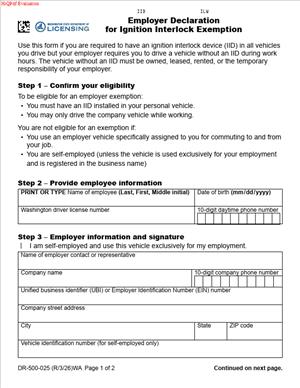
DR-500-025 – Employer Declaration for Ignition Interlock Exemption
Fill out nowJurisdiction: Country: United States | Province or State: Washington
If you are completing DR-500-025 – Employer Declaration for Ignition Interlock Exemption, you are likely trying to address a driving restriction related to an ignition interlock device requirement. This form is used in specific employment situations where driving is part of your job duties.
The document allows an employer to confirm certain facts about your employment. It connects your work responsibilities with a request related to ignition interlock requirements. The information provided must be clear and accurate.
You may be filling this out because your job requires you to operate vehicles owned by your employer. In some cases, state rules may allow limited exemptions while you are performing work duties. This form supports that process.
Understanding what the form does—and what it does not do—can help you complete it correctly. It is not a general permission slip. It is a formal declaration made by an employer to a state agency.
This guide explains how the form works, when it is used, and how to fill it out step by step.
What is DR-500-025 – Employer Declaration for Ignition Interlock Exemption?
Clear definition
DR-500-025 – Employer Declaration for Ignition Interlock Exemption is a written declaration completed by an employer. It verifies that an employee is required to drive as part of their job and may request an exemption from ignition interlock device requirements while operating employer-owned vehicles during work hours.
An ignition interlock device is typically installed in a vehicle and requires a breath sample before the vehicle can start. Some drivers are required to use this device because of prior driving-related offenses. This form addresses situations where installing such a device in every employer-owned vehicle may not be practical.
The document serves as an official statement. It provides employment details and confirms that the driving is work-related. It does not replace a driver’s license or remove other restrictions.
Who typically uses this form?
This form is commonly used by employees who are subject to an ignition interlock requirement and whose job duties include driving vehicles owned, leased, or controlled by their employer.
Employers who may complete this declaration include construction companies, delivery services, maintenance businesses, landscaping companies, utilities, and other organizations that require staff to drive fleet vehicles. Office-based employers may also use it if employees must travel between job sites.
The employee does not complete the employer section alone. An authorized representative of the employer usually signs the declaration. That person may be an owner, manager, human resources representative, or supervisor with authority to confirm job duties.
Why might you need this form?
You might need this form if your driving privileges are restricted and you are required to use an ignition interlock device, but your job requires you to drive vehicles that do not have one installed.
Installing ignition interlock devices in company vehicles may be expensive or operationally difficult. Some businesses operate shared fleet vehicles used by many employees. In those cases, an exemption during work hours may be considered.
The form provides the state with written confirmation that driving is part of your employment. It helps clarify that the vehicle use is limited to job-related tasks and not for personal purposes.
Without this declaration, your ability to drive employer vehicles may be limited. That could affect your ability to perform your job.
Typical real-life scenarios
- You work for a construction company and drive a company truck to job sites every day. You are subject to an ignition interlock requirement on your personal vehicle. The company does not install interlock devices on its fleet. Your employer may complete this declaration to confirm your work-related driving.
- You are a technician who travels between customer locations using a shared service van. The van is assigned daily to different employees. Installing an ignition interlock device in every shared vehicle would disrupt operations. The employer may use this form to explain the situation.
- You work for a delivery company and operate a company-owned vehicle only during scheduled shifts. You do not use the vehicle for personal errands. The employer declaration can confirm that your driving is strictly tied to employment duties.
- You are a farm employee who operates farm vehicles and equipment on public roads as part of your daily tasks. Your employer may use this document to describe your role and the necessity of driving during work hours.
- In each of these situations, the declaration focuses on work-related driving. It does not address personal driving outside of employment.
When would you use DR-500-025 – Employer Declaration for Ignition Interlock Exemption?
You would use this form when your driving privilege includes an ignition interlock requirement and your employment requires you to operate vehicles that are not equipped with such a device.
This often arises after a license suspension or restriction tied to a driving offense. When driving privileges are reinstated with conditions, an ignition interlock requirement may be one of those conditions.
If your job involves regular vehicle use and your employer’s vehicles do not have interlock devices installed, this document may be part of the administrative process to clarify your work-related driving.
Employees in fields such as construction, transportation, maintenance, utilities, agriculture, and field services commonly encounter this issue. Supervisors, route drivers, delivery personnel, sales representatives, and technicians may all need to drive during work hours.
The form is typically used before or during the period when you are subject to the ignition interlock requirement. It is part of a larger licensing or compliance process.
It is not used for personal vehicles. It addresses employer-owned or employer-controlled vehicles used strictly for job duties.
Legal characteristics of DR-500-025 – Employer Declaration for Ignition Interlock Exemption
This document functions as a formal declaration by an employer to a state licensing authority. It provides factual statements about employment, job duties, and the need to operate specific vehicles.
For the form to be effective, it usually must be completed fully and accurately. Missing signatures, incomplete employment information, or unclear vehicle details may cause delays or rejection. The person signing must have authority to represent the employer.
The declaration typically includes identifying information for both the employee and the employer. It may require details such as the business name, address, phone number, and a description of the employee’s driving responsibilities.
False or misleading statements can create serious consequences. Because this is a formal declaration, it is expected to be truthful and complete. Inaccurate information may affect both the employee’s driving privileges and the employer’s credibility.
Different states handle ignition interlock exemptions in different ways. Some states allow broader employer exemptions, while others limit them or do not permit them at all. In Washington, this document is used as part of the state’s process for addressing employer-related driving situations.
It is important to understand what this document does not do. It does not remove the ignition interlock requirement entirely. It does not restore full, unrestricted driving privileges. It does not allow personal use of employer vehicles without restrictions. It does not change court orders or erase prior violations.
The form is one piece of a larger administrative framework related to driver licensing.
Is it legally binding?
Yes, in the sense that it is a formal declaration made to a government agency. The employer’s signature represents a statement that the information provided is true.
While the form itself is not a contract between you and the state, it carries legal weight because it is submitted as part of an official licensing process. The information may be relied upon when determining how driving restrictions apply in a work setting.
If the conditions described in the declaration are not followed, the exemption may not apply. For example, if an employee uses an employer vehicle for personal purposes outside the scope of employment, that use may fall outside what was declared.
The document does not create new employment rights or obligations beyond what is stated. It does not replace an employment agreement. Its binding effect is tied to the accuracy of the statements and their use in the licensing context.
How to fill out DR-500-025 – Employer Declaration for Ignition Interlock Exemption
Step 1 – Review the entire form before writing
Start by reading the full DR-500-025 – Employer Declaration for Ignition Interlock Exemption from beginning to end. This helps you understand what information is required and who must complete each section. Pay attention to which parts are for the employee and which are for the employer.
Step 2 – Enter the employee’s identifying information
Provide the employee’s full legal name as it appears on their driver’s license. Include the driver’s license number and any other identifying details requested on the form. Double-check spelling and numbers for accuracy.
Step 3 – Provide employer business details
Enter the legal name of the business. Include the business address, city, state, and zip code. Add a current phone number where the employer can be reached if verification is needed.
Step 4 – Describe the employee’s job position
State the employee’s job title or role within the company. Be specific. Instead of writing “worker,” describe the actual position, such as “field technician” or “delivery driver.” This helps clarify why driving is required.
Step 5 – Explain the driving duties
Clearly describe how driving is part of the employee’s job. Indicate whether the employee drives daily, occasionally, or only during certain projects. Note whether the vehicles are company-owned, leased, or controlled by the employer.
Keep this section factual and focused on work activities. Avoid general statements. The goal is to show that driving is necessary for job performance.
Step 6 – Confirm vehicle ownership and use limits
Indicate that the vehicles driven are owned, leased, or otherwise controlled by the employer. Clarify that the vehicles are used for business purposes. If the form includes language about limiting use to work hours or specific duties, ensure the description matches the actual practice.
Step 7 – Review the declaration statement
Read the certification or declaration language carefully. This section typically confirms that the information provided is true and correct. Make sure all earlier sections are complete before signing.
Step 8 – Employer signature and date
An authorized employer representative signs and dates the form. The signature should be handwritten if required. The signer may need to print their name and title. Ensure the date is accurate and legible.
Step 9 – Employee acknowledgment if required
If the form includes a section for the employee’s signature or acknowledgment, complete it as instructed. Confirm that the employee understands the limits of the exemption described.
Step 10 – Make a copy for your records
Before submitting the completed document, make a clear copy for both the employer and the employee. Keep the copy in a secure place. It may be helpful if questions arise later about what was declared.
Legal terms you might encounter in DR-500-025 – Employer Declaration for Ignition Interlock Exemption
- Ignition Interlock Device (IID): An ignition interlock device is a breath-testing unit installed in a vehicle. It prevents the vehicle from starting if alcohol is detected. In this form, the device is central because the exemption applies only to certain employer-owned vehicles that do not have an IID installed.
- Exemption: An exemption is a legal exception to a general rule. Here, it refers to the limited ability of an employee with an interlock requirement to drive a qualifying employer vehicle without an IID. The exemption applies only under specific conditions described in the document.
- Employer Declaration: This is the employer’s formal written statement. By signing, the employer confirms that the information provided is true and that the employee’s job requires driving. The declaration carries legal weight and can be reviewed by licensing authorities.
- Scope of Employment: This term refers to activities performed as part of your job duties. The form limits the exemption to driving that occurs within your assigned work tasks. Personal use of the vehicle is outside the scope of employment and is not covered.
- Employer-Owned Vehicle: This means a vehicle owned or leased by the business. The exemption generally does not apply to a vehicle you personally own. The form requires confirmation that the vehicle belongs to the employer and is used for work purposes.
- Authorized Signer: An authorized signer is a person who has the legal authority to sign on behalf of the business. This may be an owner, officer, or manager. The form relies on this person’s signature to validate the declaration.
- License Restriction: A license restriction is a limitation placed on your driving privileges. An ignition interlock requirement is one type of restriction. This document addresses how that restriction interacts with your work duties.
- False Statement: A false statement is incorrect or misleading information given on an official document. Providing false information on this declaration can lead to penalties, including possible changes to your driving status. Both the employer and employee should review the information carefully before signing.
- Effective Period: The effective period is the timeframe during which the exemption is valid. It is typically tied to the duration of your employment or the ignition interlock requirement. If your job changes or ends, the exemption may no longer apply.
FAQs
Does this form remove the ignition interlock requirement from my license completely?
No. This document does not erase the restriction on your license. It allows you to drive certain employer-owned vehicles without an ignition interlock device, but only while performing job duties and only if the conditions in the form are met. Your personal vehicle and any non-qualifying vehicles must still comply with the restriction.
Who must sign DR-500-025 – Employer Declaration for Ignition Interlock Exemption?
An authorized representative of your employer must sign it. This is usually an owner, corporate officer, or manager with authority to make official statements for the business. You may also need to sign to acknowledge the information, depending on how the form is structured. Make sure the signer includes their title and contact details so the declaration can be verified if needed.
What information does my employer need to provide on this document?
Your employer must enter the business name, address, and contact information. They must describe your job position and confirm that driving is part of your regular duties. The form also requires a statement that the vehicle is employer-owned and that your driving will be limited to work-related activities.
Can I use the employer vehicle for personal errands under this exemption?
No. The exemption applies only when you are driving within the scope of your employment. Personal errands, commuting outside approved use, or using the vehicle for non-work purposes are not covered. If you drive outside the permitted scope, you may violate your license restriction.
What happens if I change jobs after this form is submitted?
The exemption is tied to the specific employer who completed and signed the document. If you leave that job, the exemption connected to that employer no longer applies. A new employer would need to complete a new declaration before you could rely on a similar exemption in a different position.
Do I need to submit this form myself, or does my employer send it?
You should confirm the submission process before relying on the exemption. In many cases, you are responsible for ensuring the completed DR-500-025 – Employer Declaration for Ignition Interlock Exemption is properly submitted to the appropriate licensing authority. Keep a copy for your records so you can show proof if questions arise.
How do I know if the exemption has been accepted?
You should look for confirmation from the licensing agency, such as an updated license record or written notice. Until you receive confirmation, do not assume the exemption is active. Driving without an ignition interlock in a non-qualified vehicle before acceptance could put you at risk of violating your restriction.
What if the information on this form is incorrect after it is filed?
If you discover an error, correct it as soon as possible. Contact your employer and prepare an updated declaration with accurate details. Do not continue relying on incorrect information, because inaccurate statements can lead to enforcement action or suspension of your driving privileges.
Checklist: Before, During, and After DR-500-025 – Employer Declaration for Ignition Interlock Exemption
Before
- Confirm that your license has an ignition interlock restriction.
- Verify that your job truly requires you to drive as part of your duties.
- Check that the vehicle you will drive is owned or leased by your employer.
- Identify the correct authorized person who can sign for the business.
- Gather accurate business contact information.
- Review your job description to describe driving duties clearly.
- Make sure you understand the limits of the exemption.
- Ask how and where the completed form must be submitted.
During
- Print or type all information clearly and legibly.
- Enter your full legal name exactly as it appears on your license.
- Provide complete employer details without abbreviations that cause confusion.
- Describe your driving duties specifically, not in general terms.
- Confirm that the vehicle qualifies under the exemption rules.
- Review every statement before signing.
- Ensure the authorized signer includes their title.
- Date all signatures accurately.
- Double-check for missing fields or blank sections.
After
- Make a clear copy of the signed form for yourself.
- Provide a copy to your employer for their records.
- Submit the form according to the required process.
- Wait for confirmation before driving without an interlock in a work vehicle.
- Monitor your driving record for updates.
- Keep the document in your vehicle if appropriate.
- Notify the licensing authority if your employment changes.
- Update the form if your job duties significantly change.
Common mistakes to avoid with DR-500-025 – Employer Declaration for Ignition Interlock Exemption
- Mistake: Assuming the exemption applies to all vehicles, which happens when people skim the form; this can lead to driving violations and penalties, so do not forget that it applies only to qualifying employer-owned vehicles used for work.
- Mistake: Having an unauthorized employee sign the form because it seems convenient; this can invalidate the declaration and delay approval, so do not forget to confirm the signer’s authority and title.
- Mistake: Providing vague job descriptions like “various duties,” which often happens from rushing; this may cause rejection or follow-up questions, so do not forget to clearly explain how driving is part of your job.
- Mistake: Leaving sections blank because they seem unimportant; incomplete forms can be refused or returned, so do not forget to review every line before submission.
- Mistake: Failing to keep a copy, often due to last-minute filing; this can create problems if proof is requested, so do not forget to store a complete copy for your records.
- Mistake: Continuing to rely on the exemption after changing jobs, which happens when people assume it transfers automatically; this can result in a violation, so do not forget that a new employer must complete a new declaration.
- Mistake: Using the vehicle for personal errands because it feels harmless; this can breach your license restriction and trigger penalties, so do not forget that the exemption covers work-related driving only.
- Mistake: Ignoring errors after submission, often out of fear of drawing attention; uncorrected mistakes can lead to enforcement action, so do not forget to promptly file a corrected declaration if needed.
What to do after filling out DR-500-025 – Employer Declaration for Ignition Interlock Exemption
Once the form is fully completed and signed, slow down and review your next steps. Do not assume that signing the document automatically activates the exemption. You need to confirm that it has been properly processed.
Start by organizing your paperwork. Keep the original signed document in a safe place. Create at least one clear copy for yourself and one for your employer’s records.
- Step 1: Make a complete copy of the signed form for your personal file.
- Step 2: Confirm who is responsible for submitting the form and how it must be delivered.
- Step 3: Submit the form using the required method, ensuring all pages are included.
- Step 4: Note the date of submission and keep proof of delivery if available.
- Step 5: Monitor your license status or driving record for updates.
- Step 6: Wait for confirmation that the exemption is recognized before driving a qualifying employer vehicle without an IID.
- Step 7: Inform your supervisor once confirmation is received, so expectations are clear.
- Step 8: Keep a copy accessible in case a law enforcement officer or compliance officer asks for documentation.
- Step 9: Review your job duties periodically to ensure they still match what was described.
- Step 10: If your employment ends or your duties change, stop relying on the exemption and address any new requirements promptly.
Stay proactive. If you do not receive confirmation within a reasonable time, follow up. Do not drive under the assumption that “no news is good news.” Clear confirmation protects you.
Keep your employer informed about your licensing status. If your restriction period ends, you may no longer need the exemption. If your restriction is extended or modified, check whether a new declaration is required.
Finally, treat this document as part of your broader compliance record. Store it with other driving-related documents. Staying organized reduces stress and helps you respond quickly if questions arise.
Disclaimer: This guide is provided for informational purposes only and is not intended as legal advice. You should consult a legal professional.