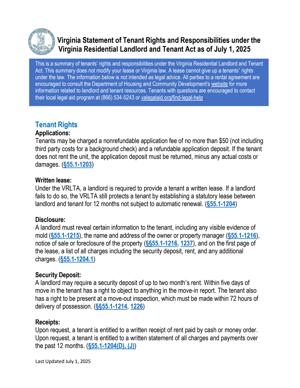
Acknowledgement of Receipt of Statement of Tenant Rights and Responsibilities
Fill out nowJurisdiction: Country: United States | Province or State: Virginia
The Acknowledgement of Receipt of Statement of Tenant Rights and Responsibilities is a written confirmation that you received a document explaining your rights and duties as a tenant. It does not create a new lease. It simply confirms delivery and receipt of important information.
You will usually see this form at the start of a rental relationship. It may be included in a leasing packet or provided separately. In Virginia, it is connected to guidance issued by the state housing authority.
If you are about to sign the Acknowledgement of Receipt of Statement of Tenant Rights and Responsibilities, you are not agreeing to new rules. You are confirming that you received a written statement outlining existing tenant rights and responsibilities.
This matters because written confirmation helps prevent disputes. If questions come up later about what information was shared, this document serves as a record.
What is Acknowledgement of Receipt of Statement of Tenant Rights and Responsibilities?
Clear definition
The Acknowledgement of Receipt of Statement of Tenant Rights and Responsibilities is a short form that confirms a tenant received a separate written statement describing tenant rights and responsibilities under Virginia law.
It is not the same as a lease agreement. The lease sets out the rental terms, such as rent, length of tenancy, and house rules. This form only confirms that the tenant was given an informational statement.
The document usually includes spaces for the tenant’s name, the rental property address, and the date of signing. It may also include a line for the landlord or property manager to confirm delivery.
In simple terms, it is proof of receipt. It creates a paper trail showing that the required information was provided to you.
Who typically uses this form?
Tenants use this form when entering into a residential rental agreement. It is most common in standard apartment or single-family home rentals.
Landlords and property managers also use the form. They provide the statement of rights and responsibilities and then ask the tenant to sign the acknowledgement as confirmation.
Property management companies often include it as part of a move-in packet. Individual landlords may provide it along with the lease for signature at the same time.
In some cases, housing programs or publicly supported housing providers may also use a similar acknowledgement process as part of their onboarding documents.
Why might you need this form?
You may need this form because state housing rules require that tenants be informed of their rights and responsibilities. The acknowledgement confirms that this step was completed.
The form helps establish transparency. It shows that you were given written information about maintenance responsibilities, notice requirements, and other basic legal duties.
It can also reduce misunderstandings. If a dispute arises about what you were told at move-in, the signed acknowledgement shows that the written statement was provided.
For landlords, it supports recordkeeping. For tenants, it confirms that the information was formally delivered and acknowledged.
Typical real-life scenarios
- You sign a one-year lease for an apartment. During the lease signing meeting, the landlord hands you a packet. Inside is the tenant rights statement and the acknowledgement form. You review it and sign to confirm receipt.
- You move into a property managed by a management company. Before you receive the keys, the office staff asks you to sign several documents, including this acknowledgement. It becomes part of your tenant file.
- You renew your lease after a year. The landlord provides an updated statement of tenant rights and responsibilities. You are asked to sign a new acknowledgement confirming you received the updated version.
- You transfer from one unit to another within the same apartment complex. The property manager treats the transfer like a new tenancy and includes the acknowledgement form in your new paperwork.
When would you use Acknowledgement of Receipt of Statement of Tenant Rights and Responsibilities?
You use this form at the beginning of a tenancy. It typically accompanies the lease signing process. The landlord provides the written statement, and you sign the acknowledgement shortly after reviewing it.
It may also be used when a tenancy changes in a significant way. For example, if a new lease is signed after a prior one ends, the landlord may provide the statement again and request a new acknowledgement.
If the housing authority updates the official statement of tenant rights and responsibilities, landlords may distribute the revised version to current tenants. In that case, tenants may be asked to sign a new acknowledgement to reflect receipt of the updated document.
This form is usually signed by tenants. Landlords or property managers often countersign to confirm delivery, though the exact format can vary. The timing is commonly at move-in, lease renewal, or another formal transition in the rental relationship.
Legal Characteristics of Acknowledgement of Receipt of Statement of Tenant Rights and Responsibilities
This document functions as written confirmation of delivery. For it to be effective, it generally needs clear identification of the tenant, the property, and the date of receipt. A signature is typically required to confirm acknowledgment.
Clarity matters. If the form does not clearly reference the statement of tenant rights and responsibilities, it may create confusion about what was received. Incomplete fields, missing signatures, or unclear dates can weaken its value as a record.
The document is usually simple and short. It does not restate the entire list of rights and responsibilities. Instead, it refers to the separate statement that contains the full explanation.
Requirements and formatting can vary by jurisdiction. In Virginia, the statement of tenant rights and responsibilities is associated with state housing authorities. The acknowledgement form reflects compliance with that informational requirement.
It is important to understand what this form does not do. It does not change the terms of your lease. It does not waive your rights. It does not automatically resolve disputes. It only confirms that you received a specific informational document.
Is it legally binding?
The Acknowledgement of Receipt of Statement of Tenant Rights and Responsibilities is legally significant in a limited way. By signing, you confirm that you received the referenced statement.
Your signature does not mean you agree with every detail of the statement. It confirms receipt, not acceptance of new terms beyond what the law and your lease already provide.
In general, once signed, the acknowledgement can be used as evidence that the required information was delivered. If a disagreement arises about whether the statement was provided, the signed form may be presented as proof of receipt.
However, the form does not create new obligations beyond those already established by law and your lease agreement. Its binding effect relates to confirmation of delivery, not the creation of new rental terms.
How to fill out the Acknowledgement of Receipt of Statement of Tenant Rights and Responsibilities
Step 1 – Review the Statement of Tenant Rights and Responsibilities
Before completing the acknowledgement, read the full statement that explains your rights and responsibilities. Make sure you understand that this is the document you are confirming receipt of. The acknowledgement refers to this specific statement, so reviewing it first helps ensure accuracy.
Step 2 – Enter the Tenant’s Full Legal Name
Write your full legal name exactly as it appears on your lease agreement. If there are multiple tenants on the lease, each person may need to sign a separate acknowledgement or be listed on the same form, depending on the format provided.
Step 3 – Provide the Rental Property Address
Fill in the complete address of the rental property. Include the unit number if applicable. The address should match the address listed in your lease to avoid confusion about which property the acknowledgement relates to.
Step 4 – Confirm the Date of Receipt
Enter the date you received the statement of tenant rights and responsibilities. This is often the same date you sign the lease, but it can differ if the documents were delivered earlier or later. The date creates a clear timeline for recordkeeping.
Step 5 – Sign the Form
Sign your name in the designated signature line. Your signature confirms that you received the statement. It does not indicate that you are creating new lease terms, only that the document was provided to you.
Step 6 – Print Your Name Clearly
If the form includes a printed name line, write your name clearly below or next to your signature. This helps ensure that your identity is easy to verify in the future, especially if your signature is difficult to read.
Step 7 – Landlord or Property Manager Confirmation
If the form includes a section for the landlord or property manager, they may sign and date it to confirm delivery. This step creates a complete record showing both delivery and receipt of the statement.
Step 8 – Keep a Copy for Your Records
After the form is completed and signed, make sure a copy is kept with your rental documents. Keeping the acknowledgement with your lease and related paperwork helps you maintain a clear record of your tenancy documents.
Legal terms you might encounter in Acknowledgement of Receipt of Statement of Tenant Rights and Responsibilities
- Statement of Tenant Rights and Responsibilities: This is a separate document that explains your legal rights and duties as a tenant. The acknowledgement form confirms you received that statement. It does not restate all the rights and responsibilities. Instead, it acts as proof that the information was provided to you.
- Acknowledgement: An acknowledgement is a written confirmation that you received something. In this context, it means you are confirming receipt of the rights and responsibilities statement. You are not necessarily agreeing with every word. You are confirming that the document was given to you.
- Receipt: Receipt refers to the act of receiving the document. The date of receipt is important. It shows when you were provided with the required information.
- Tenant: The tenant is the person who rents the property and signs the lease. The name on this form should match the name on the lease. If there are multiple tenants, each may need to sign separately.
- Landlord: The landlord is the property owner or the person authorized to manage the property. This person provides the statement and may sign to confirm it was delivered. The landlord’s information should match the lease and rental records.
- Property Address: This is the full physical address of the rental unit. It identifies the specific unit covered by the acknowledgement. Accuracy matters, especially in multi-unit buildings.
- Effective Date: The effective date is when the acknowledgement becomes valid. Often, this is the date you sign the form. In some cases, it may align with the lease start date.
- Signature: Your signature shows that you personally received the statement. A handwritten or legally accepted electronic signature may be used, depending on how the document is completed. The signature must match the name listed on the lease.
- Authorized Agent: An authorized agent is someone legally allowed to act on behalf of the landlord. This might be a property manager. If an agent signs, they should indicate their role clearly.
- Compliance: Compliance refers to meeting legal requirements. This acknowledgement helps demonstrate that the landlord met the requirement to provide the statement. It also shows you were informed of your rights and responsibilities.
FAQs
Do I have to sign the Acknowledgement of Receipt of Statement of Tenant Rights and Responsibilities?
If you are entering into a lease or starting a tenancy, you are generally expected to sign to confirm you received the required information. Signing this form does not mean you agree to change your rights. It confirms that the statement was given to you. Refusing to sign may delay paperwork or create confusion about whether you received the required notice.
What if my name is spelled differently on this document than on my lease?
Your name should match your lease and any identification documents used for the rental. If you see a spelling error, ask for it to be corrected before signing. Small mistakes can create issues later if there is ever a dispute about who signed or received the statement.
Do all tenants in the unit need to sign?
If more than one person is listed as a tenant on the lease, each tenant may need to sign separately. Check whether there are multiple signature lines. Each person is confirming that they personally received the statement.
What date should I write on the form?
You should enter the actual date you received and sign the document. Do not backdate or postdate it. The date helps establish when the information was provided to you, which can matter if questions arise later.
Am I agreeing to all the rules in the statement by signing?
No. By signing this form, you are confirming receipt of the statement, not agreeing to new lease terms. Your lease agreement controls your rental terms. This document simply records that you were given the required explanation of your rights and duties.
What if I never received the actual rights and responsibilities statement?
You should not sign until you receive and review the full statement. The purpose of this form is to confirm delivery. If the statement is missing, ask for a complete copy before signing so you understand what you are acknowledging.
Does this form get filed with a court or government office?
In most cases, this document is kept in the landlord’s and tenant’s records. It is not typically filed with a court at the time of signing. However, it can later be used as evidence that the required information was provided.
Can I request a copy of the signed acknowledgement?
Yes. You should always keep a copy for your records. If you sign electronically, download or print the final version. Keeping a copy protects you if there is ever a disagreement about whether you received the information.
Checklist: Before, During, and After Acknowledgement of Receipt of Statement of Tenant Rights and Responsibilities
Before
- Review the full Statement of Tenant Rights and Responsibilities carefully.
- Confirm your full legal name matches your lease.
- Verify the complete rental property address, including unit number.
- Check that all tenants listed on the lease are identified.
- Make sure the statement is complete and not missing pages.
- Confirm the landlord or property manager’s name is correct.
- Set aside time to read the document without pressure.
- Prepare identification if needed to verify your name spelling.
During
- Enter your full legal name clearly and legibly.
- Fill in the correct rental property address.
- Write the actual date you received and sign the form.
- Read the acknowledgement language before signing.
- Sign exactly as your name appears on the lease.
- Ensure each co-tenant signs on the appropriate line.
- Confirm that the landlord or authorized agent signs if required.
- Check that no blanks are left unfilled.
After
- Request a complete copy of the signed form immediately.
- Store a digital copy in a secure folder.
- Keep a paper copy of your lease documents.
- Note the date in your personal rental records.
- Confirm that the landlord also retains a copy.
- Save any email confirmation if signed electronically.
- Review the rights and responsibilities statement again later if needed.
- Update your personal file to reflect that the document was completed.
Common mistakes to avoid with Acknowledgement of Receipt of Statement of Tenant Rights and Responsibilities
- Mistake: Signing without reading the actual rights and responsibilities statement, which happens when tenants feel rushed, and this can leave you unaware of important duties, so do not forget to review the full document before signing.
- Mistake: Using a nickname or shortened version of your name, which often occurs out of habit, and this can create confusion about who signed, so do not forget to match your name exactly to the lease.
- Mistake: Leaving the date blank, which happens when people assume it will be filled in later, and this can weaken proof of when you received the statement, so do not forget to enter the correct signing date.
- Mistake: Forgetting to include the unit number in multi-unit properties, which is common in large buildings, and this can make the document unclear, so do not forget to write the full address.
- Mistake: Allowing only one co-tenant to sign when multiple tenants are listed, which may occur due to oversight, and this can lead to disputes about notice, so do not forget that each listed tenant may need to sign.
- Mistake: Failing to keep a personal copy, which happens when you rely on the landlord to store records, and this can leave you without proof later, so do not forget to save or print your own copy.
- Mistake: Signing before errors are corrected, which often happens when you want to finish quickly, and this can lock in incorrect information, so do not forget to review all details carefully before signing.
- Mistake: Assuming this form changes your lease terms, which happens due to misunderstanding the purpose of an acknowledgement, and this can cause unnecessary concern, so do not forget that it confirms receipt, not agreement to new terms.
What to do after filling out the Acknowledgement of Receipt of Statement of Tenant Rights and Responsibilities
Once you complete the form, focus on documentation and organization. This form is about proof. You want clear records that show when and how you received the required information.
Start by making sure all signatures are present. Look at the signature lines for each tenant and the landlord or authorized agent. Confirm that dates are filled in and legible. Small gaps can create unnecessary questions later.
- Step 1: Review the completed form one final time for accuracy and completeness.
- Step 2: Make at least one copy for your personal records.
- Step 3: If signed electronically, download the final signed version immediately.
- Step 4: Save a digital copy in a secure location, such as a password-protected folder.
- Step 5: Place a paper copy of your lease agreement and related documents.
- Step 6: Confirm the landlord or property manager has also signed, if required.
- Step 7: Ask for written confirmation of receipt if the document was exchanged by email.
- Step 8: Record the completion date in your personal rental file or calendar.
- Step 9: Revisit the Statement of Tenant Rights and Responsibilities to make sure you understand key obligations like maintenance requests, rent payment timing, and notice requirements.
- Step 10: Keep the document accessible in case a question arises about whether you were properly informed.
If a dispute ever comes up about notice, repairs, rent increases, or lease termination, this acknowledgement may be referenced. Having your own organized copy helps you respond confidently.
Also, treat this as a prompt to understand your responsibilities. The form itself is short. The real value is in the statement you received. Review sections about maintenance duties, security deposits, entry rights, and notice periods. Knowing these rules early can prevent misunderstandings later.
Finally, maintain a consistent recordkeeping for all rental documents. Create a single folder—digital, physical, or both—for your lease, addenda, inspection reports, and this acknowledgement. Clear records make communication easier and reduce stress if questions arise during your tenancy.
Disclaimer: This guide is provided for informational purposes only and is not intended as legal advice. You should consult a legal professional.