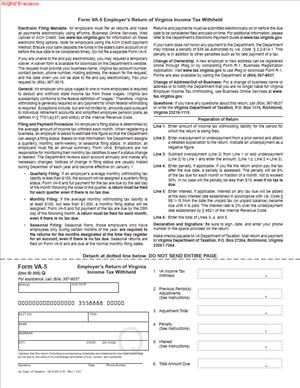
Form VA-5 – Employer’s Return of Virginia Income Tax Withheld
Fill out nowJurisdiction: Country: United States | Province or State: Virginia
Form VA-5 – Employer’s Return of Virginia Income Tax Withheld is a state tax filing used by employers to report and pay Virginia income tax withheld from employees’ wages. If you run payroll in Virginia, this form plays a central role in your tax reporting process.
When you withhold state income tax from employee paychecks, you are holding that money in trust for the state. This form accounts for those amounts and sends them to the proper authority. It connects your payroll records to your tax payment.
If you are about to complete this form, you are likely handling payroll responsibilities for a business. You may be an owner, manager, payroll administrator, or bookkeeper. Understanding what the form requires helps you avoid delays, corrections, and penalties.
This document is not about your business’s income tax. It focuses only on the Virginia income tax you withheld from employees. Clear reporting and timely submission keep your payroll process aligned with state requirements.
What is Form VA-5 – Employer’s Return of Virginia Income Tax Withheld?
Clear definition
Form VA-5 – Employer’s Return of Virginia Income Tax Withheld is a periodic withholding tax return. Employers use it to report the total amount of Virginia state income tax withheld from employees during a specific filing period and to remit that amount to the state.
The form summarizes payroll activity for the period. It shows how much tax was withheld and how much is being paid with the return. It acts as both a report and a payment voucher.
This filing is separate from federal payroll tax forms. It applies only to Virginia state income tax withholding.
Who typically uses this form?
This form is used by employers who withhold Virginia income tax from employee wages. That includes corporations, limited liability companies, partnerships, sole proprietors, and nonprofit organizations with employees.
It is often completed by a payroll administrator or internal accounting staff. In smaller businesses, the owner may handle it directly.
If you are registered as an employer for Virginia withholding tax, you are generally responsible for filing this return based on your assigned filing frequency.
Why might you need this form?
You need this form when you are required to report and pay Virginia income tax withheld from employee wages. Filing ensures that the amounts taken from paychecks are properly credited and accounted for.
The state assigns employers a filing frequency. This may be monthly, quarterly, or another schedule, depending on payroll size and withholding volume. Your assigned frequency determines when this form is due.
If you have withheld any Virginia income tax during the period, this form is the mechanism for reporting and paying it. Even if no tax was withheld for a period, a return may still be required, depending on your registration status.
Typical real-life scenarios
- You run a small retail store in Virginia with five employees. Each pay period, you withhold state income tax from their wages. At the end of the assigned reporting period, you use this form to report the total withheld and submit payment.
- You operate a growing technology company. Your payroll is processed twice a month, and withholding amounts vary. The form helps you reconcile your payroll reports with the state’s records for each filing cycle.
- You recently hired your first employee. After registering for the Virginia withholding tax, you are notified of your filing frequency. You now use this form to report the tax withheld from your employee’s paycheck.
- You temporarily had no employees during part of the year, but you remain registered for withholding. For the reporting periods when no wages were paid, you may still need to file the form showing zero withholding to keep your account current.
When would you use Form VA-5 – Employer’s Return of Virginia Income Tax Withheld?
You use this form at the end of each assigned withholding reporting period. The specific timing depends on the filing frequency assigned to your business.
If you are a monthly filer, you complete the form after the close of each month in which wages were paid. If you are a quarterly filer, you complete it after the end of each calendar quarter.
You also use this form when reconciling your payroll records. Before submitting the return, you compare the total Virginia income tax withheld in your payroll system to the amount reported on the form. This helps ensure that your reporting matches your internal records.
If your business changes structure or closes, there may be a final filing requirement. In that situation, the form is used to report the last period of withholding before the account is closed.
Payroll staff, controllers, and business owners often use this form as part of their recurring payroll tax calendar. It becomes a routine compliance task tied to regular wage payments.
Legal characteristics of Form VA-5 – Employer’s Return of Virginia Income Tax Withheld
This form functions as an official tax return. When you complete and submit it, you are formally reporting tax amounts to a state authority. The information provided is part of your employer’s tax record.
For the return to be effective, it must be complete and accurate. This typically includes correct employer identification information, the proper reporting period, and accurate totals for tax withheld and payment remitted.
Returns are commonly rejected or flagged when identification numbers do not match state records, when the reporting period is incorrect, or when payment amounts differ from the reported withholding. Mathematical errors can also trigger issues.
The form does not calculate employee withholding for you. That calculation occurs during payroll processing. This document only reports the totals already withheld.
It also does not replace annual reconciliation filings or employee wage statements. It is one piece of the overall payroll tax reporting process.
Requirements and filing methods may vary depending on employer size and assigned filing status. Some employers may be required to file electronically, while others may have more than one reporting option. The core purpose of the form remains the same: to report and remit withheld state income tax.
Is it legally binding?
Yes, in the sense that it is an official tax return submitted to a government authority. When you file it, you are making a formal declaration of the amount of Virginia income tax withheld during the reporting period.
Submitting the form generally includes a declaration that the information provided is true and correct to the best of your knowledge. This gives the document legal weight.
If the reported amounts are inaccurate, incomplete, or not paid as reported, this can lead to notices, assessments, penalties, or additional review. The form itself creates an official record of what you reported and when you reported it.
However, the form does not create a contract between you and your employees. It does not determine how much tax an employee ultimately owes. It strictly reports the amounts withheld and remitted during a specific period.
How to fill out Form VA-5 – Employer’s Return of Virginia Income Tax Withheld
Step 1 – Enter your employer information
Start by entering your business name and mailing address exactly as registered for Virginia withholding tax. Include your employer identification number and any state-issued account number associated with your withholding account. These identifiers connect your filing to the correct account.
Step 2 – Identify the correct reporting period
Enter the specific month or quarter covered by the return. Make sure the dates match your assigned filing frequency. Reporting the wrong period can cause processing delays or misapplied payments.
Step 3 – Report total Virginia income tax withheld
Using your payroll records, calculate the total Virginia income tax withheld from all employees during the reporting period. Enter this total in the space provided. Double-check your payroll summaries to confirm the figure matches your internal reports.
Step 4 – Enter any adjustments if applicable
If the form includes a line for adjustments, enter any allowed corrections for prior periods as directed by the form’s instructions. Adjustments should reflect documented differences, such as corrected payroll entries. Ensure the math reflects the adjustment clearly.
Step 5 – Calculate the total amount due
Add or subtract any adjustments from the total withholding to determine the net amount due for the period. Review the calculation carefully. The amount shown as due should match the payment you are submitting with the return.
Step 6 – Provide payment information
Indicate the amount being paid with the return. If paying separately from the paper form, ensure the payment is properly referenced with your employer identification details so it is credited to the correct account.
Step 7 – Review for accuracy
Before submitting, review every entry. Confirm employer identification numbers, reporting period, and total withholding amounts. Compare the form to your payroll register and bank records to ensure consistency.
Step 8 – Sign and submit the form
If a signature line is included, sign and date the return where required. The person signing is typically an authorized individual, such as an owner, officer, or designated payroll representative. Submit the form using the approved filing method for your account and retain a copy with your payroll tax records.
Legal terms you might encounter in Form VA-5 – Employer’s Return of Virginia Income Tax Withheld
- Withholding Tax: This is the Virginia income tax you deduct from your employees’ wages and hold in trust for the state. On this form, you report the total amount withheld during a specific filing period. It is not your business income. You are acting as a collection agent for the state.
- Reporting Period: This refers to the specific month or quarter covered by the return. You must match the period shown on the form to your payroll records. Filing for the wrong period can cause misapplied payments and account discrepancies.
- Employer Identification Number (EIN): This is the federal tax ID assigned to your business by the IRS. You enter it on the form to identify your withholding account. An incorrect EIN can delay processing or apply your payment to the wrong account.
- Account Number: This is the Virginia withholding tax account number assigned by the Department of Taxation. It links your return and payment to your state tax account. Always verify it against prior filings or official notices.
- Total Tax Withheld: This is the cumulative amount of Virginia income tax deducted from employee wages during the reporting period. You calculate it from your payroll records. The figure must match your internal payroll reports for that same period.
- Adjustments: These are corrections to previously reported amounts. You may use them if you overreported or underreported withholding in a prior return. Adjustments should be supported by documentation in case of review.
- Penalty: A penalty is an added charge for late filing, late payment, or underpayment. If you miss a deadline or submit less than the required amount, the state may assess a penalty automatically. The form may require you to include calculated penalties if applicable.
- Interest: Interest accrues on unpaid tax from the original due date until the balance is paid. Even if you correct the issue later, interest can continue to accumulate. You may need to include interest when calculating your total payment due.
- Authorized Signature: This is the signature of the person legally permitted to sign on behalf of the business. It confirms that the information reported is accurate to the best of your knowledge. Signing without authority can create internal and legal issues.
FAQs
Do I need to file this form if I did not withhold any Virginia income tax during the period?
In most cases, you are still expected to file a return for the reporting period even if no tax was withheld. You would enter zero amounts where appropriate. Filing a zero return keeps your account in good standing and avoids automatic penalty notices for missing returns.
How do I know which reporting period to enter on Form VA-5 – Employer’s Return of Virginia Income Tax Withheld?
Check your Virginia withholding filing schedule, which is based on the amount of tax you withhold. Your assigned schedule determines whether you file monthly, quarterly, or on another basis. Always match the dates on the return to your payroll records for that same period.
What happens if my business name has changed since the last filing?
You should enter the current legal name of your business exactly as registered, and verify that it matches the name associated with your withholding account. If the name change has not been updated with the state, you may need to notify the tax authority separately. Using a different name without updating your account can delay processing.
Who is allowed to sign this document?
The signer must have authority to act on behalf of the business. This is usually an owner, officer, member, partner, or another authorized representative. The signature confirms that the information is accurate and complete, so you should not delegate signing to someone without proper authority.
Can I correct an error after I submit Form VA-5 – Employer’s Return of Virginia Income Tax Withheld?
Yes. If you discover an error after filing, you generally correct it by filing an amended return or adjusting a future return, depending on the situation. You should review your payroll records first to confirm the exact discrepancy before making changes.
What if the amount I withheld from employees does not match what I am about to pay?
The amount you pay should match the total tax withheld for the reporting period, plus any penalties or interest if applicable. If there is a difference, review your payroll summaries and prior adjustments. Paying less than the withheld amount can trigger notices and additional charges.
Do I need to attach payroll records or employee lists?
Typically, you do not attach detailed payroll records to this return. However, you must keep those records in your files. If the state questions your reported amounts, you may be asked to provide documentation showing how you calculated the total withholding.
How do I confirm that my return and payment were accepted?
If you file electronically, you should receive a confirmation number or acknowledgment. If you file by mail, you can confirm acceptance by checking your account status or ensuring your payment clears. Keep copies of the return and proof of payment in case questions arise later.
Checklist: Before, During, and After Form VA-5 – Employer’s Return of Virginia Income Tax Withheld
Before
- Confirm your assigned filing frequency and due date.
- Gather payroll reports for the exact reporting period.
- Verify your Virginia withholding account number.
- Confirm your federal EIN and legal business name.
- Review prior returns for any unresolved adjustments.
- Calculate total Virginia income tax withheld for the period.
- Check whether any penalties or interest may apply.
- Ensure you have the authority to sign the return.
During
- Enter your business name exactly as registered.
- Input the correct EIN and state account number.
- Select or confirm the correct reporting period.
- Report the total tax withheld from payroll records.
- Enter any adjustments carefully and document the reason.
- Calculate penalties or interest if required.
- Double-check all math before finalizing.
- Review every field for completeness.
- Sign and date the return with an authorized signature.
After
- Make a full copy of the completed return.
- Save proof of payment or transaction confirmation.
- Note the filing date in your compliance calendar.
- Reconcile the payment with your accounting records.
- File payroll reports with the return copy for reference.
- Monitor your tax account for confirmation or notices.
- Address any correspondence from the state promptly.
- Update internal tracking spreadsheets or systems.
Common mistakes to avoid with Form VA-5 – Employer’s Return of Virginia Income Tax Withheld
- Mistake: Entering the wrong reporting period because you rely on memory instead of payroll records, which can misapply payments and trigger notices, so do not forget to verify the exact dates before filing.
- Mistake: Using an outdated business name or incorrect EIN due to recent changes, which can delay processing, so do not forget to confirm that your identifying information matches your state account.
- Mistake: Reporting estimated withholding instead of actual payroll totals, often caused by rushing near the deadline, which may result in underpayment penalties, so do not forget to reconcile against finalized payroll reports.
- Mistake: Forgetting to file a zero return when no tax was withheld, which can generate automatic late notices, so do not forget that a filing requirement may still exist even with no wages paid.
- Mistake: Ignoring small underpayments, assuming they will not matter, which can lead to accumulating interest and penalties, so do not forget to pay the full balance due.
- Mistake: Failing to keep copies and proof of payment, often because filing feels routine, which leaves you unprepared for audits or disputes, so do not forget to store documentation securely.
- Mistake: Letting an unauthorized employee sign the return for convenience, which can create internal compliance issues, so do not forget to ensure the signer has proper authority.
- Mistake: Not reviewing prior adjustments before filing a new return, which can compound earlier errors, so do not forget to check your account history first.
What to do after filling out Form VA-5 – Employer’s Return of Virginia Income Tax Withheld
Once you complete the return, shift your focus to submission, confirmation, and recordkeeping. Filing the form is only part of your responsibility. You must also make sure the payment is properly applied, and your records are clean.
Start by reviewing the entire document one more time. Confirm that the reporting period matches your payroll cycle. Verify that the total tax withheld equals the amount you are paying, unless you are including penalties or interest.
- Step 1: Make a complete copy of the signed return for your records.
- Step 2: Submit the return using the approved filing method for your account.
- Step 3: Initiate payment for the full amount due on or before the deadline.
- Step 4: Save confirmation numbers or proof of mailing.
- Step 5: Record the payment in your accounting system.
- Step 6: Reconcile the payment against your payroll liability account.
- Step 7: Calendar the next filing deadline immediately.
- Step 8: Monitor your tax account for processing confirmation.
- Step 9: Respond quickly to any notice or discrepancy.
- Step 10: Store all related payroll and tax documents together.
Keep your documentation organized by reporting period. Store copies of payroll summaries, employee withholding reports, proof of payment, and the filed return in the same folder or digital directory. If you ever need to respond to a question from the Department of Taxation, you will be able to produce accurate records quickly.
Finally, build a routine. Treat each filing as part of a repeatable compliance process. Review your withholding calculations regularly. Check due dates in advance. When your internal system is consistent, completing future returns becomes faster and less stressful.
Disclaimer: This guide is provided for informational purposes only and is not intended as legal advice. You should consult a legal professional.