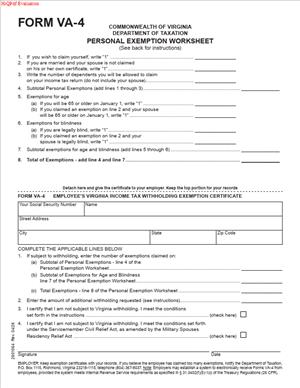
Form VA-4- Personal Exemption Worksheet
Fill out nowJurisdiction: Country: United States | Province or State: Virginia
If you are starting a new job or reviewing your paycheck, you may be asked to complete the Form VA-4- Personal Exemption Worksheet. This form affects how much Virginia state income tax is withheld from your wages.
The Form VA-4- Personal Exemption Worksheet helps you calculate the number of personal exemptions you can claim for Virginia income tax purposes. Your employer uses this information to determine how much state tax to withhold from each paycheck.
This document is not filed with the court. It is part of your employment and payroll records. It connects directly to your state income tax obligations.
Filling it out correctly matters. The number you enter can increase or decrease the amount of money taken out of your pay. That can affect whether you receive a refund or owe additional tax when you file your Virginia return.
What is Form VA-4- Personal Exemption Worksheet?
Clear definition
The Form VA-4- Personal Exemption Worksheet is a state tax form used in Virginia to calculate how many personal exemptions you may claim for payroll withholding purposes.
It works alongside the main VA-4 employee withholding form. The worksheet helps you determine the correct number before you enter it on the withholding certificate you give to your employer.
The document guides you through basic questions about yourself, your spouse, and your dependents. Based on your answers, you total the exemptions and transfer that number to the main form.
Who typically uses this form?
Employees who earn wages in Virginia commonly use this form when they start a new job. Employers often include it in new hire paperwork.
Current employees may also complete it again if their personal situation changes. For example, if you get married or have a child, you may update your withholding information.
Payroll departments rely on the information you provide. Human resources staff may distribute the form, but the responsibility for accurate completion is yours.
Self-represented individuals who work as employees, rather than independent contractors, are the usual users. Independent contractors generally handle estimated taxes differently.
Why might you need this form?
You may need this form to avoid having too much or too little Virginia income tax withheld from your paycheck.
If you claim more exemptions, less tax is withheld from each pay period. If you claim fewer exemptions, more tax is withheld.
The worksheet helps you estimate your proper exemption count so your withholding better reflects your personal tax situation.
It can also reduce surprises at tax time. Adjusting your withholding during the year may affect whether you owe money or receive a refund when you file your state return.
Typical real-life scenarios
- You start a full-time job with a Virginia employer. As part of your onboarding packet, you receive state and federal withholding forms. The worksheet helps you determine how many Virginia exemptions to claim before you submit the final withholding form.
- You recently got married. Your spouse also works. You want to review how your combined household income affects your state withholding. You use the worksheet to reconsider the number of exemptions you previously claimed.
- You had a child during the year. This changes the number of dependents in your household. You complete the worksheet again to reflect the new dependent and adjust your paycheck withholding.
- You moved to Virginia from another state and began working for a Virginia company. Because each state has its own withholding system, you complete the worksheet to align your pay with Virginia’s rules.
When would you use Form VA-4- Personal Exemption Worksheet?
You typically use this form at the beginning of employment. Employers often request it before processing your first paycheck so they can withhold the correct amount of state tax.
You may also use it when your family situation changes. Marriage, divorce, birth, adoption, or a dependent no longer qualifying can affect your exemption count.
A significant change in income may also lead you to revisit the worksheet. If you take on a second job or your spouse starts or stops working, your total household income may shift your withholding needs.
Some people review their withholding annually. At the start of a new calendar year, you might complete the worksheet again to confirm that your exemption number still fits your situation.
If you notice that you owed a large amount of Virginia tax when filing your return, you might use the worksheet to adjust your exemptions for the current year. The same applies if you received a much larger refund than expected and prefer to have more take-home pay during the year.
Legal characteristics of Form VA-4- Personal Exemption Worksheet
The Form VA-4- Personal Exemption Worksheet is an administrative tax document used by employers to calculate payroll withholding. It becomes effective once you submit the related withholding certificate to your employer.
For the form to function properly, it must be completed clearly and accurately. Missing information, incorrect math, or failing to transfer the correct exemption total to the main form can create withholding errors.
Employers rely on the information you provide in good faith. If the numbers are inconsistent or incomplete, payroll staff may request clarification before processing your submission.
Different states have different withholding forms and exemption rules. This worksheet applies specifically to the Virginia state income tax. It does not replace federal withholding forms or documents required by other states.
The worksheet does not determine your final tax liability. It only helps estimate how much tax is withheld from each paycheck. Your actual tax obligation is calculated when you file your Virginia income tax return for the year.
Is it legally binding?
The worksheet itself is not a contract between you and your employer. However, the information you provide is used to calculate tax withholding, which has legal and financial consequences.
When you sign and submit the related withholding certificate, you are certifying that the information is true to the best of your knowledge. That certification gives the document practical legal effect in payroll processing.
If incorrect information leads to under-withholding, you may still be responsible for any unpaid tax when you file your return. The form does not shield you from tax obligations.
At the same time, claiming fewer exemptions than you qualify for generally results in higher withholding. That does not violate the rules, but it changes how much of your wages you receive during the year.
How to fill out Form VA-4- Personal Exemption Worksheet
Step 1 – Review the instructions carefully
Start by reading the entire worksheet before entering any numbers. Pay attention to definitions of personal exemptions, dependents, and any special categories listed. Understanding these terms helps you avoid miscounting.
Step 2 – Enter your personal exemption
Locate the line for your own personal exemption. If you qualify under the listed criteria, enter the number indicated, usually one exemption for yourself. Write the number clearly in the space provided.
Step 3 – Consider your spouse
Find the section addressing a spouse. If you are married and meet the conditions described, enter the appropriate number for your spouse. If you are single or your spouse does not qualify under the worksheet’s terms, leave that line blank or enter zero as directed.
Step 4 – Count qualifying dependents
Move to the portion covering dependents. Review who qualifies under the worksheet’s guidelines. Enter the total number of dependents that meet those requirements. Take care not to include individuals who do not meet the listed criteria.
Step 5 – Apply any additional exemption categories
Some versions of the worksheet include additional categories, such as age-based or other specific exemptions. Read each line carefully. If you qualify, enter the number specified. If not, skip that line.
Step 6 – Add all exemption lines together
After completing each applicable section, add the numbers from all relevant lines. Double-check your math. The total represents the number of personal exemptions you may claim for Virginia withholding purposes.
Step 7 – Transfer the total to the main withholding form
Locate the corresponding line on the Virginia employee withholding certificate. Enter the total number of exemptions from the worksheet onto that form. Ensure the number matches exactly.
Step 8 – Sign and date the required form
Complete any required signature and date fields on the withholding certificate. Your signature confirms that the information provided is accurate to the best of your knowledge.
Step 9 – Submit the form to your employer
Provide the completed withholding certificate, along with the calculated exemption total, to your employer or payroll department. Keep a copy for your personal records so you can refer to it if questions arise later.
Legal terms you might encounter in Form VA-4- Personal Exemption Worksheet
- Personal Exemption: A personal exemption is a specific amount you claim to reduce the income subject to state withholding. In this document, you calculate how many exemptions you are entitled to based on your personal and family situation. The total number directly affects how much Virginia income tax your employer withholds from your paycheck.
- Withholding Allowance: A withholding allowance represents a unit used to estimate how much tax should be taken out of your wages. Each allowance you claim lowers the amount withheld. On this worksheet, you determine how many allowances you can reasonably claim before transferring that number to the main withholding certificate.
- Qualifying Dependent: A qualifying dependent is a child or other person who meets certain criteria to be claimed for tax purposes. On this worksheet, you count dependents who meet the eligibility rules for Virginia income tax withholding. The number of qualifying dependents increases your total exemptions.
- Filing Status: Filing status reflects whether you are single, married, or fall into another recognized category for tax purposes. Your filing status affects how many exemptions you may claim and how withholding is calculated. You must make sure your status on this worksheet matches your actual tax situation.
- Spouse Exemption: If you are married and your spouse qualifies, you may be able to claim an exemption for them. This depends on factors such as whether your spouse has income and whether you are filing jointly or separately. The worksheet guides you through whether you can include this exemption in your total.
- Additional Withholding: Additional withholding is an optional extra amount you ask your employer to withhold from each paycheck. While this worksheet focuses on exemptions, you may decide to request extra withholding if you expect to owe more tax. This is usually entered on the main withholding form, not the worksheet itself.
- Nonresident: A nonresident is someone who does not live in Virginia but earns income from Virginia sources. If you are a nonresident working in Virginia, special rules may apply to your withholding. Your exemption calculation may differ depending on your residency status.
- Effective Date: The effective date is when your new withholding instructions begin. This is usually tied to when you submit the updated withholding form to your employer. Changes on the worksheet affect your paychecks only after the employer processes the updated form.
- Certification: Certification refers to your signed statement that the information you provided is true and correct. Although the worksheet helps you calculate exemptions, the certification typically appears on the main withholding certificate. Your signature confirms that you understand your responsibility for accurate reporting.
FAQs
Do I have to submit the Form VA-4- Personal Exemption Worksheet to my employer?
In most cases, you do not submit the worksheet itself. You use this document to calculate your total exemptions, then enter that number on the main withholding certificate you give to your employer. Keep the worksheet for your own records in case questions arise about how you arrived at your total.
What if my spouse also works and claims exemptions?
You and your spouse should coordinate your withholding so you do not both over-claim exemptions. Review both incomes and decide how many exemptions each of you should claim. If both of you claim the maximum without adjusting for combined income, you may have too little tax withheld.
How do I know how many dependents I can legally count on this form?
You can only count dependents who meet the eligibility rules under state tax law. That usually means they rely on you for financial support and meet age or relationship requirements. If you are unsure, review your most recent tax return to see who you claimed there and confirm that the situation has not changed.
What happens if I claim too many exemptions?
If you claim more exemptions than you qualify for, your employer will withhold less state income tax from each paycheck. That can lead to a tax balance due when you file your state return. In serious cases, intentionally providing false information on the Form VA-4- Personal Exemption Worksheet can expose you to penalties.
When should I update this document?
You should update your withholding whenever your personal or financial situation changes. Common triggers include marriage, divorce, the birth of a child, or a significant change in income. You complete a new worksheet and provide an updated withholding certificate to your employer so future paychecks reflect the change.
Does this form change my official tax filing with the state?
No. This document only affects how much tax is withheld from your wages during the year. It does not replace your annual income tax return and does not officially change your filing status with the tax authority. You still must file your state return each year and reconcile the actual tax owed.
What if my employer says my form is incomplete?
If your employer believes information is missing, they may ask you to complete a new withholding certificate. Review your calculations and make sure you transferred the correct total exemptions from this worksheet. Confirm that you signed and dated the required form before resubmitting it.
Do I need to attach proof of my dependents or marital status?
Generally, you do not attach supporting documents when giving your withholding certificate to your employer. However, you should keep records, such as birth certificates or prior tax returns, in case your withholding choices are ever questioned. Accurate records help you explain how you calculated your exemptions.
Checklist: Before, During, and After Form VA-4- Personal Exemption Worksheet
Before
- Review your most recent state income tax return.
- Confirm your current filing status (single, married, etc.).
- Make a list of all dependents you financially support.
- Verify whether your spouse has income.
- Gather recent pay stubs to understand current withholding.
- Check whether you previously claimed exemptions with your employer.
- Consider any major life changes in the past year.
- Estimate whether you owed or received a refund last tax season.
During
- Read each exemption category carefully before entering numbers.
- Enter your own personal exemption first.
- Add a spouse exemption only if you qualify.
- Count only dependents who meet eligibility rules.
- Double-check each line before adding totals.
- Use clear, legible handwriting if completing by hand.
- Recalculate the total exemptions to avoid math errors.
- Transfer the final number accurately to the withholding certificate.
After
- Make a copy of the completed worksheet for your records.
- Submit the updated withholding certificate to your employer.
- Confirm your employer received and processed the form.
- Review your next paycheck to verify changes took effect.
- Store the worksheet with your tax documents.
- Monitor your pay stubs over the next few months.
- Revisit your exemptions if your situation changes.
- Keep notes explaining how you calculated your totals.
Common mistakes to avoid with Form VA-4- Personal Exemption Worksheet
- Mistake: Claiming every possible exemption without confirming eligibility, often because you assume more exemptions mean more money now, which can result in owing a large tax balance later, so do not forget to match each exemption to an actual qualifying person or status.
- Mistake: Forgetting to coordinate with a working spouse, which happens when couples complete forms separately, leading to under-withholding and potential tax due, so do not forget to review both incomes together.
- Mistake: Using outdated information from a prior year, which happens when you copy last year’s numbers without checking changes, causing inaccurate withholding, do not forget to account for marriages, divorces, births, or income shifts.
- Mistake: Making simple math errors when totaling exemptions, which often occurs when rushing through the worksheet, resulting in the wrong number transferred to the main form, so do not forget to double-check your addition.
- Mistake: Failing to submit an updated withholding certificate after completing the worksheet, which happens when you assume the worksheet alone changes your withholding, meaning no payroll adjustment occurs, so do not forget to provide the signed form to your employer.
- Mistake: Not reviewing pay stubs after submitting changes, which happens when you assume payroll processed everything correctly, potentially leaving errors uncorrected for months, so do not forget to confirm the effective change on your next paycheck.
- Mistake: Intentionally overstating exemptions to increase take-home pay, which can trigger penalties and a large tax bill at filing time, so do not forget that you are responsible for accurate reporting.
- Mistake: Ignoring residency rules, which happens when nonresidents assume the same exemption rules apply in all situations, potentially leading to incorrect withholding, so do not forget to consider your Virginia residency status.
What to do after filling out Form VA-4- Personal Exemption Worksheet
Once you complete the worksheet, your next steps focus on making sure the information actually affects your paycheck and remains properly documented.
- Step 1: Review your total exemptions one more time for accuracy.
- Step 2: Transfer the final exemption number to the official Virginia withholding certificate required by your employer.
- Step 3: Sign and date the withholding certificate where indicated.
- Step 4: Make a clear copy or take a scanned image of both the worksheet and the signed certificate for your records.
- Step 5: Submit the signed certificate to your employer’s payroll or human resources department.
- Step 6: Ask when the change will take effect and whether you will receive confirmation.
- Step 7: Check your next one or two pay stubs to confirm the updated withholding amount appears correctly.
- Step 8: Compare the new withholding amount with your expectations to ensure it aligns with your financial plan.
- Step 9: Store the worksheet with your annual tax documents so you can reference it when filing your Virginia income tax return.
- Step 10: Set a reminder to review your withholding at least once a year or after any major life event.
By following these steps, you stay in control of your state tax withholding. Small adjustments now can prevent surprises at tax time. Treat this worksheet as part of your broader financial planning, not just a one-time payroll task.
Disclaimer: This guide is provided for informational purposes only and is not intended as legal advice. You should consult a legal professional.