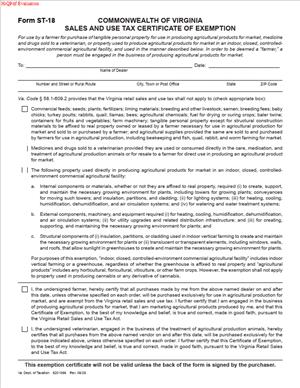
Form ST-18 – Sales And Use Tax Certificate of Exemption
Fill out nowJurisdiction: Country: United States | Province or State: Virginia
Form ST-18 – Sales And Use Tax Certificate of Exemption is a tax document used in Virginia to claim an exemption from sales and use tax. If you are about to complete this form, you are likely buying goods or services that you believe qualify for tax-free treatment under state law.
This form is not filed casually. It is presented to a seller at the time of purchase. By signing it, you certify that the purchase qualifies for a specific exemption.
The document plays an important role in sales transactions. It shifts responsibility from the seller to you, the purchaser, for claiming the exemption properly. If completed incorrectly, it can create tax liability later.
You may encounter this form if you run a business, manage purchasing for an organization, or represent a nonprofit, government entity, or contractor. Understanding what it does and how it works helps you avoid delays and unexpected tax assessments.
What is Form ST-18 – Sales And Use Tax Certificate of Exemption?
Clear definition
Form ST-18 – Sales And Use Tax Certificate of Exemption is a written certification used to claim exemption from Virginia sales and use tax on qualifying purchases. Instead of paying tax at the point of sale, you provide this document to the seller to explain why tax should not be charged.
The form identifies the purchaser, describes the nature of the exemption, and includes a signed declaration. It functions as evidence for the seller that the transaction qualifies for tax-free treatment.
It does not automatically make a purchase exempt. The exemption must fit within recognized categories under Virginia tax law.
Who typically uses this form?
Businesses often use this form when purchasing items for resale, manufacturing, or other exempt purposes. For example, a retailer buying inventory for resale may use it to avoid paying tax on goods that will later be sold to customers.
Nonprofit organizations, schools, and government agencies may also use it when making qualifying purchases. Contractors and service providers sometimes rely on it in specific project settings.
Purchasing managers, accountants, and business owners are common signers. The person signing must have authority to certify the exemption on behalf of the organization.
Why might you need this form?
You might need this form if you are buying tangible personal property and believe the purchase qualifies for exemption. Without it, a seller will typically charge sales tax.
Providing the certificate at the time of purchase allows the seller to document why tax was not collected. This protects the seller during a tax review.
If you do not provide a valid certificate when required, you may later need to request a refund or pay tax directly. Using the form correctly can prevent extra administrative work.
Typical real-life scenarios
- You operate a retail store and purchase inventory from a supplier. Because you plan to resell the items, you present the certificate to avoid paying sales tax at wholesale.
- You manage purchasing for a manufacturing company. You buy machinery and raw materials that qualify for a manufacturing exemption. You use the form to certify that the items will be used directly in production.
- You work for a nonprofit organization making qualifying purchases for its exempt activities. The seller requests documentation before removing sales tax from the invoice.
- You are involved in a construction project where certain purchases may qualify for exemption based on the project’s nature. The supplier asks for a completed exemption certificate before processing the order.
When would you use Form ST-18 – Sales And Use Tax Certificate of Exemption?
You use this form at the time of purchase, not after the transaction is complete. It is typically presented before or during payment.
The form is commonly used in business-to-business transactions. A supplier may keep it on file for recurring purchases, so you do not need to complete a new certificate each time.
It may also be used for one-time transactions. In those cases, the certificate usually applies only to the specific purchase described.
Different roles interact with this document in different ways. As a purchaser, you complete and sign it. As a seller, you review it for completeness and keep it in your records. As an internal administrator, you may verify that the exemption category matches your organization’s activities.
Timing matters. If the certificate is not provided when required, the seller may charge tax and refuse to remove it later without proper documentation.
Legal characteristics of Form ST-18 – Sales and Use Tax Certificate of Exemption
This form operates as a certification under Virginia tax law. When you sign it, you affirm that the purchase qualifies for an exemption and that the information you provide is accurate.
For the certificate to be effective, it generally must be complete, signed, and connected to a valid exemption category. Missing information, vague descriptions, or unsigned forms can lead to rejection.
Sellers rely on this document during tax audits. If the certificate is incomplete or clearly does not match the transaction, the seller may be held responsible for uncollected tax. As a result, many sellers review certificates carefully before accepting them.
Common problems include using the wrong exemption category, failing to provide required identification numbers, or applying the certificate to items that do not qualify. These issues may result in assessments of tax, interest, or penalties.
This form does not grant exemption status by itself. It documents your claim of exemption. The underlying eligibility must already exist under applicable tax rules.
Exemption certificates vary by state. While the structure and purpose are similar across jurisdictions, the categories and requirements differ. A certificate valid in one state may not satisfy another state’s rules.
Is it legally binding?
Yes, in a practical sense, this document is legally binding once signed and relied upon in a transaction. By signing, you are making a formal declaration about the nature of the purchase.
Your signature confirms that the information is true and that the goods will be used in the manner described. If that statement is incorrect, the transaction may be subject to tax and additional consequences.
The seller’s reliance on your certification gives the form legal weight. It becomes part of the transaction record and may be reviewed by tax authorities.
However, the form itself does not create an exemption. It reflects an existing legal status. If the purchase does not actually qualify, signing the certificate does not change that fact.
How to fill out Form ST-18 – Sales And Use Tax Certificate of Exemption
Step 1 – Review the purpose of your purchase
Start by confirming why you believe the purchase qualifies for exemption. Identify the specific exemption category that applies, such as resale or manufacturing use. Make sure the items you are buying match that category. This helps you complete the correct section of the form.
Step 2 – Enter the purchaser’s legal name and business information
Provide the full legal name of the individual or organization claiming the exemption. Include the business address and any requested identification numbers, such as a state registration or account number. Use the exact information associated with your tax registration.
Step 3 – Describe the type of business or activity
The form typically asks you to describe your business or exempt activity. Be specific. For example, state that you operate a retail clothing store or a manufacturing facility. Clear descriptions help the seller understand how the exemption applies.
Step 4 – Select or state the applicable exemption category
Indicate the reason for exemption by marking the appropriate category or writing in the explanation requested. Ensure that the category aligns with your stated business activity and the items being purchased. Avoid broad or unclear statements.
Step 5 – Specify the nature of the property being purchased
Some sections require you to describe the tangible personal property involved. Use straightforward terms, such as inventory for resale or raw materials for production. The description should connect logically to the exemption claimed.
Step 6 – Confirm whether the certificate is for a single purchase or ongoing transactions
If the form allows, indicate whether it applies to one transaction or to future purchases from the same seller. Choose the option that matches your situation. This determines how long the seller may rely on the certificate.
Step 7 – Sign and date the certificate
An authorized individual must sign the form. Print your name and title if requested. Include the date of signing. Your signature certifies that the information provided is accurate and that the exemption claim is valid.
Step 8 – Provide the completed form to the seller
Deliver the signed certificate to the seller before or at the time of purchase. The seller will typically keep it on file. Retain a copy for your own records in case questions arise later.
Legal terms you might encounter in Form ST-18 – Sales And Use Tax Certificate of Exemption
- Purchaser: This is the individual or business claiming the tax exemption. In this document, you are the purchaser if you are the one buying goods without paying sales tax. Your legal name must match your business registration or government records to avoid rejection.
- Seller: The seller is the business providing the goods or services. You give the completed certificate to the seller, not to the tax department. The seller keeps it on file as proof of why they did not charge you sales tax.
- Sales and Use Tax: Sales tax applies when you buy taxable goods in the state. Use tax applies when sales tax was not charged but should have been. This certificate allows the seller to not collect sales tax because you claim a lawful exemption.
- Exemption Category: This refers to the legal reason you qualify to purchase items tax-free. The form requires you to identify the specific type of exemption that applies to your situation. You must choose the category that accurately describes your business or intended use.
- Tangible Personal Property: This means physical goods you can see and touch. The exemption typically applies to certain tangible items, depending on your exemption type. Services and digital goods may be treated differently.
- Single Purchase Certificate: This option applies when the exemption is used for one specific transaction. It covers only the items listed for that one sale. If you check this option, the seller cannot apply it to future purchases.
- Blanket Certificate: A blanket certificate covers multiple purchases over time. You give it to a seller you buy from regularly. It remains valid until revoked or until your eligibility changes.
- Good Faith Acceptance: This concept protects the seller if they reasonably rely on the certificate you provide. The seller must accept it in good faith, meaning the exemption claimed must make sense for your type of business. If it appears incorrect, the seller may refuse it.
- Authorized Signature: The certificate must be signed by someone with authority to bind the business. This could be an owner, officer, or other authorized representative. By signing, you confirm that the information is accurate and truthful.
- Misuse of Exemption: This refers to using the certificate for purchases that do not qualify. Misuse can result in assessment of unpaid taxes, penalties, and interest. The responsibility for incorrect claims usually falls on the purchaser.
FAQs
Do I send Form ST-18 – Sales And Use Tax Certificate of Exemption to the tax department?
No. You give this document directly to the seller at the time of purchase or shortly after. The seller keeps it in their records to justify not charging you sales tax. You generally do not file it with the Department of Taxation unless specifically requested during a review or audit.
What information must match my official business records?
Your legal business name, address, and any registration or identification number you provide must match your official filings. If your business is registered under a formal name, do not use a nickname or trade name unless the form allows it and you list both. Mismatched information can cause the seller to reject the certificate.
Can I use this form for both one-time and ongoing purchases?
Yes, but you must clearly indicate whether it applies to a single purchase or serves as a blanket certificate. Check the appropriate box or complete the correct section. If you leave this unclear, the seller may treat it as invalid or limit it to one transaction.
What happens if I later realize I claimed the wrong exemption category?
You should notify the seller as soon as possible and correct the certificate. If the exemption was not valid, you may be responsible for paying the unpaid tax. It is better to address the issue early than wait for a tax review.
Does the effective date matter for this document?
Yes. The certificate typically applies from the date you sign it forward. It does not automatically cover past purchases unless the seller allows it and the transaction qualifies. Make sure the date reflects when you intend the exemption to begin.
Who is allowed to sign this certificate for a business?
An owner, officer, partner, or other authorized representative can sign. The person must have the authority to bind the business legally. If someone without authority signs, the seller may reject the document or question its validity.
What should I do if a seller refuses to accept my completed certificate?
Ask the seller what part appears incomplete or inconsistent. Review the exemption category and your business description to ensure they align. Sellers must accept certificates in good faith, but they are not required to accept one that seems incorrect.
What records should I keep after giving the seller this form?
Keep a copy of the signed certificate and any related invoices. Maintain documentation showing why your purchases qualify under the exemption category you selected. These records help you respond clearly if questions arise later.
Checklist: Before, During, and After Form ST-18 – Sales And Use Tax Certificate of Exemption
Before
- Confirm that your business or activity qualifies for a specific exemption category.
- Review your business registration details for accuracy.
- Gather your legal business name, address, and identification numbers.
- Determine whether the purchase is taxable without an exemption.
- Decide if you need a single purchase or blanket certificate.
- Verify that the items you plan to buy fit the exemption.
- Identify who in your organization has authority to sign.
- Check that the seller accepts exemption certificates.
During
- Enter your full legal name exactly as registered.
- Provide complete and current contact information.
- Accurately describe the nature of your business or activity.
- Select the correct exemption category without guessing.
- Clearly indicate single purchase or blanket status.
- Describe the property being purchased in reasonable detail.
- Review every field for completeness before signing.
- Sign and date the certificate using an authorized signature.
After
- Provide the completed certificate directly to the seller.
- Keep a copy in your business tax records.
- Attach a copy to related purchase invoices if helpful.
- Monitor that sales tax is not charged incorrectly.
- Review future purchases to ensure continued eligibility.
- Update the seller if your business status changes.
- Replace the certificate if business details change.
- Retain documentation supporting your exemption claim.
Common mistakes to avoid with Form ST-18 – Sales And Use Tax Certificate of Exemption
- Mistake: Selecting the wrong exemption category because you assume all business purchases are exempt, which happens when you do not read the category descriptions carefully; this can lead to tax assessments and penalties, so do not forget to match your actual business activity to the exact exemption listed.
- Mistake: Using a trade name instead of the full legal business name, which happens when businesses rely on branding rather than registration documents; this may cause rejection by the seller, so do not forget to verify your registered name before completing the form.
- Mistake: Leaving required sections blank because you think they do not apply, which often occurs when instructions are skimmed; incomplete forms can be refused, so do not forget to review every field before signing.
- Mistake: Failing to indicate whether the certificate is for a single purchase or blanket use, which happens when you overlook that checkbox or line; this creates confusion and possible misuse, so do not forget to clearly mark your intent.
- Mistake: Allowing someone without proper authority to sign, which can occur in larger organizations with unclear roles; this may invalidate the certificate, so do not forget to confirm the signer’s authority.
- Mistake: Using the certificate for non-qualifying items out of convenience, which happens when purchasing staff assume all items from a vendor are exempt; this exposes you to back taxes and interest, so do not forget to review each purchase against the exemption.
- Mistake: Forgetting to update the seller after your business structure changes, which can happen after reorganizations or address changes; outdated information may invalidate the exemption, so do not forget to provide a revised certificate when details change.
- Mistake: Not keeping a copy of the signed certificate, which often occurs during busy purchasing cycles; without records you may struggle to respond to questions later, so do not forget to store a copy in your tax files.
What to do after filling out Form ST-18 – Sales And Use Tax Certificate of Exemption
Once you complete the certificate, your next steps focus on proper delivery, documentation, and ongoing compliance.
- Step 1: Make a clear copy of the signed and dated certificate for your records.
- Step 2: Provide the original or a legible copy to the seller before or at the time of purchase.
- Step 3: Confirm with the seller that they have accepted it and applied the exemption to your transaction.
- Step 4: Review your invoice to ensure sales tax was not charged in error.
- Step 5: Store the certificate in your tax records, organized by vendor name.
- Step 6: Keep supporting documents that explain why your purchases qualify under the selected exemption category.
- Step 7: Monitor future invoices from the same seller if you issued a blanket certificate.
- Step 8: Update the certificate if your business name, address, or structure changes.
- Step 9: Reassess your eligibility if your business activities shift.
- Step 10: Maintain records for several years in case of a tax review.
You should treat this certificate as an ongoing compliance document, not a one-time form. Build a simple internal process. For example, instruct staff responsible for purchasing to check whether an exemption certificate is on file before placing orders. If you work with multiple vendors, keep a tracking list showing which sellers have current certificates.
If you discover that tax was not charged when it should have been, address it quickly. Contact the seller and clarify whether the exemption applied. If needed, arrange to pay the correct tax. Acting promptly reduces complications later.
When your business grows or changes structure, review all exemption certificates you have issued. A merger, name change, or new line of business can affect eligibility. Issue updated certificates to vendors when required.
Keeping your records organized and current protects you. It also shows that you acted responsibly and in good faith if questions arise in the future.
Disclaimer: This guide is provided for informational purposes only and is not intended as legal advice. You should consult a legal professional.