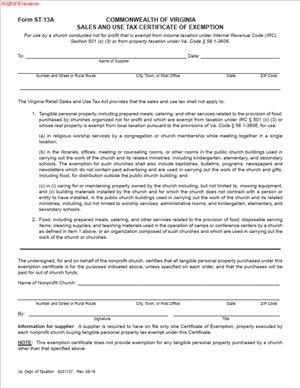
Form ST-13A – Sales And Use Tax Certificate of Exemption
Fill out nowJurisdiction: Country: United States | Province or State: Virginia
Form ST-13A – Sales And Use Tax Certificate of Exemption is a tax document used in Virginia to claim an exemption from sales and use tax on certain purchases. You provide it to a seller to show that the items you are buying qualify for a specific exemption under state law.
If you are filling out this form, you are likely making a purchase that would normally be taxed. Instead of paying sales tax at checkout, you are certifying that your purchase meets the requirements for exemption. The seller keeps the completed document in their records.
This form matters because it shifts responsibility. By signing it, you are stating that your purchase qualifies for tax-exempt treatment. If the exemption does not apply, the tax may still be owed.
Understanding what the form does before you sign it helps you avoid delays, rejected transactions, or later tax issues. You are not just filling out paperwork. You are making a formal statement about how the purchased items will be used.
What is Form ST-13A – Sales And Use Tax Certificate of Exemption?
Clear definition
Form ST-13A – Sales And Use Tax Certificate of Exemption is a written certification that certain tangible personal property qualifies for exemption from Virginia retail sales and use tax. It is typically presented to a vendor at the time of purchase.
The form identifies the purchaser, describes the type of exemption being claimed, and includes a declaration that the information provided is accurate. The seller relies on this certificate to justify not collecting sales tax.
Without this document, a seller would generally be required to charge sales tax on the transaction. The form serves as proof that the buyer, not the seller, is claiming responsibility for the exemption.
Who typically uses this form?
This form is commonly used by contractors, nonprofit organizations, government entities, and businesses purchasing items for specific exempt purposes. The exact exemption depends on the nature of the purchase.
For example, a contractor performing certain qualifying work may use the form when buying materials that will become part of real property in an exempt project. Similarly, organizations engaged in specific activities recognized under Virginia tax rules may use it when buying qualifying supplies or equipment.
Vendors also interact with this form. While they do not complete it on behalf of the buyer, they review it for completeness and retain it in their records.
Why might you need this form?
You may need this form if you are purchasing items that qualify for a statutory exemption from Virginia sales and use tax. The exemption does not apply automatically. It must be claimed.
If you do not provide the certificate at the time of purchase, the seller will usually charge sales tax. In some situations, you may later request a refund, but that process can be time-consuming and require additional documentation.
Using the form at the time of purchase helps ensure the transaction is handled correctly from the start. It clarifies the tax treatment and reduces the risk of later disputes.
Typical real-life scenarios
- You are a contractor hired to build or renovate property for an organization that qualifies for a sales tax exemption on construction materials. When you purchase lumber, wiring, or plumbing supplies for that specific project, you provide the exemption certificate to the supplier.
- You represent a nonprofit organization that qualifies for an exemption on certain purchases related to its mission. When buying office equipment or supplies used directly in those activities, you present the form to avoid paying sales tax.
- You are working on a government-funded project that qualifies under specific rules. Materials that become part of the completed structure may be purchased using the certificate, depending on how the exemption is structured.
- You operate a business engaged in activities that qualify for partial or full exemption under Virginia law. When purchasing specialized equipment directly used in those activities, you provide the certificate to the vendor to document the tax-exempt nature of the transaction.
- In each situation, the key factor is not who you are alone, but how the purchased items will be used. The exemption is tied to the purpose of the purchase.
When would you use Form ST-13A – Sales And Use Tax Certificate of Exemption?
You use this form at the point of sale, before or during the purchase of goods. It is typically given to the seller when placing an order, opening an account, or making a qualifying transaction.
The timing matters. Sellers rely on exemption certificates to determine whether to charge tax. If you provide the certificate after the transaction is complete, the seller may already have reported and remitted the tax.
This form is often used in business-to-business transactions rather than personal retail purchases. Contractors, purchasing agents, financial officers, and project managers are common users.
You might also use the form when setting up an account with a supplier for ongoing purchases. In that case, the certificate may remain on file and apply to future qualifying transactions, rather than being submitted for each individual purchase.
The form is generally used only when the items meet the specific exemption described on the certificate. If you are making mixed purchases, some taxable and some exempt, the seller may require separate documentation or invoices.
Legal characteristics of Form ST-13A – Sales And Use Tax Certificate of Exemption
This form functions as a written statement of fact. You are certifying that the items being purchased qualify for exemption under Virginia’s sales and use tax rules. The seller relies on your certification to avoid collecting tax.
For the certificate to be effective, it typically must be complete and signed. Missing information, incorrect identification details, or vague descriptions of the exemption may cause a seller to reject it.
Accuracy is critical. If the exemption claimed does not apply to the items purchased, the tax may still be assessed later. In many cases, the responsibility falls on the purchaser who signed the certificate.
Sellers are generally required to exercise reasonable care when accepting exemption certificates. If a form appears incomplete or inconsistent, a seller may refuse to accept it. This protects the seller from liability.
This document does not create an exemption by itself. The exemption must already exist under Virginia law. The form only documents your claim that the purchase qualifies.
Rules and interpretations can change over time. Different types of exemptions may have specific conditions, such as limits on the type of property, how it is used, or who may claim it. The form does not override those requirements.
Is it legally binding?
Yes, the certificate is legally significant once you sign it. By signing, you are declaring that the information provided is true and that the purchase qualifies for the claimed exemption.
Your signature represents a formal certification. If the information is inaccurate or misleading, there may be financial consequences, including tax assessments, interest, or penalties.
The binding nature of the form applies to the statements you make within it. It does not create a contract between you and the seller in the traditional sense, but it does allocate responsibility for the tax treatment of the transaction.
The seller relies on your signed certification as part of their compliance obligations. That reliance is what gives the form its practical legal effect.
How to fill out Form ST-13A – Sales and Use Tax Certificate of Exemption
Step 1 – Review the purpose of the purchase
Before writing anything, confirm that the items you are buying qualify under one of the exemptions described on the form. Focus on how the items will be used. The intended use is often more important than the type of item itself.
Make sure the exemption applies to this specific transaction. Do not assume that because you qualified in the past, every purchase is exempt.
Step 2 – Enter the purchaser’s legal name and business information
Provide the full legal name of the individual or organization claiming the exemption. If you are purchasing on behalf of a business or organization, use its registered legal name.
Include the business address and any identification numbers requested on the form. This may include a Virginia tax registration number or other identifying details. Write clearly and ensure the information matches official records.
Step 3 – Identify the type of exemption being claimed
The form typically lists specific categories of exemption. Select or indicate the one that matches your situation.
Be precise. If the form requires a description of the exempt activity or project, provide enough detail to show how the purchase qualifies. Avoid vague statements. The seller needs a clear connection between the exemption category and the items being purchased.
Step 4 – Describe the property being purchased
Some versions of the certificate require a description of the tangible personal property being bought. Describe the items in general but clear terms, such as construction materials, equipment, or supplies.
The description should align with the exemption claimed. If the exemption is limited to certain types of property, make sure your description reflects that limitation.
Step 5 – Confirm the intended use
If the form includes a statement about how the property will be used, read it carefully before signing. The exemption often depends on direct use in a specific activity or project.
Ensure that the intended use stated on the form matches your actual plans. The exemption may not apply if the items are later used for a different purpose.
Step 6 – Sign and date the certificate
An authorized individual must sign the form. This is often an owner, officer, purchasing agent, or other representative with authority to act for the organization.
By signing, you are certifying that the information is accurate. Add the date of signature. Make sure the signature is legible and consistent with the printed name provided.
Step 7 – Provide the completed form to the seller
Give the signed certificate to the vendor at the time of purchase or when establishing your account. The seller will retain it in their records.
Keep a copy for your own files. This helps you track which purchases were made under the exemption and supports your records if questions arise later.
Legal terms you might encounter in Form ST-13A – Sales And Use Tax Certificate of Exemption
- Sales and Use Tax: This is the tax imposed on the sale, lease, or use of tangible personal property. On this form, you are certifying that a specific purchase is not subject to that tax because it qualifies for an exemption. The form directly affects whether the seller collects tax from you at the time of sale.
- Certificate of Exemption: This is the written statement you give to a seller to claim that a transaction is tax-exempt. By signing it, you are formally declaring that your purchase meets the legal requirements for exemption. The seller relies on this certificate to justify not charging tax.
- Tangible Personal Property: This refers to physical items you can see and touch, such as equipment, supplies, or goods. The form applies only to qualifying tangible items. It does not generally apply to services unless specifically allowed.
- Exempt Use: This describes the specific purpose for which you will use the property. The exemption depends on how the property is used, not just what it is. You must clearly identify the intended use to support your claim.
- Good Faith Acceptance: This is a standard that protects the seller if they accept your certificate without knowing it is false. If you provide inaccurate information, the seller may still be protected if they reasonably relied on what you stated. That means the responsibility can shift back to you.
- Purchaser: This is you or your business entity claiming the exemption. The name listed must match the legal name associated with the qualifying activity. If you are buying on behalf of a business, the business is usually the purchaser.
- Seller: This is the business or individual providing the goods. The seller keeps the completed certificate in their records. They are not required to send it to the tax authority unless requested during an audit.
- Tax Liability: This is the legal responsibility to pay tax if the exemption does not apply. If your claim is invalid, you may owe the unpaid tax, plus interest or penalties. Signing the form confirms you understand this risk.
- Authorized Signature: This refers to the person legally allowed to sign on behalf of the purchaser. If you are signing for a company, you must have the authority to bind that company. Your signature certifies that the information is true and correct.
FAQs
Do I send Form ST-13A – Sales And Use Tax Certificate of Exemption to the tax department?
No. You provide this form directly to the seller at the time of purchase. The seller keeps it in their records to justify why they did not collect sales tax. It is generally not filed with the tax authority unless specifically requested during a review or audit.
What date should I enter on this document?
You should enter the date you sign the certificate. This shows when you officially claimed the exemption. The date helps the seller confirm that the exemption was in effect at the time of the transaction.
Does the name on this form have to match my business registration exactly?
Yes. The purchaser’s name should match your legal business name as it appears in your registration or formation documents. If the names do not match, the seller may question the validity of the exemption and refuse to accept it.
Can I use one certificate for multiple purchases?
That depends on how the seller handles exemption certificates. Some sellers accept a blanket certificate that covers ongoing purchases of qualifying items. Others may require a separate certificate for each transaction. Confirm this with the seller before relying on one document for repeated purchases.
What happens if I claim an exemption by mistake?
If you claim an exemption that does not apply, you may become responsible for the unpaid tax. This can include interest and possible penalties. The seller may be protected if they accepted the certificate in good faith, so the obligation could fall on you.
Who is allowed to sign this document?
The person signing must have authority to bind the purchaser. If you are an individual buyer, you can sign for yourself. If you are purchasing on behalf of a company, you should be an officer, owner, or authorized employee with authority to make tax certifications.
Do I need to attach supporting documents?
Usually, you do not attach documents when giving the certificate to the seller. However, you should keep internal records that support your claim, such as proof of your business activity or documentation showing how the property will be used. If questioned later, you will need to show that your exemption was valid.
What changes in the public record after I complete this form?
Nothing is added to a public database simply because you complete this form. The document stays with the seller as part of their private records. It only becomes part of a formal review if a tax authority audits the transaction.
Checklist: Before, During, and After Form ST-13A – Sales And Use Tax Certificate of Exemption
Before
- Confirm that your purchase qualifies for a specific exemption category.
- Review how you will use the property to ensure it meets exempt use rules.
- Verify your legal business name and registration details.
- Confirm you have authority to sign on behalf of the purchaser.
- Ask the seller whether they accept blanket certificates.
- Gather internal records supporting your exempt status.
- Check that the items you are buying are tangible personal property.
- Make sure your exemption claim matches the seller’s invoice description.
During
- Enter the full legal name of the purchaser.
- Provide complete and accurate business information.
- Select or state the correct exemption category.
- Clearly describe the items being purchased.
- Confirm the intended exempt use in writing if required.
- Review all entries for accuracy before signing.
- Sign and date the certificate yourself.
- Provide the completed certificate directly to the seller.
After
- Keep a copy of the signed certificate for your records.
- Store related invoices with the certificate copy.
- Track which vendors have your exemption certificate on file.
- Review your future purchases to ensure continued eligibility.
- Update the seller if your business name or status changes.
- Correct any errors immediately if discovered.
- Retain documentation in case of audit or review.
- Reassess your exemption eligibility periodically.
Common mistakes to avoid with Form ST-13A – Sales and Use Tax Certificate of Exemption
- Mistake: Claiming an exemption without confirming the qualifying use, often because you assume all business purchases are exempt, which can lead to tax assessments later; do not forget to match the exemption to the specific use of the property.
- Mistake: Using a trade name instead of the legal business name, which happens when businesses operate under a “doing business as” name, potentially causing rejection by the seller; do not forget to verify the exact registered name.
- Mistake: Signing without proper authority, often when an employee completes paperwork routinely, which can invalidate the certificate; do not forget to ensure the signer has legal authority.
- Mistake: Providing incomplete descriptions of the items purchased, which occurs when you rush through the form, creating confusion during audits; do not forget to clearly identify the property.
- Mistake: Reusing an old certificate after your business activities change, which happens when companies evolve but paperwork stays the same, increasing the risk of noncompliance; do not forget to review exemption eligibility regularly.
- Mistake: Failing to keep a copy, often because you rely on the seller’s records, which leaves you without proof if questions arise; do not forget to store your own signed copy with supporting documents.
- Mistake: Assuming the certificate applies automatically to all vendors, which happens when you provide it to one seller and forget others require their own copy, leading to unexpected tax charges; do not forget to confirm each seller’s requirements.
- Mistake: Not updating the seller when your business information changes, which occurs after reorganizations or address changes, potentially invalidating the certificate; do not forget to notify vendors of material changes.
What to do after filling out Form ST-13A – Sales And Use Tax Certificate of Exemption
Once you complete the form, your responsibility does not end with your signature. You need to manage how the certificate is delivered, stored, and supported.
Start by confirming the seller received it and accepted it. If you are making an in-person purchase, hand it directly to the appropriate representative. If you are ordering remotely, follow the seller’s preferred submission method and request confirmation that it is on file.
Keep organized records. You want to be able to connect each exempt purchase to a valid certificate and supporting documentation. This makes future reviews much easier.
- Step 1: Make a clear copy of the signed certificate for your own records.
- Step 2: Attach or digitally store the related invoice with the certificate copy.
- Step 3: Deliver the original certificate to the seller using their required method.
- Step 4: Ask the seller to confirm they have accepted it and applied the exemption.
- Step 5: Check your invoice to ensure sales tax was not charged incorrectly.
- Step 6: Maintain a list of vendors who have your exemption certificate on file.
- Step 7: Review your purchases periodically to confirm they still qualify.
- Step 8: Update or replace the certificate if your business name, structure, or exempt activity changes.
- Step 9: Keep all records accessible in case of audit or inquiry.
- Step 10: Train relevant staff so future purchases follow the same compliance process.
Treat this as part of your broader tax compliance system. Accurate records, consistent procedures, and periodic reviews will reduce the risk of disputes or unexpected tax bills later.
Disclaimer: This guide is provided for informational purposes only and is not intended as legal advice. You should consult a legal professional.