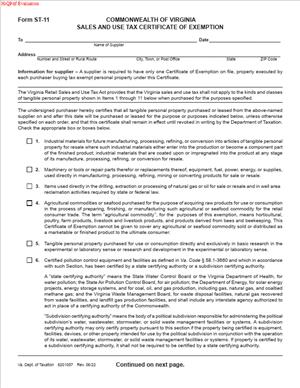
Form ST-11 – Sales And Use Tax Certificate of Exemption
Fill out nowJurisdiction: Country: United States | Province or State: Virginia
Form ST-11 – Sales And Use Tax Certificate of Exemption is a document used in Virginia to claim an exemption from sales and use tax on certain purchases. You give this form to a seller when you are buying items that qualify for a specific tax exemption.
If you are about to fill it out, you are likely trying to avoid being charged sales tax on a transaction that meets Virginia’s exemption rules. This form serves as your written statement that the purchase qualifies.
It is not a general tax form for reporting income or filing returns. Instead, it is a certificate that supports a tax-free purchase at the time of sale.
Understanding how this document works helps you avoid delays, rejected purchases, or later tax assessments. When completed correctly, it provides the seller with the documentation they need to not charge you sales tax.
What is Form ST-11 – Sales and Use Tax Certificate of Exemption?
Clear definition
Form ST-11 – Sales And Use Tax Certificate of Exemption is a certificate issued by the Commonwealth of Virginia Department of Taxation. It allows certain purchasers to claim an exemption from Virginia sales and use tax on qualifying tangible personal property.
The form acts as a declaration. You state that the items you are purchasing qualify under a specific exemption category provided by Virginia law. The seller keeps the certificate in their records as proof that the sale was tax-exempt.
This document does not automatically grant tax-exempt status to every buyer. It only applies when the purchase meets the specific exemption described in the form.
Who typically uses this form?
This form is commonly used by manufacturers, processors, and certain industrial businesses. It may also be used by other entities that qualify under Virginia’s manufacturing or processing exemptions.
Business owners, purchasing managers, and accounting staff often complete and sign the certificate. In smaller businesses, the owner may handle the form directly when buying equipment or supplies.
Vendors and suppliers also rely on this form. They request it before removing sales tax from an invoice. Without it, they may be required to charge tax even if the purchase might otherwise qualify.
Why might you need this form?
You may need this form when buying machinery, tools, repair parts, or other items used directly in manufacturing or processing. If the purchase qualifies, you can avoid paying sales tax at the time of sale.
Using the certificate can reduce your upfront costs. Sales tax on equipment and materials can be significant, especially for high-value items.
The form also protects the seller. By collecting a properly completed certificate, the seller documents why tax was not charged.
For you as the purchaser, completing the form carefully helps prevent future tax issues. If the exemption is questioned later, the certificate becomes part of the record explaining the tax treatment of the transaction.
Typical real-life scenarios
- You operate a manufacturing business in Virginia and purchase new production machinery. The equipment will be used directly in the production line. You provide the completed certificate to the supplier so the sale is processed without sales tax.
- You replace a worn-out component in an assembly machine. The replacement part is integral to the production process. You present the form to the parts supplier to document the exemption.
- You buy raw materials that will become part of a finished product sold to customers. If those materials qualify under the manufacturing exemption, the certificate supports the tax-free purchase.
- You purchase specialized tools used exclusively on the factory floor. Because they are directly involved in production, you use the form to claim exemption from sales tax.
- You acquire equipment for research and development directly tied to production improvements. In certain circumstances, this type of purchase may qualify, and the form serves as the written claim for exemption.
When would you use Form ST-11 – Sales And Use Tax Certificate of Exemption?
You use this form at the time of purchase, not after the fact. It is generally given to the seller before or during the transaction so they can decide whether to charge sales tax.
If you are setting up a new manufacturing facility, you may use this form multiple times while purchasing equipment and production-related supplies. Each seller may require its own copy for their records.
You might also use the certificate for ongoing purchases. Some suppliers keep the form on file and apply it to future qualifying transactions. In those cases, you complete the certificate once, and it remains valid for recurring purchases, depending on the seller’s policies.
Purchasing agents and accounts payable departments often manage these certificates in larger organizations. They ensure that vendors have current exemption certificates on file to avoid unnecessary tax charges.
If you are audited or reviewing past transactions, you may revisit the circumstances under which the form was used. Proper timing and accurate completion at the point of sale are key to avoiding disputes.
Legal characteristics of Form ST-11 – Sales and Use Tax Certificate of Exemption
This certificate is effective when it is properly completed, signed, and provided to the seller in good faith. The seller relies on the information you provide to justify not collecting sales tax.
Accuracy is essential. The form typically requires identifying information about your business, a description of the type of exemption being claimed, and a signature. Missing information or vague descriptions can create problems later.
A common issue arises when items purchased do not actually qualify under the claimed exemption. If the exemption is applied too broadly, tax authorities may later determine that sales tax was owed.
Another frequent problem is using the certificate for purchases that are partly exempt and partly taxable without clearly separating the items. Sellers often need clarity about which items qualify.
Requirements can vary by state. While this form is specific to Virginia, other states have their own exemption certificates with different rules and categories. Using the correct form for the correct jurisdiction matters.
This document does not replace a business license or a general tax registration. It does not automatically make your entire business tax-exempt. It only applies to specific purchases that meet defined exemption criteria.
It also does not eliminate recordkeeping responsibilities. Both you and the seller typically retain copies as part of your tax records.
Is it legally binding?
Yes, in practical terms, it is legally binding as a declaration. When you sign the certificate, you are affirming that the information provided is true and that the purchase qualifies for the exemption claimed.
Your signature represents more than a simple request. It is a statement made under the applicable tax laws. If the information is incorrect, there may be financial consequences, such as being responsible for unpaid taxes.
For the seller, the form provides a measure of protection. If they accept the certificate in good faith and it appears properly completed, it can serve as evidence that they had reason not to collect sales tax.
The binding effect depends on honest and accurate completion. If the form is incomplete, misleading, or used outside its intended scope, its protective value may be limited.
How to fill out Form ST-11 – Sales and Use Tax Certificate of Exemption
Step 1 – Review the purpose of the form
Start by reading the title and description on the form. Confirm that it matches the type of exemption you intend to claim. Make sure your purchase fits within the manufacturing or processing categories described.
Understanding the scope of the exemption helps you avoid using the certificate for items that do not qualify.
Step 2 – Enter the purchaser’s legal name
Provide the full legal name of your business or organization. Use the name that appears on your tax registrations and official records.
Avoid abbreviations unless they are part of your registered legal name. Consistency with your other tax documents helps prevent confusion.
Step 3 – Provide your business address
Fill in your complete business address, including street, city, state, and ZIP code. This identifies the location connected to the exemption claim.
Ensure the address is current. An outdated address can raise questions if the transaction is reviewed later.
Step 4 – Include identifying tax information
The form may request a Virginia tax registration number or similar identifying information. Enter the number carefully and double-check for accuracy.
Incorrect numbers can delay acceptance by the seller or create issues if the transaction is reviewed.
Step 5 – Describe the nature of your business
Provide a brief but clear description of your business activities. Focus on how your operations relate to manufacturing or processing.
This section helps the seller understand why you qualify for the exemption category selected.
Step 6 – Specify the type of property being purchased
Indicate the type of items you are purchasing under the exemption. Be specific about whether the items are machinery, tools, repair parts, raw materials, or other qualifying property.
Clear descriptions reduce the risk of misunderstanding about what the exemption covers.
Step 7 – Confirm that the property will be used directly in production
The form generally requires you to state that the items will be used directly in manufacturing or processing. Read this statement carefully before signing.
Make sure your intended use matches the description. The exemption often depends on direct use in production, not general business use.
Step 8 – Sign and date the certificate
An authorized person must sign the form. This is usually an owner, officer, or authorized employee.
By signing, you are confirming that the information is accurate. Add the date of signature to the document when the certificate was completed.
Step 9 – Provide the completed form to the seller
Give the signed certificate to the vendor at the time of purchase. The seller typically keeps the original or a copy for their records.
Keep a copy for your own files. Retaining your copy helps you track which transactions were processed as tax-exempt and supports your records if questions arise later.
Legal terms you might encounter in Form ST-11 – Sales and Use Tax Certificate of Exemption
- Exemption Certificate: This is the written statement you give to a seller to claim that a purchase is not subject to sales tax. In this document, you certify that the items you buy qualify for a specific exemption. The seller relies on your certificate to justify not charging you tax.
- Sales and Use Tax: Sales tax is charged by the seller at the time of purchase. Use tax applies when sales tax was not collected but should have been. This form relates to both because it supports why neither tax applies to your qualifying purchase.
- Industrial Manufacturer: This term refers to a business that produces tangible personal property for sale through a manufacturing process. On the form, you confirm that your business fits this category. The exemption usually applies only if you meet this definition.
- Processing: Processing means changing the form, composition, or character of tangible personal property as part of production. The form may require you to certify that the items you purchase are used directly in processing. You must understand how your activities qualify as processing under tax rules.
- Tangible Personal Property: This is physical property you can see and touch. The exemption generally applies to specific types of tangible personal property used in production. Services or intangible items usually do not qualify unless specifically allowed.
- Direct Use: Direct use means the item is an immediate part of the production process. It is not enough that the item supports the business in general. The form requires you to confirm that the property will be used directly in manufacturing or processing.
- Production Line: This refers to the integrated series of operations that transform raw materials into finished goods. When completing the certificate, you may need to determine whether the items are used within this production line. Items used before or after the production line may not qualify.
- Certificate of Registration: This is your business’s sales tax registration number issued by the state tax authority. You typically enter this number on the form. It helps verify that you are registered and recognized for tax purposes.
- Good Faith Acceptance: This describes the seller’s responsibility to accept your certificate only if it appears valid and complete. If the form is incomplete or inconsistent, the seller may reject it. Your accuracy protects both you and the seller.
- Liability for Tax: If the exemption is claimed incorrectly, you may become responsible for the unpaid tax, plus penalties or interest. By signing the form, you accept responsibility for the truth of your statements. This makes accuracy essential.
FAQs
Do I send Form ST-11 – Sales And Use Tax Certificate of Exemption to the tax department?
No. You give this document directly to the seller at the time of purchase or before the transaction is completed. The seller keeps it in their records to support why they did not collect sales tax. You should also keep a copy for your own files in case of questions later.
What information must match my business registration records?
Your legal business name, address, and registration or account number must match what is on file with the state tax authority. If the name on this document does not match your official registration, the seller may refuse to accept it. Always check your registration certificate or recent tax filing before entering details.
Can I use this form for all of my business purchases?
No. This document only applies to purchases that qualify under the specific exemption described. You must confirm that each item you buy is used directly in the qualifying activity. General office supplies, administrative equipment, or items used outside production typically do not qualify.
What happens if I make a mistake on the certificate?
If you discover an error before giving it to the seller, complete a new copy with correct information. If the seller has already accepted it, provide a corrected certificate as soon as possible. Leaving an incorrect document on file may expose you to tax liability if the exemption is later questioned.
Does the certificate expire?
In many cases, this type of certificate remains valid as long as the information stays accurate and your business activities do not change. If your business structure, name, or qualifying activity changes, you should issue an updated document. Sellers may also request a new one periodically for their records.
Who is allowed to sign this document?
An authorized individual must sign, such as an owner, officer, or responsible manager. The signer confirms that the statements are true and that the purchases qualify. Do not allow someone without authority to sign, because the signature carries legal responsibility.
What if the seller refuses to accept my exemption certificate?
The seller has the right to refuse if the document appears incomplete, inconsistent, or unrelated to the items being sold. In that case, you may need to pay the tax and later request a refund if you believe the exemption applies. Review the completed form carefully to reduce the chance of rejection.
Do I need to attach proof or supporting documents?
Usually, you do not attach additional paperwork when giving this certificate to the seller. However, you should have internal records that support your claim, such as production descriptions or equipment lists. If the exemption is ever reviewed, you may need to show how the purchased items are used directly in qualifying activities.
Checklist: Before, During, and After Form ST-11 – Sales And Use Tax Certificate of Exemption
Before
- Confirm your business qualifies as an industrial manufacturer or processor.
- Review the exemption rules to ensure your intended purchases are eligible.
- Locate your correct legal business name and address.
- Find your sales tax registration or account number.
- Identify the specific items you plan to purchase tax-free.
- Verify that those items will be used directly in production.
- Check whether your business information has changed recently.
During
- Enter your full legal business name exactly as registered.
- Provide your complete and accurate business address.
- Fill in your registration or account number without errors.
- Describe your business activity clearly and accurately.
- Confirm the type of tangible personal property being purchased.
- Review the statement about direct use in manufacturing or processing.
- Read the certification language carefully before signing.
- Sign and date the certificate as an authorized person.
After
- Provide the completed certificate to the seller before or at the time of purchase.
- Keep a signed copy in your tax records.
- Store the document with related purchase invoices.
- Monitor that exempt purchases are actually used as stated.
- Update the certificate if your business information changes.
- Review your records periodically to ensure ongoing eligibility.
- Be prepared to explain how items are used in production if asked.
Common mistakes to avoid with Form ST-11 – Sales and Use Tax Certificate of Exemption
- Mistake: Claiming the exemption for general business supplies because you assume all business purchases qualify, which happens due to a misunderstanding of “direct use,” leading to denied exemptions and tax assessments, do not forget to verify each item’s specific role in production.
- Mistake: Entering a trade name instead of the registered legal name, which often happens when businesses use branding in daily operations, causing rejection by the seller, so do not forget to match the name exactly to your tax registration.
- Mistake: Leaving out the registration number because you think the seller already has it on file, which can make the certificate incomplete and invalid, so do not forget to fill in every required identification field.
- Mistake: Allowing an unauthorized employee to sign, which happens for convenience, but shifts legal responsibility improperly and can invalidate the certificate, so do not forget that only an authorized person should sign.
- Mistake: Failing to update the certificate after a change in business structure, which occurs during reorganizations, resulting in outdated information on file, so do not forget to issue a new certificate when details change.
- Mistake: Using one certificate for purchases that fall outside manufacturing or processing, which happens when businesses expand operations, creating exposure to back taxes and penalties, so do not forget to reassess eligibility as your activities evolve.
- Mistake: Providing an incomplete description of your business activity, which often results from rushing through the form, leading to seller refusal, so do not forget to clearly state the nature of your production operations.
- Mistake: Not keeping a copy of the signed certificate, which happens during busy transactions, making it hard to defend your position in an audit, so do not forget to store a copy with your tax records.
What to do after filling out Form ST-11 – Sales And Use Tax Certificate of Exemption
Once you complete the certificate, your next steps focus on delivery, documentation, and oversight. The form only works if it is properly given to the seller and supported by accurate records. You stay responsible for how the exemption is used.
- Step 1: Review every entry one more time for spelling errors, missing numbers, or incomplete descriptions.
- Step 2: Confirm that the items you are purchasing match the exemption claimed in the certificate.
- Step 3: Make a clear copy of the signed document for your internal records.
- Step 4: Provide the certificate to the seller before the sale is finalized or at the time of purchase.
- Step 5: Ask the seller to confirm they have accepted it for their files.
- Step 6: Attach your copy to the related purchase invoice or store it in your tax exemption folder.
- Step 7: Track how the purchased items are actually used in your operations.
- Step 8: Conduct periodic internal reviews to ensure exempt items remain in qualifying use.
- Step 9: Issue an updated certificate if your legal name, address, registration number, or business activity changes.
- Step 10: Retain the certificate and supporting records according to your document retention practices.
You should treat this certificate as part of your tax compliance system. Keep it organized and accessible. If questions arise later, you will need to show that your purchases matched the exemption you claimed. Careful follow-through protects your business from unexpected tax bills, penalties, or interest.
Disclaimer: This guide is provided for informational purposes only and is not intended as legal advice. You should consult a legal professional.