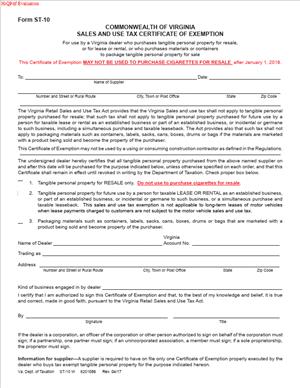
Form ST-10 – Sales and Use Tax Certificate of Exemption
Fill out nowJurisdiction: Country: United States | Province or State: Virginia
If you are completing Form ST-10 – Sales And Use Tax Certificate of Exemption, you are dealing with Virginia sales and use tax rules. This document allows certain purchases to be made without paying sales tax at the time of sale.
This form is typically given to a seller, not filed directly with the tax department. It tells the seller that you qualify for a specific exemption under Virginia law. In simple terms, you are certifying that your purchase meets the rules for tax-free treatment.
For many business owners, this form comes up when buying inventory, raw materials, or other items that will be resold or used in a qualifying way. It is also relevant for certain nonprofit or exempt organizations making eligible purchases.
Understanding what this form does is important. If it is filled out incorrectly, the seller may refuse the exemption. If it is used improperly, you may later face tax assessments, penalties, or questions about the transaction.
Before you complete it, you need to know who can use it, what it covers, and what your signature means.
What is Form ST-10 – Sales and Use Tax Certificate of Exemption?
Clear definition
Form ST-10 – Sales And Use Tax Certificate of Exemption is a written certificate used in Virginia to claim a sales and use tax exemption for certain purchases. It is provided by a purchaser to a seller to document why sales tax should not be charged.
When you present this form, you are stating that the items you are buying qualify under a specific exemption category. The seller keeps the certificate in their records as proof that they were authorized not to collect sales tax.
The document generally includes identifying information about your business or organization, your Virginia tax registration number, and the reason for the exemption. By signing it, you certify that the information is correct and that the purchase meets the legal requirements.
It is not a refund request. It is not a tax return. It is a certification given at the time of purchase.
Who typically uses this form?
Most commonly, businesses that resell goods use this form. For example, retailers buying products for resale often provide this certificate to wholesalers so they are not charged sales tax on items they will later sell to customers.
Manufacturers may also use it when buying raw materials, component parts, or certain machinery that qualifies for exemption. The key factor is that the purchase fits within a recognized category under Virginia’s tax rules.
Certain nonprofit organizations may use exemption certificates if they qualify under specific provisions. However, eligibility depends on the type of organization and the nature of the purchase.
Sellers also interact with this form regularly. Although they do not complete it for the purchaser, they rely on it to justify not collecting sales tax during an audit.
Why might you need this form?
You may need this form when you are making a purchase that would normally be taxed, but you believe it qualifies for an exemption. Without a properly completed certificate, the seller is generally required to collect sales tax.
Using the form can prevent you from paying tax upfront and later seeking a refund. It streamlines transactions by addressing the tax issue at the point of sale.
If you are audited, this document helps show that the transaction was handled according to established procedures. It also protects the seller by shifting responsibility for the exemption claim to the purchaser who signed the certificate.
In practical terms, you need this form when your business model involves resale, manufacturing, or other activities that Virginia law treats as exempt from sales tax under defined conditions.
Typical real-life scenarios
- You operate a retail clothing store in Virginia. You buy inventory from a wholesaler. Because you will resell the clothing to customers and collect sales tax at that time, you provide the exemption certificate to the wholesaler so you are not taxed twice on the same items.
- You run a manufacturing business that produces custom metal parts. You purchase raw steel that will become part of the finished product. If the purchase qualifies under manufacturing exemptions, you give the supplier this form to avoid paying tax on materials that will be incorporated into goods for sale.
- You own a small electronics shop. You buy components that you will assemble into finished devices for resale. Instead of paying tax on each component purchase, you use the certificate to claim the resale exemption.
- You manage purchasing for a qualifying nonprofit entity. When buying items that fall within the organization’s exemption category, you present the certificate to document why sales tax does not apply to that specific transaction.
- You operate an online store based in Virginia and source products from a local distributor. Since you will resell those products to customers, you provide the exemption certificate to the distributor to document that the purchase is for resale.
- In each of these situations, the form functions as proof. It connects your role as a purchaser to a recognized exemption and gives the seller written support for not charging sales tax.
When would you use Form ST-10 – Sales and Use Tax Certificate of Exemption?
You use this form at the time of purchase when a transaction qualifies for exemption. It is typically completed before or during the first exempt transaction with a seller.
In many cases, you provide the certificate once, and the seller keeps it on file for future purchases of the same type. If your business relationship changes or the type of goods changes, an updated certificate may be needed.
You would not use this form for personal purchases. It is generally limited to business or organizational use connected to specific exempt purposes.
If you are a retailer buying inventory, you use it when ordering goods for resale. If you are a manufacturer, you use it when purchasing qualifying raw materials or machinery. If you are an authorized representative of an exempt organization, you use it when buying eligible items for that organization.
The form comes into play when a seller asks for documentation to support an exemption. Sellers are responsible for collecting sales tax unless they have proper documentation. Without this certificate, they may decline to process the sale as tax-exempt.
It may also be used when establishing a new vendor relationship. Many suppliers require exemption documentation before processing the first tax-free order.
If your registration status changes, such as updating your business structure or tax registration number, you may need to provide a new certificate to existing vendors.
Legal characteristics of Form ST-10 – Sales and Use Tax Certificate of Exemption
This certificate works because it is recognized under Virginia tax law as acceptable documentation for exempt sales. It must contain accurate identifying information and a valid Virginia tax registration number, if required for the exemption category.
For the certificate to be effective, it generally must be fully completed and signed by an authorized individual. Incomplete forms, missing registration numbers, or vague exemption claims often lead to rejection by the seller.
Sellers are expected to exercise reasonable care. If a certificate appears invalid on its face, such as listing a business type that does not match the claimed exemption, the seller may question it. Clear, consistent information helps avoid delays.
Common problems include using an expired or incorrect registration number, claiming an exemption that does not apply to the type of property purchased, or signing without proper authority. These issues can trigger tax assessments later.
High-level differences may exist between states, but this certificate applies specifically to Virginia transactions. A resale certificate from another state is not automatically interchangeable. Multi-state businesses often maintain separate exemption documentation for each state.
This form does not automatically make every purchase tax-exempt. It applies only to purchases that meet the stated exemption category. If you buy items outside that category, those purchases may still be taxable even if the seller has a certificate on file.
It also does not relieve you from recordkeeping. Businesses typically keep copies of certificates they issue and track which purchases were made under exemption claims.
Is it legally binding?
Yes, the certificate is legally binding in the sense that you are making a formal statement about the nature of your purchase. By signing, you are certifying that the information is true and that the transaction qualifies for exemption under Virginia law.
Your signature represents that you understand the basis for the exemption. If the information is incorrect or the exemption does not apply, you may be responsible for the unpaid tax, and possibly penalties or interest.
For sellers, the certificate provides legal protection if it is accepted in good faith and appears valid. It shifts responsibility for the exemption claim to the purchaser who signed the form.
The binding nature depends on accurate completion and legitimate use. If it is used outside its intended purpose, its protective effect may be limited.
How to fill out Form ST-10 – Sales and Use Tax Certificate of Exemption
Step 1 – Identify the purchaser’s legal name
Enter the full legal name of your business or organization. Use the name that appears on your Virginia tax registration and official records. Avoid abbreviations unless they are part of your registered name.
Step 2 – Provide your business address
Fill in the complete business address, including street, city, state, and ZIP code. This should be the primary location associated with your tax registration. Accurate address information helps link the certificate to your official records.
Step 3 – Enter your Virginia tax registration number
Include your Virginia sales and use tax registration number, if required for your exemption category. Double-check the number for accuracy. A missing or incorrect number is a common reason a seller may refuse the exemption.
Step 4 – Describe the general nature of your business
State the type of business you operate, such as retail sales, manufacturing, or another qualifying activity. This description should align with the exemption you are claiming. Keep it clear and specific.
Step 5 – Select or state the exemption reason
Indicate the reason for claiming exemption as outlined on the form. This often involves identifying that the property is for resale, will be incorporated into a product for sale, or qualifies under another defined category. Make sure the reason matches the actual use of the items being purchased.
Step 6 – Identify the type of tangible personal property
Some versions of the form request a description of the property being purchased tax-free. Provide a general description, such as inventory for resale or raw materials for manufacturing. The description should be consistent with your business activity and exemption claim.
Step 7 – Provide the seller’s information if required
If the form includes a section for the seller’s name and address, complete it accurately. This ties the certificate to a specific vendor relationship and transaction context.
Step 8 – Review the certification statement carefully
Read the certification language before signing. It explains that you are affirming the truth of the information and that the purchases qualify for exemption. Confirm that all entries are accurate and complete before moving forward.
Step 9 – Sign and date the form
An authorized individual must sign the certificate. This is often an owner, officer, or other responsible representative. Add the date of signing. The signature makes the certification official and usable by the seller.
Step 10 – Provide the completed form to the seller
Give the signed certificate to the seller at or before the time of purchase. Keep a copy for your own records. Maintaining organized copies helps you track which vendors have a valid exemption certificate on file and supports your records if questions arise later.
Legal terms you might encounter in Form ST-10 – Sales And Use Tax Certificate of Exemption
- Tangible Personal Property: This means physical items you can see, touch, and move. On this form, you are certifying that the tangible personal property you buy qualifies for an exemption. It does not apply to services unless those services are directly connected to exempt property.
- Sales and Use Tax: Sales tax is charged at the time of purchase. Use tax applies when sales tax was not collected but should have been. This document allows you to claim an exemption from paying those taxes on qualifying purchases.
- Exemption Certificate: This is the document you give to a seller to prove you do not have to pay sales tax on specific purchases. The certificate shifts the responsibility to you to ensure the purchase truly qualifies. If it does not, you may owe the tax later.
- Dealer: The dealer is the seller who would normally collect sales tax from you. When you provide this certificate, the dealer relies on your statements to avoid charging tax. The dealer must keep your certificate in their records.
- Purchaser: You are the purchaser if you are buying the goods. Your legal name and registration number must match official records. Any mismatch can raise questions about the validity of the exemption.
- Registration Number: This is your Virginia sales tax registration number issued by the Department of Taxation. You enter it to show that you are properly registered. An incorrect or missing number can cause a seller to reject the certificate.
- Good Faith Acceptance: This refers to the seller accepting your certificate honestly and without reason to doubt it. If the information looks incomplete or inconsistent, the seller may refuse it. The seller must believe your claim is legitimate.
- Blanket Certificate: This is a certificate used for ongoing purchases rather than a single transaction. If you check or indicate blanket use, it may apply to all future qualifying purchases from that seller. You are responsible for updating it if your exemption status changes.
- Certification Statement: This is the legal declaration near the signature line. By signing, you confirm the information is true and that you understand the consequences of misuse. Signing falsely can lead to tax liability and penalties.
FAQs
Do I need to submit Form ST-10 – Sales And Use Tax Certificate of Exemption to the tax department?
No. You generally provide this document directly to the seller, not to the Department of Taxation. The seller keeps it in their records to support why they did not collect sales tax from you. You should keep a copy for your own files in case of questions later.
What happens if my business name on this document does not exactly match my registration?
The name you enter should match the legal name associated with your sales tax registration number. If it does not match, the seller may refuse to accept the certificate. Even if accepted, a mismatch can cause problems during a tax review. Always confirm the spelling and entity type before signing.
Can I use this form for one purchase and not future ones?
Yes. You can issue it for a single transaction instead of as a blanket certificate. Make sure the seller understands that it applies only to the specific invoice or order. If you later want blanket coverage, you may need to provide a new certificate.
What if I am not yet registered for a Virginia sales tax number?
You generally need a valid registration number to complete this document properly. If you are not registered, a seller is unlikely to accept the certificate. You may need to register first so you can enter an accurate number on the form.
Does this document have an effective date?
This form does not usually require a separate effective date field. It becomes effective when you sign and deliver it to the seller. For a blanket certificate, it typically remains in effect until you revoke it or your exemption status changes.
Who is allowed to sign this document?
An authorized person must sign. That usually means the business owner, an officer, or someone with authority to bind the company. The signer’s role should match your internal records, and the signature confirms you take responsibility for the exemption claim.
Do I need to attach proof of my exemption to this form?
In most cases, you do not attach extra documents when giving it to the seller. The key proof is your valid registration number and completed certification. However, a seller may request additional information if they are unsure about the exemption type you claim.
What if I realize I gave a seller incorrect information on this form?
You should correct the mistake as soon as possible. Provide an updated certificate with accurate details and clearly state that it replaces the earlier version. If tax should have been paid, you may need to work with the seller to resolve the unpaid amount.
Checklist: Before, During, and After Form ST-10 – Sales And Use Tax Certificate of Exemption
Before
- Confirm your business is properly registered for Virginia sales tax.
- Locate your correct Virginia sales tax registration number.
- Verify your exact legal business name and address.
- Review the type of exemption you qualify for.
- Identify the specific items you plan to purchase tax-free.
- Decide whether you need a single-use or blanket certificate.
- Make sure the person signing has the authority to bind the business.
During
- Enter your full legal name without abbreviations unless officially registered that way.
- Provide your complete and current business address.
- Carefully write your sales tax registration number.
- Describe the general nature of your business clearly.
- Specify the type of tangible personal property covered.
- Review the exemption reason to ensure it matches your purchase.
- Read the certification statement word for word.
- Sign and date the form clearly and legibly.
After
- Make a copy of the signed certificate for your records.
- Provide the original or required copy to the seller.
- Confirm the seller has accepted it in good faith.
- Check your invoice to ensure sales tax was not charged.
- Store the certificate with your tax records.
- Monitor your purchases to ensure they match the exemption.
- Update the seller if your registration number or business status changes.
Common mistakes to avoid with Form ST-10 – Sales and Use Tax Certificate of Exemption
- Mistake: Using a trade name instead of your legally registered name, which happens when businesses rely on branding; this can cause rejection or audit issues, so do not forget to match the name exactly to your registration.
- Mistake: Entering an incorrect or outdated registration number because you copied it from an old document; this may invalidate the certificate, so do not forget to verify the current number.
- Mistake: Claiming an exemption for items that do not qualify due to a misunderstanding of the rules; this can lead to tax assessments and penalties, so do not forget to confirm that each purchase fits the exemption category.
- Mistake: Forgetting to sign and date the certificate, often due to rushing; an unsigned form is not valid, so do not forget the certification step.
- Mistake: Giving a blanket certificate when you only intended a one-time purchase, which can expose you to liability for future transactions; do not forget to clarify the scope with the seller.
- Mistake: Failing to update the seller after your business structure changes, which happens during reorganizations; this can make the certificate inaccurate, so do not forget to issue a new one if details change.
- Mistake: Assuming the seller will verify your eligibility, which leads to complacency; the responsibility rests with you, so do not forget that you are legally accountable for false claims.
- Mistake: Not keeping a copy for your records because you think the seller’s copy is enough; this can leave you unprepared during a review, so do not forget to retain your own file copy.
What to do after filling out Form ST-10 – Sales And Use Tax Certificate of Exemption
Once you complete the certificate, your job is not done. You need to make sure it is properly delivered, accepted, and tracked. This protects you if questions come up later.
- Step 1: Make a clear copy of the signed and dated certificate for your internal records.
- Step 2: Provide the certificate directly to the seller before or at the time of purchase.
- Step 3: Ask the seller to confirm they have accepted it and applied the exemption to your order.
- Step 4: Review your invoice carefully to ensure sales tax was not charged in error.
- Step 5: File the copy in your tax records, organized by vendor name.
- Step 6: Track which vendors have a blanket certificate on file for your business.
- Step 7: Periodically review your purchases to confirm they match the exemption category you claimed.
- Step 8: Update the seller immediately if your registration number, legal name, or business structure changes.
- Step 9: Replace the certificate if your exemption status changes or if you no longer qualify.
- Step 10: Keep the document for the same retention period as your other tax records in case of audit or review.
Treat this certificate as part of your tax compliance system. You are certifying facts that affect whether tax is collected. Staying organized and proactive reduces risk and keeps your records clean.
Disclaimer: This guide is provided for informational purposes only and is not intended as legal advice. You should consult a legal professional.