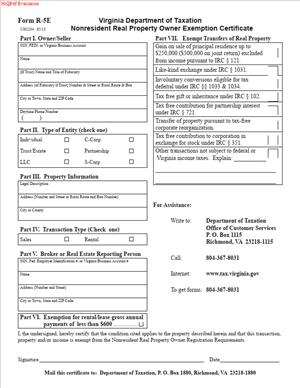
Form R-5E – Nonresident Real Property Owner Exemption Certificate
Fill out nowJurisdiction: Country: United States | Province or State: Virginia
Form R-5E – Nonresident Real Property Owner Exemption Certificate is a tax document used in Virginia when a nonresident owns real property and certain tax withholding rules may apply. You complete this form to certify that you qualify for an exemption from withholding on income connected to that property.
If you live outside Virginia but own rental property, commercial real estate, or other income-producing real estate in the state, this form may affect how state income tax is handled. It often comes into play when payments are being made to you, and someone is required to consider withholding Virginia income tax.
This document matters because it can change how and when taxes are collected. Without it, a payer may withhold tax from amounts due to you. With it, and if you qualify, that withholding may not occur.
If you are preparing to fill it out, you likely want to know what information it asks for, what you are certifying, and what happens after submission. The sections below walk through those points in plain language.
What is Form R-5E – Nonresident Real Property Owner Exemption Certificate?
Clear definition
Form R-5E – Nonresident Real Property Owner Exemption Certificate is a written certification submitted to address Virginia income tax withholding related to real property owned by a nonresident. It states that the nonresident property owner meets specific conditions that qualify them for an exemption from withholding.
In practical terms, it is not a tax return. It is not a payment voucher. It is a statement made under penalty of perjury that certain facts are true. Those facts relate to your residency status and your Virginia tax obligations tied to the property.
The form is generally used in situations where Virginia law would otherwise require withholding on income connected to real property owned by someone who does not reside in the state.
Who typically uses this form?
You typically use this form if you are an individual who lives outside Virginia but owns real property located within Virginia. This may include rental homes, apartment buildings, commercial spaces, farmland, or other real estate that produces income.
It can also apply to nonresident entities, such as partnerships, limited liability companies, or corporations organized outside Virginia, if they own Virginia real estate and meet the conditions described in the form.
Property managers, closing agents, or other payers may request this form from you. They often need it for their records to determine whether they must withhold Virginia income tax from payments made to you.
Why might you need this form?
You might need this form to prevent withholding from rental payments, sale proceeds, or other income connected to Virginia real property. If you qualify for an exemption but do not provide the certificate, the payer may withhold tax by default.
The form can also help clarify your tax position. By submitting it, you formally state that you meet the exemption criteria described in the document. This creates a record that explains why withholding did not occur.
In some cases, providing the exemption certificate simplifies transactions. It can reduce administrative steps for both you and the person making payments to you.
Typical real-life scenarios
- You live in another state but own a rental house in Virginia. A property management company collects rent on your behalf. The company reviews its obligations regarding Virginia income tax withholding. If you qualify, you may provide this certificate so the company does not withhold tax from the rental income it sends to you.
- You inherit real estate in Virginia while residing outside the state. The property generates income, or you later sell it. During the process, someone involved in handling funds asks for documentation about your tax status. This form may be used to address whether withholding is required.
- You operate a business entity formed in another state, and that entity owns commercial property in Virginia. Lease payments are made regularly. The entity may complete the exemption certificate to certify its status under Virginia’s rules.
- You sell Virginia real estate as a nonresident owner. At closing, there may be questions about withholding obligations tied to the transaction. Depending on your situation and eligibility, this form can be part of the documentation reviewed to determine whether withholding applies.
When would you use Form R-5E – Nonresident Real Property Owner Exemption Certificate?
You would use this form when you are a nonresident of Virginia and are involved in a transaction or ongoing payment arrangement related to Virginia real property, and withholding rules may apply.
It often comes up before payments are made. For example, before a property manager begins sending rental income, or before a closing agent disburses proceeds from a sale, they may confirm whether withholding is required. If you believe you qualify for an exemption, you may provide the completed form at that time.
Timing matters. The certificate is typically provided before or at the time of payment. If it is not submitted in advance, withholding may already occur, and reversing that process may require additional steps.
Different roles may be involved. As the property owner, you complete and sign the form. A payer, such as a property manager or settlement agent, reviews it to determine how to handle withholding. Each party relies on the information stated in the document.
You may also use the form when your status changes. For example, if your residency or tax situation has changed in a way that affects withholding requirements, a new certificate may be necessary to reflect updated information.
Legal characteristics of Form R-5E – Nonresident Real Property Owner Exemption Certificate
This form functions as a formal certification. It typically requires you to provide identifying information, such as your name, address, and taxpayer identification number, and to attest that you meet specific exemption criteria.
For it to be effective, the information must be complete and accurate. Missing identification numbers, unsigned forms, or unclear statements may cause the payer to reject it. If a form is rejected, withholding may proceed as though no exemption was claimed.
The form generally includes a declaration that the information provided is true and correct. Signing under penalty of perjury means you are making a legally significant statement. Providing false information can lead to tax consequences or other legal issues.
Requirements and procedures can vary slightly depending on the type of owner and the nature of the transaction. For example, rules may differ between ongoing rental income and a one-time sale. The exemption criteria referenced in the document determine whether withholding is avoided.
It is important to understand what this form does not do. It does not eliminate your obligation to file a Virginia income tax return if you are required to do so. It does not waive tax that may ultimately be owed. It addresses withholding at the payment stage, not the final calculation of tax liability.
Is it legally binding?
Yes, in the sense that it is a signed certification made under penalty of perjury. When you sign it, you are legally affirming that the statements in the document are true to the best of your knowledge.
The binding effect relates to the truthfulness of your statements. If the information is accurate and you qualify under the stated criteria, the form serves as a valid basis for a payer to refrain from withholding. If the information is inaccurate, you may face consequences under tax law.
The document itself is not a contract between you and the payer. Instead, it is a statutory certification used to satisfy tax withholding requirements. Its legal weight comes from the declaration and the governing tax rules that recognize it.
How to fill out Form R-5E – Nonresident Real Property Owner Exemption Certificate
Step 1 – Enter your name and identifying information
Begin by writing your full legal name exactly as it appears on your tax records. If the property is owned by an entity, enter the full legal name of that entity. Provide your current mailing address, including city, state, and ZIP code. Add your taxpayer identification number, such as a Social Security number or federal employer identification number, as requested on the form.
Ensure that the information matches official records. Inconsistent names or numbers can delay acceptance of the document.
Step 2 – Confirm your nonresident status
Indicate that you are not a resident of Virginia. The form typically includes a statement or checkbox addressing residency. Read this section carefully before marking it. Your residency status is central to whether the exemption applies.
If the property is owned by an entity, confirm the entity’s state of formation or principal place of business as required. Provide accurate details reflecting your current status at the time of signing.
Step 3 – Identify the Virginia real property
Provide information that identifies the specific real property connected to the exemption claim. This may include the property address, parcel number, or other identifying details. The goal is to clearly link the certificate to a particular property or transaction.
If multiple properties are involved, check whether separate forms are required or whether all properties can be listed on one document, depending on the structure of the form.
Step 4 – Review the exemption statement
Read the exemption language in full. The form typically outlines the conditions under which withholding is not required. Make sure you understand what you are certifying. The statements may refer to expected tax filing, compliance history, or other eligibility factors.
Do not skip this section. Your signature confirms that you meet the stated conditions. If any part is unclear, pause and review the language carefully before proceeding.
Step 5 – Sign and date the form
Sign your name in the designated signature area. Use your legal signature, consistent with other official documents. Enter the date of signing next to your signature.
If you are signing on behalf of an entity, include your title or capacity, such as member, manager, officer, or authorized representative, if the form requests it. This clarifies your authority to act for the owner.
Once signed and dated, provide the completed form to the appropriate party, such as the property manager, payer, or settlement agent handling the transaction. Ensure they receive it before payments are finalized so it can be considered in determining whether withholding applies.
Legal terms you might encounter in Form R-5E – Nonresident Real Property Owner Exemption Certificate
- Nonresident: A person or entity that does not meet the state’s definition of a resident for income tax purposes. On this form, you confirm that you live outside the state or that your business is formed and based elsewhere. Your residency status affects whether certain tax withholding rules apply to you.
- Real Property: Land and anything permanently attached to it, such as buildings or improvements. The form requires you to identify the specific property involved, usually by address or legal description. This ensures the exemption applies to the correct parcel.
- Withholding: A portion of money held back to cover potential tax liability. In real estate transactions, withholding may apply when a nonresident sells property. This document is used to claim that withholding should not apply in your situation.
- Exemption Certificate: A signed statement claiming that you qualify for a specific exception under tax law. By submitting this certificate, you are asserting that you meet the requirements to avoid withholding. The accuracy of your claim matters because tax authorities rely on it.
- Transferor: The person or entity transferring ownership of the property, usually the seller. If you are selling property, you may be the transferor completing this document. The form connects your identity as a transferor to the exemption you are claiming.
- Transferee: The person or entity receiving ownership of the property, typically the buyer. While the buyer may not complete the form, they may rely on it to determine whether they must withhold funds. Clear identification of both parties helps prevent disputes.
- Tax Identification Number (TIN): A unique number used by tax authorities to identify you or your business. This could be a Social Security number or an employer identification number. You must enter the correct number so the exemption can be matched to your tax records.
- Certification: A formal statement that the information you provide is true and correct. When you sign, you are certifying under penalty of law that your statements are accurate. False certification can lead to penalties or additional tax assessments.
- Consideration: The total amount paid or to be paid for the property. This figure may determine whether withholding rules apply. Accurate reporting of consideration is critical for evaluating eligibility for exemption.
- Penalty of Perjury: A legal declaration that the statements you make are true to the best of your knowledge. Signing under penalty of perjury raises the seriousness of the document. It means incorrect or misleading information can result in legal consequences.
FAQs
Do I need to file Form R-5E – Nonresident Real Property Owner Exemption Certificate before closing?
You generally complete and provide this document as part of the closing process when ownership is being transferred. The key is timing. The buyer or closing agent needs it before funds are disbursed so they know whether to withhold any portion of the sale proceeds. If you wait until after closing, it may be too late to prevent withholding.
What information must exactly match my tax records?
Your full legal name and your tax identification number must match what tax authorities already have on file. If you recently changed your name or business structure, confirm that your records have been updated before you submit this document. Mismatched information can delay acceptance or trigger follow-up questions.
What happens if I qualify for only a partial exemption?
This document is typically used when you meet specific exemption criteria. If your situation does not fully meet those criteria, withholding may still apply to part of the transaction. You should review the exemption statement carefully and confirm that every condition applies to you before signing.
Do I need to attach supporting documents?
In many cases, this document stands on its own as a signed certification. However, a closing agent or buyer may request proof of your nonresident status or other details. Keep documents that support your claim, such as formation documents for a business or identification records, in case you are asked to provide them.
Who keeps the completed form after I sign it?
The signed document is usually kept with the transaction records by the buyer or closing professional. It may also be provided to tax authorities if required. You should always keep a copy for your own records in case questions arise later.
What if I discover an error after submitting this form?
If you find a mistake in what you submitted, act quickly. Notify the party handling the transaction and provide a corrected version if possible. Errors involving your tax identification number or the property description can create confusion and may affect how the exemption is processed.
Does signing this document change the public property record?
This document does not transfer ownership by itself. It supports the tax treatment of a property transfer that is already occurring. The deed or other transfer document is what updates the public record, while this form addresses withholding obligations tied to that transfer.
Can a business entity use this document instead of an individual?
Yes, a business that owns property can complete this document if it meets the exemption criteria. The signer must have authority to act on behalf of the entity. Make sure the entity’s legal name and tax identification number are entered exactly as registered.
Checklist: Before, During, and After Form R-5E – Nonresident Real Property Owner Exemption Certificate
Before
- Confirm that you are classified as a nonresident for state tax purposes.
- Review the property details, including address and legal description.
- Verify your tax identification number against official records.
- Confirm the total consideration amount for the transfer.
- Determine whether you meet every requirement listed in the exemption statement.
- Gather supporting documents that confirm your identity or business status.
- Coordinate with the closing agent about when the form is needed.
- Review related transaction documents to ensure consistent information.
During
- Enter your full legal name without abbreviations unless officially registered.
- Provide the correct tax identification number in the required format.
- Accurately list the property address and any required parcel identifiers.
- Double-check the stated consideration amount for accuracy.
- Read the certification language carefully before signing.
- Ensure the signer has proper authority if signing for a business.
- Sign and date the form clearly and legibly.
- Provide the completed document to the appropriate party at closing.
After
- Keep a signed copy in your permanent tax records.
- Confirm with the closing agent that the form was accepted.
- Verify whether any funds were withheld despite your submission.
- Monitor your transaction documents for consistency.
- Retain proof of delivery or submission if available.
- Check your final settlement statement to confirm withholding treatment.
- Be prepared to reference the document if tax authorities request clarification.
- Store the form with your property sale and tax documentation.
Common mistakes to avoid with Form R-5E – Nonresident Real Property Owner Exemption Certificate
- Mistake: Entering a nickname or shortened business name because it seems informal and easier, which happens when people copy from memory, leading to mismatches with tax records and processing delays, so do not forget to use your exact legal name.
- Mistake: Transposing digits in your tax identification number due to rushing, which is common during closing, causing verification problems and possible rejection, so do not forget to double-check every digit.
- Mistake: Listing the wrong property address because you own multiple properties, which can confuse the transaction and affect withholding decisions, so do not forget to confirm the correct parcel details.
- Mistake: Signing without reviewing the certification language because it looks standard, which can result in unintentionally making a false statement, so do not forget to read each exemption condition carefully.
- Mistake: Assuming the buyer or agent will correct small errors, which happens when responsibility is unclear, leading to invalid or incomplete filings, so do not forget that you are responsible for accurate information.
- Mistake: Failing to keep a copy because you believe it is only needed at closing, which makes it harder to respond to later tax inquiries, so do not forget to store a signed copy with your records.
- Mistake: Using outdated entity information after a merger or name change, which can create inconsistencies with official filings and delay acceptance, so do not forget to confirm current registration details.
- Mistake: Waiting until the last minute to complete the form, which increases the chance of errors and rushed review, so do not forget to prepare it well before closing.
What to do after filling out Form R-5E – Nonresident Real Property Owner Exemption Certificate
Once you complete the form, your job is not quite finished. You need to make sure it is properly delivered, acknowledged, and stored. Small follow-up steps can prevent larger tax issues later.
- Step 1: Make at least one clear copy of the signed form for your personal records.
- Step 2: Provide the original signed document to the closing agent, buyer, or other designated party handling the transaction.
- Step 3: Confirm how and when the form will be used in the closing process.
- Step 4: Ask whether any additional documentation is required to support your exemption claim.
- Step 5: Review your settlement statement after closing to see whether any withholding was applied.
- Step 6: If withholding was applied unexpectedly, request clarification immediately.
- Step 7: File your copy of the form with your property sale documents and annual tax records.
- Step 8: Keep the form accessible in case tax authorities request proof of exemption.
- Step 9: Monitor any correspondence related to the transaction for follow-up questions.
- Step 10: Update your internal financial records to reflect the final sale amount and withholding treatment.
By taking these steps, you create a clear paper trail. That protects you if questions arise months or even years later. Staying organized also makes future property transactions easier because you will understand how exemption certificates work and what information you need to provide.
Disclaimer: This guide is provided for informational purposes only and is not intended as legal advice. You should consult a legal professional.