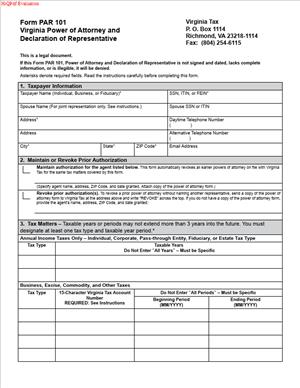
Form PAR 101 – Virginia Power of Attorney and Declaration of Representative
Fill out nowJurisdiction: Country: United States | Province or State: Virginia
Form PAR 101 – Virginia Power of Attorney and Declaration of Representative is a document used to authorize someone to act on your behalf in certain tax matters before the Virginia Department of Taxation. If you are about to fill it out, you are likely trying to let another person communicate with the department for you.
This form allows you to formally appoint a representative. That representative can receive information, discuss your account, and in some cases act for you within the limits you set.
You might need this document if you are dealing with a tax issue and want professional help. It is also used when you cannot handle the matter yourself.
Understanding how this form works helps you avoid delays. Small mistakes can slow down your filing or limit what your representative can do.
What is Form PAR 101 – Virginia Power of Attorney and Declaration of Representative?
Clear definition
Form PAR 101 – Virginia Power of Attorney and Declaration of Representative is an authorization form issued by the Virginia Department of Taxation. It gives a named individual the authority to represent you in specified tax matters before the department.
It is both a power of attorney and a declaration. The power of attorney section grants authority. The declaration section is where the representative confirms their eligibility and role.
This document is limited to Virginia tax matters. It does not apply to federal taxes or to other state agencies.
Who typically uses this form?
Individuals use this form when they want someone else to speak to the Virginia Department of Taxation for them. This often includes accountants, tax preparers, attorneys, or enrolled agents.
Business owners also use the form. A corporation, partnership, or limited liability company may appoint a representative to handle sales tax, withholding tax, or corporate income tax issues.
Sometimes a family member is appointed. This may happen if the taxpayer is elderly, ill, or temporarily unavailable.
Tax professionals frequently request this form before discussing your account with the department. Without it, the department may refuse to share detailed information.
Why might you need this form?
You may need this form if the department has sent you a notice. If you want your representative to respond directly, they need proper authorization.
You may also need it during an audit. The department may require a signed authorization before speaking with your accountant or attorney.
If you are disputing an assessment, your representative can prepare and submit documents on your behalf. The form confirms they have permission to act.
This document is also useful when you want ongoing representation for specific tax years or types of tax. It clarifies the scope of authority in writing.
Typical real-life scenarios
- You receive a letter stating that you owe additional income tax. You disagree with the amount. You hire a tax professional to review your return and communicate with the department. The department requires this form before discussing your case.
- You run a small business and are facing a sales tax audit. Your accountant handles the audit process. To allow direct communication between the accountant and the department, you complete this form.
- You moved out of Virginia, but still have unresolved tax issues from prior years. Because you are no longer local, you appoint a representative to manage the matter in your absence.
- You are dealing with a medical issue and cannot manage paperwork. A trusted individual is authorized through this document to handle conversations and submissions related to your Virginia tax account.
When would you use Form PAR 101 – Virginia Power of Attorney and Declaration of Representative?
You would use this form any time you want another person to interact with the Virginia Department of Taxation on your behalf. This typically happens after a notice, bill, or audit inquiry.
It is commonly used during assessments, appeals, payment arrangement discussions, and refund disputes. The form may also be used when requesting confidential account information.
Both individuals and businesses use it. For a business, an officer or authorized person signs the form to appoint a representative. For an individual, the taxpayer signs directly.
You might also use it when you expect ongoing communication with the department over several months. By submitting the form early, your representative can respond quickly without waiting for additional authorization.
Legal characteristics of Form PAR 101 – Virginia Power of Attorney and Declaration of Representative
This document is an official authorization recognized by the Virginia Department of Taxation. It must clearly identify the taxpayer and the representative. It must also specify the tax matters and time periods covered.
The authority granted is limited to what is written in the form. If you do not list certain tax types or years, the representative may not be able to act for those matters.
The form generally becomes effective once it is properly completed, signed, and accepted by the department. Incomplete information can delay processing.
Common problems include missing signatures, unclear tax years, or incorrect identification numbers. If the taxpayer’s name or identification number does not match department records, the authorization may not be processed.
This document does not give general financial power. It does not allow the representative to manage bank accounts or make personal decisions outside of tax matters. It is limited to representation before the Virginia Department of Taxation.
Other types of powers of attorney may exist for broader purposes. This form is specific to Virginia tax administration.
Is it legally binding?
When properly completed and signed, this form is legally binding for the purposes stated in it. It authorizes the representative to act within the defined scope.
The department relies on the signed form to determine who may receive confidential information. Without a valid signature from the taxpayer or authorized business officer, the form has no effect.
The binding nature applies only to the relationship between you, your representative, and the Virginia Department of Taxation. It does not automatically bind other agencies.
If the form is revoked or replaced, the prior authorization may no longer apply. The department generally follows the most recent valid authorization on file.
How to fill out Form PAR 101 – Virginia Power of Attorney and Declaration of Representative
Step 1 – Provide taxpayer information
Enter your full legal name exactly as it appears on your tax records. Include your Social Security number or federal employer identification number, depending on whether you are filing as an individual or business.
Add your current mailing address and contact information. Make sure the details match the records held by the Virginia Department of Taxation to avoid delays.
Step 2 – Identify the representative
List the full name of the person you are authorizing. Include their mailing address, phone number, and any professional identification information requested on the form.
If you are appointing more than one representative, provide complete information for each one. Be clear and accurate so the department can recognize them without confusion.
Step 3 – Specify the tax matters and periods
Clearly state the type of tax involved, such as individual income tax, corporate income tax, sales tax, or withholding tax. Then list the specific tax years or periods covered.
Be precise. If you only list certain years, the representative’s authority is limited to those years. If you need broader coverage, the form must reflect that.
Step 4 – Define the scope of authority
Review the section that outlines what your representative is allowed to do. This may include receiving confidential information, representing you in discussions, or signing certain documents.
Read the language carefully. The authority granted is limited to what is described in this section. If there are restrictions or special instructions, include them clearly where the form allows.
Step 5 – Review notices and communications preferences
Some versions of the form allow you to indicate whether copies of notices should be sent to your representative. Indicate your preference if the form provides that option.
Consider how you want communication handled. The department typically follows the instructions written in the document.
Step 6 – Sign and date the form
Sign your name exactly as required. If you are signing for a business, include your title to show that you are authorized to act for the entity.
Enter the date of signature. An undated form may not be processed. Ensure the signature is clear and matches the taxpayer identified earlier in the document.
Step 7 – Representative declaration and signature
The representative must complete and sign the declaration section. This confirms their eligibility and acceptance of the appointment.
Without the representative’s signature, the form is incomplete. Confirm that all required fields in this section are filled out before submission.
Legal terms you might encounter in Form PAR 101 – Virginia Power of Attorney and Declaration of Representative
- Taxpayer Identification Number (TIN): This is the number the Department of Taxation uses to identify you or your business. For individuals, it is typically your Social Security number. For businesses, it may be a federal employer identification number. On this document, the number must match what the tax agency already has on file.
- Representative: This is the person you authorize to act on your behalf. It can be an attorney, certified public accountant, enrolled agent, or another individual permitted under tax rules. The representative’s name and contact details must be clearly listed so the Department knows who can receive information and speak for you.
- Tax Matters: This refers to the specific types of taxes covered by the authorization. Examples include individual income tax, corporate income tax, sales and use tax, or withholding tax. You must identify each tax type clearly so the authority is not overly broad or unintentionally limited.
- Tax Periods: These are the years or specific filing periods the authorization covers. You might list calendar years (such as 2023 and 2024) or specific quarters for sales tax. If you leave this section vague, the representative may not be able to act for certain years.
- Scope of Authority: This describes what your representative is allowed to do. It may include receiving confidential information, signing agreements, or negotiating payment plans. The scope is controlled by what you write in the form and any limitations you add.
- Declaration of Representative: This is the section where the representative confirms they are authorized and eligible to represent you. They certify their professional status and agree to follow applicable rules. Without this declaration, the form may not be processed.
- Revocation: Revocation means canceling a prior power of attorney. If you file a new authorization covering the same matters and periods, it may replace earlier ones unless you state otherwise. You must be clear whether you want older authorizations to stay active.
- Confidential Tax Information: This includes your returns, account balances, audit results, and payment history. By signing this document, you allow your representative to access this information for the tax matters listed.
- Authorized Signature: This is the legally valid signature of the taxpayer or business representative. For individuals, it is usually your own signature. For businesses, it must be someone with proper authority, such as an officer, partner, or member, depending on the entity type.
FAQs
Do I need to list every tax year separately on this form?
You need to clearly identify the tax periods your representative will handle. If the form provides space for specific years or quarters, list each one. If you want ongoing authority for future periods, check whether the form allows you to state “all periods” or a range of years. If you leave a year out, your representative may not be able to discuss that year with the Department.
Can I appoint more than one representative on Form PAR 101 – Virginia Power of Attorney and Declaration of Representative?
Yes, you can generally list more than one representative if the form provides space. You must include full contact details for each person. Be clear whether each representative can act independently or if you expect them to act together. If you do not specify limits, the Department may treat each listed representative as fully authorized.
Does this document allow my representative to sign my tax returns?
Not automatically. You must review the section that describes the scope of authority. Some powers of attorney allow return signing only in limited situations, such as when you are unavailable due to illness or absence. If return signing is important to you, confirm that the form includes that authority or attach a clear statement.
When does the authorization become effective?
The authorization generally becomes effective once the Department receives and processes the completed form. The effective date is usually tied to the signature date and the listed tax periods. If you sign it but never submit it, the agency will not recognize your representative.
What happens to my previous power of attorney when I file this form?
If this document covers the same tax matters and periods as an earlier authorization, it may revoke the prior one. Some forms include a box you can check to keep earlier authorizations in place. Review that section carefully so you do not accidentally cancel a representative you still need.
Can I limit what my representative can see or do?
Yes. You can limit authority by clearly describing restrictions in the appropriate section. For example, you might allow access to information but not authority to sign agreements. If you do not write specific limits, the authority may be interpreted broadly for the listed tax matters.
What if my name or business name has changed?
Enter your current legal name exactly as it appears in tax records. If you recently changed your name, make sure the Department’s records are updated or note the prior name if the form requests it. Mismatched names can delay processing because the agency may not be able to match the account.
How do I know if the Department has accepted the Form PAR 101 – Virginia Power of Attorney and Declaration of Representative?
Acceptance is usually confirmed when your representative is able to contact the Department and discuss your account. Some agencies send written confirmation, while others do not. You or your representative can follow up to confirm that the authorization is on file and active for the listed tax matters.
Checklist: Before, During, and After Form PAR 101 – Virginia Power of Attorney and Declaration of Representative
Before
- Confirm the exact legal name and taxpayer identification number on file with the Department.
- Decide which tax types and years you want covered.
- Choose a representative who is eligible to act in tax matters.
- Discuss the scope of authority with your representative.
- Gather prior power of attorney documents to see if revocation is needed.
- Verify the correct mailing or submission method.
- Check whether you need supporting documents for the business authority.
During
- Print or type names exactly as they appear in official records.
- Enter complete contact information for each representative.
- List each tax matter and period clearly and specifically.
- Review any boxes related to revoking prior authorizations.
- Add written limitations if you want to restrict authority.
- Ensure both you and the representative sign and date in the correct sections.
- Double-check that all required fields are completed.
After
- Make a copy of the signed document for your records.
- Provide a copy to each listed representative.
- Submit the form using the approved method.
- Note the date of submission for follow-up.
- Confirm processing with your representative.
- Store the document with your tax records.
- Update internal records if you are a business.
- Revoke the authorization in writing if you later change representatives.
Common mistakes to avoid with Form PAR 101 – Virginia Power of Attorney and Declaration of Representative
- Mistake: Listing the wrong taxpayer identification number because you copied it from an old document, which can lead to rejection or delays, so do not forget to verify the number against current tax records.
- Mistake: Failing to specify tax periods clearly because you assume “all years” is implied, which can prevent your representative from accessing certain accounts, so do not forget to list each year or range as required.
- Mistake: Forgetting the representative’s signature in the declaration section because you focused only on your own signature, which can make the form incomplete, so do not forget both signatures.
- Mistake: Accidentally revoking a prior power of attorney because you did not read the revocation section carefully, which can remove authority from another trusted advisor, so do not forget to check the correct box.
- Mistake: Using a nickname or trade name instead of the registered legal name, which can cause processing issues, so do not forget to match the name exactly to tax filings.
- Mistake: Leaving contact information incomplete because you assume the Department already has it, which can delay communication, so do not forget to provide full mailing addresses and phone numbers.
- Mistake: Not keeping a copy of the signed form because you think submission is enough, which can create confusion later, so do not forget to store a complete copy in your records.
- Mistake: Granting broader authority than intended because you did not write clear limitations, which can allow actions you did not expect, so do not forget to state any restrictions in writing.
What to do after filling out Form PAR 101 – Virginia Power of Attorney and Declaration of Representative
Once you complete the document, your next steps matter. The form only works if it reaches the right office and is properly processed.
- Step 1: Review every page for completeness. Confirm names, identification numbers, tax matters, and tax periods are accurate and consistent.
- Step 2: Make at least one clear copy for your personal records and one for each representative.
- Step 3: Submit the form using the accepted delivery method, such as mailing, faxing, or electronic submission if available.
- Step 4: Record the date you submitted it and the method used.
- Step 5: Inform your representative that the form has been sent, so they know when to begin contacting the Department.
- Step 6: Allow reasonable processing time before expecting the representative to access your account.
- Step 7: Have your representative confirm that the authorization is active by successfully discussing your account.
- Step 8: Store the original signed copy in a secure place with your tax returns and related documents.
- Step 9: Update any internal compliance files if you are acting for a business entity.
- Step 10: If your situation changes, prepare and submit a written revocation or a new authorization to replace this one.
Keep communication open with your representative. If you receive notices from the Department after filing, confirm whether copies are also being sent to your representative. Staying organized will help you avoid missed deadlines and confusion.
Disclaimer: This guide is provided for informational purposes only and is not intended as legal advice. You should consult a legal professional.