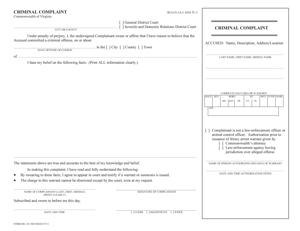
DC-311 – Criminal Complaint
Fill out nowJurisdiction: Country: United States | Province or State: Virginia
The DC-311 – Criminal Complaint is a court form used in Virginia’s General District Court to start a criminal case. It puts an alleged offense into writing and asks a magistrate or judge to consider formal charges. If you are filling it out, you are likely trying to report a crime or respond to a request from a court official.
This document is not just a report. It is a sworn statement. That means the information you provide is made under oath. The court relies on it when deciding whether to issue a warrant or summons.
You may come across DC-311 – Criminal Complaint if you are a victim, a witness, or a law enforcement officer. In some situations, a private citizen can also present facts to a magistrate for review. The form creates an official court record.
Because this filing can lead to criminal charges, accuracy matters. Small details, such as dates, locations, and names, can affect what happens next. Understanding what the form does helps you complete it clearly and confidently.
What is DC-311 – Criminal Complaint?
Clear definition
DC-311 – Criminal Complaint is a standardized Virginia court form used to formally accuse someone of committing a criminal offense. It describes the alleged crime, identifies the accused person, and outlines key facts supporting the charge.
The complaint is typically reviewed by a magistrate. The magistrate decides whether there is probable cause to believe a crime occurred and that the named person committed it. If probable cause is found, the court may issue a warrant for arrest or a criminal summons.
This document becomes part of the official court file. It marks the beginning of a criminal case in the district court system.
Who typically uses this form?
Law enforcement officers commonly prepare and submit this form after investigating an incident. They include the facts gathered during the investigation and the specific law believed to have been violated.
In certain situations, a private citizen may appear before a magistrate and provide sworn information. The magistrate or court staff may then use that information to complete the form. This often happens in cases involving assault, threats, or property damage where police were not present at the time of the incident.
Court officials and magistrates are also involved in reviewing and processing the complaint. While they do not act as advocates, they ensure the form meets procedural requirements before taking further action.
Why might you need this form?
You might need this form if you want the court to consider bringing criminal charges based on specific conduct. The form creates a structured way to present the essential facts.
It may also be required when law enforcement determines that an arrest or summons is appropriate. In that case, the complaint supports the legal basis for that action.
If you are involved in a case as a victim, the complaint can document what happened and formally initiate the court process. It ensures the allegations are clearly stated in writing rather than handled informally.
Typical real-life scenarios
- A person reports being physically assaulted during an argument. After reviewing the facts, an officer prepares a complaint describing the alleged assault and the identities of those involved. The magistrate reviews it to decide whether to issue a warrant.
- A store owner discovers that merchandise was taken without payment. Surveillance footage identifies a suspect. A complaint is prepared outlining the alleged theft and the supporting evidence.
- An individual receives repeated threats that cause fear for personal safety. The person appears before a magistrate and provides sworn details. The complaint summarizes the threats and requests court action.
- Property is damaged during a dispute between neighbors. Law enforcement documents the incident and files a complaint stating the estimated damage and the alleged unlawful conduct.
- In each of these examples, the complaint does not decide guilt. It begins the formal court process so the case can move forward under judicial supervision.
When would you use DC-311 – Criminal Complaint?
You would use DC-311 – Criminal Complaint at the start of a criminal case in Virginia’s district court. It is used when someone believes a specific crime has been committed and there is enough factual detail to present the matter to a magistrate.
The timing usually follows an incident and any immediate investigation. Law enforcement may prepare the document shortly after responding to a call or completing an investigation. In situations involving private citizens, the complaint is often prepared during a meeting with a magistrate.
This form is used before the trial. It comes before arraignment, plea discussions, or hearings. Its purpose is to establish probable cause, not to prove the case beyond a reasonable doubt.
Different roles may be involved in the process. An officer may act as the complainant. A private individual may serve as the person providing sworn facts. A magistrate reviews the information and determines whether legal grounds exist to move forward.
The form is not used for civil disputes such as contract disagreements or property boundary issues. It applies only to alleged violations of criminal law. If the issue does not involve a criminal offense defined by law, this form is not the appropriate filing.
Legal characteristics of DC-311 – Criminal Complaint
One key feature of DC-311 – Criminal Complaint is that it is made under oath. The person providing the facts swears or affirms that the information is true to the best of their knowledge. False statements can carry legal consequences.
The form must clearly identify the accused person. This includes a full name and, when available, identifying details such as date of birth or address. Incomplete or incorrect identification can delay the process or lead to errors.
It must also state the specific criminal offense. This usually includes a citation to the relevant law and a short description of the conduct. Vague language can create problems if the alleged behavior does not match the legal elements of the crime.
Dates and locations are important. The complaint should indicate when and where the alleged offense occurred. Missing or inconsistent information may raise questions during review.
The magistrate reviews the complaint for probable cause. This means there must be reasonable grounds to believe a crime was committed and that the accused person committed it. If the facts do not support that standard, the magistrate may decline to issue a warrant or summons.
Procedural requirements can vary slightly between jurisdictions, even within the same state. For example, local practices may affect how appointments are scheduled or how supporting information is presented. However, the core legal standard of probable cause remains consistent.
This form does not determine guilt. It does not replace a trial. It does not guarantee that charges will proceed to conviction. It simply initiates the criminal case so the court can address the matter through established procedures.
It also does not resolve civil claims. If someone seeks financial compensation for damages, that is typically handled through a separate civil process.
Is it legally binding?
Yes, in the sense that once accepted and acted upon, the complaint has legal effect. If a magistrate finds probable cause, the complaint can lead to the issuance of an arrest warrant or criminal summons. That action carries legal consequences for the accused person.
The sworn nature of the document is also legally significant. The person signing or affirming the complaint is bound by the oath. Providing knowingly false information can expose that person to criminal penalties.
However, the complaint itself does not bind the court to a final outcome. The accused person has the right to contest the charges. The prosecution must still prove the case in court. The complaint starts the process; it does not end it.
How to fill out DC-311 – Criminal Complaint
Step 1 – Identify the court and jurisdiction
Begin by confirming that the form is for the correct General District Court in Virginia. Enter the name of the court and the city or county where the alleged offense occurred. The location must match the place where the incident happened, as jurisdiction depends on it.
Step 2 – Enter the accused person’s information
Provide the full legal name of the person you are accusing. Include identifying details such as address, date of birth, or other available information. Accurate identification reduces confusion and helps the court process the case correctly.
Step 3 – State the specific criminal charge
Write the name of the alleged offense and, if requested, the code section. Use clear language that matches the conduct you are describing. The charge should reflect a recognized criminal offense under Virginia law.
Step 4 – Describe the facts of the incident
Summarize what happened in clear, factual terms. Include the date, time, and exact location of the incident. Describe actions you personally observed or facts you have direct knowledge of. Keep the narrative focused on relevant details rather than opinions.
Step 5 – Indicate how you know the information
Clarify whether your knowledge is based on personal observation, statements from others, or investigative findings. If you are a witness, explain your role in the event. This helps the magistrate evaluate whether probable cause exists.
Step 6 – Review the information for accuracy
Read the entire form carefully before signing. Check names, dates, and locations for errors. Make sure the description of events matches your understanding of what occurred. Corrections are easier before the form is sworn.
Step 7 – Swear or affirm before the magistrate
Sign the complaint under oath in the presence of a magistrate or authorized official. The magistrate will administer the oath or affirmation. Once signed, the form becomes a sworn statement and part of the official court record.
Step 8 – Receive the magistrate’s decision
After reviewing the completed complaint, the magistrate decides whether probable cause exists. If so, a warrant or summons may be issued. If not, the matter may not proceed at that time. The process at this stage concludes with the magistrate’s determination.
Legal terms you might encounter in DC-311 – Criminal Complaint
- Complainant: The complainant is the person who brings the complaint to the magistrate. On this form, you are the complainant if you are reporting the alleged crime. Your name, address, and contact details must be accurate because the court may use them to reach you about hearings or testimony.
- Accused (Defendant): The accused is the person you believe committed the crime. This form requires identifying details such as full legal name, date of birth (if known), and address. The more precise you are, the easier it is for law enforcement to identify the correct individual.
- Magistrate: A magistrate is a judicial officer who reviews your complaint. After you complete the document, the magistrate decides whether there is enough information to issue a criminal charge. You must swear or affirm the truth of your statements in front of the magistrate.
- Probable Cause: Probable cause means there are reasonable grounds to believe a crime occurred and that the accused committed it. The magistrate looks for specific facts in your written statement that support this standard. Vague or unsupported claims may not meet this threshold.
- Oath or Affirmation: When you sign this document, you do so under oath or affirmation. This means you are legally promising the information is true to the best of your knowledge. False statements can expose you to legal consequences.
- Charge: The charge is the specific criminal offense you believe occurred. It may refer to a statute or describe the type of crime, such as assault, larceny, or trespass. The magistrate may adjust or clarify the charge based on the facts you provide.
- Summons: A summons is a court order requiring the accused to appear in court on a specific date. If the magistrate finds probable cause but does not believe the accused needs to be arrested, a summons may be issued instead of a warrant.
- Arrest Warrant: An arrest warrant authorizes law enforcement to take the accused into custody. If the magistrate believes there is probable cause and circumstances justify it, they may issue a warrant based on the information in your complaint.
- Jurisdiction: Jurisdiction refers to the court’s authority to hear the case. The complaint must involve conduct that occurred within the court’s geographic area. Listing the correct location of the incident helps confirm jurisdiction.
- Perjury: Perjury is the act of knowingly making false statements under oath. Because you sign this form under oath or affirmation, intentionally false information can lead to criminal penalties. Accuracy and honesty are critical.
FAQs
Do I need to know the exact law before completing DC-311 – Criminal Complaint?
No. You are not expected to cite a statute number. You should clearly describe what happened, when it happened, and where it happened. The magistrate determines the appropriate charge based on the facts you provide. Focus on specific actions rather than legal labels.
What if I do not know the accused person’s full legal name?
Provide as much identifying information as you can. This may include a nickname, physical description, approximate age, address, workplace, or relationship to you. The court uses these details to ensure the correct person is identified. Leaving the name blank without any other identifying information may delay or prevent action.
How detailed should my description of the incident be?
Be factual and chronological. Include the date, time, location, what was said or done, and whether there were witnesses. Avoid opinions or emotional language. The magistrate needs concrete facts that show why you believe a crime occurred.
Do I need to attach evidence to this form?
You are not required to attach physical evidence when completing this document, but you should mention any evidence that exists, such as photos, messages, or witness names. Bring copies with you if possible. The magistrate may review them when deciding whether to issue a summons or warrant.
What happens after I sign the form?
After you sign under oath, the magistrate reviews the information and may ask you questions. The magistrate then decides whether there is probable cause. If so, a summons or arrest warrant may be issued. If not, the complaint may be declined.
Can I change information after I submit the DC-311 – Criminal Complaint?
If you realize something is incorrect before the magistrate makes a decision, tell the magistrate immediately. If a charge has already been issued, changes usually require returning to the court to clarify the record. Do not ignore mistakes, especially if they involve names, dates, or the description of the event.
Will the accused see what I wrote?
Yes. If charges are issued, the accused has the right to know the allegations. Your written statement becomes part of the court record. Write clearly and stick to facts, knowing that the other party and their attorney may review your words.
What if the magistrate refuses to issue a charge?
If the magistrate determines there is not enough probable cause, no warrant or summons will be issued. You can ask what information was missing or unclear. If new facts or evidence become available later, you may be able to present them in a new complaint.
Checklist: Before, During, and After DC-311 – Criminal Complaint
Before
- Confirm the incident occurred within the correct court’s geographic area.
- Gather dates, times, and the exact location of the incident.
- Write down a clear timeline of what happened.
- Collect names and contact information of any witnesses.
- Organize any documents, photos, or messages related to the event.
- Verify the accused person’s identifying details as accurately as possible.
- Review your notes to ensure your statements are factual and specific.
- Prepare a government-issued ID to present to the magistrate.
During
- Print clearly or type if permitted, avoiding abbreviations that may confuse the reader.
- Fill in all required fields, especially names, dates, and locations.
- Describe actions in chronological order.
- Stick to observable facts instead of opinions.
- Answer the magistrate’s questions directly and honestly.
- Review each section before signing.
- Ask for clarification if you do not understand a question on the form.
- Sign only in the presence of the magistrate when instructed.
After
- Ask whether a summons or arrest warrant was issued.
- Write down any case or reference number provided.
- Confirm the next court date, if one is scheduled.
- Keep a copy of your notes and any documents you brought.
- Update your contact information with the court if it changes.
- Prepare to be contacted as a witness if charges move forward.
- Organize your evidence in a safe place for future hearings.
- Monitor mail or phone messages for court communication.
Common mistakes to avoid with DC-311 – Criminal Complaint
- Mistake: Writing emotional or argumentative statements instead of facts, which happens when you are upset, and it can weaken probable cause; do not forget to describe specific actions, dates, and locations clearly.
- Mistake: Guessing about details like dates or times because you feel pressure to complete the form, which can create inconsistencies later; do not forget to check your records or state that a detail is approximate if you are unsure.
- Mistake: Providing incomplete identifying information for the accused due to limited knowledge, which can delay service or lead to confusion; do not forget to include any physical description or known address.
- Mistake: Leaving sections blank because you think they are optional, which may cause the magistrate to question the completeness of your complaint; do not forget to review every field before submission.
- Mistake: Signing before reviewing the full statement, often because you assume it is correct, which can lock in errors under oath; do not forget to read the entire document carefully before swearing to it.
- Mistake: Exaggerating facts to strengthen your case, which may seem helpful in the moment but can damage credibility and expose you to perjury risk; do not forget that accuracy is more persuasive than intensity.
- Mistake: Failing to mention available witnesses or evidence because you assume the court will find them, which can affect the probable cause decision; do not forget to list names and describe supporting materials.
- Mistake: Ignoring follow-up communication from the court after filing, which can result in missed hearings or dismissed charges; do not forget to monitor your mail and keep contact information current.
What to do after filling out DC-311 – Criminal Complaint
Once you complete the form and sign it under oath, your role shifts from writer to participant in a criminal case. The next steps matter. Staying organized and responsive helps the process move smoothly.
- Step 1: Confirm the magistrate’s decision before you leave. Ask whether a summons or arrest warrant was issued and write down the outcome.
- Step 2: Obtain any available case or reference number. You will need this number when contacting the court or law enforcement.
- Step 3: Clarify the next event. If a court date has been set, record the date, time, and courtroom location immediately.
- Step 4: Keep your personal copy of notes and any drafts you prepared. Even if you do not receive a stamped copy of the complaint, your notes will help you stay consistent later.
- Step 5: Store your evidence in a safe and organized place. Label digital files clearly and keep physical documents together in a folder.
- Step 6: Update your contact information with the court if you move or change phone numbers. Court notices are often sent by mail, and missed communication can affect the case.
- Step 7: Prepare to testify if required. Review your written statement so your testimony matches the facts you swore to in the complaint.
- Step 8: Avoid discussing the case publicly, especially on social media. Public statements can complicate proceedings and may be used in court.
- Step 9: Respond promptly to any requests from the prosecutor or court staff. They may contact you for clarification or additional documentation.
- Step 10: Mark all court dates on your calendar and set reminders. Arriving early and prepared shows that you take your sworn statement seriously.
Filing this complaint is not the end of your involvement. It is the beginning of a formal legal process. Staying accurate, organized, and responsive protects your credibility and supports the court’s ability to move the case forward.
Disclaimer: This guide is provided for informational purposes only and is not intended as legal advice. You should consult a legal professional.