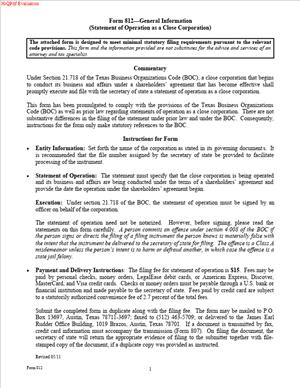
Form 812 – Statement of Operation as a Close Corporation
Fill out nowJurisdiction: Country: United States | Province/State: Texas
What is a Form 812 – Statement of Operation as a Close Corporation?
Form 812 is a public filing you submit to the Texas Secretary of State to place your Texas for-profit corporation under the statutory “close corporation” rules. In plain English, you use it to formally elect a simplified, shareholder-centered mode of corporate governance and ownership. It moves your company from standard corporate rules to a model designed for a small, closely held group of owners.
A close corporation is built for companies with a small number of shareholders and no public market for their stock. The law gives you more flexibility to run the company through a written agreement among shareholders. You can restrict stock transfers to keep ownership stable. You can even operate without a board of directors if the shareholders agree and if your governing documents permit it. These features reduce corporate formality and help align control with ownership.
Who typically uses this form?
Founders and owners of small to mid-sized private corporations. Family businesses, professional services firms, real estate holding companies, and investor-backed startups with a tight cap table are common users. Corporate secretaries, in-house counsel, and outside corporate lawyers also file this on behalf of clients.
Why would you need this form?
You need it if you want the legal benefits of statutory close corporation status. These benefits include:
- Statutory recognition of shareholder agreements that modify typical corporate governance rules.
- The option to eliminate or limit a board of directors and manage through shareholders or managers is allowed.
- Stronger and cleaner enforcement of stock transfer restrictions, such as rights of first refusal and buy-sell triggers.
- Simpler governance while maintaining corporate limited liability and formal structure.
Typical usage scenarios include aligning the company’s legal structure with a long-term plan to keep ownership in a small group; clarifying management and buyout rules for a family business as it transitions to the next generation; codifying existing transfer restrictions that investors already expect; and reducing friction from a formal board when the same small group owns and manages the business.
In short, Form 812 is the public, controlling statement that your Texas corporation has elected to operate as a close corporation. It makes your governance model enforceable under Texas law and visible on the public record.
When Would You Use a Form 812 – Statement of Operation as a Close Corporation?
You use this form when your business is, and intends to remain, closely held. If you started as a standard corporation, and your certificate of formation does not include close corporation provisions, Form 812 is how you opt in after formation. You also use it when your shareholders have negotiated a shareholder agreement that shifts management roles, restricts transfers, or adds buy-sell obligations, and you want those terms to carry the stronger backing of the close corporation framework.
Say you run a family-owned services company with eight shareholders. You plan to keep ownership within the family and want clear rules for buyouts if someone dies, divorces, quits, or retires. You also want to manage the company without a formal board. Filing Form 812 supports this plan and ensures your buy-sell and management terms are enforceable as part of the statutory scheme.
Imagine a startup with five founders and two angel investors. You want to prevent unexpected secondary sales that could disrupt control. You also want to allow shareholder management by written consent. Form 812 helps lock in those controls and gives your transfer restrictions stronger teeth.
If you are restructuring governance to reduce formal board meetings and allow decisions by shareholder agreement, the close corporation election is often the cleanest path. You file Form 812 to confirm the shift, then align your bylaws and shareholder agreements with the new structure.
You may also file Form 812 as part of a post-closing cleanup after a financing or ownership consolidation. If your due diligence revealed incomplete or non-public transfer restrictions, this filing corrects the public record and strengthens enforceability.
Finally, if you inherited an entity formed years ago and discovered it was not set up as a close corporation, but is run as one in practice, you file to align the public record with reality. This reduces risk and avoids disputes over governance later.
Legal Characteristics of the Form 812 – Statement of Operation as a Close Corporation
Form 812 is a legally binding public instrument. Once accepted for filing, it places your corporation under Texas’s close corporation provisions. It does not replace your certificate of formation. Instead, it works with your certificate, bylaws, and any shareholder agreement to define your governance and ownership restrictions.
What ensures enforceability? First, proper approval and execution under Texas law and your governing documents. Second, correct and complete the content within the statement. Third, compliance with related statutory notice and legend requirements, especially for stock transfer restrictions. When you add or tighten transfer restrictions, you must give conspicuous notice on stock certificates or in electronic ownership statements. If you fail to give proper notice, a later buyer without knowledge may not be bound by those restrictions. You should update every certificate, equity award agreement, and capitalization record after filing.
Close corporation status can support provisions that would be unusual under standard corporate rules. Examples include operating without a board, unanimous or supermajority shareholder approval for key actions, or special deadlock resolution processes. These provisions must fit within statutory boundaries and your certificate of formation. Your shareholder agreement should not conflict with your certificate, and your Form 812 should accurately reflect core elections.
The filing’s effect is prospective. It does not automatically fix past procedural gaps or unauthorized issuances. If you need ratification of past actions, handle that under proper corporate procedures before or alongside this filing.
You must also maintain eligibility for close corporation status. This generally includes remaining privately held and keeping your shareholders within statutory or agreed limits. Issuing shares or allowing transfers that violate your restrictions can undermine your status or trigger disputes. You should keep strict control over your stock ledger and transfer process.
Approvals matter. Actions that eliminate a board, add transfer restrictions, or change core governance often require strong shareholder approval thresholds. Your bylaws or shareholder agreement may call for unanimous consent. If your governing documents are silent, Texas law sets the baseline. When in doubt, aim for unanimous written consents to remove any question. Keep the consent records with your minute book.
Finally, close corporation status does not change your tax classification by itself. It is a governance choice, not a tax election. If you plan tax elections (such as S corporation status), handle those separately and coordinate with your shareholder limits and transfer rules.
How to Fill Out a Form 812 – Statement of Operation as a Close Corporation
Follow these steps to complete and file Form 812 correctly the first time.
1) Confirm your eligibility and intent
- Confirm your corporation is a Texas for-profit corporation in good standing.
- Confirm your stock is privately held and that you will maintain a small shareholder base.
- Decide whether you will operate with or without a board. If you plan to eliminate the board, ensure your certificate of formation and shareholder agreement allow it, or plan amendments as needed.
- List the transfer restrictions you want: rights of first refusal, buy-sell triggers, drag-along, tag-along, restrictions for deadlock, and limitations on transfers to non-permitted parties.
2) Align your governing documents
- Review your certificate of formation and bylaws. Identify any conflicts with your desired close corporation provisions. Prepare amendments if needed.
- Draft or update your shareholder agreement to reflect management structure, voting thresholds, transfer restrictions, valuation methods, and dispute resolution. The shareholder agreement will work alongside your Form 812 and certificate.
- If you are eliminating the board or shifting management, draft clear written procedures for shareholder action, including meeting requirements, written consents, officer authority, and tie-breakers.
3) Obtain required approvals
- Prepare a board resolution recommending operation as a close corporation and approving the filing.
- Circulate the form of statement to all shareholders with a clear summary of effects: transfer restrictions, management changes, approval thresholds, and buyout provisions.
- Obtain the level of shareholder approval required under Texas law and your governing documents. Strong approval (often supermajority or unanimous) is advisable for any provision that restricts transfer or changes governance.
- Capture approvals as signed written consents or meeting minutes. Keep them in your minute book.
4) Gather filing information
Have these details ready before you complete the form:
- Exact legal name of the corporation, matching the Secretary of State records.
- Texas Secretary of State file number.
- A statement that the corporation elects to operate as a close corporation under Texas law.
- Any specific elections that the statute allows or requires you to declare in the statement. This may include operation without a board, shareholder management authority, or other statutory elections.
- A list or summary of transfer restrictions or a clear incorporation by reference to your certificate of formation or shareholder agreement. Be precise so third parties can see the core restrictions from the public record.
- The date on which shareholders approved the election and how approval was obtained.
- Effectiveness of filing: upon filing, a delayed date, or upon occurrence of a future event within the allowed timeframe.
- Name, title, and signature of the authorized officer who will sign.
5) Complete the key sections of the form
While the exact layout of the form is standardized, you will generally address these areas:
- Entity information. Enter the exact corporate name and the Secretary of State file number. Use the name as it appears on the state’s records. Do not abbreviate or alter punctuation.
- Statement of operation as a close corporation. Insert a clear, direct sentence electing close corporation status. Example: “The corporation elects to operate as a close corporation.”
- Optional management provision. If you will operate without a board, state that election. Example: “The corporation will be managed by its shareholders and will not have a board of directors, as permitted by Texas law.” If you will keep a board but restrict its powers, describe the structure or point to the controlling provisions in the certificate or shareholder agreement.
- Transfer restrictions. Summarize the core restrictions or incorporate them by reference to governing documents. Be specific. If you lean on a shareholder agreement, identify it by title and effective date. Example: “Transfers are subject to a right of first refusal, mandatory buy-sell on specified events, and limitations on transfers to non-permitted transferees, as set forth in the Shareholder Agreement dated [date].”
- Approval statement. State that the shareholders approved the election, include the date of approval, and note that the required vote was obtained.
- Effectiveness of filing. Choose immediate effectiveness on filing, a delayed date, or a future event within the allowed period. Delayed effectiveness can help you coordinate with certificate amendments, stock certificate updates, or closing dates.
- Execution. An authorized officer signs. Include printed name, title, and date.
6) Attach schedules if needed
- If your restrictions or governance terms are too detailed for the main body, attach a Schedule A with the full text or a clean summary. Keep the public statement coherent and complete enough to give notice to third parties.
- If you reference a shareholder agreement, do not attach the entire agreement unless you want it on the public record. You can incorporate by reference. Many companies prefer to keep private agreements off the public filing and rely on legends and internal compliance to bind shareholders.
7) Prepare legends and notices
- Draft a conspicuous legend for your stock certificates and electronic statements. It should flag that shares are subject to transfer restrictions and refer to the controlling documents. Ensure every outstanding certificate and every new issuance carries the updated legend.
- Update your cap table and ledger to reflect close corporation status and restrictions. Mark any lock-ups, ROFRs, and buy-sell obligations.
8) File the form and pay the fee
- Submit Form 812 to the Texas Secretary of State with the required filing fee. You can file using the available submission methods. Keep your file-stamped copy for your records. Track the effective date.
9) Update internal records and third parties
- Update your minute book with the filed form, board resolution, and shareholder approvals.
- Align your bylaws and shareholder agreement with the filed statement. If conflicts exist, resolve them now.
- Notify your transfer agent, if any, and your registered agent of the change.
- Inform your bank, lenders, and insurers if they require notice of governance changes. Provide them with a certified copy if requested.
- Train your officers and administrators on the new approval thresholds and transfer processes. Put a checklist in place for proposed transfers and new issuances.
10) Avoid common errors
- Do not file if your entity is not a Texas for-profit corporation.
- Do not skip shareholder approvals or rely on an approval level below what your documents or law require.
- Do not leave transfer restrictions vague. Ambiguity invites disputes and weakens enforcement against buyers.
- Do not forget stock legends. A missing legend can undercut restrictions against transferees who lacked notice.
- Do not overlook harmonizing your certificate, bylaws, and shareholder agreement. Inconsistencies cause litigation risk.
- Do not issue stock or options that would push you beyond your shareholder limits if those limits apply under your structure.
Real-world example: A five-owner engineering firm wants to eliminate the board and require a right of first refusal on all transfers. They pass a unanimous shareholder consent adopting close corporation status, update their bylaws to remove the board, and adopt a shareholder agreement with ROFR and buy-sell terms. They file Form 812, select immediate effectiveness, and update all share certificates with a new legend. The cap table is updated. Going forward, any attempted transfer requires notice to the company and compliance with the ROFR. The shareholders manage the business by written consent, keeping governance lean and aligned with ownership.
Another example: A family company uses a delayed effective date to coordinate Form 812 with a certificate amendment and a refinancing. The delayed date gives the lender time to review the governance shift. On the effective date, the close corporation status takes effect, and the family’s buy-sell and anti-dilution rules gain statutory support.
If you follow these steps and keep your documents aligned, Form 812 is straightforward. If you elect close corporation status, you give the public the notice required by law, and you create a governance and ownership framework that fits a small, private company.
Legal Terms You Might Encounter
- Close corporation means a corporation that chooses special rules for small, closely held ownership. Form 812 is how you declare that choice. It tells the state you will operate under close corporation provisions.
- Certificate of formation is your corporation’s birth document. It must already contain close corporation provisions, or be amended to include them. Form 812 confirms you are actually operating under those provisions.
- Shareholder management means shareholders can manage the business directly. You can bypass a board if your certificate allows it. Form 812 signals that this corporate structure applies to you.
- Board of directors is the people who manage a standard corporation. A close corporation can limit its role or remove the board entirely. Form 812 should align with any shift from board-managed to shareholder-managed.
- Unanimous shareholder agreement is a signed agreement among all shareholders. It can reassign or limit board powers, or set special rules. If your structure relies on one, Form 812 should reflect that framework.
- Transfer restrictions are rules that limit who can buy or receive shares. They prevent unwanted owners and preserve “closely held” status. Your certificate or shareholder agreement should include these restrictions. Form 812 confirms you are operating with them.
- Share certificate legend is a notice printed on stock certificates. It alerts holders to transfer restrictions and close corporation status. Make sure your legends match the rules you adopt when filing Form 812.
- Written consent is a way to approve actions without a meeting. Shareholders or directors can use it to adopt close corporation operations. Form 812 will ask how approval was obtained and when.
- Effective date is when your close corporation status starts. You may choose immediate effectiveness or a later date. The date you list on Form 812 should match your approvals and records.
- Termination of the close status ends the special operating rules. You would use a different filing to do that. Keep Form 812 on file for your history if you ever end in a closed status.
- Entity file number is the unique number assigned to your corporation. You will use it on Form 812 so the record matches the right entity. Check it against prior filings to avoid misidentification.
FAQs
Do you need to amend your certificate before filing Form 812?
Yes, if your certificate does not already include close corporation provisions. The form confirms operation under existing provisions. If they are missing or incomplete, amend first, then file Form 812.
Do you need unanimous shareholder approval to operate as a close corporation?
You need the level of approval required by your governing documents and law. Many corporations use unanimous approval for major changes. Check your certificate and any shareholder agreements before you act.
Do you still need a board if you operate as a close corporation?
Not necessarily. Your certificate or shareholder agreement can allow shareholder management. If you keep a board, you can also limit its powers. Form 812 should align with the structure you choose.
Do you have to update share certificates after filing Form 812?
Yes. Update the legends to reflect transfer restrictions and close status. Replace old certificates or add a notice to them. Keep proof of the update in your corporate records.
Do you need to notify lenders, insurers, or key partners about Form 812?
You should. Many contracts require notice of governance changes. Deliver the notice promptly and keep copies. Late or missed notice can trigger penalties under those contracts.
Do you have to keep minutes or written consents supporting Form 812?
Yes. Keep approvals, consents, and vote tallies in your minute book. They support the filing and protect you during audits or disputes. Store them with your certificate and bylaws.
Do you lose limited liability by operating as a close corporation?
No. Close corporation status does not remove limited liability. You must still observe corporate formalities. Keep separate books and avoid commingling funds.
Do you need to file something else to end the close corporation status later?
Yes. If you end in a close status, you will file a termination statement. Update your certificate and internal records as needed. Notify shareholders and update any stock legends.
Checklist: Before, During, and After the Form 812 – Statement of Operation as a Close Corporation
Before signing
- Confirm your certificate includes close corporation provisions.
- If not, adopt an amendment before you file Form 812.
- Draft or review any unanimous shareholder agreement that reallocates powers.
- Review bylaws. Ensure they align with shareholder or board management.
- Confirm transfer restrictions exist in your certificate or agreements.
- Identify your corporation’s exact legal name and entity file number.
- Prepare the proposed effective date.
- Plan the approval method: meeting or written consent.
- Collect vote records: who approved, how many shares, and the date.
- Check for contractual notice requirements to lenders or partners.
- Confirm tax and regulatory registrations won’t be affected.
- Assign who will update the share certificate legends and the stock ledger.
During signing
- Verify the corporation name matches the state record.
- Enter the entity file number accurately.
- State that the corporation will operate as a close corporation.
- Confirm the approval date and approval method.
- Record the vote tally, including any against or abstaining if applicable.
- Select the effective date and manner of effectiveness.
- Confirm the authorized officer or agent signing has proper authority.
- Use the correct signature block and printed name.
- Check that all required fields are complete and readable.
- Review for consistency with your certificate and bylaws.
After signing
- File the form with the state using an accepted submission method.
- Calendar the expected processing time and effective date.
- Store a stamped copy in your minute book when returned.
- Update internal governance documents to reflect the close status.
- Issue updated share certificate legends or notices to holders.
- Update the stock ledger and cap table to reflect restrictions.
- Notify lenders, insurers, and key partners if required by contract.
- Train directors or shareholders on new decision-making processes.
- Update any internal approval checklists for future actions.
- Monitor share issuances to keep ownership within your limits.
- Set a reminder to revisit the status if ownership changes.
Common Mistakes to Avoid Form 812 – Statement of Operation as a Close Corporation
Not aligning your certificate and bylaws
- Consequence: Conflicts between documents can invalidate decisions.
- Don’t forget to amend bylaws and any shareholder agreements to match.
Leaving out transfer restrictions
- Consequence: Unrestricted transfers can undermine close status.
- Don’t forget to include clear transfer rules and stock legends.
Skipping formal approvals or poor records
- Consequence: Challenges to authority or process during disputes.
- Don’t forget to keep minutes, consents, and vote tallies with dates.
Choosing the wrong effective date
- Consequence: Actions may occur before authority actually exists.
- Don’t forget to align the effective date with approvals and filings.
Failing to update share certificates and ledgers
- Consequence: Holders may claim free transfer rights or lack of notice.
- Don’t forget to add legends and update the stock ledger promptly.
Ignoring contract notice clauses
- Consequence: Defaults, penalties, or acceleration under loan or vendor agreements.
- Don’t forget to send notices and keep proof of delivery.
What to Do After Filling Out the Form 812 – Statement of Operation as a Close Corporation
Confirm filing acceptance
- Track the form until it is accepted and effective. Save the stamped copy. Note the effective date in your records. Update your corporate calendar.
Update internal governance
- Align bylaws with shareholder-managed or modified board structures. Attach any unanimous shareholder agreement to your minute book. Create a clear approval workflow for future actions.
Refresh your stock paperwork
- Reprint or sticker share certificates with the correct legends. Include transfer restrictions and close corporation status. Log each update in the stock ledger.
Brief your leadership
- Explain how decisions are now made. If shareholders manage, define voting thresholds and meeting cadence. If a board remains, clarify any reduced or reallocated powers.
Notify key counterparties
- Review contracts for notice requirements. Send formal notices to banks, insurers, landlords, and major customers if needed. Include the effective date and a short description of the change.
Tighten your share transfer process
- Create a simple intake process for proposed transfers. Add a review checklist covering rights of first refusal or consents. Keep denials and approvals documented.
Coordinate with your tax and compliance calendar
- Note that a closed status does not change your filing obligations. Maintain annual reports, franchise tax filings, and licenses. Keep deadlines visible to all responsible team members.
Plan for new issuances and ownership changes
- Confirm all new stock issuances comply with restrictions. Add warnings to any subscription documents. Revisit your status if ownership size or structure changes.
Prepare for future changes
- If you later end the close status, plan the termination filing. Review any needed amendments to the certificate and bylaws. Update share legends again to remove the close notice.
Maintain a clean paper trail
- Store the accepted Form 812 with your certificate, bylaws, and consents. Index all documents by date and topic. This helps during audits, diligence, and disputes.
Review annually
- Add an annual governance check. Confirm your operations still fit the close corporation framework. Make updates if your business outgrows the structure.
Disclaimer: This guide is provided for informational purposes only and is not intended as legal advice. You should consult a legal professional.