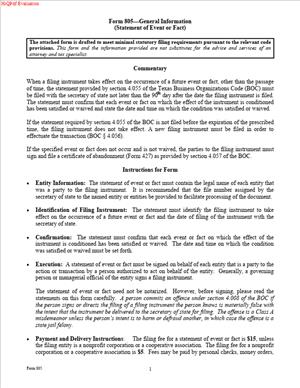
Form 805 – Statement of Event or Fact
Fill out nowJurisdiction: Country: United States | Province or State: Texas
What is a Form 805 – Statement of Event or Fact?
Form 805 is a Texas Secretary of State filing used to place a consequential event or fact into the public record for a Texas business entity. Practically, it is most often used to “activate” an earlier filing that was conditioned on a later approval or occurrence. It can also be used to file a certified court order or other fact that affects an entity’s legal status, governance, or the effectiveness of a prior submission.
The form connects a real-world event—such as a member vote, board approval, lender consent, or a court’s appointment of a receiver—to the state’s official record of your entity. Once accepted, it becomes part of the permanent filing history, so banks, investors, counterparties, regulators, and courts can rely on the public record for the entity’s current status and the effect of earlier filings.
Who files?
Texas entities and persons legally empowered to act for them: LLC managers, corporate officers and directors, general partners, nonprofit officers or directors, and authorized attorneys or agents. Court‑appointed receivers, custodians, or similar fiduciaries also file when a court order requires it or when court action changes the public record.
Why is Form 805 necessary?
Many filings are drafted to be effective only after a condition precedent occurs. For example, a certificate of formation or merger may state it is effective upon member or shareholder approval. Form 805 provides the Secretary of State with confirmation that the condition has occurred. Without it, the earlier filing may remain dormant. Similarly, filing a certified court order through Form 805 ensures the public record mirrors the entity’s actual governance or control.
Form 805 does not replace filings that have dedicated forms (amendments, periodic reports, registered agent changes, assumed names) and does not replace internal approvals. It confirms that the approvals required by your earlier filing have happened and instructs the Secretary of State to give those documents legal effect as drafted.
When Would You Use a Form 805 – Statement of Event or Fact?
File Form 805 after the triggering event occurs, and the public record needs to reflect it. Common scenarios include:
- Formation conditioned on investor or member approval: You filed a certificate of formation that becomes effective upon approval. Once obtained, file Form 805 stating the approval date so the formation takes effect.
- Merger or conversion conditioned on a vote: Your merger or conversion filing awaits shareholder, member, or partner approval. After the vote, file Form 805 confirming approvals and the date so the transaction becomes effective.
- Amendments conditioned on consent: Your amendment requires a class vote, lender consent, or board approval. Form 805 confirms the consents occurred.
- Court orders affecting status or governance: A court appoints a receiver or issues an order changing control or governance. Filing a certified copy via Form 805 places the order in the public file and provides clear notice.
Timing is controlled by your earlier filing. If it says “effective upon approval,” file after approval. If it says “effective upon court order,” file it when you have a certified order. If deadlines or windows are specified, file within that period to preserve the intended effective path.
You typically do not use Form 805 if an earlier filing specified a fixed, delayed effective date not dependent on a later event; those become effective automatically. Routine administrative changes with dedicated forms should be made on those forms, not via Form 805.
Typical filers include owners, managers, corporate officers, nonprofit directors, in‑house counsel, outside counsel, and court‑appointed fiduciaries acting under authority or order.
Legal Characteristics of the Form 805 – Statement of Event or Fact
Form 805 is an official state filing that updates the public record by affirming that a specified condition or event occurred, or by placing a court order or other required fact into the entity’s file. It is not a contract and does not by itself create private rights. Once accepted, it provides public notice and enables third‑party reliance.
Effectiveness follows the terms of the earlier filing and filing rules. If the earlier filing became effective upon a defined event, Form 805 verifies that event and triggers the stated result. Depending on the earlier filing’s language, the legal effective date could be the event date, the state’s acceptance date, or another stated date. Always review the underlying document to confirm which date controls.
Accuracy, authority, and compliance are critical:
- The signer must have authority under the earlier filing, governing documents, or applicable law. If a specific capacity was required, use that capacity.
- If the event is a court order, attach a certified copy; uncertified copies usually do not establish the official record.
- Statements must be truthful and precise. False filings risk rejection and civil or criminal consequences. Align names, dates, and terms with the underlying filing.
- Some earlier filings impose timing requirements; missing those may require refiling or amendment.
The Secretary of State’s review is ministerial, focusing on completeness, compliance, and sufficiency, not adjudicating internal corporate validity. Clear statements and proper attachments reduce questions and delays. Because filings are public and permanent, avoid unnecessary confidential information. Use concise descriptions and labeled exhibits to keep the record accurate without overdisclosure.
How to Fill Out a Form 805 – Statement of Event or Fact
Use these steps to prepare and submit Form 805 correctly.
1) Confirm you need this form
- Review the earlier filing for language tying effectiveness to a future approval, consent, vote, or court action.
- Identify the precise condition and who may certify it. Note any required signer or office.
- Check for deadlines or windows for the condition. If expired, consider amending or refiling rather than using Form 805.
2) Gather key information
- Exact legal name of the entity as it appears in state records.
- Texas file number for matching.
- Identification of the earlier filing awaiting activation, including filing date and title.
- A concise description of the event or fact that occurred.
- The date (and time, if relevant) of the event. Confirm whether staged approvals are permitted or a single date is required.
- Supporting materials as required: certified court orders or internal approvals if the earlier filing requires attachments.
- Name, title, and authority of the signer; if authority has changed, gather documents establishing the current authority.
3) Complete the parties section
- Use the exact legal name and Texas file number.
- Provide a contact person with a mailing address, phone, and email who can respond promptly to state inquiries.
4) Identify the underlying filing
- State the type and date of the filing awaiting effectiveness (e.g., “Certificate of Formation filed on March 2, 20XX”).
- Reference any sections or defined terms used in that filing to make the connection clear.
- Mirror specific approvals named in the earlier filing (e.g., “Series A investors,” “Class B shareholders”).
5) State the event or fact (the core clause)
- Write a direct statement that the condition occurred and the date it occurred; avoid excess narrative.
- If multiple approvals were required, list each as completed.
- If the earlier filing allows effectiveness as of the event date, state that date. If effectiveness follows state acceptance, state the event date without asserting an effective date.
- Example: “On June 15, 20XX, the members of [Entity Name], by written consent, approved the action described in the certificate of formation filed May 20, 20XX, thereby satisfying the condition precedent to effectiveness.”
6) Attach schedules or exhibits as needed
- Attach a certified copy if a court order is the basis for the statement.
- Attach internal approvals only if required by the earlier filing or governing documents.
- Label attachments clearly (e.g., “Exhibit A – Certified Court Order”) and index them if multiple exhibits are included.
- Do not include unnecessary confidential material.
7) Sign and date
- Sign in the required capacity (manager, officer, general partner, etc.).
- Print or type the signer’s name and title and date the form. Follow portal instructions for e‑signatures if filing online.
- Notarization is generally not required unless specifically requested by the earlier filing or your circumstances.
8) Pay and submit
- Include the required state filing fee. Pay online, by check, or through accepted methods for your submission channel.
- Submit online, by mail, or in person. Online filing is typically faster; mail or in‑person may be best for certified copies or large exhibits.
- Retain copies of the filing, attachments, and proof of payment. Obtain an acknowledgment or file‑stamped copy after acceptance.
9) After filing
- Monitor for acceptance and confirm the public record reflects the correct status and effective date.
- Update internal records: minutes, consents, member/shareholder registries, cap tables, and organizational charts.
- Complete follow‑on tasks triggered by effectiveness, such as lender notices, insurance updates, bank record changes, license updates, contract notices, or tax registrations.
Practical tips
- Mirror names, dates, and defined terms from the underlying filing to reduce questions.
- Keep the narrative short and factual; the state needs confirmation, not argument.
- File promptly after the event, especially if deadlines or closing conditions are involved.
- If the authority has changed since the earlier filing, include a brief explanation or documentation.
- Use clear exhibit labels and, if multiple attachments, a simple index.
Legal Terms You Might Encounter (Form 805 – Statement of Event or Fact)
- Condition precedent: An approval or event that must occur before an earlier filing becomes effective. Form 805 confirms the condition was met.
- Effective date: The date the earlier filing becomes legally operative. It may be the event date or the state’s acceptance date, depending on the underlying language.
- Underlying filing: A prior formation, merger, conversion, amendment, or other filing conditioned on a future event. Form 805 ties your statement to that filing.
- Authorized representative: A manager, officer, director, general partner, attorney, or agent empowered to sign under statute and governing documents.
- Certified copy: A court‑stamped copy of an order or judgment. It substantiates court events for the public record.
- Record of filing: The state’s acknowledgment that your statement has been filed and added to your entity’s public file.
- Statement of fact: The core declaration in Form 805 confirms that the required event occurred on a specific date.
- Reliance: Third parties’ ability to trust the accuracy of the public record for diligence, financing, and contracting.
- Public notice: The legal effect of a filed statement, placing the event on record, and reducing disputes about satisfaction of conditions.
- Curative filing: A subsequent submission (amendment or supplement) used to correct or clarify a prior statement.
FAQs (Form 805 – Statement of Event or Fact)
Do you need this form if your earlier filing had a delayed date but no condition?
Generally, no. If your earlier filing specified a fixed effective date without a later event, it becomes effective automatically.
Do you have to attach internal approvals or resolutions?
Only if the earlier filing or governing documents require them, a clear statement of the approvals and date is often sufficient. If a court order is involved, attach a certified copy. If voluntarily attaching internal approvals, redact unnecessary sensitive information.
Do you have to be the same person who signed the earlier filing?
Not necessarily. You must have proper authority at the time of signing Form 805. If a specific office or signer was required, mirror that requirement. If roles changed, include documentation of the current authority.
Do you need notarization?
Typically, no. Unless the earlier filing or your situation requires a sworn statement, an authorized signature is sufficient. If uncertain, follow applicable instructions for your submission channel.
Do you have a deadline to file after the event occurs?
If the earlier filing sets a deadline, you must meet it. If not, file promptly to avoid confusion or the need to refile the underlying document.
Can you list multiple events on one form?
Use one underlying filing per statement. Combining unrelated events or multiple underlying filings in one statement can create ambiguity.
Do you need to notify anyone after filing?
Yes. Provide acceptance confirmation to owners, directors, or managers, lenders, insurers, and counterparties whose obligations depend on effectiveness.
What if the state rejects your filing?
Review the rejection, correct the issues, and resubmit promptly. Common problems: mismatched names or file numbers, vague event descriptions, missing certified court orders, or a signer without proper authority. Keep correspondence and corrected drafts.
Checklist: Before, During, and After the Form 805 – Statement of Event or Fact
Before signing
- Exact legal name and Texas file number.
- Copy of the underlying filing and its date.
- Clear description of the triggering event and the date it occurred.
- Proof of approvals, if required by the earlier filing.
- Certified court order, if applicable.
- Evidence of the signer’s current title and authority.
- Payment method and chosen submission channel.
During signing
- Verify entity name and file number match state records.
- Confirm the date and type of the underlying filing; use consistent terminology.
- State the event clearly with the exact date; avoid ambiguity.
- Ensure the signer’s capacity meets the earlier filing’s requirements.
- Label and include required attachments; ensure court orders are certified.
- Cross‑check names, dates, and defined terms for consistency.
After signing
- Submit with the required fee and retain proof of submission.
- Obtain and store the acknowledgment or file‑stamped copy.
- Update minutes, cap tables, registers, and organizational charts.
- Notify owners, managers, lenders, insurers, and counterparties.
- Calendar follow‑up filings, tax registrations, license updates, or closing deliverables.
Common Mistakes to Avoid (Form 805 – Statement of Event or Fact)
- Vague event descriptions: State precisely what occurred and on what date.
- Mismatched names or file numbers: Copy the entity name and file number exactly as they appear in state records.
- Wrong signer or insufficient authority: Follow the required capacity or document the current authority.
- Missing certified court order: When a court order is the basis, an uncertified copy is usually inadequate.
- Missing timing windows: If the underlying filing sets deadlines, do not let them lapse.
- Over‑inclusion of confidential data: Include only what is necessary to substantiate the event.
- Inconsistent terminology: Use the exact defined terms and approval labels from the underlying filing.
What to Do After Filling Out the Form (Form 805 – Statement of Event or Fact)
- File and pay: Submit the completed statement with the applicable fee. Retain proof of submission and copies of all materials.
- Verify status: Confirm that the public record reflects the correct effective status and date. If discrepancies arise, contact the filing office and provide your acknowledgment or file‑stamped copy.
- Distribute confirmations: Share the accepted filing with internal leadership and counterparties whose contracts, financing, or insurance depend on effectiveness.
- Update governance and registers: Record approvals and effective dates in minutes, resolutions, equity ledgers, and officer/manager/director rosters.
- Trigger follow‑on actions: Complete tax registrations, license updates, bank changes, contract notices, and insurance updates tied to effectiveness.
- Amend if needed: If you find an error, file a corrective submission referencing the original statement and stating the correction.
- Archive securely: Store the underlying filing, Form 805, exhibits (including certified orders), acceptance proofs, and related correspondence together for a clean audit trail.
Disclaimer: This guide is provided for informational purposes only and is not intended as legal advice. You should consult a legal professional.