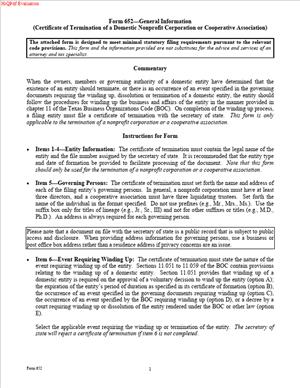
Form 652 – Certificate of Termination of a Domestic Nonprofit Corporation or Cooperative Association
Fill out nowJurisdiction: Country: United States | Province or State: Texas
Form 652 – Certificate of Termination of a Domestic Nonprofit Corporation or Cooperative Association is a filing used to formally end the existence of certain organizations. It is part of the public record that confirms the organization has completed its internal winding-up process.
You encounter this form when an organization is no longer operating and needs to close cleanly. It matters because termination affects legal status, public records, and how others view the organization going forward.
This document is typically prepared near the end of an organization’s life cycle. By the time you fill it out, most activities have already stopped, and remaining affairs have been addressed.
If you are about to complete this form, you are likely asking what information is required and how each section fits together. This guide walks you through that context in plain language.
What is Form 652 – Certificate of Termination of a Domestic Nonprofit Corporation or Cooperative Association?
Clear definition
Form 652 – Certificate of Termination of a Domestic Nonprofit Corporation or Cooperative Association is a formal filing that records the termination of a Texas-based nonprofit corporation or cooperative association. Once accepted, it signals that the entity no longer exists as an active legal organization.
The document captures key facts about the organization and confirms that termination conditions have been met. It is filed with the state authority responsible for business entity records.
This form does not create the termination on its own. It documents that termination has occurred through the organization’s internal process.
Who typically uses this form/document?
This form is commonly used by people acting on behalf of a nonprofit corporation or cooperative association. That may include officers, directors, managers, or other authorized representatives.
You may also see this form prepared by someone helping with administrative or recordkeeping tasks. The filer is usually familiar with the organization’s formation details and final decisions.
Although the organization is ending, a responsible individual still signs and submits the document. That person represents the entity for this final filing.
Why you might need this form/document
You need this form when the organization has decided to terminate and wants the state’s records to reflect that status. Without this filing, the organization may still appear active in public databases.
Termination affects how the organization is viewed by regulators, donors, members, and the public. The form helps close that loop.
Filing the certificate also creates a clear end date for the entity’s existence. That date can matter for records, contracts, and historical clarity.
Typical real-life scenarios
A nonprofit may complete its mission and decide to wind down operations. After distributing remaining assets and closing accounts, this form records the termination.
A cooperative association may dissolve after members vote to end the organization. Once internal steps are complete, the certificate is filed to finalize the process.
In some cases, an organization stops operating years earlier but never files termination paperwork. This form is then used to formally close the record.
When would you use Form 652 – Certificate of Termination of a Domestic Nonprofit Corporation or Cooperative Association?
You would use this form only after the organization has already taken all required internal steps to end its existence. That typically means a formal approval to terminate has been adopted, operations have stopped, and the organization is no longer carrying out its mission or business activities.
The filing comes at the conclusion of the winding-up phase, not at the moment the decision to dissolve is first made. By the time this document is prepared, day-to-day affairs should be closed, and no new obligations should be incurred.
This form is also relevant when an organization has been inactive for an extended period but never formally recorded its termination. In that case, the filing serves to update the public record so it accurately reflects that the entity is no longer active.
You would not use this form to pause operations, reorganize, or change the organization’s structure. Its purpose is narrowly focused on documenting a completed termination.
Legal characteristics of Form 652 – Certificate of Termination of a Domestic Nonprofit Corporation or Cooperative Association
This document becomes effective when it is accepted for filing by the state. Acceptance generally depends on complete information, proper signatures, and consistency with existing records.
Common problems arise from mismatched names, incorrect entity numbers, or missing statements. Even small errors can delay acceptance.
The form reflects general requirements that apply to domestic nonprofit corporations and cooperative associations. Similar concepts exist in other states, but details and terminology often differ.
Filing this document does not handle every loose end. It does not resolve private disputes, enforce internal decisions, or substitute for other required actions outside the filing itself.
The certificate also does not erase past obligations or rewrite history. It records termination but does not undo what occurred while the organization existed.
How to fill out Form 652 – Certificate of Termination of a Domestic Nonprofit Corporation or Cooperative Association
Step 1 – Identify the organization
You start by providing the organization’s exact legal name. This should match the name on file with the state, including punctuation and any designators.
You may also be asked for a file number or similar identifier. This helps connect the termination to the correct entity in state records.
Step 2 – Confirm the type of entity
The form distinguishes between a nonprofit corporation and a cooperative association. You indicate which category applies to the organization being terminated.
This section ensures the termination is processed under the correct statutory framework. Accuracy here avoids processing issues later.
Step 3 – State the basis for termination
You provide information showing that the organization has been terminated according to its governing rules. This often includes confirmation that required approvals were obtained.
The wording in this section is usually standardized. You review it carefully to make sure it aligns with what actually occurred.
Step 4 – Address remaining property or assets
If the form asks about property or assets, you disclose how they were handled. This reflects that the organization no longer holds assets after termination.
The goal is to show that the organization has completed its winding-up activities. Clear answers help prevent follow-up questions.
Step 5 – Provide the effective date
You indicate when the termination became effective. This may be the date of a vote, a written consent, or another triggering event.
The effective date helps establish the official end of the organization’s existence. It should be consistent with internal records.
Step 6 – Sign and submit the form
An authorized person signs the document. The signature confirms that the information is accurate to the best of that person’s knowledge.
After signing, the form is submitted to the appropriate state office for filing. Once accepted, the termination is reflected in the public record.
Legal terms you might encounter in Form 652 – Certificate of Termination of a Domestic Nonprofit Corporation or Cooperative Association
Certificate of Termination
This is the formal document filed with the state to record that an organization has ended its legal existence. In this context, it confirms that a nonprofit corporation or cooperative association has completed termination under applicable rules.
Domestic Entity
A domestic entity is one that was originally formed under the laws of the state where the termination is being filed. Form 652 applies only to organizations created within that jurisdiction, not to those formed elsewhere.
Winding Up
Winding up refers to the process of concluding the organization’s affairs before termination. This includes stopping activities, settling obligations, and addressing remaining property.
Governing Body
The governing body is the group with authority to make major decisions for the organization, such as directors or members. Their approval is typically required before termination can be recorded.
Authorized Person
An authorized person is an individual permitted to sign and submit the termination filing on behalf of the organization. This authority usually comes from the organization’s governing documents or internal approvals.
Effective Date
The effective date is the point in time when the termination is considered to have occurred. It may be earlier than the filing date if the form allows a delayed or specified effective date.
Cooperative Association
A cooperative association is an entity owned or controlled by its members for mutual benefit. This form accommodates cooperatives that are ending operations under the same filing framework as certain nonprofits.
Public Record
Once filed, the information in the certificate becomes part of the state’s public records. This means the termination status can be viewed by third-party reviewing entities.
Entity Name
The entity name is the organization’s exact legal name as registered with the state. Consistency with existing records is critical for the termination to be properly applied.
FAQs – Form 652 – Certificate of Termination of a Domestic Nonprofit Corporation or Cooperative Association
Does filing Form 652 immediately end the organization?
Filing the form does not initiate the termination process. It records that the organization has already completed the required internal steps and is formally documenting that outcome with the state.
Who is allowed to sign the certificate of termination?
The form must be signed by someone with authority to act for the organization at the end of its existence. This is often an officer, director, manager, or another individual granted signing authority.
Can this form be used if the organization has been inactive for years?
Yes, it can be used to formally close the record even if operations stopped long ago. The information provided should reflect what actually occurred at the time of termination.
What happens if the entity name does not match state records?
A mismatch can cause the filing to be rejected or delayed. The name should be entered exactly as it appears in the state’s existing records.
Is Form 652 used for for-profit corporations?
No, this form is limited to domestic nonprofit corporations and cooperative associations. Different termination filings apply to other types of entities.
Does the certificate resolve unpaid obligations?
The filing itself does not settle debts or obligations. It only records termination and assumes those matters were addressed during the winding-up process.
Will the termination be visible to the public?
Yes, once accepted, the termination becomes part of the public record. This allows others to see that the organization is no longer active.
Checklist: before, during, and after the Form 652 – Certificate of Termination of a Domestic Nonprofit Corporation or Cooperative Association
Before
- Verify that all required termination approvals were properly adopted
- Confirm the organization is no longer conducting activities
- Check the exact entity name against state records
- Gather the entity file number and formation details
- Confirm all property and assets have been addressed
- Identify the individual authorized to sign the filing
During
- Select the correct classification for the entity
- Enter identifying information exactly as recorded
- Review each statement for accuracy and completeness
- Confirm the termination basis matches internal actions
- Enter an effective date consistent with organizational records
- Sign the form using the authorized signer’s name and capacity
After
- Submit the completed form for official filing
- Save a copy of the signed document
- Confirm the filing was accepted without issues
- Update internal records to reflect termination
- Notify members or stakeholders as appropriate
- Store termination materials with permanent records
Common mistakes to avoid
A frequent mistake is attempting to file the certificate while unresolved internal steps remain. The form assumes the organization has already completed its termination process, and filing too early can create inconsistencies.
Another common issue is inaccurate identifying information. Small differences in spelling, punctuation, or entity numbers can prevent the filing from being matched to the correct record.
Organizations sometimes select an effective date that does not align with their approvals. This can raise questions later if internal documents show a different timeline.
Incomplete forms are also a source of delay. Leaving sections blank or missing a required signature often results in rejection or requests for correction.
Another mistake that often surfaces is a misunderstanding of the role of the person signing the certificate. The signer is not acting in a personal capacity but as a representative of an entity that is in its final stage. Problems arise when someone signs without clear authority under the organization’s governing documents or final resolutions. Even if the organization is winding down, the state still expects the signer to be properly authorized, and uncertainty here can undermine the filing.
Confusion between termination and dissolution terminology can also cause errors. Organizations sometimes use internal language that does not clearly match the statutory framework reflected in the form. If internal records describe a different action than what the certificate states, it can create inconsistencies that are difficult to reconcile later. Careful alignment between meeting minutes, written consents, and the statements in the certificate helps avoid this mismatch.
Another overlooked issue is failing to consider how prior amendments or name changes affect the filing. If the organization amended its name at some point, using an older version of the name can lead to rejection. The termination filing must reflect the most current legal name on record, regardless of how the organization commonly referred to itself internally or publicly.
Organizations also sometimes assume that inactivity alone is enough to justify termination statements. Simply ceasing operations does not automatically satisfy all internal requirements. If the governing documents require a specific vote, notice period, or member involvement, those steps should be completed and documented before the certificate is prepared. Skipping or glossing over those steps can create gaps between what the form asserts and what actually occurred.
Timing mistakes can be subtle but significant. Filing long after the effective date without reconciling what happened in the interim can raise questions. For example, if the organization engaged in activities after the stated effective date, even unintentionally, that inconsistency can complicate the record. Reviewing the timeline carefully before selecting dates helps ensure the filing accurately reflects reality.
Another error involves assumptions about asset handling. Some organizations believe that having minimal or no assets means the asset-related statements are less important. In reality, the form’s statements are meant to confirm that nothing remains unaddressed, even if the answer is that there were no assets to distribute. Vague or incomplete responses in this area can lead to follow-up questions.
Finally, organizations sometimes overlook the importance of internal consistency across all termination-related documents. While the certificate itself is brief, it should align with resolutions, consents, and final reports. Discrepancies may not always be caught immediately, but they can surface later when records are reviewed. Taking time to cross-check these materials before filing helps prevent lingering issues tied to the termination.
What to do after filling out the Form 652 – Certificate of Termination of a Domestic Nonprofit Corporation or Cooperative Association
Once the form has been filed, retaining a copy with the organization’s permanent records is an important final step. This provides clear documentation of when the legal existence ended.
You should also check that the termination appears correctly in public records after acceptance. This helps ensure that outside parties see an accurate status for the former organization.
Supporting materials, such as approval records and asset disposition documentation, should be organized alongside the filed certificate. Keeping these records together creates a clear and complete closing file for future reference.
After filing, it is useful to think beyond the immediate confirmation of acceptance and consider how the termination will be understood in the future. Former officers, directors, or members may need to reference the termination years later, and a well-organized closing file makes that process much easier. Clear labeling of documents and notes explaining the sequence of events can provide helpful context long after memories fade.
It is also wise to review how the termination affects ongoing relationships that may not be obvious at first glance. Even though the organization no longer exists, correspondence, archived communications, or historical references may still circulate. Ensuring that stakeholders understand the organization has formally ended can prevent confusion or misdirected inquiries.
Another step after filing is to reconcile internal records with external perceptions. If the organization maintained internal databases, mailing lists, or shared storage, those systems should be updated to reflect termination. This does not mean erasing history, but rather clearly marking the organization as closed so that no one inadvertently treats it as active.
Former leaders should also consider how they will respond to future questions about the organization. Having a consistent explanation of when and how termination occurred helps maintain clarity. The filed certificate serves as an anchor for that explanation, allowing responses to be factual and consistent with the public record.
Record retention deserves thoughtful attention at this stage. While the organization has ended, certain documents may still need to be kept for historical, informational, or practical reasons. Grouping the certificate with approvals, final financial summaries, and correspondence creates a coherent archive that reflects the full closing process.
It can also be helpful to document who is responsible for maintaining these records after termination. Even informal notes identifying a custodian of records can reduce uncertainty later. This is particularly useful if former leaders move on or contact information changes.
Finally, take a moment to reflect on whether any final communications are appropriate. While not required by the filing itself, some organizations choose to formally acknowledge the conclusion of their existence to members or supporters. Doing so after the certificate is filed ensures that such communications align with the official status reflected in public records and reinforces a clean, orderly conclusion to the organization’s lifecycle.
Disclaimer: This guide is provided for informational purposes only and is not intended as legal advice. You should consult a legal professional.