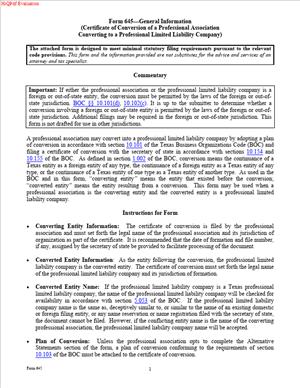
Form 645 – Certificate of Conversion of a Professional Association Converting to a Professional Limited Liability Company
Fill out nowJurisdiction: Country: United States | Province or State: Texas
What is a Form 645 – Certificate of Conversion of a Professional Association Converting to a Professional Limited Liability Company?
Form 645 is a filing with the Texas Secretary of State that formally records the statutory conversion of an existing professional association into a professional limited liability company. It allows a licensed professional practice to change its legal entity type without terminating its existence or interrupting operations. Through this conversion, the business continues as the same legal entity, but in the form of a PLLC rather than a professional association. As a result, the practice generally retains its assets, liabilities, contracts, and professional history automatically by operation of law.
This form is designed specifically for professional entities governed by Texas law, such as practices providing services that require state licensure. It is not a formation document for a new entity and does not dissolve the existing association. Instead, it implements a conversion authorized by the Texas Business Organizations Code, provided the profession is permitted to operate as a PLLC, and the conversion has been properly approved internally. Filing Form 645 creates a clear public record that the entity has changed form while remaining the same ongoing professional practice.
When Would You Use a Form 645 – Certificate of Conversion of a Professional Association Converting to a Professional Limited Liability Company?
Form 645 is used when the owners of a Texas professional association have decided to convert the practice into a professional limited liability company and have obtained the necessary approvals under the association’s governing documents and applicable law. This decision is often driven by a desire for greater flexibility in management, ownership structure, or succession planning, or to align the entity form with current business and tax planning objectives. The form is filed after the internal decision to convert has been made, not as part of forming a new practice or closing an existing one.
The form is appropriate only when the intent is continuity rather than replacement. It serves to notify the state that an approved statutory conversion is taking place and to establish the PLLC as the surviving entity. Professionals use Form 645 when they want the practice to continue seamlessly under a different legal structure while maintaining compliance with Texas business law and professional licensing requirements. It is not used for mergers, dissolutions, or initial registrations, but solely to document and effectuate a conversion that has already been authorized.
Legal Characteristics of the Form 645 – Certificate of Conversion of a Professional Association Converting to a Professional Limited Liability Company
Form 645 is legally binding once it is properly completed, signed, and filed with the Secretary of State of Texas. The conversion becomes effective on the filing date or on a delayed effective date stated in the form. From that point forward, the PLLC is the surviving entity.
Enforceability comes from compliance with Texas law, including approval of the conversion under the professional association’s governing documents and applicable professional licensing rules. The form works together with the plan of conversion, which you keep in your internal records. Accuracy matters. Errors or missing information can delay the conversion or cause legal issues later.
You should confirm that all owners and professionals involved are eligible to be members of a PLLC and that the converted entity will continue to meet licensing requirements.
How to Fill Out a Form 645 – Certificate of Conversion of a Professional Association Converting to a Professional Limited Liability Company
- Start by entering the exact legal name of the professional association as it currently appears in state records. Use the full name, including any required professional designation.
- Next, list the name of the professional limited liability company as it will exist after conversion. The name must meet Texas naming rules and include “PLLC” or “Professional Limited Liability Company.”
- Identify the converting entity as a professional association and the converted entity as a professional limited liability company. You will also state that the conversion was approved in accordance with Texas law and the association’s governing documents.
- Provide the jurisdiction of formation for the professional association. For most filers, this will be Texas.
- If the form asks for a delayed effective date, decide whether the conversion should take effect later than the filing date. If you leave this blank, the conversion becomes effective when the Secretary of State files the form.
- Complete the execution section by signing on behalf of the converting professional association. The signer must have authority to act for the entity, such as an officer or authorized manager.
- Review the entire form for accuracy. Names, dates, and entity types must match exactly. Once signed, submit the form to the Secretary of State of Texas with the required filing fee. Keep a copy for your firm’s records, along with your plan of conversion and updated governing documents.
Legal terms you might encounter (Form 645 – Certificate of Conversion of a Professional Association Converting to a Professional Limited Liability Company)
Several legal concepts appear in Form 645 and the surrounding conversion process that are helpful to understand before filing. The converting entity is the existing professional association that is changing its legal form, while the converted entity is the professional limited liability company that results from the conversion and continues the practice. A plan of conversion is an internal document approved by the owners that outlines how the conversion will occur, including ownership interests and governing rules, even though it is not filed with the state. The effective date is the date the conversion becomes legally operative, either upon filing or on a later date specified in the form. Professional limited liability company status also means the entity must comply not only with Texas business law but with profession-specific licensing rules.
Beyond the basic definitions, it is useful to understand how certain conversion-related terms function in practice. The concept of statutory conversion is central, meaning the change in entity form occurs under a specific statute rather than through dissolution and reformation. This distinction matters because statutory conversion preserves continuity of the entity, which can be important for professional history, malpractice coverage continuity, and long-term contracts. The term “surviving entity” is sometimes used interchangeably with converted entity and refers to the PLLC as the legal continuation of the professional association after the conversion takes effect. The converting entity legally ceases to exist as a separate form, but its rights and obligations do not disappear.
Another term that often causes confusion is “governing documents.” For a professional association, these may include articles of association, bylaws, shareholder agreements, or similar instruments. For the PLLC, the governing document is typically a company agreement. Texas law allows considerable flexibility in how a PLLC is managed, but the company agreement should be consistent with the plan of conversion and professional licensing rules. The plan of conversion itself does not need to be filed, but it must be adopted properly and should be retained in case of audits, disputes, or regulatory inquiries.
You may also encounter references to “eligibility” and “professional services.” Eligibility means that only individuals or entities authorized by the relevant licensing authority may own or control a professional entity. Professional services are those services that require a state license, such as legal, medical, or accounting services. The conversion does not expand or change the scope of services the entity may provide. Finally, the phrase “operation of law” indicates that transfers of property and obligations occur automatically as a legal consequence of the conversion, without the need for separate assignments in most cases.
Understanding how Form 645 terminology interacts with professional regulation is especially important in Texas because business entity law and licensing law operate in parallel. While the Business Organizations Code governs the mechanics of conversion, licensing boards regulate who may own, manage, and practice through the converted PLLC. Terms such as “member,” “manager,” and “professional service” may carry different implications under licensing statutes than they do in general business contexts. For example, some boards restrict non-licensed individuals from having voting rights or management authority, even if Texas business law would otherwise allow it. Appreciating these nuances helps ensure that the conversion does not inadvertently violate professional rules.
Another concept that deserves attention is continuity of existence. Statutory conversion means the entity’s legal identity continues uninterrupted, which can be critical for issues like statute of limitations calculations, credentialing with insurers, or participation in long-term programs or panels. In regulated professions, the ability to demonstrate uninterrupted existence may affect credentialing status or reimbursement eligibility. This is why the distinction between a conversion and a dissolution followed by a new formation is more than semantic; it has real operational and regulatory consequences.
You may also see references to “ownership interests” being converted or exchanged. In practice, this means that shares in the professional association are typically converted into membership interests in the PLLC according to the plan of conversion. The plan should specify valuation methods, percentage interests, and any special rights or restrictions attached to those interests. Even though this document stays internal, it plays a central role in defining the post-conversion relationship among owners and can be decisive if disputes arise later.
FAQs (Form 645 – Certificate of Conversion of a Professional Association Converting to a Professional Limited Liability Company)
Do we need a new federal tax identification number (EIN) after conversion?
Often, no. In many cases, the IRS allows the PLLC to continue using the same EIN, but this depends on the entity’s tax classification and other facts. A tax professional should confirm whether the EIN can remain the same and what reporting changes apply.
Do contracts, leases, and obligations have to be reassigned?
Usually not. Most contracts, leases, and obligations transfer automatically by law through conversion. Still, lenders, landlords, and some agencies may require notice or updated documentation, so key agreements should be reviewed and follow-up paperwork handled promptly.
Is formal approval required to convert?
Yes. The conversion must be formally authorized in accordance with the professional association’s governing documents and Texas law.
When does the conversion become effective?
Typically, the conversion is effective when the Texas Secretary of State files the conversion documents, unless a delayed effective date is selected.
Does converting to a PLLC change liability protection for owners?
It can change how liability is allocated, but it does not protect professionals from liability for their own professional negligence. Texas law generally keeps licensed professionals personally responsible for their own acts regardless of entity form. A PLLC may still help limit exposure for certain contractual liabilities or claims tied to other members’ acts, subject to statutory limits and insurance coverage.
Do we have to file Form 645 at the same time as the PLLC’s certificate of formation?
In a statutory conversion, the PLLC’s certificate of formation is typically filed as part of, or in conjunction with, the conversion process (depending on Secretary of State filing requirements at the time). The key is ensuring all required documents are submitted so the public record clearly reflects the PLLC’s existence after conversion.
Do we need client or patient consent?
Usually, no. Because the entity continues as the same legal practice by operation of law, consent typically is not legally required. However, ethical rules, professional standards, or contractual obligations may require notice or disclosure—especially in regulated professions.
Do insurance policies need to be updated?
Often, yes. Malpractice and general liability policies may need updates to reflect the new entity name and form, even if coverage continues without interruption. Coordinating with brokers and carriers helps avoid gaps, endorsement delays, or claim-handling issues.
Can the conversion be reversed later?
Not automatically, but Texas law allows additional conversions. Each conversion requires proper approval and filing, and repeated changes can increase administrative complexity.
What happens to employees after the conversion?
Employment relationships generally continue seamlessly. Employees of the professional association typically become employees of the PLLC automatically by operation of law, without new offer letters or employment agreements. However, payroll systems, benefit plans, and workers’ compensation policies may still need updates to reflect the new entity name and form.
What happens to intellectual property like trade names, logos, and domains?
These assets usually transfer automatically to the PLLC as part of the conversion. Still, it’s smart to review trademark registrations, assumed name certificates, and domain registrations to make sure ownership records match the converted entity. Some updates may be needed with the Texas Secretary of State or the USPTO to avoid discrepancies.
How does conversion affect pending litigation or claims?
Generally, it doesn’t disrupt them. Because the PLLC is the legal continuation of the professional association, ongoing lawsuits typically proceed without interruption. Courts may require notice and captions may need updating, but claims and defenses do not reset. Existing judgments and settlement obligations remain enforceable against the converted entity.
Does conversion affect retirement plans or other benefit arrangements?
Possibly. Many plans can continue, but plan documents may need amendments to reflect the new entity form. Benefits advisors can help ensure compliance with ERISA and tax rules and reduce the risk of unintended consequences for owners and employees.
Will ownership percentages and voting power change automatically?
Not automatically. The conversion itself doesn’t redefine economic or voting rights unless the plan of conversion or the PLLC’s company agreement changes them. Owners should document whether “membership interests” are intended to mirror corporate-style shares (or not) to prevent disputes about control, distributions, or exit rights.
Will profit distributions change after conversion?
It depends on the PLLC’s company agreement and tax classification. For example, a PLLC taxed as a partnership may allow special allocations that weren’t used or available in the professional association context, but any allocation must follow tax rules and professional regulations. This is an area where careful structuring and documentation matter.
Do creditor rights change after conversion?
Generally, no. Creditors of the professional association typically become creditors of the PLLC without losing rights because of the change in entity form. Conversion is usually treated as a continuation rather than a transfer, but it’s still prudent to review debt agreements for provisions that could trigger a technical default.
Are there new recordkeeping requirements after conversion?
The plan of conversion and company agreement generally aren’t filed publicly, but the PLLC must maintain proper internal records at its principal office. These records can be requested during audits, licensing reviews, or litigation, so organized recordkeeping helps reduce disruption and supports compliance.
Will conversion affect goodwill or valuation?
Legally, goodwill stays with the continuing entity. Practically, the new structure can influence how valuation provisions are drafted going forward. Addressing valuation methods clearly in the company agreement can prevent uncertainty when an owner retires, becomes disabled, or exits the practice.
Checklist: before, during, and after the Form 645 – Certificate of Conversion of a Professional Association Converting to a Professional Limited Liability Company
Before filing Form 645
You should confirm that all owners are eligible to be members of a PLLC under Texas professional licensing rules and that the entity name you plan to use is available. You should also prepare and approve a written plan of conversion and updated governing documents for the PLLC. During the filing process, carefully review the form to ensure the entity names, jurisdictions, and entity types are accurate and consistent with state records. After filing, monitor the filing status with the Secretary of State and retain stamped copies for your records. Once the conversion is effective, update internal documents, notify banks and key vendors, and ensure professional licenses, insurance policies, and tax records reflect the new PLLC status.
In practice, the preparation stage before filing often takes longer than expected, especially for professional practices with multiple owners or complex governance arrangements. Taking time to review existing bylaws, ownership restrictions, and buy-sell provisions can prevent conflicts later. Aligning the plan of conversion with updated company agreement terms helps ensure that ownership percentages, voting rights, and management authority are clearly defined from the outset of the PLLC’s existence. Coordination with legal, tax, and licensing advisors at this stage can reduce the risk of having to amend documents after filing.
During the filing stage
Attention to detail is critical. Even minor inconsistencies between the professional association’s name on record and the name listed on Form 645 can delay acceptance. It is also wise to confirm the authority of the individual signing the form and to document that authority internally. Retaining proof of filing, including any acknowledgment issued by the Secretary of State, is important for banking, licensing, and insurance updates that may follow shortly after the conversion becomes effective.
After the conversion, the follow-through phase is often underestimated. Internal systems such as payroll, accounting software, and compliance calendars should be updated to reflect the PLLC status. Ownership records should clearly show how shares or interests in the professional association translated into membership interests in the PLLC. Many practices also find it helpful to communicate the change to staff to avoid confusion when dealing with vendors or regulators. Treating the checklist as an ongoing process rather than a one-time task helps ensure the conversion delivers its intended benefits.
Before the conversion, it is also prudent to review external agreements for change-of-entity provisions. Although statutory conversion generally preserves contracts, some agreements include notice requirements or require consent when an entity changes form. Identifying these provisions early allows the practice to manage communications proactively and avoid surprises after filing. This review is particularly important for loan agreements, professional service contracts, and leases that may have strict compliance terms.
During the conversion process, coordination among advisors can significantly streamline implementation. Legal counsel can address entity and licensing compliance, accountants can assess tax classification and reporting implications, and insurance professionals can ensure uninterrupted coverage. Keeping these advisors aligned reduces the risk that one change triggers unintended consequences elsewhere. Even for smaller practices, a coordinated approach often saves time and expense compared to fixing issues after the fact.
After filing
Governance discipline becomes critical. The PLLC’s company agreement should not sit unused; it should guide actual decision-making and management practices. Scheduling an initial members’ or managers’ meeting after conversion can help formalize roles, ratify actions taken during the conversion, and set expectations for future operations. Documenting these steps reinforces the legitimacy of the new structure and demonstrates good governance if the practice is ever reviewed by regulators or third parties.
Finally, periodic check-ins after conversion can be valuable. As the practice operates under the PLLC structure, real-world issues may reveal the need for amendments to the company agreement or internal policies. Treating the checklist as a living framework rather than a static list helps ensure the conversion continues to support the practice’s strategic goals.
An often overlooked step in the checklist is internal communication planning. Before filing, deciding how and when to explain the conversion to staff, clients, or referral sources can prevent misunderstandings. While the legal change may be technical, people interacting with the practice may perceive it as significant unless it is clearly framed as a continuity event rather than a sale or shutdown.
During the filing window, it is also helpful to calendar expected response times from the Secretary of State and build in buffer periods. Conversion filings are usually processed quickly, but delays can occur due to name issues or payment problems. Planning for these contingencies avoids pressure to operate under inconsistent names or entity descriptions.
After conversion, updating authority matrices is another practical step. Banks, vendors, and internal teams often rely on lists of who may sign contracts or approve expenditures. Revisiting these authorizations ensures they align with the PLLC’s management structure and prevents reliance on outdated officer titles that no longer exist in the same form.
The checklist should also include a review of data privacy and compliance policies. If policies reference the professional association by name, they should be updated to the PLLC to maintain consistency and credibility. This is especially important in regulated professions that handle sensitive client or patient information.
Common mistakes to avoid (Form 645 – Certificate of Conversion of a Professional Association Converting to a Professional Limited Liability Company)
- One common mistake is entering an entity name that does not exactly match the Secretary of State’s records, which can result in rejection or delay. Another frequent issue is filing the form before the owners have properly approved the conversion, which can later lead to disputes or challenges to the validity of the conversion. Some filers fail to confirm that their profession is permitted to operate as a PLLC or that all owners meet licensing eligibility requirements. Selecting an ill-timed, delayed effective date without coordinating with tax, banking, or licensing considerations can also create problems. In addition, forms are sometimes rejected due to improper signatures or because the signer lacked authority to act for the professional association.
- Another mistake that occurs is assuming that the conversion alone resolves underlying governance or ownership issues. If the professional association had outdated or unclear governing documents, converting without addressing those issues can simply carry problems forward into the PLLC. The conversion process is an opportunity to modernize management structures and clarify decision-making authority, but only if those changes are intentionally documented. Overlooking this opportunity can result in disputes that are harder to resolve once the PLLC is operating.
- Some filers also underestimate the importance of aligning the conversion with tax planning. While the legal entity may continue seamlessly, the tax classification of the PLLC may differ from that of the professional association. Failing to make timely elections or to notify accountants can lead to unexpected tax treatment or compliance gaps. Similarly, neglecting to update state and local tax registrations can cause confusion when filing franchise taxes or sales and use taxes.
- There is also a tendency to assume that third parties will automatically recognize the conversion. While the law provides for continuity, practical realities often require proactive communication. Banks may freeze accounts temporarily if documentation is unclear, and licensing boards may question discrepancies in entity names. Finally, rushing the filing without verifying current Secretary of State forms and fees can result in avoidable delays, as form requirements and filing methods can change over time.
- Another mistake to avoid is overlooking assumed name or “DBA” filings. If the professional association operated under an assumed name, the conversion does not automatically update those records. The PLLC may need to file a new assumed name certificate to continue using the same trade name legally. Failing to do so can create issues with contracts, marketing materials, or bank accounts that reference the assumed name.
- Some practices also misjudge the impact of conversion on ownership transitions. If there are pending buy-ins, retirements, or succession plans, converting without addressing these issues can complicate implementation. The plan of conversion and company agreement should clearly address how future ownership changes will be handled under the PLLC structure. Ignoring these considerations can lead to disputes that might have been avoided with clearer documentation.
- Another pitfall is inadequate communication with staff and clients. While the law treats the entity as continuous, confusion can arise if employees or clients suddenly see a new entity designation without explanation. This can lead to uncertainty about authority, billing, or contractual obligations. Clear, timely communication helps maintain trust and operational stability.
- Finally, some filers rely on outdated guidance or assumptions about filing procedures. The Texas Secretary of State periodically updates forms, fees, and filing methods. Submitting an obsolete form or incorrect fee can delay the conversion and disrupt carefully planned timelines. Verifying current requirements immediately before filing helps avoid these preventable setbacks.
- A subtle but significant mistake is treating the conversion as purely administrative and delegating it without oversight. While staff or service providers may handle filings, ultimate responsibility for accuracy and compliance remains with the owners. Reviewing final documents personally helps ensure that the conversion reflects the intended structure and complies with professional rules.
- Another error is failing to reconcile historical records. Practices sometimes discover years later that internal minutes, ownership ledgers, or tax records still reference the professional association without noting the conversion. These inconsistencies can complicate due diligence or regulatory reviews. Taking time to align historical and current records reduces long-term risk.
- Some practices also overlook the impact of conversion on dispute resolution provisions. If bylaws contained arbitration or venue clauses, these do not automatically carry over unless restated in the company agreement. Failing to address dispute resolution can leave the PLLC subject to default rules that the owners did not intend.
- Finally, assuming that conversion fixes liability concerns can be misleading. While entity form matters, risk management still depends on insurance, compliance, and professional conduct. Overconfidence in the PLLC structure may lead to underinvestment in these areas, increasing exposure despite the conversion.
What to do after filling out the Form 645 – Certificate of Conversion of a Professional Association Converting to a Professional Limited Liability Company
- After filing Form 645, you should confirm that the Secretary of State has accepted the filing and note the official effective date of the conversion. The PLLC’s company agreement, ownership records, and internal governance documents should then be finalized and updated to reflect the new entity structure. Banks, insurers, landlords, and key vendors should be notified of the conversion, even though the business continues as the same legal enterprise. Professional licensing boards, tax authorities, and regulatory agencies should also be updated where required. Finally, update contracts, letterhead, websites, and other branding materials to reflect the professional limited liability company designation to ensure consistency going forward.
- Once the conversion is complete, it is helpful to take a structured approach to post-filing implementation. Confirming acceptance with the Secretary of State is only the first step. The PLLC should maintain a complete conversion file that includes the filed Form 645, the plan of conversion, approval resolutions, and updated governing documents. This file can be invaluable if questions arise years later from auditors, lenders, or regulators who want to understand the entity’s history.
- Operationally, updating external relationships should be prioritized. Financial institutions may require revised signature cards or operating agreements before allowing transactions under the PLLC name. Insurance carriers often need endorsements or updated declarations pages. Professional licensing boards may require notice of the conversion even if licenses remain active, and failure to provide timely notice can trigger compliance issues. Updating these records early helps avoid disruptions to day-to-day operations.
- Finally, consider the long-term implications of the new structure. The PLLC format may support future changes such as admitting new members, implementing succession plans, or restructuring compensation. Reviewing the conversion outcomes after several months can help confirm that the PLLC is functioning as intended. By treating post-conversion steps as part of an ongoing compliance and governance strategy, the practice can fully realize the advantages of converting from a professional association to a professional limited liability company.
- After initial notifications are complete, attention should turn to compliance calendars and reporting obligations. The PLLC will be subject to ongoing requirements such as Texas franchise tax filings, annual reports, and professional license renewals. Ensuring these obligations are tracked under the correct entity name and identification numbers reduces the risk of missed deadlines or mismatched records. Updating compliance software or internal tracking systems at this stage can prevent recurring issues.
- It is also wise to review risk management practices after conversion. While the entity form has changed, exposure to professional liability remains. Confirming that malpractice coverage limits, tail coverage provisions, and indemnification terms align with the PLLC structure provides reassurance that the practice is adequately protected. This review can be especially important if the conversion coincides with changes in ownership or management.
- From a strategic perspective, the post-conversion period is an opportunity to assess whether the PLLC is delivering the intended benefits. Owners may find that management flexibility, tax treatment, or succession planning options have improved, or they may identify areas needing adjustment. Documenting these observations and addressing them through formal amendments strengthens the long-term effectiveness of the structure.
- Finally, maintaining clear records of the conversion supports future transactions. Whether the practice later admits new members, seeks financing, or undergoes another restructuring, having a well-documented conversion history simplifies due diligence. Treating Form 645 not as an isolated filing but as part of a broader governance narrative helps position the PLLC for stability and growth over time.
- After the immediate post-filing updates, it can be beneficial to conduct a formal post-conversion review meeting. This meeting can confirm that all required notices were sent, documents updated, and systems aligned with the PLLC structure. Documenting this review creates a clear record that the conversion was fully implemented rather than merely filed.
- Long-term, the PLLC should integrate the conversion into strategic planning. Decisions about growth, mergers, or additional conversions will be easier if the rationale and mechanics of the original conversion are well understood by current and future owners. Keeping a concise summary of the conversion in governance records supports continuity as leadership changes over time.
- It is also advisable to monitor regulatory developments after conversion. Changes in Texas business law or professional licensing rules may affect PLLCs differently than professional associations. Periodic legal check-ins help ensure the entity remains compliant and takes advantage of any new flexibility offered by law.
- Finally, the conversion should be reflected in the practice’s institutional memory. Training new managers or owners on the PLLC structure, including why the conversion occurred, helps ensure consistent decision-making. Treating the conversion as a foundational event rather than a one-time filing strengthens governance and supports the long-term stability of the professional practice.
Disclaimer: This guide is provided for informational purposes only and is not intended as legal advice. You should consult a legal professional.