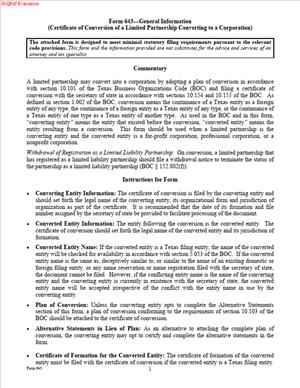
Form 643 – Certificate of Conversion of a Limited Partnership Converting to a Corporation
Fill out nowJurisdiction: Country: United States | Province or State: Texas
Form 643 – Certificate of Conversion of a Limited Partnership Converting to a Corporation is a formal filing used to change an existing limited partnership into a corporation. It records the conversion with the state so the new entity form is recognized.
This document matters because it creates a legal bridge between the old structure and the new one. It helps ensure the business continues without interruption while changing how it is organized.
You usually encounter this form when the business has already been operating as a limited partnership and now needs a corporate structure. That shift often affects ownership, governance, and ongoing obligations.
If you are preparing to fill it out, you are likely coordinating timing, names, and signatures. Understanding what the form captures will help you complete it accurately and avoid delays.
What is Form 643 – Certificate of Conversion of a Limited Partnership Converting to a Corporation?
Clear definition
Form 643 – Certificate of Conversion of a Limited Partnership Converting to a Corporation is a state filing that documents the conversion of a limited partnership into a corporation. It formally states that one type of legal entity is becoming another.
The form does not create a brand-new business from scratch. Instead, it records the continuation of the same business in a different legal form, subject to state law requirements.
Who typically uses this form/document?
This form is typically used by limited partnerships that want to operate as corporations. The person completing it is often an authorized partner or an individual handling entity filings.
Accountants, managers, or internal staff may prepare the information. The signer is usually someone with authority to act for the converting entity.
Why you might need this form/document
You might need this form when the partnership structure no longer fits the business’s goals. Corporations are commonly used for different ownership arrangements or governance models.
The filing creates an official record of the conversion. Without that record, the state continues to recognize the business only as a limited partnership.
Typical real-life scenarios
A growing business may want a corporate structure to accommodate new investors. Another common situation is a business planning to issue shares rather than partnership interests.
Sometimes the change follows internal restructuring, succession planning, or preparation for a transaction. In each case, the form documents the change so public records stay accurate.
When would you use Form 643 – Certificate of Conversion of a Limited Partnership Converting to a Corporation?
Form 643 is used at the point when a limited partnership has already approved a conversion internally and needs to make that change legally effective in state records. The form is filed to formally notify the state that the entity will no longer operate as a limited partnership and will instead continue as a corporation as of a specified effective time.
This filing is commonly coordinated with other documents related to establishing the corporation so that public records show a clear and uninterrupted transition. Businesses rely on this timing to ensure there is no ambiguity about which legal form applies at a given moment, particularly when contracts, filings, or transactions occur close to the conversion date.
You would not use this form to explore or propose a conversion. It is used only after the decision has been made and authorization obtained, serving as the official record that implements the change in legal form.
Legal characteristics of Form 643 – Certificate of Conversion of a Limited Partnership Converting to a Corporation
Form 643 has legal effect only once it is accepted by the state filing authority, at which point the conversion is recognized under applicable law. Until acceptance, the limited partnership remains the legally recognized form of the entity, regardless of internal intentions or preparations.
The form operates within a statutory framework that allows an entity to change its legal structure without winding up or transferring its existence. By documenting continuity, it preserves the entity’s history while changing how it is classified and governed going forward.
Form 643 does not itself define ownership rights, management authority, or operational rules of the resulting corporation. Those matters are addressed through separate governing documents and internal actions, while this filing serves to align the public record with the legal change in form.
How to fill out Form 643 – Certificate of Conversion of a Limited Partnership Converting to a Corporation
Step 1 – Identify the converting limited partnership
You begin by providing the exact legal name of the limited partnership as it appears in state records. Accuracy matters because the name ties the conversion to the existing entity.
You also include jurisdictional details that identify where the limited partnership was originally formed. This confirms the entity’s current legal status before conversion.
Step 2 – Identify the resulting corporation
Next, you list the legal name of the corporation that will exist after the conversion. This name must match the name used in the corporation’s formation filing.
This section connects the old entity to the new one. It shows that the business is continuing under a different legal form rather than ending operations.
Step 3 – State the type of conversion
The form requires a clear statement that a limited partnership is converting into a corporation. This confirms the nature of the transaction being recorded.
This step distinguishes a conversion from other changes, such as mergers or amendments. Using the correct description helps avoid processing issues.
Step 4 – Provide approval and authorization details
You include statements confirming that the conversion was approved according to the governing documents of the limited partnership. This reflects internal authorization rather than state approval.
The form typically does not require you to attach the approval documents. It relies on the signer’s confirmation that approval occurred.
Step 5 – Address the effectiveness of the conversion
You indicate when the conversion becomes effective. This may be upon filing or on a later specified date.
The effective date determines when the corporation replaces the limited partnership in public records. Clear dates help avoid overlap or gaps in recognition.
Step 6 – Review consistency with related filings
Before signing, you review the information for consistency with other documents submitted as part of the conversion. Names, dates, and entity details must align.
This step reduces the risk of rejection or follow-up questions from the filing office. Small discrepancies can delay processing.
Step 7 – Sign and submit the form
An authorized individual signs the form on behalf of the converting entity. The signature confirms that the information is accurate to the signer’s knowledge.
Once signed, the form is submitted to the appropriate filing office along with any required fees. Processing is complete when the filing is accepted.
Legal terms you might encounter in the Form 643 – Certificate of Conversion of a Limited Partnership Converting to a Corporation
Conversion
Conversion refers to the statutory process by which a limited partnership changes its legal form into a corporation. In this context, the business continues as the same entity, but under a different organizational structure recognized by the state.
Converting Entity
The converting entity is the limited partnership that exists before the filing of Form 643. Its legal name and jurisdiction must match existing state records to properly link the conversion.
Resulting Entity
The resulting entity is the corporation that exists after the conversion becomes effective. This term emphasizes continuity rather than the creation of an entirely new business.
Certificate of Conversion
A certificate of conversion is the formal filing that records the change in entity type with the state. Form 643 serves this function for a limited partnership converting into a corporation.
Effective Date
The effective date is the date on which the conversion legally takes effect. It determines when the corporation replaces the limited partnership for official purposes.
Authorization
Authorization refers to the internal approval required under the limited partnership’s governing documents to proceed with the conversion. The form relies on confirmation that this approval was properly obtained.
Filing Office
The filing office is the state agency responsible for accepting and recording entity filings. Acceptance by this office is necessary for the conversion to be recognized.
Continuity of Existence
Continuity of existence means the business remains the same legal entity despite the change in form. Assets, liabilities, and history generally carry over through the conversion.
FAQs Form 643 – Certificate of Conversion of a Limited Partnership Converting to a Corporation
Does Form 643 create a new corporation?
No, the form records the continuation of the same business in corporate form. The limited partnership does not terminate and restart; it legally continues as a corporation once the conversion is effective.
Who is authorized to sign Form 643?
The signer must have authority to act on behalf of the limited partnership under its governing documents. This is often a general partner or another authorized individual.
Can the conversion take effect on a future date?
Yes, the form allows the conversion to become effective upon filing or on a later specified date. The chosen date should align with related filings and internal planning.
Is Form 643 filed by itself?
The form is often submitted along with other conversion-related documents. Coordinating these filings helps ensure the public record reflects a clear and consistent transition.
Does this form transfer assets automatically?
The form records the legal conversion but does not independently document asset transfers. Asset continuity is addressed under conversion statutes and internal agreements.
What happens if the information is inconsistent with other filings?
Inconsistencies can delay acceptance or cause rejection by the filing office. Reviewing names, dates, and entity details across all documents is critical before submission.
Checklist: before, during, and after the Form 643 – Certificate of Conversion of a Limited Partnership Converting to a Corporation
Before
- Confirm the conversion was approved according to the partnership agreements
- Verify the limited partnership’s legal name and jurisdiction
- Select and clear the corporate name to be used after conversion
- Decide on an effective date that aligns with related filings
- Identify who has the authority to sign the conversion filing
During
- Enter entity names exactly as they appear in official records
- Clearly state that the transaction is a conversion to a corporation
- Specify whether the conversion is effective upon filing or later
- Review all entries for accuracy and consistency
- Obtain a valid signature from an authorized individual
After
- File the form with the appropriate office and required fee
- Verify the filing has been accepted and recorded
- Update internal documents to reflect corporate status
- Adjust governance and ownership records as needed
- Inform relevant parties of the completed conversion
Common mistakes to avoid
A frequent error is providing entity names that do not exactly match existing records, which can delay or prevent acceptance. Another common problem is selecting an effective date that conflicts with other conversion filings, creating uncertainty about when the change takes place. Missing signatures or signatures from unauthorized individuals also cause avoidable rejections.
Some businesses file the form without completing internal approval steps, assuming the state filing alone is sufficient. Others overlook inconsistencies between this form and the corporation’s formation documents. Reviewing all materials together before submission helps reduce corrections and processing delays.
Another mistake arises when filers treat the conversion as a purely administrative step and fail to think through how the change in entity form affects ongoing relationships. Even though the law treats the corporation as a continuation of the limited partnership, third parties may still react based on what they see in public records or internal paperwork. If the form is filed without aligning internal records, letterhead, and authority structures, confusion can arise about who has the power to bind the business during the transition period.
Timing errors are also common when the conversion is coordinated with other events such as ownership changes or financing activities. Filing too early or too late relative to those events can complicate the record of who owned what at a given moment. This is particularly problematic if documents reference the entity by name and form, because a mismatch can later raise questions about enforceability or intent, even if the underlying business never stopped operating.
Some filers underestimate the importance of the statements made within the form itself. Because the filing relies on representations that proper authorization has occurred, signing without verifying compliance with the partnership’s governing documents can expose the signer to internal disputes. If a limited partner later challenges whether the conversion was validly approved, the contents of the filed certificate may become a focal point, making accuracy and internal alignment essential.
Another avoidable issue is assuming that the filing office will correct or overlook small inconsistencies. In practice, clerks generally review filings for formal compliance, not for substantive intent. A minor discrepancy in punctuation, abbreviations, or jurisdiction references can result in rejection or require resubmission, which can disrupt carefully planned effective dates. Building in time for possible corrections helps prevent knock-on effects in the overall conversion timeline.
Finally, businesses sometimes fail to retain clear copies of the filed and accepted certificate. Relying solely on online records or third-party confirmations can create problems later if proof of conversion is needed. Maintaining organized records of what was submitted, when it was accepted, and what effective date applies helps avoid uncertainty long after the conversion is complete.
Another mistake involves assuming that continuity of existence eliminates the need to review regulatory or licensing requirements. While the entity continues by operation of law, some licenses, permits, or registrations are issued based on entity type. If those records still show a limited partnership after the conversion, agencies or counterparties may question whether the business is properly authorized to operate. Addressing these items proactively avoids interruptions that can arise well after the filing is accepted.
Businesses also sometimes overlook how the conversion affects authority perceptions inside the organization. Partners and managers who were accustomed to acting under partnership rules may continue to do so out of habit, even though the corporate form imposes different approval thresholds or formalities. If actions are taken based on outdated assumptions, later challenges can arise over whether those actions were validly authorized once the corporation existed.
A related error is failing to coordinate messaging during the transition period. Internally, different teams may operate on different understandings of when the conversion became effective, especially if a future effective date was selected. Externally, communications may reference the corporation before it legally exists or continue referencing the limited partnership after it no longer does. These mixed signals can complicate negotiations and documentation, particularly in fast-moving transactions.
Some filers underestimate the role of recordkeeping after acceptance. While the state’s acknowledgment confirms the conversion, internal reliance on informal confirmations rather than maintaining the filed certificate can cause problems later. If questions arise years down the line about entity status on a particular date, the absence of a readily available, accepted filing can slow responses and create unnecessary doubt.
There is also a tendency to treat Form 643 as interchangeable with other conversion filings, assuming that terminology or formatting differences are insignificant. In practice, each form is tailored to a specific transaction and entity type. Using language or assumptions borrowed from other conversations can lead to inaccurate statements, which may not be caught until review or challenge.
Finally, some businesses move forward quickly after filing without pausing to assess whether the conversion achieved its intended purpose. If the form was filed to support a change in ownership structure or governance, but internal practices remain unchanged, the benefits of conversion may not materialize. Recognizing Form 643 as a trigger for broader alignment rather than a standalone task helps avoid this disconnect.
What to do after filling out the Form 643 – Certificate of Conversion of a Limited Partnership Converting to a Corporation
Once the filing is accepted, you should confirm that the state records reflect the corporation as the continuing entity. Internal documents should be revised to match the corporate structure, including governance materials and ownership records. Operational systems may also need updates to reflect the new legal form.
It is important to notify parties who rely on accurate entity information, such as banks and contractual partners. Keeping organized records of the conversion supports continuity and provides clarity as the business moves forward under its corporate structure.
After acceptance, attention should shift from the filing itself to how the corporation functions on a day-to-day basis. The conversion changes the legal framework through which decisions are made, even though the underlying business may look the same from the outside. Updating governance practices to reflect corporate requirements helps ensure that actions taken after the effective date are properly authorized and documented.
You should also review existing agreements to see how they reference the entity. While many contracts automatically continue through a statutory conversion, outdated references to the limited partnership can cause confusion or administrative friction. Clarifying the entity’s name and form in ongoing communications can help counterparties feel confident that obligations remain intact.
Internal financial and accounting systems often require adjustment after a conversion. Even if tax treatment remains unchanged, reporting formats, account titles, and approval workflows may need to align with the corporate structure. Addressing these operational details promptly reduces the risk of errors that could surface later during audits or internal reviews.
Employee-facing documents may also need attention. Policies, benefit materials, and internal communications should reflect the corporation as the employer or operating entity. Consistency across these materials reinforces the reality of the conversion and avoids mixed signals that could undermine confidence or create administrative complications.
Over time, questions may arise about events that occurred before and after the effective date of conversion. Keeping a clear internal timeline that notes when the limited partnership ceased to be the operating form and when the corporation took over can be valuable. This context helps management, advisors, and future stakeholders understand decisions and transactions in their proper legal setting.
Finally, consider how the conversion fits into the business’s longer-term plans. The filing itself is a discrete event, but it often signals a broader shift in strategy, governance, or growth approach. Periodically revisiting the reasons for the conversion and assessing whether corporate practices are supporting those goals can help ensure that the change in form delivers the intended benefits rather than becoming just another administrative milestone.
Disclaimer: This guide is provided for informational purposes only and is not intended as legal advice. You should consult a legal professional.