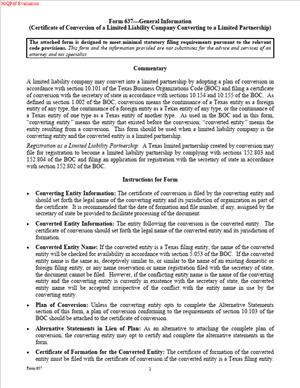
Form 637 – Certificate of Conversion of a Limited Liability Company Converting to a Limited Partnership
Fill out nowJurisdiction: Country: United States | Province or State: Texas
Form 637 – Certificate of Conversion of a Limited Liability Company Converting to a Limited Partnership is a filing used when a Texas limited liability company changes its legal structure into a limited partnership. It records the conversion with the state so the new entity form is officially recognized.
This document matters because a conversion affects how the business exists under the law. The form connects the old entity to the new one and confirms that the change followed the required process.
If you are filling out this form, you are likely coordinating a structural change rather than starting or ending a business. The goal is continuity, not termination.
This guide explains what the form does, when it is used, and how to complete it clearly and accurately.
What is Form 637 – Certificate of Conversion of a Limited Liability Company Converting to a Limited Partnership?
Clear definition
Form 637 – Certificate of Conversion of a Limited Liability Company Converting to a Limited Partnership is a formal state filing. It documents that an existing limited liability company has converted into a limited partnership under Texas law.
The form captures identifying details about the original LLC and the resulting limited partnership. Once accepted, the state recognizes the limited partnership as the continuing entity.
This is not a private agreement. It is a public record filed with the Secretary of State.
Who typically uses this form/document?
This form is typically used by business owners or managers of a Texas LLC. It may also be prepared by someone authorized to act for the company during the conversion.
In many cases, one person signs on behalf of the converting entity. That person acts in an official capacity, not as an individual owner.
The audience is usually small businesses, closely held companies, or investment-focused entities restructuring their form.
Why you might need this form/document
You may need this form when the business wants a limited partnership structure instead of an LLC. The reasons vary and can include management preferences, investment arrangements, or tax planning considerations.
The form provides the legal bridge between the two entity types. Without it, the state has no record of the conversion.
Filing this document is often part of a larger set of internal decisions and documents, even though only this form is submitted to the state.
Typical real-life scenarios
- A company may bring in new investors who prefer limited partnership roles. The existing LLC converts so that one party can act as a general partner and others as limited partners.
- Another scenario involves restructuring ownership and control. The business continues operations, but the legal form better matches how the parties want to allocate authority and responsibility.
- Conversions also happen during long-term planning. A business may anticipate growth, succession, or exit strategies that align better with a limited partnership model.
When would you use Form 637 – Certificate of Conversion of a Limited Liability Company Converting to a Limited Partnership?
You would use this form once the decision to convert the existing Texas limited liability company into a limited partnership has been formally approved within the business. The filing reflects actions that have already occurred internally rather than initiating the decision itself.
This form is typically prepared when the company is ready to make the change legally effective with the state. The timing often aligns with operational, financial, or ownership changes that require the new entity structure to be recognized without interrupting the business’s continuity.
It is also used when the business wants to preserve its history, contracts, and relationships while changing its statutory form. Rather than dissolving the LLC and forming a new entity, the conversion allows the company to continue as the same legal enterprise in a different form.
The form is not appropriate for starting a new limited partnership or ending an LLC. It is specifically designed for situations where an existing Texas LLC is transitioning to a limited partnership under applicable conversion rules.
Legal characteristics of Form 637 – Certificate of Conversion of a Limited Liability Company Converting to a Limited Partnership
For the form to be effective, it must be properly completed, signed, and accepted by the state filing office. Accuracy and consistency across entity names and details are critical.
Common issues that delay or prevent acceptance include name mismatches, missing signatures, or incomplete sections. Using an entity name that does not exactly match state records is a frequent problem.
While conversion concepts exist in many jurisdictions, the format and requirements of this document are specific to Texas. Other states may use different forms or terminology.
This form does not replace internal agreements. It does not set partnership terms, allocate profits, or define partner rights. Those details are typically handled in separate governing documents.
It also does not handle tax registrations, licenses, or contracts. The filing only records the conversion at the state entity level.
How to fill out Form 637 – Certificate of Conversion of a Limited Liability Company Converting to a Limited Partnership
Step 1 – Identify the converting entity
- Begin by entering the exact legal name of the limited liability company that is converting. This name must match the state’s records precisely.
- You will also include the entity’s file or identification number if the form requests it. This helps the state confirm which LLC is converting.
- Check spelling, punctuation, and spacing carefully. Small differences can cause processing delays.
Step 2 – Identify the resulting limited partnership
- Next, provide the name of the limited partnership that will exist after the conversion. This is the new entity form, even though the business itself continues.
- The name must comply with Texas naming rules for limited partnerships. It should be clear that the entity is a limited partnership.
- If the name is changing as part of the conversion, this section captures that change.
Step 3 – State the jurisdiction and type of conversion
- This step confirms that the conversion is occurring under Texas law. It identifies the original entity type and the resulting entity type.
- You are documenting a conversion from a limited liability company to a limited partnership. The form language typically guides how this is stated.
- This section establishes the legal framework for the conversion.
Step 4 – Approval and authorization statement
- Here, the form usually requires a statement that the conversion was approved according to the governing documents and applicable law.
- You are not attaching evidence of approval. You are certifying that the approval occurred.
- This representation is important because it confirms internal compliance before filing.
Step 5 – Effective date of the conversion
- The form asks when the conversion becomes effective. This may be the filing date or a later specified date.
- If a future date is used, it must typically fall within an allowed time window. The effective date controls when the limited partnership legally exists.
- Choose this date carefully, as it affects records and ongoing obligations.
Step 6 – Additional statements or confirmations
- Some versions of the form include brief confirmations or required statutory language. These sections are usually prewritten with blanks or checkboxes.
- Read these statements closely before completing them. They describe the legal effect of the conversion.
- Do not add extra language unless the form specifically allows it.
Step 7 – Signatures and execution
- The final step is signing the form. An authorized person signs on behalf of the converting entity.
- The signature confirms that the information is correct and that the signer has the authority to submit the filing.
- Once signed, the form is ready for submission according to the state’s filing process.
Legal terms you might encounter
Certificate of Conversion
This is the official filing that documents the change of an entity from one legal form to another. In this context, it records the conversion of a Texas LLC into a limited partnership and makes that change effective under state law.
Converting Entity
The converting entity is the limited liability company that is changing its legal form. Its existing legal identity carries through the conversion rather than being terminated.
Resulting Entity
The resulting entity is the limited partnership that exists after the conversion takes effect. Although the legal form changes, it is treated as the continuation of the prior entity.
Effective Date
The effective date is the moment when the conversion legally becomes operative. This date determines when the limited partnership is recognized for state law purposes.
Authorized Person
An authorized person is an individual with the power to sign and submit the form on behalf of the entity. Their signature certifies that the information is accurate and properly approved.
Governing Documents
Governing documents include the LLC’s operating agreement and any other internal rules that control approvals. These documents typically outline how a conversion must be authorized.
State Filing Office
This refers to the government office that accepts and processes the conversion filing. Acceptance by this office is required for the conversion to be legally recognized.
Continuity of Existence
Continuity of existence means the business continues without interruption despite the change in entity form. Assets, obligations, and relationships generally remain with the converted entity.
Statutory Conversion
A statutory conversion is a change in entity form permitted by law without dissolving the original entity. Form 637 implements this type of conversion for Texas entities.
FAQs
Does filing this form end the existence of the LLC?
No. The filing changes the legal form of the entity but does not terminate its existence. The business continues as the same entity in the form of a limited partnership.
Is this form used to create a brand-new limited partnership?
No. This form is only used when an existing Texas LLC is converting. A separate formation filing is used for a newly created limited partnership.
Can the entity name change during the conversion?
Yes. The resulting limited partnership may have a different name, as long as it complies with naming rules and is properly stated on the form.
Who must approve the conversion before filing?
Approval must occur according to the LLC’s governing documents and applicable law. The form relies on a certification that the required approval has already been obtained.
Is an operating agreement or partnership agreement filed with this form?
No. Internal agreements are not submitted with the filing. They are maintained separately as part of the entity’s records.
Can the conversion take effect on a future date?
Yes. The form allows an effective date that is later than the filing date, within permitted limits. This lets the entity coordinate the change with other events.
What happens if information on the form is inaccurate?
Inaccurate information can delay acceptance or result in rejection. Errors may require correction and resubmission before the conversion is recognized.
Checklist: before, during, and after the Form 637 – Certificate of Conversion of a Limited Liability Company Converting to a Limited Partnership
Before
- Confirm the LLC is eligible to convert under applicable law
- Review the operating agreement for required approvals
- Obtain member or manager approval as required
- Decide on the resulting limited partnership name
- Determine the desired effective date
- Verify current state records for entity details
During
- Enter the exact legal name of the converting LLC
- Complete all required sections of the form
- State the correct entity types for the conversion
- Include the chosen effective date
- Review statements for accuracy and completeness
- Sign the form using an authorized person
After
- Submit the form according to the filing instructions
- Confirm acceptance by the state filing office
- Update internal records to reflect the conversion
- Finalize the limited partnership agreement
- Notify relevant parties of the entity form change
- Align ongoing filings and records with the new entity form
Common mistakes to avoid
One common mistake is using an entity name that does not exactly match the state’s records. Even minor differences in punctuation or spelling can cause the filing to be rejected or delayed.
Another issue is overlooking internal approval requirements. Filing the form without proper authorization can create internal disputes and undermine the validity of the conversion.
Selecting an inappropriate effective date can also cause problems. A date that does not align with business operations or that falls outside allowable parameters may require correction.
Incomplete forms are a frequent source of delay. Leaving required sections blank or failing to include a signature can prevent the conversion from being processed.
Another mistake arises when filers treat the conversion as purely administrative and fail to consider how the limited partnership structure changes roles and authority. If the business does not clearly identify who will serve as the general partner and how decision-making authority shifts, the conversion filing may be correct on its face but create confusion internally immediately afterward. This confusion often shows up when banks, counterparties, or employees request confirmation of who has authority to act, and the business cannot respond consistently.
Misalignment between the conversion filing and the resulting partnership agreement is also a frequent problem. If the partnership agreement is drafted without carefully reflecting the terms approved for conversion, or if it is finalized too late, the entity can operate for a period without a clear governance framework. This gap can lead to disputes among owners or partners about rights and obligations that were assumed but never clearly documented.
Another common error is failing to coordinate the conversion with financial reporting and accounting practices. The effective date of the conversion affects how transactions are categorized and reported. If the accounting records continue to treat the entity as an LLC after the conversion date, or if the transition is handled inconsistently, it can create reconciliation issues that are difficult to untangle later. These issues are especially problematic during audits or when preparing historical financial statements.
Some businesses underestimate how closely the state filing office reviews consistency across filings. If other documents on record, such as prior amendments or assumed name filings, contain outdated or conflicting information, the conversion filing may trigger questions or delays. Reviewing the entity’s existing public record before submitting the form can help avoid unexpected rejections based on inconsistencies that are not obvious from the conversion form alone.
There is also a tendency to overlook the impact of the conversion on existing authority resolutions and delegations. Authorizations that were valid under the LLC structure may not automatically translate cleanly to a limited partnership. If the business continues to rely on outdated resolutions or delegations, third parties may challenge whether actions taken after the conversion were properly authorized.
Another mistake involves assuming that silence from third parties means no follow-up is needed. Even though the law provides continuity of existence, many institutions rely on their own internal policies. If the business does not proactively address questions or requests for updated documentation, transactions can be delayed or denied based on uncertainty about the entity’s status.
Finally, rushing the filing process without a coordinated plan can compound errors. When the conversion is treated as a last-minute task rather than a structured transition, details are more likely to be missed. Taking the time to align approvals, documents, and timing reduces the risk that the conversion will create operational friction instead of achieving its intended purpose.
What to do after filling out the Form 637 – Certificate of Conversion of a Limited Liability Company Converting to a Limited Partnership
After completing the form, the next step is to submit it through the state’s designated filing process and monitor its status until acceptance is confirmed. The conversion is not legally effective until the filing office accepts the document, so confirmation should be retained with the entity’s permanent records.
Once acceptance is received, the business should update its internal documentation to reflect the limited partnership structure. This includes aligning governance records, ownership records, and authority designations with the converted entity form so internal practices match the legal reality.
The business should then review existing contracts, registrations, and ongoing obligations to determine whether references to the prior LLC form need to be updated. While the entity continues without interruption, counterparties and records may still require clarification to avoid confusion.
After the filing is accepted, it is important to communicate the conversion clearly within the organization. Managers, partners, and key personnel should understand how the limited partnership structure affects authority, responsibility, and reporting lines. Clear internal communication helps prevent outdated assumptions from carrying over from the LLC structure and supports smoother day-to-day operations under the new form.
The business should also review how ownership interests are described and tracked going forward. Membership interests in an LLC do not translate word-for-word into partnership interests, even though economic arrangements may be similar. Updating capitalization records and ownership summaries to reflect partnership terminology helps avoid confusion when presenting information to investors, lenders, or advisors.
Operational documents should be reviewed for consistency with the converted entity form. This includes signature blocks, letterhead, invoices, and internal templates that may still reference the LLC. While these details may seem minor, inconsistent usage can raise questions about whether documents were issued by the correct legal entity, particularly in transactions or disputes.
The conversion is also a natural point to reassess compliance calendars and reporting responsibilities. Limited partnerships may have different ongoing filing or disclosure expectations than LLCs, and internal systems should be adjusted accordingly. Ensuring that reminders, workflows, and compliance checks reflect the new structure reduces the risk of missed obligations in the months following the conversion.
If the conversion involved a name change, additional attention should be paid to how that name is rolled out operationally. Consistent use of the new name across records and communications helps reinforce the continuity of the entity while clearly signaling the updated structure. Inconsistent naming can undermine that clarity and create unnecessary administrative back-and-forth.
The business should also consider how the conversion fits into its longer-term planning. Future financing, ownership changes, or succession planning may be easier or more complex depending on how the limited partnership agreement is structured. Reviewing these considerations shortly after conversion allows the entity to make refinements while the transition is still recent and before patterns are firmly established.
Finally, retaining organized records of the conversion is essential. Keeping copies of the filed form, acceptance confirmation, approval documentation, and updated governing documents in a central location provides a clear history of the change. These records are often requested years later during transactions, due diligence, or internal reviews. Having them readily available supports continuity, reduces uncertainty, and reinforces the legitimacy of the converted entity’s ongoing operations.
Disclaimer: This guide is provided for informational purposes only and is not intended as legal advice. You should consult a legal professional.