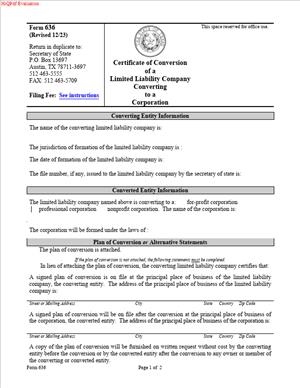
Form 636 – Certificate of Conversion of a Limited Liability Company Converting to a Corporation
Fill out nowJurisdiction: Country: United States | Province or State: Texas
Form 636 – Certificate of Conversion of a Limited Liability Company Converting to a Corporation is a filing used to change a company’s legal form from an LLC to a corporation. It is part of the public record created when that change is officially recognized.
This document matters because it marks the moment your business stops being an LLC and begins operating as a corporation under state records. Banks, investors, and other parties often rely on this filing to confirm the conversion.
You will usually complete this form alongside other documents, such as formation papers for the new corporation. The conversion itself is not automatic. It is reflected only when this filing is accepted.
This form belongs to the Secretary of State of Texas and is submitted as part of a state-level business filing process.
What is Form 636 – Certificate of Conversion of a Limited Liability Company Converting to a Corporation?
Clear definition
Form 636 – Certificate of Conversion of a Limited Liability Company Converting to a Corporation is a formal certificate that records the conversion of an existing LLC into a corporation. It states key facts about the LLC before conversion and the corporation after conversion.
The document confirms that the converting entity has approved the change and is transitioning into a different legal structure. Once filed and accepted, it becomes evidence of the conversion in state records.
This form does not create a brand-new business from scratch. It reflects a continuation of the same entity in a new legal form, as recognized by the state.
Who typically uses this form/document?
This form is commonly used by business owners who started as an LLC and later decided to operate as a corporation. That includes single-member LLCs and multi-member LLCs.
It is often prepared by a company representative who has the authority to sign filings. That may be a manager, member, or authorized officer, depending on how the business is organized.
People working with accountants, investors, or internal management teams also encounter this form during restructuring discussions. It is a coordination point between business planning and public filings.
Why you might need this form/document
You may need this form when your business structure no longer fits how the company operates or plans to grow. A corporate structure is often associated with issuing shares and formal governance.
The form allows the conversion to be recognized without dissolving the LLC and starting over. That continuity can matter for contracts, accounts, and ongoing operations.
Without this filing, the state will continue to treat the business as an LLC. That can create confusion when other documents refer to a corporation.
Typical real-life scenarios
A growing company may attract outside investment and decide that a corporate structure aligns better with those discussions. The conversion is then documented through this form.
An LLC may plan to offer equity to employees and shift to a corporate framework to support that plan. The conversion is recorded so internal changes match public records.
Sometimes the change follows advice from financial planning or internal restructuring, where the owners want a clearer separation between ownership and management roles.
When would you use Form 636 – Certificate of Conversion of a Limited Liability Company Converting to a Corporation?
You would use Form 636 when the owners or authorized decision-makers of an existing LLC have already approved a conversion to a corporate structure and are ready to make that change official in state records. The form is not used to explore options or begin discussions, but to document a decision that has already been finalized internally.
The filing typically occurs at the same time as, or immediately before, the formation filing for the resulting corporation. Coordinating these filings helps ensure that the public record reflects a continuous transition rather than a gap between entity types.
Form 636 is used before the business starts operating, contracting, or representing itself as a corporation. Using it at the correct moment avoids inconsistencies between how the business is described in agreements, banking records, and state filings.
This form is commonly prepared during a planned restructuring, ownership change, or growth phase, when accuracy of timing and entity status is important for external relationships and compliance.
Legal characteristics of Form 636 – Certificate of Conversion of a Limited Liability Company Converting to a Corporation
For Form 636 – Certificate of Conversion of a Limited Liability Company Converting to a Corporation to be effective, it must be completed accurately and accepted for filing. Acceptance generally depends on clear identification of both the converting LLC and the resulting corporation.
Common problems include inconsistent names, missing signatures, or dates that do not align with other filings. Errors in entity names are a frequent cause of delays because the state relies on exact matches.
This document has legal significance because it changes how the entity is classified in state records. After acceptance, references to the business as an LLC may no longer match its registered status.
High-level rules around conversion exist across many jurisdictions, but details vary. What information is required and how conversion is treated can differ by state.
This form does not handle internal governance, ownership percentages, or tax treatment. Those matters are addressed in separate agreements and filings. The certificate only records the fact of conversion.
How to fill out Form 636 – Certificate of Conversion of a Limited Liability Company Converting to a Corporation
Step 1 – Identify the converting LLC
Begin by entering the exact legal name of the LLC as it appears in state records. This establishes which entity is converting.
You will also include identifying details that distinguish this LLC from others. Accuracy here is critical because the conversion relies on matching existing records.
Step 2 – State the type of conversion
The form asks you to specify that the LLC is converting into a corporation. This confirms the direction and nature of the change.
This section clarifies that the business is not merging or dissolving. It is a conversion from one legal form to another.
Step 3 – Provide information about the resulting corporation
You will enter the legal name of the corporation that will exist after the conversion. This name must align with the related formation document.
This part connects the old entity to the new legal form. It shows continuity between the LLC and the corporation.
Step 4 – Confirm approval of the conversion
The form includes language confirming that the conversion was properly approved under the LLC’s governing rules. You are acknowledging that internal authorization has occurred.
This statement is brief but important. It supports the validity of the conversion without detailing the internal process.
Step 5 – Set the effective date
You will indicate when the conversion takes effect. This may be a specific date or tied to filing acceptance.
The effective date determines when the business is treated as a corporation in the public record.
Step 6 – Review entity details for consistency
Before signing, review all names, dates, and references for consistency with related filings. Mismatches are a common source of rejection.
This review step helps ensure that the conversion and formation documents align.
Step 7 – Sign and submit the form
An authorized person signs the form to certify that the information is correct. The signature finalizes the filing.
Once submitted and accepted, the conversion is reflected in state records, completing the process described in this form.
Legal terms you might encounter
Conversion
Conversion refers to the legal process by which an existing LLC changes its form into a corporation without terminating the underlying entity. In this document, conversion is the event being officially recorded with the state.
Converting Entity
The converting entity is the LLC that exists before the filing of Form 636. The form identifies this entity so the state can link the prior LLC records to the new corporate status.
Resulting Corporation
The resulting corporation is the legal form the business takes after the conversion becomes effective. Its name and status must align with the related corporate formation filing.
Certificate of Conversion
A certificate of conversion is a formal filing that states key facts about a legal form change. In this context, it serves as proof that the LLC has converted into a corporation under state law.
Effective Date
The effective date is the moment when the conversion legally takes effect. It determines when the entity is treated as a corporation in state records and for public-facing purposes.
Authorized Signatory
An authorized signatory is the individual who has the power to sign and submit the form on behalf of the LLC. Their signature confirms that the information provided is accurate and approved.
Governing Authority
Governing authority refers to the internal rules or decision-making structure of the LLC that allowed the conversion to be approved. The form relies on a statement that this approval has already occurred.
Filing Acceptance
Filing acceptance is the state’s confirmation that the document meets formal requirements. The conversion is recognized only after this acceptance occurs.
Continuity of Entity
Continuity of entity means the business is treated as the same underlying organization before and after conversion. The form reflects this continuity rather than the creation of a completely new entity.
FAQs
Does Form 636 create a new corporation?
Form 636 does not create a new business from scratch. It records the conversion of an existing LLC into a corporation, preserving the continuity of the entity in state records.
Is internal approval required before filing Form 636?
Yes, the form includes a statement confirming that the conversion was properly approved under the LLC’s governing rules. The state relies on this confirmation rather than reviewing internal documents.
Can the effective date be different from the filing date?
The form allows you to specify an effective date for the conversion. Depending on how it is completed, the conversion may take effect on filing acceptance or on a stated later date.
Who is allowed to sign Form 636?
The form must be signed by a person authorized to act for the LLC. This is typically a member, manager, or other individual with signing authority under the company’s structure.
Does Form 636 address ownership or share structure?
No, the form does not describe ownership percentages, stock issuance, or governance details. Those matters are handled in separate corporate documents.
What happens if information on the form does not match other filings?
Inconsistent names, dates, or entity details can delay acceptance or cause rejection. The state expects exact matches between this form and related formation documents.
Is Form 636 sufficient by itself to complete the conversion?
Form 636 records the conversion, but it is usually filed alongside corporate formation paperwork. Both filings work together to complete the transition in state records.
Checklist: before, during, and after the Form 636 – Certificate of Conversion of a Limited Liability Company Converting to a Corporation
Before
- Confirm internal approval of the LLC conversion
- Verify the exact legal name of the LLC
- Choose and clear the name of the resulting corporation
- Coordinate timing with corporate formation documents
- Decide on the conversion effective date
- Identify the authorized signatory
During
- Enter LLC information exactly as shown in state records
- Specify the conversion from LLC to a corporation
- Provide the correct name of the resulting corporation
- Confirm approval language is included
- Review dates and entity references for consistency
- Sign the form using the authorized individual
After
- Confirm filing acceptance by the state
- Retain a copy of the filed certificate
- Align business records with corporate status
- Update contracts or internal references if needed
- Ensure related formation documents are on record
- Communicate the conversion to relevant stakeholders
Common mistakes to avoid
One common mistake is using an LLC name that does not exactly match state records. Even minor differences can cause delays because the conversion depends on the precise identification of the converting entity.
Another issue is misalignment between Form 636 and the corporate formation documents. If the resulting corporation’s name or effective date differs, the filings may be rejected or questioned.
Some filers overlook the importance of the effective date and select one that conflicts with planned operations or other filings. This can create confusion about when the entity officially became a corporation.
Missing or unauthorized signatures are also a frequent problem. The form must be signed by someone with proper authority, or it may not be accepted.
Rushing the review process increases the risk of inconsistencies. A careful final check helps prevent administrative delays and repeat filings.
Another frequent mistake involves assuming that conversion automatically updates all public-facing records. While Form 636 changes the entity’s status in state records, it does not amend prior filings, assumed name records, or registrations with other agencies. Treating the conversion as a global update can lead to mismatched records that continue to identify the business as an LLC in certain contexts, creating confusion when those records are later reviewed.
Filers sometimes misunderstand the continuity concept and inadvertently describe the transaction as if the LLC is being terminated and replaced. Using language internally or externally that suggests dissolution can cause practical problems, particularly when counterparties believe contracts must be re-executed. The form reflects a continuation of the same entity, and framing it incorrectly can introduce unnecessary questions about whether obligations survived the change.
Another error arises when the timing of internal actions does not line up with the effective date selected on the form. For example, adopting corporate-style governance documents or issuing shares before the conversion is effective can blur the line between the LLC period and the corporate period. While the form itself does not govern these actions, inconsistent timing can complicate recordkeeping and future explanations of when the corporate structure actually began.
Some businesses fail to consider how the conversion will be interpreted by third parties reviewing the public record. If the resulting corporation’s name is very similar but not identical to the LLC’s name, reviewers may question whether the correct entity converted. Small naming changes are permitted, but they should be deliberate and clearly supported by matching formation documents to avoid uncertainty.
There is also a tendency to treat Form 636 as a routine filing without appreciating its evidentiary role. Because the certificate becomes part of the permanent state record, errors may be difficult to correct later without additional filings. Overlooking this permanence can lead to casual mistakes that remain visible long after the conversion is complete.
Another common issue is failing to coordinate signatures and authority across documents. The person signing Form 636 should be consistent with the authority reflected in internal approvals and related filings. When different individuals sign different documents without a clear explanation, it can raise questions about whether the conversion was properly authorized.
Finally, some filers underestimate how closely state reviewers compare related documents submitted around the same time. Even if Form 636 is accurate on its own, inconsistencies with companion filings can delay acceptance. Treating the conversion as a coordinated package rather than a standalone form helps avoid this type of administrative friction.
What to do after filling out the Form 636 – Certificate of Conversion of a Limited Liability Company Converting to a Corporation
After completing Form 636, the first step is to verify that the filing has been accepted and recorded by the state. The conversion is not considered effective until acceptance occurs, so confirmation ensures the business is officially recognized as a corporation in public records.
Once acceptance is confirmed, make sure the related corporate formation filing is also finalized and consistent with the conversion details. Together, these filings establish the entity’s legal status and should reflect matching names, dates, and entity information.
Next, update internal documents to reflect the corporate form. Organizational records, internal approvals, and operational references should no longer describe the business as an LLC once the conversion is effective.
External relationships should then be reviewed and aligned with the new status. Financial accounts, contractual relationships, and internal teams should rely on information that matches the corporation’s designation in state records.
After the conversion is effective, it is important to take a step back and confirm that the business is consistently presenting itself as a corporation in practice, not just on paper. This includes how the entity is named in correspondence, invoices, internal communications, and decision-making records. Inconsistent usage can undermine the clarity that the conversion was meant to achieve.
Internal governance should be reviewed to ensure that decision-making processes align with the corporate structure. While Form 636 does not dictate governance, the shift from an LLC framework to a corporate one often changes how authority is exercised and documented. Aligning meeting records, approvals, and roles with the corporate form helps maintain coherence between legal status and daily operations.
Attention should also be given to how historical records are preserved. Documents from the LLC period remain relevant, and maintaining a clear record of when the conversion occurred helps distinguish actions taken before and after the effective date. This chronological clarity can be valuable when reviewing past decisions or responding to questions about legacy obligations.
Communication with stakeholders deserves deliberate handling after the filing. Even if key parties were aware of the planned conversion, confirmation that it has been completed helps reset expectations. Clear communication reduces the risk that someone continues to rely on outdated assumptions about the company’s structure or authority.
Operational systems may need adjustment to reflect the new entity type. Accounting classifications, internal reporting labels, and approval workflows sometimes embed assumptions about entity form. Reviewing these systems after the conversion helps ensure that they support, rather than contradict, the corporation’s status.
It is also prudent to consider how the conversion affects long-term planning and record maintenance. Future filings, amendments, or restructurings will often refer back to the conversion, and having a well-organized record simplifies those processes. Treating the conversion as a foundational event rather than a one-time task supports smoother administration later.
Finally, the period immediately after filing is a good time to conduct a holistic review of compliance posture. While Form 636 addresses only the conversion, the new corporate status may carry different expectations for documentation and formalities. Identifying and addressing any gaps early helps the business fully transition into operating as a corporation with confidence and clarity.
Disclaimer: This guide is provided for informational purposes only and is not intended as legal advice. You should consult a legal professional.