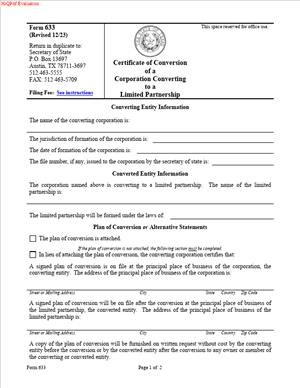
Form 633 – Certificate of Conversion of a Corporation Converting to a Limited Partnership
Fill out nowJurisdiction: Country: United States | Province or State: Texas
Form 633 – Certificate of Conversion of a Corporation Converting to a Limited Partnership is a filing used to change an existing corporation into a limited partnership. It records that change with the state, so the entity’s structure is officially updated.
You use this document when a corporation is not dissolving but transforming into a different type of entity. The business continues, but its legal form, ownership roles, and governance framework change.
This form matters because state records control how the business is recognized by others. Lenders, contracting parties, and government agencies often rely on these records.
Completing the form carefully helps avoid processing delays. It also helps ensure that the converted entity aligns with its internal agreements and expectations.
You will encounter this form during a larger transition. That transition often includes internal approvals, new governing documents, and updates to business relationships.
What is Form 633 – Certificate of Conversion of a Corporation Converting to a Limited Partnership?
Clear definition
Form 633 – Certificate of Conversion of a Corporation Converting to a Limited Partnership is a formal filing submitted to the Texas Secretary of State. It states that an existing corporation is converting into a limited partnership.
The document identifies the original corporation and the resulting limited partnership. It confirms that the conversion follows applicable conversion procedures.
This filing does not create a brand-new business from scratch. Instead, it records the continuation of the entity in a new legal form.
Who typically uses this form/document?
This form is commonly used by corporations that want a partnership-style structure. That often includes businesses seeking different management or ownership arrangements.
It is usually prepared by business owners, officers, or authorized representatives. In practice, someone familiar with the company’s records completes it.
Self-represented business owners may also handle the form. That is common for closely held or family-run businesses.
Why you might need this form/document
You might need this document when a corporate structure no longer fits how the business operates. A limited partnership can offer different allocation and control features.
Some businesses convert as part of succession planning. Others convert to separate management authority from ownership interests.
The form is required to make the conversion effective in state records. Without filing it, the entity remains listed as a corporation.
Typical real-life scenarios
- A small corporation with a few owners decides to reorganize so one owner manages the business and others become passive investors. Converting to a limited partnership supports that arrangement.
- A business plans to admit new investors who prefer partnership interests rather than corporate shares. The conversion aligns the legal structure with that goal.
- A corporation involved in long-term asset ownership restructures to better reflect economic participation among owners. The limited partnership format may match those economics.
- A family business prepares for generational transition. The conversion helps distinguish between control roles and ownership roles among family members.
When would you use Form 633 – Certificate of Conversion of a Corporation Converting to a Limited Partnership?
You would use this form during a planned entity conversion. That timing usually follows internal approval of the conversion by the corporation.
The filing often happens after new partnership agreements are drafted. Those documents describe how the limited partnership will operate.
The form is typically submitted before the converted entity begins operating as a limited partnership in external dealings. This helps align public records with reality.
People involved may include corporate officers, directors, shareholders, or designated managers of the new partnership. The person signing is usually authorized to act for the entity.
Legal characteristics of Form 633 – Certificate of Conversion of a Corporation Converting to a Limited Partnership
This form is a public filing. Once accepted, it updates the state’s records to reflect the conversion.
For the filing to be effective, it generally must include accurate entity names, dates, and confirmations of approval. Missing or inconsistent information often leads to rejection.
Common problems include mismatched names, incorrect entity identifiers, or unsigned documents. Clerical errors can also delay processing.
Conversion procedures can differ by state. While the general concept is similar across jurisdictions, specific requirements may vary.
This form does not replace internal governing documents. It also does not handle tax elections, licenses, or private contracts.
Is it legally binding?
The filing is legally effective once accepted by the state. At that point, the conversion is recognized for state law purposes.
Its binding effect comes from recording a change in entity status. It does not, by itself, bind partners or shareholders to internal agreements.
Those obligations usually arise from separate approval actions and governing documents completed alongside the conversion.
How to fill out Form 633 – Certificate of Conversion of a Corporation Converting to a Limited Partnership
Step 1 – Identify the converting corporation
Begin by entering the exact legal name of the existing corporation. Use the name as it appears in state records.
This helps the filing office match the conversion to the correct entity.
Step 2 – Provide the corporation’s entity information
Include identifying details such as the entity’s file number or similar reference. Accuracy here is critical for record matching.
These details confirm which corporation is converting.
Step 3 – State the name of the resulting limited partnership
List the full legal name of the limited partnership after conversion. This name must be stated clearly and consistently.
The resulting name becomes the entity’s official name going forward.
Step 4 – Confirm the type of conversion
Indicate that the conversion is from a corporation to a limited partnership. This clarifies the nature of the filing.
This step distinguishes the filing from other types of entity changes.
Step 5 – Provide the effective date of the conversion
State when the conversion becomes effective. Some filings use the filing date, while others specify a later date.
The effective date controls when the new structure is recognized.
Step 6 – Affirm approval of the conversion
Confirm that the conversion was approved according to the corporation’s governing rules. This typically involves shareholder or board approval.
The form usually requires a simple statement of approval, not detailed resolutions.
Step 7 – Address continuation of the entity
Indicate that the limited partnership is a continuation of the corporation. This shows that the entity is not dissolving.
This helps preserve continuity for contracts and obligations.
Step 8 – Reference the plan of conversion
Acknowledge that a plan of conversion exists or was adopted. The plan itself is not typically filed with this document.
This statement confirms that the conversion followed an organized process.
Step 9 – Provide any required additional statements
Some versions of the form include space for required confirmations or statutory statements. Complete these as written.
These statements often relate to compliance with applicable rules.
Step 10 – Identify the authorized signer
List the name and role of the person signing the form. This person must have the authority to act for the entity.
Clear identification helps validate the filing.
Step 11 – Sign and date the form
The authorized signer signs and dates the document. Unsigned forms are commonly rejected.
The signature confirms the accuracy of the information provided.
Step 12 – Review the completed form
Read through the entire form before submission. Check names, dates, and entity details carefully.
Catching errors here can prevent delays.
Step 13 – Prepare the form for submission
Follow the form’s instructions for formatting and submission method. This may include copies or specific page order.
Proper preparation helps the filing move smoothly through processing.
Step 14 – Submit the filing
Submit the completed form to the appropriate state office. Submission makes the conversion request official.
Processing occurs after submission is accepted.
Step 15 – Keep a copy for records
Retain a copy of the filed document. This record is useful for future reference and business dealings.
It helps demonstrate when and how the conversion occurred.
Legal terms you might encounter in Form 633 – Certificate of Conversion of a Corporation Converting to a Limited Partnership
Conversion: Conversion is the legal process by which your business changes from one entity type to another without shutting down. In this form, conversion means the corporation becomes a limited partnership while continuing as the same business. The filing records that change in the public record.
Converting Entity: The converting entity is the corporation as it exists before the change. This term appears when the form asks for the current legal name and identifying information. You must match this information exactly to state records.
Resulting Entity: The resulting entity is the limited partnership after the conversion takes effect. The form uses this term to describe what the business will be called and recognized as going forward. This name becomes the official public name once the filing is accepted.
Effective Date: The effective date is the moment the conversion legally happens. On this form, you either accept the filing date or state a future date. That date controls when the limited partnership status begins in the public record.
Plan of Conversion: The plan of conversion is the internal document that explains how the corporation will convert. The form does not require you to attach it, but it requires you to confirm that one exists. This confirmation signals that the conversion followed an organized approval process.
Approval: Approval refers to the internal authorization required before filing. The form includes a statement that the conversion was approved according to governing rules. You are not asked to describe the vote, only to confirm that it occurred.
Continuation of Existence: This term reflects that the business does not dissolve during conversion. The form states that the limited partnership is a continuation of the corporation. This matters for contracts, assets, and obligations.
Authorized Person: The authorized person is the individual allowed to sign the filing. The form requires the signer’s name and role. This confirms that the filing is submitted by someone with authority to act for the entity.
Entity Identification Number: This is the number assigned by the state to your corporation. The form may request it to ensure accurate record matching. Using the correct number reduces processing delays.
FAQs
Do I need to dissolve the corporation before filing Form 633 – Certificate of Conversion of a Corporation Converting to a Limited Partnership?
No. This document is used specifically so you do not dissolve the corporation. The filing records that the business continues in a new form, and the public record reflects a direct conversion rather than a shutdown and restart.
What name should I use for the corporation on this document?
You must use the exact legal name as it appears in the state’s records. Even small differences, like punctuation or abbreviations, can cause rejection. Check the current record before you complete this document.
How do I choose the effective date of the conversion?
You either accept the filing date or enter a later date on the form. The date you choose controls when the limited partnership status begins in the public record. Make sure it matches your internal planning and timing.
Who is allowed to sign this form?
The signer must be someone authorized to act for the entity. This is usually an officer or another person granted authority by internal approvals. The form relies on that signature to confirm accuracy and authority.
Do I have to attach the plan of conversion to this document?
No. The form only asks you to confirm that a plan of conversion was adopted. You keep that plan with your internal records rather than submitting it with the filing.
What changes in the public record after this form is accepted?
The public record will show the business as a limited partnership instead of a corporation. The name of the resulting entity and the effective date will also appear. This is what lenders and other third parties see when they look up the entity.
What happens if the names on the form do not match state records?
If the names do not match exactly, the filing may be rejected or delayed. You would then need to correct and resubmit the document. This can slow down the conversion timeline.
How will I know that the filing was accepted?
You will receive confirmation from the filing office after processing. This confirmation shows the effective date and confirms that the conversion is officially recorded. Keep it with your permanent business records.
Checklist: Before, During, and After Form 633 – Certificate of Conversion of a Corporation Converting to a Limited Partnership
Before
- Confirm the corporation’s exact legal name in state records.
- Verify the entity identification number.
- Decide on the name of the resulting limited partnership.
- Confirm internal approval for the conversion has occurred.
- Choose the effective date you want to use.
- Identify who is authorized to sign the form.
- Review the plan of conversion for consistency with the filing.
During
- Enter the corporation’s name exactly as recorded.
- Provide the correct entity identification number.
- List the full legal name of the limited partnership.
- Clearly indicate the type of conversion.
- State the effective date accurately.
- Confirm approval and continuation statements as written.
- Print or type the authorized signer’s name and role.
- Sign and date the document.
After
- Submit the completed filing using the required method.
- Save proof of submission or confirmation.
- Monitor for acceptance or rejection notices.
- Address any corrections promptly if requested.
- Keep a stamped or accepted copy for records.
- Update internal agreements to reflect the conversion.
- Notify relevant parties of the new entity structure.
Common mistakes to avoid with Form 633
- Mistake: Using a shortened or outdated corporate name, which happens when records are not checked, causing rejection, and forgetting to match the state’s exact listing.
- Mistake: Listing the wrong effective date, often due to a misunderstanding of timing, leading to misalignment with operations, and forgetting to confirm the date before signing.
- Mistake: Naming an unauthorized signer, which happens when authority is assumed, causing invalid filings, and forgetting to confirm signing authority.
- Mistake: Mixing corporation and partnership names, which happens during drafting, creating confusion in the public record, and forgetting to clearly separate converting and resulting entities.
- Mistake: Skipping the approval confirmation, which occurs when internal steps are rushed, leading to rejection, and forgetting to check all required statements.
- Mistake: Leaving blanks on required lines, which happens during quick reviews, delays processing, and forgetting to review the entire form before submission.
- Mistake: Using inconsistent entity identification numbers, which happens when old documents are referenced, causing mismatches, and forgetting to verify the current number.
- Mistake: Not keeping a filed copy, which happens after submission, making later proof difficult, and forgetting to save confirmation records.
What to do after filling out Form 633 – Certificate of Conversion of a Corporation Converting to a Limited Partnership
After you complete the document, your focus shifts to filing, confirmation, and follow-up. These steps help ensure the conversion is recognized and supported by your records.
- Step 1: Submit the completed form using the required filing method and keep proof of submission.
- Step 2: Watch for confirmation that the filing has been accepted and note the effective date shown.
- Step 3: Save a copy of the accepted filing in both digital and paper formats.
- Step 4: Update internal governing documents so they reflect the limited partnership structure.
- Step 5: Align ownership records with the new partnership interests.
- Step 6: Review existing contracts to ensure the continuation language is consistent.
- Step 7: Update internal accounting and tax classifications to match the new entity form.
- Step 8: Inform business partners and stakeholders of the conversion.
- Step 9: Use the accepted filing as a reference when completing future business documents.
- Step 10: Store the plan of conversion with your permanent records for future reference.
Disclaimer: This guide is provided for informational purposes only and is not intended as legal advice. You should consult a legal professional.