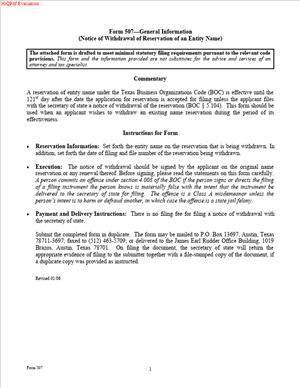
Form 507 – Notice of Withdrawal of Reservation of an Entity Name – General Information
Fill out nowJurisdiction: Country: United States | Province or State: Texas
What is a Form 507—General Information (Notice of Withdrawal of Reservation of an Entity Name)?
Form 507 is the official notice you file to cancel a name reservation you previously placed on a business name in Texas. A name reservation temporarily holds a specific entity name so others cannot use it while you plan your filing. The withdrawal ends that hold before it expires and releases the name back into general availability.
You use this form when you control an active reservation and no longer need it. The filing updates state records and removes your exclusive right to reserve that name for the remainder of the reservation term. Once processed, anyone eligible may reserve or form an entity using that name, subject to standard name rules and reviews.
The typical user is the person or organization that secured the reservation. That can be a founder, in‑house legal team, outside counsel, a corporate services professional, or a paralegal working for a client. If you are an authorized agent who placed the reservation for a client, you can file the withdrawal if you have that client’s permission.
You would need this form when your plans change. Maybe your branding shifts, your client cancels the project, or your team picks a different name. You may also need it if you reserved several name options and want to release the ones you will not use. Withdrawing names you do not plan to use helps keep the registry clear and avoids confusion.
You may choose to withdraw and let another party reserve the name directly. That is common in transactions or franchise expansions. Rather than transferring the reservation, some teams withdraw it and have the new party reserve it in their own name. This can align better with internal controls, billing, or documentation requirements.
There are everyday scenarios that prompt withdrawals. A startup may test names and drop all but one. A law firm may reserve a professional entity name for a partner who later changes plans. A nonprofit board may pivot its mission and pick a new name after donor input. In each case, a withdrawal closes the loop.
Importantly, Form 507 is not how you form a business or change an existing entity’s legal name. It only affects a temporary reservation. If you plan to form an entity with the reserved name, do not withdraw it. Keep the reservation active until your formation filing is accepted, or let it expire naturally if you no longer need the hold.
When Would You Use a Form 507—General Information (Notice of Withdrawal of Reservation of an Entity Name)?
You use this form when you want to end your reservation early and free up the name. The most common moment is immediately after a strategic shift in naming. Your marketing team might complete research and pick a different brand. You no longer want to hold the old name, so you withdraw it to avoid clutter and potential confusion.
You may also use it when a client’s engagement ends. Suppose you reserved a name for a client’s future entity. The client cancels the project or moves to another jurisdiction. Withdrawing the reservation shows professional cleanup and prevents accidental renewals or lingering records tied to your name or address.
Another frequent case is portfolio pruning. You might reserve multiple variations to ensure branding options. As decisions settle, you keep one and withdraw the rest. This practice is common in larger companies, franchises, and healthcare groups, forming professional entities for different regions or service lines.
Withdrawal can also support a change in transaction structure. If you first intended to transfer the reservation to a partner, but the deal timeline slips, it may be cleaner to withdraw the hold. The partner can then reserve the name in their own right when they are ready. That approach can reduce coordination risk and avoid mismatched signatures or authority questions.
Sometimes the reason is a discovered conflict or compliance flag. Maybe the reserved name is too similar to another name or includes restricted words you cannot use. While you could let the reservation expire, withdrawing now can be prudent. It clears your docket, prevents mistaken reliance by team members, and signals the decision has been made.
You may also need to correct an error that cannot be fixed. If the name was reserved with a spelling mistake and the correction requires a new reservation, withdrawing the erroneous hold is a clean step. It prevents two similar versions from lingering at once and avoids confusion during formation.
If you are an out‑of‑state company exploring registration in Texas, you may withdraw a reservation after choosing a different compliant name. For example, your true name might conflict with an existing Texas entity. You reserve a substitute name for evaluation, then later choose a different alternative. Withdrawing the unused option eliminates clutter.
Corporate legal teams often handle withdrawals during rebrand projects. You might reserve names early in the process to secure options while clearing trademarks and design. Once the final name is settled, the team withdraws the rest to tidy the registry and keep internal records clean.
Legal Characteristics of the Form 507—General Information (Notice of Withdrawal of Reservation of an Entity Name)
This filing is legally effective because name reservation and withdrawal are governed by state business law. The Texas Secretary of State administers name reservations. The withdrawal updates the public record and ends the temporary right you held under the reservation.
It is not a contract between private parties. It is a unilateral filing that modifies your statutory hold on the name. When the filing is accepted, your reservation is no longer active. You cannot enforce any exclusive claim to the name under that reservation after the withdrawal takes effect.
Enforceability comes from compliance with state requirements. You must be the rightful reservation holder or an authorized agent. You must identify the reserved name and reservation details clearly. You must sign the form with proper authority. The filing office relies on your certification and processes the document into the public record.
The withdrawal does not affect trademarks, service marks, or other intellectual property rights. A name reservation is not a trademark and does not create brand rights. Ending a reservation does not waive any separate rights you may hold. It only ends the temporary hold for entity formation purposes.
Withdrawing a reservation also does not rename an existing entity. If an entity already exists, you would need a different filing to change its name. Similarly, a withdrawal does not affect assumed name filings or tax registrations. It only affects the temporary reservation record.
Once processed, a withdrawal is generally final. If you change your mind after acceptance, you cannot restore the old reservation. You would need to submit a new reservation if the name remains available. Someone else may have reserved or formed under the name in the meantime.
Accuracy matters. The filing includes a certification statement. Submitting false or misleading information can lead to civil or criminal penalties. Make sure the reserved name, reservation number, and holder’s identity match the state’s records. Ensure the signature matches the authority that placed the reservation or a valid successor.
There is no refund of the original reservation fee when you withdraw. You paid for the hold period when you reserved the name. Withdrawals end the hold early, but do not credit back unused time. That is a practical consideration when you weigh whether to withdraw or simply let the reservation expire.
Finally, remember that withdrawal makes the name available for others, subject to name rules. Availability is not guaranteed to you later. If the name is important to your future plans, consider the timing carefully. Coordinate with formation or further reservations to avoid gaps.
How to Fill Out a Form 507—General Information (Notice of Withdrawal of Reservation of an Entity Name)
Use these steps to complete the form accurately and avoid rejection.
1) Confirm you are the reservation holder
- Verify that the reservation is in your name or your organization’s name.
- If you are an agent, confirm written authority from the holder.
- Do not proceed if you do not control the reservation.
2) Gather reservation details
- Locate the reservation certificate or confirmation.
- Note the exact reserved entity name, including punctuation and spacing.
- Find the reservation or file number assigned by the state.
- Note the reservation’s expiration date for your records.
3) Identify the reserved entity name
- Enter the reserved name exactly as it appears on the reservation.
- Do not shorten or reformat words.
- Include any designators, like LLC, LP, PLLC, or Inc., if they were part of the reservation.
4) Provide the reservation number
- Enter the reservation number assigned at the time of reservation or renewal.
- Double‑check digits and any letter prefixes.
- If you are unsure, verify against your confirmation or internal logs.
5) Name the reservation holder
- Enter the full legal name of the person or organization that holds the reservation.
- If the holder is a company, use its full legal name, not a trade name.
- If the reservation was renewed or transferred previously, ensure the current holder is listed.
6) Provide mailing address and contact information
- List a complete mailing address for the reservation holder.
- Include city, state, and ZIP code.
- Provide an email and phone number for questions. Use a monitored inbox.
- Ensure consistency with prior filings to smooth processing.
7) State the withdrawal clearly
- The form includes a statement withdrawing the reservation.
- If there is a field for an effective date, choose one.
- Most documents take effect when filed if no delayed date is set.
- If a delayed date is allowed and you need it, supply a date you can support operationally.
8) Consider timing and coordination
- Do not withdraw if you still plan to file a formation under the reserved name soon.
- If a partner needs the name, align your withdrawal with their reservation filing.
- Avoid gaps in which an unrelated party could reserve the name.
9) Confirm signer authority
- If the holder is an individual, the holder signs.
- If the holder is an entity, an authorized officer, manager, member, partner, or agent signs.
- If an attorney‑in‑fact signs, confirm that the power of attorney is current and covers this action.
- Use your true legal name and include your title when signing for an entity.
10) Sign and date the form
- Sign in ink if filing on paper, or execute electronically if using an electronic channel.
- Print or type the signer’s name below the signature line.
- Include the title or capacity if signing for an organization.
- Date the form. Use a current date to avoid stale filings.
11) Review for accuracy and completeness
- Match the reserved name and reservation number to the confirmation.
- Confirm the holder’s name is correct and current.
- Ensure all required fields are complete and legible.
- Check that the signature and title align with your internal authority records.
12) Attach any required supporting documents if applicable
- This filing typically requires no attachments.
- If your authority to sign is not obvious, keep supporting documents in your file.
- You may be asked for evidence if questions arise.
13) Keep internal records
- Save a copy of the signed form for your records.
- Retain the original reservation confirmation and any renewal notices.
- Update your entity formation checklist to reflect the withdrawal.
- Notify stakeholders who were tracking the reserved name.
14) Plan for next steps after withdrawal
- If a partner will reserve the name, coordinate the timing of their filing.
- If you need a different name, prepare a new reservation in advance.
- If you intend to form under another name, confirm its availability before proceeding.
Practical tips can help avoid issues. Use the same contact details you use for other state filings to prevent misrouted questions. If your organization recently changed its name, decide whether to identify the holder by the pre‑change or post‑change name. Match the name on the reservation to avoid confusion, then note the current contact details.
If you reserved several similar names, withdraw them one at a time to prevent data mix‑ups. Track each reservation number to the specific name. Label internal files clearly so the wrong name is not withdrawn by mistake. That error can be hard to correct if a third party reserves the released name immediately.
If you are closing out many reservations after a rebrand, set a withdrawal schedule. Group filings by business unit or project lead. Require a final check by marketing or legal to ensure no active campaign or draft filing still references the reserved name. This prevents accidental loss of a strategic option.
Consider delayed effectiveness only if your operations need it and the form allows it. A delay can help coordinate with a partner’s planned reservation. But any delay extends the period in which others cannot use the name. Use it only when justified. Immediate withdrawal is simpler and reduces administrative risk.
Finally, be decisive about whether to withdraw or let the reservation expire. If the name has no future use and you want to avoid internal confusion, withdraw now. If you think you may still use the name before the reservation ends, hold it. An early withdrawal cannot be undone once accepted.
Legal Terms You Might Encounter
- Reservation of an entity name means you secured exclusive rights to a specific name for a limited time. Form 507 cancels that reservation so others can use the name again. You use it when you no longer need the reserved name or when plans have changed.
- Reserved name refers to the specific name you locked down previously. It must match the name on your original reservation. When you withdraw, you surrender control of that exact name.
- Applicant is the party that submitted the original name reservation. On this form, the applicant (or a successor with legal rights) is the one who withdraws the reservation. If you are not the applicant, you must show authority to act.
- Successor in interest is someone who acquired the applicant’s rights to the name reservation. This can happen through an assignment, merger, or other transfer. A successor must state how they acquired those rights before signing the withdrawal.
- Withdrawal means the formal act of canceling your reserved name. It removes the reservation from the state’s records. Once effective, the name returns to general availability.
- Effective date is when the withdrawal takes legal effect. If you do not specify a future date, the withdrawal becomes effective when the filing office accepts it. If you set a future date, the reservation stays in place until that date.
- Domestic entity means the entity is formed under Texas law. Foreign entity means the entity is formed under another state or country’s laws. Either type of filer can reserve and withdraw a name in Texas.
- Assumed name (also called a trade name or DBA) is different from a reserved name. A reserved name only holds the name for future entity formation or registration. It does not grant rights to use the name in business. Form 507 affects only the reservation, not any assumed name filings.
- Execution means signing the form with authority. The individual who signs must be the applicant or a person with proper authority for the applicant or successor. If you sign without authority, the filing can be rejected or later challenged.
FAQs
Do you need to withdraw if you are not forming the entity?
Yes. If you will not form or register under the reserved name, file a withdrawal. That frees the name for others and avoids confusion. It also prevents internal teams from assuming the name is still locked when it is not in use.
Do you need the original reservation number?
Ideally, yes. It helps the filing office locate the correct record. If you do not have it, provide the exact reserved name and the applicant’s name and address. Be precise to avoid delays.
Do you risk losing the name immediately after you withdraw?
Yes. Once the withdrawal is effective, anyone can reserve or file the name if available. If you plan to use a similar or revised name, check availability before you withdraw. If necessary, reserve the new name first.
Do you need to withdraw if the reservation expired on its own?
No. If the reservation period already ended, there is nothing to withdraw. That said, use a withdrawal if you want to release the name before the expiration date. This can help another affiliate or partner reserve it sooner.
Do you need to be the same person who reserved the name?
You must be the applicant or a successor in interest. If a company reorganization, merger, or acquisition transferred rights, state that on the form. The signer must have authority for the current rights holder.
Do you need to withdraw before filing a new reservation for a different name?
You do not have to, but it is smart housekeeping. If you no longer need the old name, withdraw it. Keep your name portfolio clean so internal teams do not rely on outdated holds.
Do you need to file the withdrawal if you already formed under a different name?
You should. If you will not use the reserved name at all, withdraw it to release the hold. That avoids confusion in future searches and keeps your records tidy.
Do you get a refund if you withdraw early?
No. Withdrawing does not entitle you to a refund of any prior reservation fee. You are simply ending the reservation ahead of its normal expiration.
Checklist: Before, During, and After the Form 507—General Information (Notice of Withdrawal of Reservation of an Entity Name)
Before signing
- Identify the exact reserved name as it appears on the original reservation.
- Locate the reservation number, if available.
- Confirm the applicant’s legal name and address used on the reservation.
- Determine who has authority to sign (applicant or successor in interest).
- If a successor will sign, gather the document showing the transfer of rights.
- Decide the effective date. Immediate effectiveness is common unless you have timing needs.
- Confirm that you truly no longer need the name. Consider internal branding plans.
- Check the availability of any new name you plan to reserve or use instead.
During signing
- Verify the reserved name is correct with exact spelling and punctuation.
- Confirm that the applicant or successor information is accurate and consistent with prior filings.
- State clearly whether you are the applicant or a successor in interest.
- If stating successor status, describe the basis (assignment, merger, or other transfer).
- Choose the effective date and ensure it fits your internal timeline.
- Review the signature block for the correct title and authority.
- Double-check contact information for confirmation or questions.
After signing
- File the form using your preferred submission method and retain proof of filing.
- Calendar expected processing time and any effective date you selected.
- Notify your legal, branding, marketing, and IT teams that the name is no longer reserved.
- Remove the name from internal hold lists, style guides, and naming trackers.
- Update any internal databases and project plans that reference the reserved name.
- If needed, submit a new reservation for a different name before releasing the old one.
- Store a copy of the filed form and confirmation with your entity records.
Common Mistakes to Avoid
Using the wrong name format
- Consequence: Delayed processing or misapplied withdrawal.
- Tip: Don’t forget to match the reserved name exactly as on the reservation.
Having an unauthorized signer
- Consequence: Rejection or later challenge to the withdrawal’s validity.
- Tip: Make sure the signer is the applicant or a documented successor in interest.
Ignoring timing with another filing
- Consequence: You could release a name before you secure a replacement.
- Tip: Coordinate the withdrawal with any new reservation or formation filing.
Skipping the reservation number when you have it
- Consequence: Extra review time to locate your record.
- Tip: Include the reservation number to speed up the match.
Not telling internal teams the name was released
- Consequence: Teams may keep using or referencing a name you no longer control.
- Tip: Send a clear notice and update internal systems the same day you file.
What to Do After Filling Out the Form
- File the withdrawal promptly. If you choose immediate effectiveness, the reservation ends once the filing office accepts the form. If you selected a future date, plan around that date. Do not assume the reservation is gone until you receive confirmation or the effective date arrives.
- Tell your team the name has been released. Alert marketing, legal, product, and IT. Remove the name from any “on hold” or “do not use” lists if those were tied to the reservation. If a related domain name or social handle is no longer needed, decide whether to keep it, transfer it, or let it lapse.
- Update your naming plan. If you are shifting to a different name, reserve that new name or move ahead with entity formation or registration. Check name availability before you commit to documents, branding assets, or vendor contracts.
- Store your records. Keep a copy of the signed form, proof of filing, and confirmation. File them with your entity naming records and transaction logs. If you acted as a successor in interest, keep the transfer documents that prove your authority.
- If something changes, amend your approach. You cannot amend a withdrawal once accepted because the reservation is already released. If you need the name again, submit a new reservation, subject to availability. If you withdrew by mistake, act quickly to reserve the name again if it is still available.
- Coordinate with related filings. If you withdrew the name to allow an affiliate to reserve it, make sure the timing lines up. The new reservation should be filed as soon as the withdrawal is effective. This reduces the risk that a third party reserves the name first.
- Follow through on communications. If external partners or vendors were expecting to use the reserved name, tell them it is no longer reserved. Provide updated naming instructions and timelines so they can adjust deliverables.
- Maintain a clean audit trail. Note the business reason for the withdrawal, the date, and who approved it. This helps you answer questions later and keeps your corporate housekeeping tight.
Disclaimer: This guide is provided for informational purposes only and is not intended as legal advice. You should consult a legal professional.