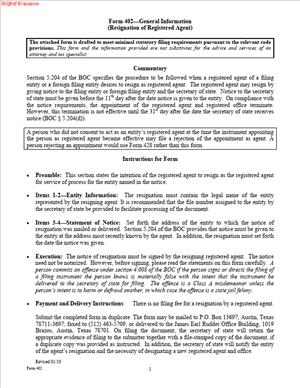
Form 402 – Resignation of Registered Agent
Fill out nowJurisdiction: Country: United States | Province/State: Texas
What is a Form 402 – Resignation of Registered Agent?
Form 402 is the official document a registered agent files to step down. It applies to Texas entities and foreign entities registered in Texas. It updates the public record, so you are no longer obligated to accept legal documents for that entity after the effective date.
You use this form when you are the registered agent of record. That includes commercial registered agent companies, law firms, or individuals named as agents. It also covers internal agents like an owner, manager, officer, or employee who agreed to serve.
Texas requires every filing entity to maintain a registered agent and registered office in the state. The registered agent receives lawsuits, subpoenas, and state notices. When you resign, the entity still must keep a Texas agent and office on file. Your resignation releases you from future service duties, but only after it becomes effective.
Why would you need this form?
Because you no longer wish to serve. Maybe your client stopped paying. Maybe you are leaving the firm or retiring. Maybe the entity closed, moved, or will not respond. Perhaps you are consolidating your agent portfolio and need to end certain appointments. Form 402 gives you a formal, clean break that the state recognizes.
Typical usage scenarios
. You run a registered agent service. An LLC ignores your renewal invoices and mail. You send a written notice and file Form 402 to end your appointment. Or you are a solo attorney. You agreed to serve as an agent for a startup as a favor. You move out of Texas and cannot keep a Texas-registered office. You resign. Or you are an internal officer named as an agent. You leave the company and do not want personal service at your home or office. You resign to avoid risk.
Foreign entities use it too. A Delaware corporation registers in Texas. You are its Texas agent. The company switches to a national provider. You resign to stop future mail and personal service. Form 402 records that change for Texas.
This form belongs to the Texas Secretary of State. You file it with that office. The filing updates the state’s records for the entity’s registered agent and office status.
When Would You Use a Form 402 – Resignation of Registered Agent?
You use Form 402 when you are the registered agent on file and want to step down. The timing is practical. You have written to the entity and told them you will resign. You have no interest in continuing. You want a definitive end date that the state will honor.
Here are common situations. You are a commercial registered agent, and the client is unresponsive. You cannot keep forwarding service to a dead mailbox. You resign. You run a small firm and plan to stop offering agent services. You resign from every appointment in your portfolio. You are a consultant who agreed to be an agent for a friend’s LLC. The friend dissolved the business informally and vanished. You do not want to be served with debt lawsuits. You resign.
Sometimes resignation helps force a transition. You notify the entity that you will resign on a date. They delay appointing a replacement. You file anyway. Your resignation becomes effective on a fixed timeline set by law. That gives the entity a clear deadline to act.
You also use it when you cannot reach the entity. Maybe the mail gets returned. Maybe the email bounces. You still can resign. You must send written notice using the best address you have. Then file.
If you are the business owner and want to replace your agent, this is not your form. The entity would file a change of registered agent and office. Form 402 is for the agent to use when the agent resigns. However, as an owner, you should understand this process. A resignation can create a gap. During the gap, the entity may face service through substitute methods. It is best to appoint a new agent quickly.
Nonprofits, corporations, LLCs, LPs, LLPs, and professional entities all rely on a registered agent. They all can be affected by a resignation. If you serve any of these, you may need this form.
Legal Characteristics of the Form 402 – Resignation of Registered Agent
Form 402 is a statutory filing. It is legally binding because state law authorizes a registered agent to resign. The Texas Secretary of State accepts the filing and updates the record. Once effective, the resignation ends your legal duty to accept service for that entity.
Enforceability rests on three pillars. First, you are the agent of record at the time of filing. Second, you gave written notice to the entity that you will resign. Third, the filed resignation reaches its effective date. After that date, you are no longer the agent.
The effective date follows a set rule. Your resignation becomes effective on the 31st day after the Secretary of State receives your filing. It can become effective sooner if the entity appoints a new agent and office before the 31st day. You cannot pick an earlier date. You cannot make it effective immediately. The statute sets the timing to protect due process.
Your duties continue until the effective date. You must accept service delivered to you during that period. You cannot abandon the registered office early. Keep your address and business hours consistent until the resignation takes effect.
The entity remains obligated to maintain a registered agent and office in Texas. Your resignation does not relieve the entity of that duty. If the entity fails to appoint a successor, it risks penalties. It may face administrative action, including termination or revocation, depending on its type and status. It also risks missing lawsuits. If there is no agent, the service may shift to substitute methods permitted by law. That often includes service through the Secretary of State as the agent of last resort. That can still lead to valid judgments.
Your resignation does not change the entity’s registered office address. It changes your status as an agent. Only the entity can update the registered office. If the entity does not act, the public record may show an office with no active agent. That creates risk for both sides. The best practice is a coordinated handoff. But the law allows you to resign even if the entity refuses to cooperate.
The form requires a statement that you gave written notice to the entity. This prevents surprise and makes the record reliable. You should keep proof of that notice. Proof helps if the entity disputes the timing or content of your resignation.
Finally, one filing covers one entity. Each resignation is entity-specific. If you need to resign from multiple entities, file separate resignations for each one.
How to Fill Out a Form 402 – Resignation of Registered Agent
Follow these steps to complete and file Form 402 correctly.
Step 1: Confirm you are the agent of record.
- Check the exact legal name of the entity as recorded with the state.
- Confirm your name appears as the registered agent on the record.
- Have the entity’s state file number ready. Use your internal records or recent state mail.
Step 2: Gather the registered office address on record.
- Use the registered office as it appears on the state’s record.
- This must be a physical Texas street address.
- A P.O. Box alone is not acceptable. If used, it must be paired with a street address.
- Do not substitute a different address. Accuracy matters.
Step 3: Prepare your written notice to the entity.
- Write to the entity stating you resign as its registered agent.
- Include the entity name, your name, and the registered office address.
- Give the date your resignation will be filed with the state.
- Ask the entity to appoint a new agent promptly.
- Send the notice before you file the form.
- Use a reliable method. Certified mail is best. Keep proof of sending.
- If you cannot reach the entity, send it to every known address you have.
- Keep a copy of the notice and mailing proof in your file.
Step 4: Complete the entity identification section.
- Enter the exact legal name of the entity.
- Enter the Texas file number assigned to the entity.
- Enter the registered office address on record, including suite number.
Step 5: Identify the resigning agent.
- Enter your full legal name if you are an individual agent.
- If you are an organization, enter the exact company name.
- Use the same name shown on the state record for the agent.
Step 6: Make the required notice statement.
- Affirm that you gave written notice to the entity of your resignation.
- Provide the date you sent that notice.
- Provide the address you used for the notice, if the form requests it.
- If applicable, state that you mailed notice to the entity’s last known address.
- Be truthful and precise. This statement is part of a public filing.
Step 7: Understand the effective date.
- Your resignation becomes effective on the 31st day after the state receives it.
- If the entity appoints a new agent earlier, your resignation becomes effective then.
- You cannot set a custom effective date on this form.
- Plan for continuing service during the 31-day period.
Step 8: Sign and date the form.
- The resigning agent must sign. The entity does not sign this form.
- If the agent is an organization, an authorized officer must sign.
- Print the signer’s name and title below the signature.
- Date the signature. Use the current date.
- Notarization is not required.
Step 9: Prepare the filing for delivery.
- Review the form for accuracy and completeness.
- Include any required state filing fee.
- One filing covers one entity. Prepare separate filings for each entity.
- Keep a copy of the signed form for your records.
Step 10: File with the Texas Secretary of State.
- You can file by mail, hand delivery, fax, or through the state’s online system.
- If you fax, include a payment authorization for the fee.
- If you file online, follow the prompts to upload or enter the form data.
- Obtain confirmation of submission. Save the receipt or acknowledgment.
Step 11: Manage the transition period.
- Continue to accept service until the resignation is effective.
- Maintain normal business hours at the registered office.
- Forward legal documents received during the transition.
- Do not return service as “not my entity” before the effective date.
Step 12: After the effective date.
- You are no longer required to accept service for the entity.
- If you receive service after the effective date, you may reject it.
- If mail still arrives, return to sender and note your resignation date.
- Keep your proof of filing and the state’s acknowledgment.
Practical tips to avoid rejection or delay
- Use the entity’s precise legal name, including commas and suffixes.
- Match the registered office address exactly as on record.
- Do not list a non-Texas address for the registered office.
- Do not sign for the entity. Only the agent signs this filing.
- Do not leave the notice statement blank. It is required.
- If your organization rebranded, sign with the name on record or disclose succession in your cover letter.
- If you believe the record shows a different agent, do not file. Resolve the discrepancy first.
How your notice should read
- Keep it simple. State that you resign as registered agent for the entity.
- Include the entity name and Texas file number, if known.
- Include the registered office address on record.
- Give the date you will file the resignation with the state.
- Provide your contact information for questions during the transition.
- Encourage the entity to file a change of registered agent immediately.
What happens if the entity ignores your notice
- You can still file the resignation.
- The resignation becomes effective on the statutory date.
- After that date, you have no duty to accept service for the entity.
- The entity may face service through substitute methods.
- Keep your records in case the entity later disputes service.
If you are the agent and also a manager or officer
- You can resign as a registered agent while remaining in your other role.
- The resignation only affects your agent status.
- Consider whether the entity still lists your office as the registered office.
- If the entity plans to keep your address, it must appoint a new agent who consents.
If the registered office is your address
- Expect that legal papers will arrive there by the effective date.
- If you will move, time your filing so you can still accept service.
- Do not abandon the location before the resignation is effective.
If you serve many entities
- Track each filing by entity name and file number.
- Stagger filings to manage the 31-day responsibility window.
- Document notice dates and mailing proofs for each entity.
Foreign entities and special types
- Foreign corporations and LLCs must have a Texas agent.
- Your resignation applies the same way. The timeline is the same.
- Professional entities and nonprofits follow the same process.
- Series LLCs appoint agents at the parent level. Confirm the correct entity name.
Common mistakes to avoid
- Filing before you send a written notice to the entity.
- Listing the wrong registered office address.
- Omitting the Texas file number when it is available.
- Using a P.O. Box with no street address.
- Having the entity sign on your behalf. Only the agent resigns.
- Assuming your resignation is immediate. It is not.
Recordkeeping best practices
- Keep a copy of your notice letter.
- Keep proof of mailing or delivery.
- Keep a copy of the signed Form 402.
- Keep the state’s filing acknowledgment.
- Retain these records well past the effective date.
If the entity asks you to withdraw the resignation
- You can only do that by agreement and new filings, if appropriate.
- If you choose to continue, the entity should confirm in writing.
- If not, proceed with the resignation and effective date.
If you already accepted service and then filed
- You must still handle documents served before the effective date.
- Forward them promptly, consistent with your service terms.
- Your filing does not cancel past obligations.
Final checkpoint before you file
- Are you the agent of record for this entity?
- Did you send a written notice? Do you have proof?
- Is the legal name and file number correct?
- Is the registered office address correct?
- Did you sign and date the form?
- Did you include the required fee?
Once you follow these steps, your resignation will be clear, compliant, and enforceable. You will have documented the transition, met your duties, and set a firm end date to your agency.
Legal Terms You Might Encounter
- Registered agent means the person or business you designated to receive legal papers for the entity. In this form, you are that agent. You are telling the state filing office you no longer want that role for the specific entity named on the form.
- Registered office is the official street address on record where the registered agent accepts documents. Form 402 uses this to confirm the exact record the state has. Use the same street address that appears on the entity’s public record. Don’t substitute a mailing address or P.O. Box unless the record itself shows one.
- Entity means the company you represent as a registered agent. It can be a corporation, LLC, LP, nonprofit, or another type. On this form, you must list the entity’s full legal name exactly as it appears on state records, not a trade name or brand name.
- Service of process refers to court papers, notices, and official mail that must be delivered to the entity through its registered agent. Even after you submit Form 402, you must still accept service for a waiting period. Your resignation is not effective immediately.
- Resignation is your formal notice that you will stop serving as the registered agent for the named entity. This form is the official way to file that notice. It does not dissolve the entity or cancel any other duties you may have agreed to outside the registered agent role.
- Effective date is when your resignation legally takes effect. By law, this happens after a short waiting period from the filing office’s receipt of your filing. If the entity appoints a new agent sooner, your resignation can take effect earlier. You cannot set an arbitrary effective date on this form.
- File number is the unique number assigned to the entity by the filing office. Form 402 asks for it so the filing office can match your resignation to the correct record. You should verify this number against a recent state search or a prior filing.
- Governing person means an individual who manages or controls the entity, such as a director, officer, manager, or general partner. This term matters because you may need to send your resignation notice to the entity’s last known address or to the attention of a governing person, so the right people get it quickly.
- Last known address is the most recent mailing address you have for the entity. You must send written notice of your resignation to this address. Use an address that is reasonably calculated to reach the entity, even if it differs from the registered office on file.
- Proof of notice means evidence that you notified the entity of your resignation. Keep dated copies, delivery receipts, or email confirmations. While the filing office does not always require you to submit proof, you should keep it in your records in case questions arise later.
FAQs
Do you need the entity’s permission to resign as registered agent?
No. You can resign without the entity’s consent. You must notify the entity in writing and file Form 402. Your resignation takes effect after the statutory waiting period or earlier if the entity appoints a new agent before the period ends.
Do you have to notify the entity before filing, or after?
Send your written notice to the entity at its last known address before or at the same time you file Form 402. Do not wait to send notice until after you file. The clock for your effective date ties to when the filing office receives your form, not when the entity receives your notice. Still, prompt notice helps the entity appoint a new agent faster.
How long does it take for the resignation to become effective?
There is a waiting period after the filing office receives your form. Your resignation becomes effective on the 31st day after receipt, unless the entity appoints a new agent earlier. If the entity files the new appointment sooner, your resignation can take effect as of that earlier date.
Can you expedite the filing to skip the waiting period?
You can often expedite the processing of the filing itself. That can speed up the acknowledgment you receive. Expedite does not eliminate the statutory waiting period. Only the entity’s appointment of a new registered agent can end your obligations earlier than day 31.
Do you have to provide the name of a new registered agent?
No. You are not responsible for naming or appointing a successor. The entity must file the new appointment. Your role is to resign and to notify the entity so it can act quickly. If the entity delays, service of process can be directed to the state during the gap.
Can you resign from multiple entities at once?
Submit a separate Form 402 for each entity unless the instructions that accompany the form allow otherwise. Do not try to attach a list of multiple entities unless the form specifically provides for that. Mixing entities on one form can cause rejection or delays.
Do you need to notarize Form 402?
No. A notarized signature is not required for this filing. Sign as the registered agent or as an authorized representative of the agent if the agent is an organization. Use your name and title consistently with how the registered agent is listed on the entity’s record.
What if the entity is inactive, forfeited, or dissolved?
File Form 402 anyway. Your resignation still matters because someone may attempt service on the last agent of record. The waiting period still applies. If legal papers arrive during the waiting period, you must accept them and forward them as required.
Can you use an electronic signature?
If you file online, you will use the electronic signature method provided by the system. For paper filings, a pen-and-ink signature is standard. If you scan and upload a signature page, follow the filing system’s directions. Illegible or incomplete signatures cause delays.
What happens to service of process during the waiting period?
You must continue to accept service at the registered office on file. If you receive legal papers during that time, accept them and promptly forward them to the entity. After your resignation is effective, service may be directed to the state or to the new agent once appointed.
Checklist: Before, During, and After the Form 402 – Resignation of Registered Agent
Before signing
- Confirm the entity’s exact legal name as it appears on state records.
- Find the entity’s file number in the state’s database or prior filings.
- Verify the registered office address currently on file.
- Gather the last known mailing address for the entity (and attention line).
- Prepare your written notice to the entity stating you will resign as registered agent.
- Choose a delivery method for your notice that provides confirmation (e.g., certified mail or traceable carrier).
- Confirm who will sign: you, or an authorized person for the agent if the agent is an organization.
- Identify your preferred return contact information for the filing office (mailing address, phone, email if applicable).
- Set a calendar reminder for 31 days after the filing office receives the form.
- Review internal contracts to manage any non-RA obligations you may still have with the entity.
During signing
- Check that the entity name and file number match the state record exactly.
- Ensure the registered agent name you list matches the official listing on record.
- Confirm the registered office street address you enter matches the record.
- State clearly that you resign as registered agent for the named entity.
- Include the date you sent (or will send) the written resignation notice to the entity.
- Use the correct signature block for an individual agent or organizational agent.
- Print your name and title clearly. Avoid initials or nicknames.
- Review every line for legibility. Avoid stray marks or cross-outs.
- If attaching additional pages, label them clearly with the entity name and file number.
- Prepare payment in the correct amount and in an accepted form.
After signing
- Send your written notice of resignation to the entity at its last known address, if not already sent.
- File Form 402 with the state filing office through your chosen method (mail, in person, or online if available).
- Include the filing fee. Use a trackable delivery method for paper filings.
- Keep copies of the signed form, proof of filing, and proof of notice to the entity.
- Monitor for an acknowledgment from the filing office. Verify the recorded date.
- Calendar the 31-day effective date and any earlier date if the entity appoints a new agent.
- Continue to accept and forward service of process during the waiting period.
- If you receive court papers after the effective date, check the record before rejecting them.
- Update your internal logs to remove the entity from your registered agent client list once effective.
- If you manage physical office signage or mail slots, update them after the effective date.
Common Mistakes to Avoid
Using a name that doesn’t match the public record
- Don’t guess at the entity’s legal name or your registered agent’s name. Mismatches trigger rejection. Always copy names exactly as they appear on the state record, including punctuation and suffixes like “LLC” or “Inc.”
Skipping the notice to the entity
- Don’t forget to send the written resignation notice to the entity at its last known address. If you fail to do so, your resignation can be delayed or challenged. Keep proof of delivery in your files.
Assuming the resignation is immediate
- Don’t stop accepting service of process the day you file. The resignation is not effective until the waiting period ends or a new agent is appointed. Rejecting service too early can expose the entity to default risk and you to complaints.
Listing the wrong registered office
- Don’t write a new or different address if the public record shows another. The filing office uses the registered office to match records. Wrong addresses cause confusion and can lead to filing rejection.
Combining multiple entities on one form
- Don’t try to resign from several entities on a single Form 402 unless the form instructions allow it. Submit a separate filing for each entity to avoid delays and record errors.
What to Do After Filling Out the Form
- Send notice to the entity: Mail or deliver your written resignation notice to the entity’s last known address. Use a method that gives you delivery proof. Note the date and keep a copy of the notice and receipt.
- File the form: Submit Form 402 to the state filing office with the required fee. Choose your preferred method: mail, in person, or online if available. If you need fast acknowledgment, consider expedited processing if offered.
- Record the filing date: When you receive confirmation, note the official date the filing office received the form. This date starts the 31-day countdown unless the entity appoints a new agent earlier.
- Continue accepting service: Maintain coverage at the registered office during the waiting period. If you receive legal papers, accept them and forward them promptly to the entity.
- Monitor for new agent appointment: Check whether the entity appoints a new registered agent. If you learn a new agent has been filed, confirm your resignation’s earlier effective date and update your records.
- Update internal systems: Remove the entity from your routing lists once your resignation is effective. Update calendars, mail handling instructions, and any service-level tracking you maintain.
- Store records: Keep a tidy file with the signed form, proof of filing, proof of entity notice, and any related correspondence. Retain these records based on your internal retention policy.
- Handle stray mail after effectiveness: If you receive mail for the entity after the effective date, do not assume it is service of process. Check the public record. If you are no longer the agent, return items to the sender or direct them to the current agent, consistent with your policies.
- Communicate with your team: If others help manage service or mail, tell them the effective date and provide instructions for handling any documents received before and after that date.
- Consider a courtesy notice: As a professional courtesy, you may inform the entity’s principal contact or governing person of the anticipated effective date and the need to appoint a new agent promptly. This can help shorten your waiting period.
Disclaimer: This guide is provided for informational purposes only and is not intended as legal advice. You should consult a legal professional.