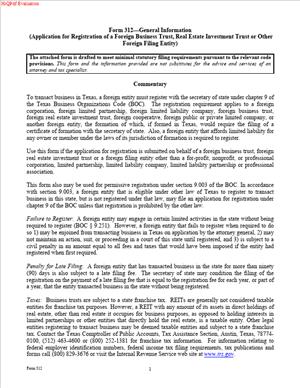
Form 312 – Application for Registration of a Foreign Business Trust, Real Estate Investment Trust or Other Foreign Filing Entity
Fill out nowJurisdiction: Country: United States | Province or State: Texas
What is a Form 312 – Application for Registration of a Foreign Business Trust, Real Estate Investment Trust or Other Foreign Filing Entity?
Form 312 lets a foreign filing entity register to do business in Texas. You use it when your entity was formed under another state’s laws. You want authority to transact business in Texas without forming a new Texas entity. This form is filed with the Texas Secretary of State.
A “foreign filing entity” covers many non‑Texas entities. For this form, it includes a foreign business trust, a real estate investment trust (REIT), or another foreign filing entity that is not already covered by a more specific foreign registration form. A common example is a Delaware statutory trust that holds real estate. Another is a Maryland REIT raising capital and buying Texas properties.
Who uses this form?
Trustees, REIT officers, in‑house counsel, outside counsel, and corporate services teams. You use it when entering the Texas market. You also use it if a counterparty or lender requires proof of Texas authority.
You need this form to lawfully conduct ongoing business in Texas. “Transacting business” is broad. Renting out Texas property, hiring Texas staff, opening a Texas office, or making repeated sales can count. If you only ship goods across state lines, you may not need to register. But the line is not always clear. Many entities register early to avoid risk.
Typical usage scenarios include buying or managing Texas real estate. A REIT that acquires a shopping center in Houston will register. A business trust that operates a wind farm in West Texas will register. A fund that sets up a local office for asset management will register. A non‑Texas trust that must sign Texas contracts or open a Texas bank account will register when asked by the bank or a landlord.
Filing Form 312 results in a certificate of registration. That certificate is public evidence of your right to do business in Texas. It also confirms your registered agent for service of process. Once accepted, you must maintain a registered agent and keep your registration current.
When Would You Use a Form 312 – Application for Registration of a Foreign Business Trust, Real Estate Investment Trust or Other Foreign Filing Entity?
Use the form before you start doing business in Texas. If you have already started, file as soon as possible to correct the gap. Many companies file prior to their first lease, purchase, or employee hire. Some files are at closing because lenders require proof of registration in their closing checklist.
A Delaware statutory trust that holds multifamily assets will file before acquiring a Texas complex. A Maryland REIT raising Texas capital and negotiating leases will file before signing. A business trust building a solar project will file before the EPC contract and interconnection steps. If your trustee needs to appear in a Texas court or record deeds under the trust’s name, you file first.
You also use the form if regulators, municipalities, or counterparties request Texas authority. Title companies will ask for it when recording deeds. Property managers and vendors ask for it before paying invoices. Courts can require it before your entity maintains a lawsuit in Texas.
If your activity is limited and isolated, you may not need to register. An isolated one‑off sale with shipment from out of state may not trigger registration. However, ongoing revenue from Texas assets usually does. Rental income, local services, and in‑state employees are clear signals to register.
If your entity changes its legal name in the home jurisdiction and still does business in Texas, you will amend your Texas records. If the name becomes unavailable in Texas, you may adopt an assumed name for Texas use. The registration remains the base filing.
Legal Characteristics of the Form 312 – Application for Registration of a Foreign Business Trust, Real Estate Investment Trust or Other Foreign Filing Entity
This filing is legally binding once accepted by the Texas Secretary of State. It creates your foreign entity’s legal authority to transact business in Texas. It also appoints your registered agent in Texas as your agent for service of process. That appointment allows lawsuits and official notices to find you reliably.
Enforceability rests on compliance with Texas law and correct filing. The Secretary of State reviews the application for statutory compliance. The office checks name availability and required data. The office also requires proof that your entity exists and is in good standing in its home jurisdiction. That proof is a certificate of existence or status issued by your home state. It must be recent. The certificate shows your entity is real, active, and authorized in its home state.
Once registered, your entity remains governed by its home jurisdiction’s internal laws for internal affairs. Texas law governs your Texas activities, public filings, and service of process. You must maintain a registered agent and a registered office in Texas. You must also keep the information in your filing current. If the agent or registered office changes, you update Texas records.
Failure to register can lead to penalties. Your entity may not maintain a civil action in Texas courts until it registers and pays fees and penalties. The state can assess fines for the period you transacted business without authority. Your private contracts generally remain valid, but delays and costs can mount. Counterparties may use your non‑registration as leverage in disputes. Lenders and buyers often treat registration as a closing condition.
Registration does not shield you from taxes. After registration, you will have state tax and reporting obligations. In many cases, that includes franchise tax filings. You will likely file public reports that list managers or trustees. These are normal post‑registration steps.
Restrictions apply to entity names that use regulated terms. Words like “bank,” “trust,” and “insurance” can require additional approvals or may be restricted. REITs often include “REIT” or “Real Estate Investment Trust” in the name, but it is not always required. If your legal name is unavailable in Texas, you will adopt an assumed name for Texas use. You disclose that on the application.
Finally, the filing creates a public record. The public will see your registered agent, Texas address for service, and governing person information. You can use a commercial registered agent and a business office address for privacy. You cannot use a P.O. Box as your registered office. Texas requires a physical street address where service can occur.
How to Fill Out a Form 312 – Application for Registration of a Foreign Business Trust, Real Estate Investment Trust or Other Foreign Filing Entity
Start by confirming that your entity type matches this form.
Use Form 312 if you are a foreign business trust, a REIT, or another foreign filing entity that is not a corporation, LLC, LP, or other entity with its own dedicated form. If you are unsure, review your formation document and home state statute. Your governing instrument also identifies the entity type. When in doubt, ask counsel to confirm fit.
Gather the items you will need before you draft.
You need your exact legal name as it appears in your home jurisdiction records. You need the home jurisdiction and the formation date. You need your principal office address. You need the name and street address of your proposed Texas registered agent and registered office. You need the names and business or mailing addresses of your governing persons. For a trust, that is the trustee or trustees. For a REIT, list the directors or trustees, depending on your structure. You will also need a recent certificate of existence or status from your home jurisdiction. Obtain it close to filing so it remains current.
Complete the “entity name” field with your exact legal name.
Use the name in your formation document and the home registry. Include commas, punctuation, and entity endings. If the name is not available in Texas, or it contains restricted words, select and list an assumed name for Texas use. The form provides a field for the assumed name. You must ensure that the assumed name is distinguishable in Texas records. You will still use your legal name in contracts, but you can do business under the assumed name in Texas.
Provide the “type of entity” and the governing law section.
Identify whether you are a business trust, REIT, or another recognized foreign filing entity. State the home jurisdiction by name, and the date you formed the entity there. Accuracy matters here. Texas will match this to your certificate of existence.
Enter your principal office address.
Use a complete street address. Include suite and floor numbers. If the principal office is outside the United States, include the foreign address exactly as used in your home filings. This address becomes part of the public record. Do not use a registered agent address here unless that is your actual principal office.
Appoint your registered agent and registered office in Texas.
Choose a commercial registered agent or an individual who resides in Texas. The registered office must be a Texas street address. A P.O. Box alone is not allowed. List the agent’s name exactly. Then list the office’s street address, city, state, and zip code. Confirm with your agent that they consent to serve. Texas accepts either the agent’s signed consent on the form or your entity’s statement that the agent has consented. If you choose a consent by statement, you must keep the agent’s written consent in your records.
State your purpose.
For most trusts and REITs, a broad purpose is fine. You can write that the entity is organized for any lawful business purpose for which a business trust or REIT may be organized in its home jurisdiction. If you have specific regulated activities, add suitable detail. If your activity involves regulated industries, confirm any additional approvals needed. The form allows supplemental provisions if your purpose or restrictions need more space.
List your governing persons.
Identify each trustee, director, or similar governing person required by your structure. Provide a name and a business or mailing address for each person. Use a consistent format. If your REIT has a board of trustees, list each trustee. If your business trust has a managing trustee, list that person and any co‑trustees. The names you list should match your internal records. If the form limits lines, attach an additional page that continues the list. Label attachments clearly as an addendum to the governing persons section.
Confirm the duration of the entity if required.
Many trusts and REITs have perpetual duration. Some trusts have a set termination date under the trust instrument. If your governing law sets a duration, include it. If perpetual, state “perpetual.” If not perpetual, list the specific expiration date or event.
Choose the effective date and time.
You can make the filing effective on the date of filing. You can also choose a delayed effective date up to a fixed period after filing. If you need the registration to activate on a specific closing date, use a delayed effective date. Check your closing calendar and buffer for processing time.
Add supplemental provisions if needed.
Use this area for restrictive clauses, special consents, or statements required by your home jurisdiction. If your entity has a series structure or internal cells, disclose how your Texas filings treat them. If your name includes restricted words that require a statement, include that language here. Keep the language clear and concise.
Review the tax and reporting note.
The form itself does not enroll you in tax programs. However, registration subjects you to Texas reporting. Plan to set up your tax accounts after you receive your file‑stamped copy. You will also prepare any assumed name filings needed in Texas counties if you transact under an assumed name. Handle those after registration.
Prepare your certificate of existence or status from your home jurisdiction.
It must show the entity exists on the date of certification and is in good standing. The certificate must be recent. Attach the certificate to your Form 312 submission. If the certificate lists a name that differs from your application, reconcile that before filing. Name inconsistencies cause rejection.
Sign the form.
The signer must be an authorized person. For a trust, a trustee usually signs. For a REIT, a trustee, director, or officer may sign, depending on your governing instrument. Print the signer’s name and title. Date the signature. If your registered agent will consent on the form, include the agent’s signature in the consent section. If not, include your statement that the agent has consented and retain the written consent in your records.
Check your attachments.
At a minimum, include the certificate of existence. Include any additional governing person pages. Include supplemental provisions pages if used. Label each attachment with the section it supplements.
Calculate the state filing fee.
Different entity types have different fees. Prepare payment in an accepted form. If you request expedited processing, add the expedite fee. Confirm the total before submission.
File the application with the Texas Secretary of State.
You can file online, by mail, or in person. Online filing is often faster. Mail and in‑person filings are also accepted. Processing times vary. If you have a hard deadline, request expedited service and plan for courier delivery if needed.
After filing, retain your file‑stamped copy and the certificate of registration.
Share copies with lenders, title companies, and counterparties. Set calendar reminders for any future updates, including registered agent changes and assumed name renewals. Keep your home jurisdiction registration in good standing. Your Texas registration relies on the continued existence of your entity at home.
Parties in the form are clear.
Your foreign entity is the applicant. The Texas Secretary of State is the filing authority. The registered agent is the appointed recipient of legal papers. Governing persons are trustees, directors, or similar managers. Clauses include your name clause, purpose clause, duration clause, and governing persons disclosures. The signature block binds the entity through the authorized signer. Schedules and attachments include the certificate of existence and any extra pages for governing persons or supplemental provisions.
A clean and complete filing avoids rejection.
Take time to confirm exact names, addresses, and dates. Get the registered agent’s consent in writing before you file. Order your certificate of existence close to filing to keep it fresh. Align your effective date with any transactions that rely on the registration. This approach saves time and reduces closing risks.
Once accepted, monitor compliance.
Keep your registered office staffed during business hours. Update Texas records when your agent or address changes. File any required periodic reports on time. If your entity merges, converts, or dissolves in its home jurisdiction, close out your Texas registration with the proper filing. That lifecycle discipline protects you from penalties and protects deal timelines.
Legal Terms You Might Encounter
- Foreign filing entity means your organization was formed under another state or country’s laws. You are not formed in Texas, but you want authority to do business here. Form 312 is the application you use to request that authority.
- Business trust is a trust created to run a business and earn profit. If your trust was formed outside Texas, you use Form 312 to register so it can operate in Texas.
- Real estate investment trust is a trust that invests in real estate and meets specific ownership and income rules. If your REIT is organized elsewhere, Form 312 registers it to lawfully conduct business in Texas.
- Governing jurisdiction is the state or country where you formed the entity. Form 312 asks you to name that jurisdiction, which determines your internal governance rules.
- Principal office is the main location where you direct and control the entity’s operations. Form 312 requires this address, which should be the current business headquarters, not a mail drop.
- Registered agent is the person or company you appoint to receive legal papers for your entity in Texas. Form 312 requires you to name a registered agent who has a physical street address in Texas and who has consented to serve.
- Registered office is the Texas street address where your registered agent will accept legal notices. Form 312 requires this address, and it must be a physical location, not a P.O. Box.
- Assumed name is the alternate name you adopt in Texas if your legal name is not available or does not meet state naming rules. Form 312 allows you to list an assumed name for Texas use if needed.
- Certificate of existence, also called a certificate of good standing, is an official document from your home jurisdiction. It shows your entity exists and is in good standing there. Form 312 typically requires a recent certificate as supporting evidence.
- Governing persons are the trustees, managers, or other individuals with authority to manage the entity. Form 312 may ask for their names and addresses to identify who runs the organization.
- Effective date is when your Texas registration becomes active. You can choose the filing date or set a delayed effective date on Form 312 if you want the registration to start later.
- Purpose statement describes the business activities you plan to carry out in Texas. Form 312 may ask you to describe your purpose in clear, non‑vague terms.
- Execution is the act of signing the form by an authorized person. Form 312 must be signed by someone with legal authority, such as a trustee or officer.
FAQs
Do you need to register before doing business in Texas?
Yes. If your business trust, REIT, or other foreign filing entity is transacting business in Texas, you must register. Common triggers include opening an office, having employees, owning or leasing property, or entering into recurring contracts in Texas. Occasional or isolated transactions may not require registration. When in doubt, register before you start operations.
Do you use Form 312 for an LLC or corporation?
No. Form 312 is designed for a foreign business trust, a REIT, or another foreign filing entity within that category. If you formed a corporation, LLC, or limited partnership, you will use a different application that matches your entity type.
Do you need a registered agent and office in Texas?
Yes. You must designate a registered agent with a physical Texas street address. The agent must consent to serve. A P.O. Box is not acceptable for the registered office. Failure to maintain a registered agent can lead to loss of good standing and missed legal notices.
Do you need a certificate of existence from your home jurisdiction?
Yes, in most cases. You will attach a recent certificate that shows your entity is active and compliant where formed. The certificate should be recent enough to satisfy the filing office’s requirements. If your entity is not in good standing at home, fix that before you apply.
Can you use an assumed name if your legal name is not available in Texas?
Yes. If your legal name is already taken or does not meet naming rules, you can adopt an assumed name for Texas. You will list that assumed name on Form 312. You may also need to complete any required assumed name filings. Confirm availability to avoid rejection for name conflicts.
Can you delay the effective date of registration?
Yes. You can select the date of filing or a delayed effective date. A delayed effective date is helpful if you want approval now but want the registration to start later. Set a realistic date that aligns with leases, hires, and tax planning.
Who can sign Form 312?
An authorized trustee, officer, or other governing person should sign. The signer certifies that the information is accurate and that the agent has consented. Make sure the signer’s title matches your governing documents and home jurisdiction filings.
How do you amend or fix information after filing?
If your registered agent, registered office, entity name, governing persons, or principal office changes, you file an amendment or a statement of change. If you made an error in your application, you file a correction. Keep your record current to avoid service issues and rejection of future filings.
Checklist: Before, During, and After the Form 312
Before you sign
- Confirm entity type. Verify you are a foreign business trust, REIT, or other qualifying foreign filing entity.
- Verify legal name. Run a Texas name search to check availability and rule compliance.
- Decide on an assumed name. Prepare an assumed name if your legal name is unavailable or restricted.
- Appoint a registered agent. Obtain written consent and confirm a Texas street address for the registered office.
- Gather governing jurisdiction details. Have your formation date, jurisdiction, and governing document name ready.
- List governing persons. Prepare names and business addresses for trustees or other governing persons, if required.
- Prepare a purpose statement. Describe your Texas business activities in plain language.
- Identify the principal office. Use your current main business address, not a mail drop.
- Order a certificate of existence. Obtain a recent certificate from your home jurisdiction.
- Choose the effective date. Decide whether to use the filing date or a delayed effective date.
- Confirm authority to sign. Make sure your signer has legal authority and proper title.
- Plan for fees. Ensure the payment method is acceptable to the filing office.
During completion and signing
- Verify entity name and assumed name. Confirm exact spelling and any designators.
- Check governing jurisdiction. Ensure the state or country is accurate and matches your certificate.
- Confirm principal office and registered office addresses. Use full street addresses and correct ZIP codes.
- Verify the registered agent’s consent and legal name. Avoid initials unless they are the legal name.
- Review governing persons. List only those required and use consistent titles.
- Check the purpose statement. Keep it clear and consistent with your actual activities.
- Set the effective date. Confirm any delay is intentional and properly stated.
- Attach required documents. Include the certificate of existence and any needed consents.
- Confirm contact information. Provide an email and phone for status or issue resolution.
- Sign and date. Use the authorized signer’s full name and title. Ensure signatures match your governing records.
After signing
- File the application. Submit to the state filing office by your chosen method.
- Pay the fee. Use an accepted payment method and keep proof of payment.
- Track processing. Watch for approval, rejection, or information requests.
- Respond to any office inquiries. Supply corrections or missing items quickly.
- Receive proof of registration. Keep the stamped filing or certificate for your records.
- Notify internal teams. Share the registration with legal, finance, tax, HR, and operations.
- Update licenses and permits. Align local registrations with your new authority to do business.
- Update banks and counterparties. Provide evidence of registration for account and contract updates.
- Calendar maintenance dates. Track annual obligations, agent renewals, and report deadlines.
- Secure records. Store the filed Form 312, attachments, and approval in your minute book.
Common Mistakes to Avoid
- Using the wrong form for your entity type. Don’t submit Form 312 if you are not a foreign business trust, REIT, or other qualifying foreign filing entity. Consequence: rejection and lost time.
- Listing a P.O. Box as the registered office. Don’t forget the registered office must be a Texas street address. Consequence: rejection or inability to receive legal notices.
- Assuming your legal name is available. Don’t skip name clearance. If your name conflicts with an existing record, you will need an assumed name. Consequence: rejection or delay.
- Missing or stale certificate of existence. Don’t attach an outdated or missing certificate from your home jurisdiction. Consequence: rejection until you provide a current certificate.
- Incorrect governing information. Don’t guess on formation date, jurisdiction, or governing persons. Consequence: rejection, correction filings, or future compliance issues.
What to Do After Filling Out the Form
- File the form and pay the fee. Choose your filing method and submit the signed Form 312 with all attachments. Keep a copy of everything you send.
- Monitor your filing status. Watch for acceptance, rejection, or requests for clarification. Reply quickly if the filing office asks for corrections or missing documents.
- Record the approval. Once approved, save the stamped copy and any certificate of registration. Add them to your minute book and central entity records.
- Set up ongoing compliance. Maintain a registered agent and registered office in Texas. Calendar annual report or tax deadlines. Update your internal compliance checklist to include Texas obligations.
- Update business documents. Amend contracts, leases, and insurance to reflect your Texas registration or assumed name. Share the proof of registration with lenders and key partners.
- Align licensing and tax accounts. Register for any required state and local licenses or tax accounts for your industry and activities. Coordinate with finance and payroll if you will hire in Texas.
- Plan for changes. If your registered agent, registered office, governing persons, or name changes, file an amendment or statement of change. Use a correction filing if you discover an error in your original submission.
- Consider a delayed start. If you chose a delayed effective date, prepare your staffing, leases, and operations to launch on that date. Confirm that banks and vendors are ready.
- Know how to exit if needed. If you stop doing business in Texas later, file a termination or withdrawal to end your registration. Close licenses and tax accounts and keep proof of closure.
- Keep proof accessible. Store digital and hard copies of your filing, approval, and supporting records. Ensure your legal and finance teams can access them when needed.
Disclaimer: This guide is provided for informational purposes only and is not intended as legal advice. You should consult a legal professional.