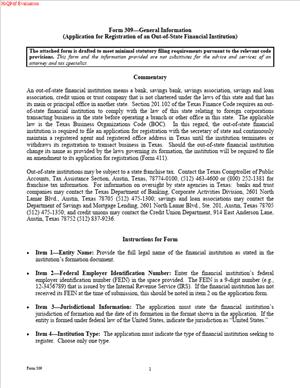
Form 309 – Application for Registration of an Out-of-State Financial Institution
Fill out nowJurisdiction: Country: United States | Province or State: Texas
What is a Form 309 – Application for Registration of an Out-of-State Financial Institution?
Form 309 is Texas’s registration filing for non-Texas financial institutions. You use it to qualify your institution to do business in Texas. It creates your legal foothold in the state. It also places your institution on the public record.
This is not a general “foreign entity” filing. It targets institutions regulated by banking or credit union laws. The form is tailored for banks, trust companies, savings banks, savings associations, and credit unions. It also covers similar institutions chartered outside Texas. Your institution may be federally or state chartered. The key is that you are not from Texas.
Who typically uses this form?
In practice, you see in-house counsel complete it. You also see regulatory officers, corporate secretaries, or outside counsel prepare it. Business line leaders may help gather facts. You will often coordinate with risk, tax, and vendor teams.
Why would you need this form?
Because you plan to transact business in Texas. You may open a branch. You may place employees in Texas. You may sign a lease. You may hire local staff. You may market fiduciary services. You may service loans from a Texas office. You may hold trust assets or act as a custodian in Texas. If any of that applies, you need the legal right to operate here.
Form 309 gives you that authority. The state reviews your filing. If accepted, you receive a certificate of registration. That certificate is proof of your authority. It also allows you to appoint a registered agent. The agent accepts service of process on your behalf. Lenders, landlords, and counterparties expect to see this in place. Without it, you risk fines and contract issues.
Typical usage scenarios
A national bank wants a Houston branch. The bank files Form 309 before opening. A Delaware trust company plans a Dallas office. It files Form 309 to qualify. An out-of-state credit union hires remote Texas loan officers. It also files Form 309. A savings association wants to market CDs to Texans from a staffed Austin site. It files Form 309 to proceed. In each case, the institution gains legal standing in Texas.
You also use this form when your name conflicts with an existing record. The form process handles name conflicts and assumed names. It confirms your registered agent details. It verifies your home jurisdiction status. It lists your principal office and Texas office. It sets your effective date. It ends with an authorized officer’s signature.
In short, Form 309 is the correct path for a non-Texas financial institution. It helps you establish presence and comply with Texas law. It is an executive-level compliance step. It also reduces operational friction once you launch.
When Would You Use a Form 309 – Application for Registration of an Out-of-State Financial Institution?
Use this form before you start a business in Texas. Do not wait until after you sign a lease or hire staff. File before you open a storefront, office, or branch. File before you begin in-person solicitation. File before you deploy a staffed operation in Texas.
Consider these practical situations. You plan to open a branch or loan production office. You will maintain a fiduciary office. You will place relationship managers in Texas. You will send account officers to Texas for regular work. You will host client meetings in a Texas office. You will hold securities or cash in a Texas vault. You will hire a Texas-based operations team. Each situation signals that you transact business here.
Think also about contracts. You intend to sign a Texas commercial lease. You will buy or lease equipment in Texas. You will negotiate vendor agreements governed by Texas law. Landlords and vendors will check if you are registered. Many refuse to proceed until you qualify.
You also need the form when you face name issues. Your home name might be unavailable in Texas. The registration process can resolve that. You may adopt an assumed name for Texas use. You would declare that name in the filing.
Typical users include general counsel and compliance leads. Corporate secretaries prepare many filings. Finance and tax teams advise on timing and structure. Real estate and HR teams push for speed. Outside counsel may handle name checks and drafting. Your registered agent provider may assist as well.
You may not need registration for isolated acts. One-off activities may fall outside “transacting business.” Still, the rule can be nuanced. If you plan to have ongoing activity in Texas, register. It reduces risk and aids operations.
If you are not a financial institution, do not use this form. A nonbank lender organized as an LLC may not qualify as a “financial institution.” That business would use a different foreign entity filing. Confirm your status before you draft.
Legal Characteristics of the Form 309 – Application for Registration of an Out-of-State Financial Institution
Form 309 is a public filing with the state. It is legally binding. You sign under the authority of your institution. You certify the facts in the filing. Misstatements can trigger penalties. The filing becomes part of the state record. Anyone can request a copy.
Enforceability comes from several elements. First, the state’s acceptance. Filing with the correct fee is required. The form must be complete and accurate. The state issues a certificate of registration after acceptance. That certificate verifies your authority to transact business in Texas. Courts and counterparties rely on it.
Second, your registered agent assures due process. The agent receives service of process in Texas. That ensures you can be sued and can defend. It also supports contract enforcement. Many contracts require you to maintain a registered agent.
Third, your home jurisdiction status matters. You must exist in good standing where you were formed. You also must be authorized to operate as a financial institution there. The form typically requires proof of that status. The proof often takes the form of a recent certificate. The certificate shows the existence and active authority to operate.
Fourth, your name use must comply with Texas naming law. If your name is available, you can use it. If not, you may adopt an assumed name for Texas. Name compliance avoids consumer confusion. It also aligns with safety and soundness concerns.
Additional legal considerations apply. Registration does not replace regulatory approvals. You may still need approvals from your primary regulator. You may need separate branch or trust approvals. Registration also does not expand your powers. You can only do what your charter allows. Texas law expects you to follow your charter limits.
Registration also brings ongoing duties. You must keep your registered agent current. You must amend your filing after key changes. For example, you must report name changes. You must also withdraw if you cease Texas operations. Withdrawal ends your authority and reporting duties.
Finally, the filing date can matter. Some deals require proof of qualification by a certain date. You can ask for a delayed effective date in the form. This helps align with leases, hiring, and launch plans.
How to Fill Out a Form 309 – Application for Registration of an Out-of-State Financial Institution
Follow these steps to complete the form accurately. Prepare first. Then draft, review, and file.
1) Confirm you qualify as a “financial institution.”
- Review your charter type. Confirm you are a bank, trust company, savings bank, savings association, or credit union.
- Confirm you are a resident outside of Texas.
- If unsure, confer with counsel. Using the wrong form delays approval.
2) Align your business plan with the filing.
- Define your planned Texas activities. Note offices, staffing, and branch plans.
- Align any regulator approvals with your timeline.
- Identify the date you want your authority to begin.
3) Check name availability in Texas.
- Search the state record for conflicts. Confirm your legal name is available.
- If unavailable, choose a Texas assumed name. Keep it distinct and compliant.
- Prepare any required assumed name documentation.
4) Gather required documents and facts.
- Obtain a recent certificate of existence from your home jurisdiction.
- Confirm your principal office address and mailing address.
- Collect your charter number or similar identifier.
- Identify your management signatory. Confirm their title and authority.
- Confirm your federal employer identification number, if requested.
- Prepare any regulatory approval proof, if required for your activity.
5) Select your Texas registered agent and office.
- Choose a reliable agent with statewide coverage.
- Confirm the physical street address in Texas. P.O. Boxes do not qualify.
- Get written consent from the agent, if requested.
6) Complete the institution identification section.
- Enter your exact legal name as formed. Use punctuation and spacing exactly.
- State your jurisdiction and date of formation.
- Identify your institution type. Use terms like bank, trust company, or credit union.
- Provide your principal office street address. Include city, state, and country.
7) Address name issues in the form.
- If using an assumed name, list it clearly.
- Confirm that marketing and signage will match the field name.
- Keep internal systems aligned with the Texas name.
8) Provide the registered agent and office.
- Enter the agent’s full legal name. Confirm it matches their appointment.
- Enter the registered office street address in Texas.
- Confirm the address is open during business hours.
9) Describe your purpose and activities.
- State that you are a financial institution. Keep to your chartered powers.
- List the core activities planned in Texas. Use precise, neutral language.
- Mention any branch or fiduciary operations. Name the city if known.
10) List your principal and Texas offices.
- Confirm your principal office address outside Texas.
- If you have a Texas office ready, list it. If not, state “to be determined.”
- Update with an amendment when you finalize the address.
11) Address duration and home status.
- State that your duration is perpetual if true. Some charters are perpetual.
- Confirm that you exist and are in good standing.
- Attach your recent certificate of existence.
12) Add directors, managers, or officers, if the form requests them.
- List names and business addresses of key leaders.
- Use titles that match your governance documents.
- Keep spellings consistent with your public records.
13) Choose the effective date.
- Select immediate effectiveness upon filing, or pick a delayed date.
- Use a delayed date to align with leases or hiring.
- Note that a delayed date cannot be indefinite.
14) Review tax and reporting implications.
- Registration may trigger tax accounts in Texas. Coordinate with tax teams.
- This filing does not alone impose tax. Activity level drives tax exposure.
- Ask your tax team to track registration and nexus.
15) Execute the form.
- Have an authorized officer sign. Use a pen or an approved electronic signature.
- Print the signer’s name and title below the signature.
- Date the form. Ensure dates match any attachments.
16) Prepare attachments.
- Attach the certificate of existence. Ensure it is recent.
- Include any assumed name documentation. Make sure it is complete.
- Include the registered agent consent if requested.
- Attach the regulator approval proof if your activity needs it.
17) Pay the filing fee.
- Check the current fee schedule before filing.
- Prepare payment in an accepted format.
- If using a service company, confirm their billing method.
18) File the form with the state.
- You may file by mail, in person, or electronically, if available.
- Keep a copy of everything you submit.
- Request a file-stamped copy for your records.
19) Track acceptance and certificate issuance.
- Monitor the filing status. Respond to any staff inquiries.
- When accepted, obtain the certificate of registration.
- Share the certificate with real estate, HR, and vendor teams.
20) Align your internal records and operations.
- Update your vendor setups with your Texas-registered agent details.
- Update contract templates to reflect your registered name.
- Add the certificate to your corporate records folder.
21) Prepare for operational launch.
- If a branch is involved, align signage with your field name.
- Verify that licenses and permits match your registered name.
- Confirm that staff know your registered agent process.
22) Maintain ongoing compliance.
- Keep your registered agent information current.
- File amendments for name, office, or management changes.
- Withdraw your registration if you exit Texas.
Practical drafting tips help avoid delays. Use short, clear answers. Do not copy-paste marketing language. Keep your purpose factual and narrow. Match every name to a document. Confirm that addresses are deliverable. Check that the signer’s title shows clear authority. If you claim a delayed effective date, calendar it. Ensure your lease and hiring plans respect that date.
Common pitfalls are avoidable. Do not omit the registered agent address. Do not use a P.O. Box for the registered office. Do not attach stale certificates of existence. Do not ignore name conflicts. Do not overstate your powers or purpose. Do not leave off the signer’s title. These mistakes slow approval.
If you have already formed a standard foreign entity filing, assess the next steps. You may need Form 309 as well if you are a financial institution. The specialized registration aligns your charter and regulator status. It prevents misclassification issues later.
Plan your filing to support your launch. File early to allow for review time. Tie the effective date to your operations plan. Have your certificate in hand before closing on leases. Vendors and landlords often require proof of registration.
With a complete Form 309, you set a strong foundation. You gain authority to transact business in Texas. You reduce legal friction for contracts and operations. You protect your institution with a compliant, clean public record.
Legal Terms You Might Encounter (Bring Form 309 – Application for Registration of an Out-of-State Financial Institution)
- Foreign financial institution means your entity was formed outside Texas. You are “foreign” to Texas, even if you operate nationwide. Form 309 registers your foreign entity to do business in Texas.
- Certificate of authority is the state’s approval to operate. It is what you receive after your Form 309 is accepted. You cannot transact business in Texas until it is effective.
- Home state means the state or federal jurisdiction that chartered you. Your legal name must match your home state records. Form 309 asks for that jurisdiction and your formation details.
- Registered agent is the person or company you appoint in Texas. They accept legal papers for your institution. Form 309 requires the agent’s full name and the Texas street address.
- Registered office is your agent’s Texas street address. It must be a physical location in Texas. Form 309 will reject a P.O. box for the registered office.
- Consent to service of process is your agreement to accept legal papers in Texas. Form 309 captures this through your registered agent information. It ensures courts can reach you.
- Good standing certificate proves your entity exists and is current in its home state. It is often called a certificate of existence. Form 309 may require you to attach a recent certificate.
- Assumed name (DBA) is a trade name different from your legal name. Using a DBA does not replace your legal name on Form 309. You may still need to file assumed name paperwork.
- Control person means an officer, director, or managing individual with authority. Form 309 may ask you to list these people. Use names and titles that match your governance records.
- Effective date is when your Texas registration starts. You can choose the filing date or a later date. Form 309 includes an effective date option.
- Merger or conversion history shows how your entity reached its current form. If your name or entity type changed, note it. Form 309 expects your current legal status to be correct.
- Principal office means your main business location. It is not the registered office. Form 309 may ask for both addresses, and they are not the same.
FAQs (Bring Form 309 – Application for Registration of an Out-of-State Financial Institution or Form category, and answer comprehensively)
Do you need to file Form 309 if you only serve Texas customers online?
If you are transacting business in Texas, you should register. Physical presence is not the only trigger. Serving Texas customers, marketing into Texas, or holding assets in Texas can require registration. When in doubt, register before you enter the market.
Do you need a Texas-registered agent to file Form 309?
Yes. You must name a Texas registered agent and a Texas registered office. The registered office must be a physical street address. Confirm your agent’s consent and ensure the address is staffed during business hours.
Do you need a certificate of good standing from your home state?
Yes, expect to provide a recent certificate of good standing. It should match your legal name on Form 309. Use a current document, typically issued within a short time window. Old or expired certificates trigger rejections.
Do you need board or officer authorization to sign Form 309?
Yes. The signer must have authority under your governance documents. Keep a board resolution or officer certificate in your records. The state may accept the signature, but you are responsible for proper internal approval.
Do you need to wait for approval before doing business in Texas?
Yes. Wait for the state to file and approve Form 309. Your certificate of authority will include the effective date. Start Texas operations only after that date.
Do you need to update the state if your name, agent, or address changes?
Yes. File an amendment promptly when any required detail changes. Update name, registered agent, registered office, or principal office without delay. Late updates risk missed legal notices and compliance issues.
Do you need to renew your Form 309 registration each year?
No separate annual renewal is typical for the registration itself. The registration remains active until you withdraw or it is revoked. You must keep your registered agent and information current and meet ongoing obligations.
Do you still need industry licenses after filing Form 309?
Yes, registration is not a substitute for licensing. If your activities require separate approvals, obtain them. Maintain those licenses in good order throughout your Texas operations.
Checklist: Before, During, and After the Form 309 – Application for Registration of an Out-of-State Financial Institution
Before signing: Information/documents needed
- Exact legal name as shown in your home state records.
- Entity type and chartering authority (state or federal).
- Formation or charter date and ID number, if applicable.
- Home jurisdiction certificate of good standing, recent and legible.
- Principal office street address and mailing address.
- Texas registered agent’s full name and Texas street address.
- Consent from your registered agent to serve.
- Names and titles of officers, directors, or control persons.
- Any assumed names you plan to use in Texas.
- Clear description of your business activities in Texas.
- Any relevant merger, conversion, or name change history.
- Desired effective date for the Texas registration.
- Signature authority documentation (resolution or officer certificate).
- Payment method for the filing fee.
- Internal contact who will track filing and receive notices.
During signing: Sections to verify
- Legal name matches the good standing certificate exactly.
- Entity type is correct for a financial institution.
- Home state or chartering jurisdiction is accurate.
- The principal office and registered office are not the same by mistake.
- Registered agent name is correct and consenting.
- Registered office is a Texas street address, not a P.O. box.
- Officers and directors are listed with correct titles and spellings.
- Any assumed name is consistent with internal approvals.
- Effective date selection is correct for your launch plan.
- Attachments are complete and labeled (good standing, resolutions).
- The signature block includes the printed name and title of the signer.
- Date of signature is present and consistent with attachments.
- All pages are complete, with no blanks that cause rejection.
After signing: Filing, notifying, storing instructions
- File Form 309 with the Secretary of State using your chosen method.
- Pay the filing fee using an approved payment type.
- Track filing status and note the effective date once accepted.
- Store the filed Form 309 and certificate of authority in your records.
- Notify compliance, legal, operations, and branch leadership.
- Confirm your registered agent’s account and routing of legal mail.
- Align internal policies with Texas compliance requirements.
- Register for any tax or reporting accounts your activities require.
- Update website and disclosures if they reference Texas operations.
- Calendar ongoing obligations and amendment triggers.
- Monitor mail sent to the registered office for time-sensitive items.
- Train front-line staff on how to route legal notices quickly.
Common Mistakes to Avoid Form 309 – Application for Registration of an Out-of-State Financial Institution
- Using a trade name instead of your legal name. Don’t forget to enter the exact legal name. Rejections and delays follow mismatched names. Fixing it later costs time and fees.
- Listing a P.O. box for the registered office. Don’t forget the registered office must be a Texas street address. A P.O. box leads to rejection. You also risk missing legal notices.
- Submitting an outdated good-standing certificate. Don’t forget to use a current certificate from your home jurisdiction. Old certificates trigger deficiencies. You will need to refile with a fresh document.
- Choosing the wrong effective date. Don’t forget to align the date with your launch plans. If you start early, you risk penalties for transacting without authority. If you start late, you delay revenue.
- Having the wrong person sign. Don’t forget the signer must have proper authority. An unauthorized signature can void the filing. It can also cause internal governance issues.
What to Do After Filling Out the Form 309 – Application for Registration of an Out-of-State Financial Institution
- File the completed form with payment and attachments. Keep a copy of everything you submit. Track the filing until you receive confirmation and the effective date.
- Hold off on Texas business until the filing is effective. Do not sign Texas contracts or open a Texas branch before approval. Confirm the effective date before public announcements.
- Distribute the field certificate to key teams. Share it with compliance, legal, finance, and operations. Provide a copy to your registered agent for their records.
- Set up your compliance calendar. Track renewal dates for licenses you hold. Track amendment triggers for name changes, agent changes, and address changes. Review your registration data quarterly.
- Update your corporate records book. File Form 309, the certificate of authority, and all attachments. Keep the home state’s good-standing certificate with the filing set. Store them in both digital and physical formats.
- Confirm tax and reporting accounts as needed. If you must register for any tax accounts, complete that setup. Align your accounting codes for Texas operations.
- Review customer-facing and vendor materials. Make sure legal names and required statements are correct in Texas. Update forms, contracts, and disclosures that reference your entity.
- Align branch or office opening plans. If you plan a Texas office, confirm local setup tasks. Verify leases, signage, and staffing align with your legal name and authority.
- Create a change-management process. Designate who will prepare amendments. Document how you will update agent, office, or officer details. Practice the process before you need it.
- Plan for withdrawal if you later exit Texas. If you close Texas operations, file a withdrawal. Close tax accounts and notify your registered agent. Keep proof of withdrawal in your records.
Disclaimer: This guide is provided for informational purposes only and is not intended as legal advice. You should consult a legal professional.