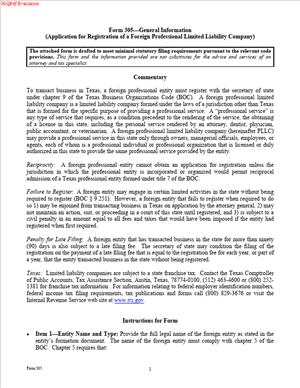
Form 305 – Application for Registration of a Foreign Professional Limited Liability Company
Fill out nowJurisdiction: Country: United States | Province or State: Texas
Form 305 – Application for Registration of a Foreign Professional Limited Liability Company is a Texas filing used when an out-of-state professional limited liability company wants authority to operate in Texas. It is part of the formal business registration process. The document connects your existing professional entity to Texas records.
You encounter this form when your professional LLC was formed outside Texas but plans to conduct business activities inside the state. The filing does not create a new company. It registers an existing one so it can operate legally in this jurisdiction.
The form matters because Texas tracks who is allowed to transact professional business within its borders. Without this registration, routine business activities may be limited or delayed. Contracts, licensing steps, or banking tasks can be affected.
If you are preparing to fill out this form, you are likely coordinating business expansion, professional licensing, or compliance requirements. Understanding each section before you start helps prevent processing delays and rejected submissions.
This guide explains what the form does, when it is used, and how to complete it accurately. It is written to help you approach the document with confidence and clarity.
What is Form 305 – Application for Registration of a Foreign Professional Limited Liability Company?
Clear definition
Form 305 – Application for Registration of a Foreign Professional Limited Liability Company is an official filing that requests Texas recognition of a professional limited liability company formed elsewhere. “Foreign” means formed outside Texas, not outside the United States. The form records key information about the existing entity in Texas business records.
The document captures identifying details such as the company’s legal name, jurisdiction of formation, and professional purpose. It also establishes a registered agent and office within Texas for official communications. Once accepted, the foreign professional LLC gains authority to transact business in Texas.
This filing is administrative in nature. It does not change the internal structure of the company. It does not replace professional licensing requirements that may apply to individual members or managers.
Who typically uses this form/document?
This form is commonly used by professional limited liability companies formed in another state. These entities often provide regulated professional services. Examples include firms organized around licensed professions.
Company managers, authorized representatives, or administrative staff often prepare the filing. In some cases, an owner handles the form directly. The person completing it usually has access to formation documents and company records.
The form is also used during expansion planning. Businesses entering Texas markets frequently encounter it as part of early setup tasks. It often appears alongside licensing, tax registration, and office establishment steps.
Why you might need this form/document
You may need this form when your professional LLC plans to conduct business activities in Texas. “Doing business” commonly includes maintaining an office, employing staff, or providing professional services within the state. The form establishes your legal presence for state records.
The registration helps Texas identify who is operating within its jurisdiction. It also provides a formal point of contact through a registered agent. This ensures official notices can be delivered reliably.
Without this registration, certain business activities may be restricted. Some third parties request proof of Texas registration before engaging in contracts or opening accounts. Completing the form helps avoid administrative roadblocks.
Typical real-life scenarios
A professional firm formed in another state opens a Texas office to serve local clients. Before signing a lease or hiring staff, the company completes this form to register its authority in Texas.
A multi-state professional practice expands its services into Texas through remote work. Even without a physical office, the company registers to align with Texas business requirements.
An existing out-of-state professional LLC acquires a Texas-based practice. As part of the transition, the company registers to reflect its expanded operations.
A professional company formed elsewhere wins a long-term Texas contract. The client requires proof of Texas registration before finalizing the agreement, prompting completion of the form.
When would you use Form 305 – Application for Registration of a Foreign Professional Limited Liability Company?
You typically use this form before beginning ongoing business operations in Texas. It often appears early in the expansion timeline. Many businesses complete it before opening offices or engaging clients.
The form is also used when a professional LLC’s activities cross a threshold into regular Texas business. Occasional or isolated activity may not trigger registration, while sustained operations often do. The form helps formalize that presence.
You may encounter this document during licensing or credentialing processes. Professional boards or counterparties sometimes request confirmation of Texas registration. Completing the filing supports those parallel requirements.
Administrative roles commonly handle the timing. Managers, compliance staff, or owners coordinate the submission with other setup tasks. The form becomes part of the company’s compliance calendar.
Legal characteristics of Form 305 – Application for Registration of a Foreign Professional Limited Liability Company
This form becomes effective once accepted and filed by the state. Acceptance usually depends on completeness, accuracy, and consistency with existing records. Incorrect names, missing signatures, or conflicting details commonly cause delays.
The document relies on information from the company’s formation jurisdiction. Details must align with existing certificates or registrations. Inconsistencies can lead to rejection or requests for clarification.
While the form is standardized, registration effects can vary by state. Texas uses this filing to grant authority to transact business, not to confer professional licensure. Other jurisdictions may use different forms or terminology for similar purposes.
The form does not create a new legal entity. It does not modify ownership interests or management authority. It also does not substitute for tax registrations or professional approvals that may apply separately.
Is it legally binding?
The form is legally significant once filed and accepted. By submitting it, the company represents that the information provided is accurate and authorized. The state relies on these representations in maintaining its records.
The filing binds the company to maintain a registered agent and comply with ongoing reporting requirements. It also subjects the company to applicable Texas business laws for registered foreign entities.
The form itself is not a contract between private parties. Its binding effect comes from its role in state registration. Accuracy and authorization are essential because the filing has legal consequences for the company’s operations.
How to fill out Form 305 – Application for Registration of a Foreign Professional Limited Liability Company
Step 1 – Identify the exact legal name of the company
Begin by entering the professional limited liability company’s full legal name as it appears in its formation state. The name must match existing records exactly. Even small differences can cause processing issues.
If the company uses a different name in Texas, the form typically asks for that alternate name. This helps Texas records reflect how the business will be known locally. Consistency across documents matters here.
Step 2 – Confirm the jurisdiction and date of formation
Provide the state or other jurisdiction where the company was originally formed. Include the formation date as recorded in that jurisdiction. This information ties the Texas registration to the existing entity.
The details help distinguish your company from others with similar names. They also confirm that the entity exists and is active elsewhere. Accuracy supports smooth verification.
Step 3 – Describe the professional purpose
The form requests a description of the professional services the company provides. This description is usually brief but specific. It reflects the regulated nature of the entity.
Use language consistent with the company’s formation documents. The description helps Texas understand the scope of activities. It does not replace licensing or professional approval steps.
Step 4 – Provide the principal office address
Enter the address of the company’s main office. This may be outside Texas. The address identifies where the company’s records or leadership are based.
Ensure the address is complete and current. Post office boxes are often treated differently from street addresses. The form usually specifies acceptable formats.
Step 5 – Designate a registered agent and registered office in Texas
The form requires naming a registered agent located in Texas. This agent receives official notices and service of process. The registered office address must be a physical Texas location.
Confirm that the agent has agreed to serve in this role. Incorrect or incomplete agent information is a common cause of rejection. This step establishes the company’s official Texas contact point.
Step 6 – State management structure and authority
You will be asked to indicate whether the company is member-managed or manager-managed. This reflects how authority is organized within the LLC. The choice should align with existing formation documents.
Some versions of the form request names or titles of authorized persons. Provide information that matches company records. This helps clarify who has authority to act for the entity.
Step 7 – Include required statements or certifications
The form includes statements confirming the company’s eligibility to register as a professional entity. These statements relate to compliance with applicable professional rules. They are typically acknowledged by checking or signing.
Read each statement carefully before acknowledging it. The representations are part of the official filing. They connect the registration to professional requirements.
Step 8 – Execute the form with an authorized signature
An authorized person must sign the form. This is often a manager, member, or authorized representative. The signature confirms that the information is accurate and approved.
Include the signer’s name and title as requested. Unsigned forms are not accepted. The execution step finalizes the document for submission.
Step 9 – Review the completed form before submission
Before submitting, review every section for completeness and consistency. Compare names, dates, and addresses against existing records. Small errors can delay acceptance.
Once satisfied, the form is ready for submission through the appropriate filing method. This completes the preparation process for Form 305 – Application for Registration of a Foreign Professional Limited Liability Company.
Legal terms you might encounter in Form 305 – Application for Registration of a Foreign Professional Limited Liability Company
- Foreign professional limited liability company: In this document, “foreign” means your company was formed under the laws of another state, not Texas. The term matters because the form is only for existing entities seeking authority to operate in Texas. You are not creating a new company here.
- Application for registration: This refers to the formal request you submit asking Texas to recognize your existing professional LLC. The application becomes part of the public record once accepted. Every field you complete supports that request.
- Jurisdiction of formation: This is the state or other legal jurisdiction where your company was originally organized. You must enter it exactly as shown on your formation documents. Texas uses this to confirm your company’s existence elsewhere.
- Professional purpose: This is the specific type of professional service your company provides, as stated in this document. It appears in a short description section. The wording should match your existing records and reflect regulated activities.
- Principal office address: This is the main business address of your company, which may be outside Texas. It identifies where the company’s leadership or records are based. The address becomes visible in state records.
- Registered agent: The registered agent is the person or entity authorized to receive official notices for your company in Texas. This role is required for registration. The agent’s consent and accurate address are essential.
- Registered office: This is the physical Texas address tied to your registered agent. It cannot be a mailbox or virtual-only location. The address establishes where official documents can be delivered.
- Member-managed: This management structure means the owners themselves manage the company. You must select this option only if it matches how your company is organized elsewhere. The choice signals who has authority to act.
- Manager-managed: This structure means designated managers run the company, not all owners. If you choose this option, it must align with your existing governance documents. It affects how Texas understands decision-making authority.
FAQs
Do I need to match the company name exactly as it appears in my home state records when completing Form 305 – Application for Registration of a Foreign Professional Limited Liability Company?
Yes. You must enter the legal name exactly as it appears in your formation state’s records. Even small differences, like punctuation or abbreviations, can cause delays. If you plan to use a different name in Texas, that information is entered separately.
Where do I find the formation date and jurisdiction needed for this document?
You can find both on your original formation filing or certificate from your home state. The date must reflect when the company was legally created. Entering an estimate or anniversary date often leads to rejection.
What address should I use for the principal office section?
Use the address where your company’s main office or leadership is located. This does not have to be in Texas. Make sure the address is current and complete because it becomes part of the public record.
Who is allowed to sign this form on behalf of the company?
The signer must have authority under your company’s existing structure. This is usually a member, manager, or authorized representative. The name and title you list should match your internal records.
What happens if my registered agent information is wrong or incomplete?
Incorrect agent details are a common reason filings are rejected. Texas relies on this information to deliver official notices. Always confirm the agent’s name, address, and consent before submitting this document.
Does filing this document change my company’s ownership or management?
No. This document only registers your existing entity to do business in Texas. It does not alter ownership percentages, voting rights, or internal agreements. Those remain governed by your original formation documents.
Is there an effective date I need to choose or confirm?
Some filings become effective upon acceptance, while others allow a delayed effective date. If an effective date field appears, confirm it matches your business plan. An incorrect date can affect when your authority begins.
How will I know if this document has been accepted?
After submission, you will receive a filing acknowledgment or certificate from the state. Review it carefully to confirm names, dates, and addresses. Keep a copy with your permanent company records.
Checklist: Before, During, and After Form 305 – Application for Registration of a Foreign Professional Limited Liability Company
Before
- Confirm your company is a professional limited liability company.
- Locate your original formation documents from your home state.
- Verify the exact legal name and formation date.
- Decide whether the company is member-managed or manager-managed.
- Select and confirm a Texas registered agent.
- Gather principal office address details.
- Review internal records to confirm signer authority.
During
- Enter the company name exactly as it appears in existing records.
- Double-check the jurisdiction of formation entry.
- Write a clear and accurate professional purpose description.
- Confirm the principal office address formatting.
- Carefully enter registered agent and registered office information.
- Select the correct management structure option.
- Review all certifications before acknowledging them.
- Sign using the authorized person’s correct name and title.
After
- Save a complete copy of the submitted document.
- Track confirmation or acceptance from the state.
- Review the filed record for accuracy once available.
- Update internal compliance and expansion checklists.
- Share confirmation with partners or managers as needed.
- Store the filing with other core company records.
- Calendar any follow-up filings or reports tied to registration.
Common mistakes to avoid with Form 305 – Application for Registration of a Foreign Professional Limited Liability Company
- Mistake: Using a shortened or trade name, which happens when people copy marketing materials, leading to rejection, so do not forget to match the legal name exactly.
- Mistake: Entering the wrong formation date, often due to guessing, which can delay acceptance, so do not forget to verify it from official records.
- Mistake: Listing an agent without consent, which happens when rushing, causing filing failure, so do not forget to confirm the agent agreed to serve.
- Mistake: Choosing the wrong management structure, which occurs when internal documents are not reviewed, creating record conflicts, so do not forget to align with your operating agreement.
- Mistake: Using an invalid registered office address, often a mailbox, which prevents service of process, so do not forget it must be a physical Texas location.
- Mistake: Leaving signature titles blank, which happens when focusing only on names, resulting in rejection, so do not forget to include the signer’s role.
- Mistake: Skipping a final review, which occurs under time pressure, causing small errors to compound, so do not forget to reread every section.
- Mistake: Assuming filing equals licensing, which leads to compliance gaps, so do not forget this document only covers registration.
What to do after filling out Form 305 – Application for Registration of a Foreign Professional Limited Liability Company
Once you complete the document, your next steps focus on submission, confirmation, and recordkeeping. Treat this filing as part of a larger compliance process, not a one-time task. Staying organized now prevents problems later.
- Step 1: Make a clean copy of the completed and signed form for your internal records.
- Step 2: Confirm the correct filing method you plan to use and prepare any required payment.
- Step 3: Submit the document through the chosen filing channel and note the submission date.
- Step 4: Monitor for confirmation, acknowledgment, or a request for corrections.
- Step 5: Review the accepted filing carefully once it is available in the public record.
- Step 6: Save the acceptance confirmation with your formation and governance documents.
- Step 7: Update internal compliance lists to reflect Texas registration status.
- Step 8: Inform managers or members that registration is active.
- Step 9: Align contracts, banking, or leases with the registered company name.
- Step 10: Calendar future reporting or renewal obligations connected to this registration.
Keeping copies, confirmations, and notes together helps you answer questions quickly later. It also supports smooth audits, renewals, or expansions into additional states.
Disclaimer: This guide is provided for informational purposes only and is not intended as legal advice. You should consult a legal professional.