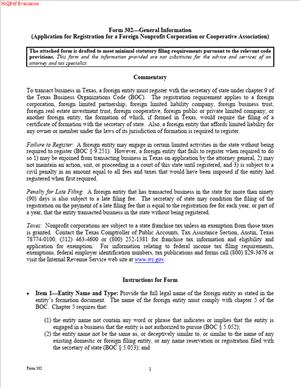
Form 302 – Application for Registration for a Nonprofit Corporation or Cooperative Association
Fill out nowJurisdiction: Country: United States | Province or State: Texas
Form 302 – Application for Registration for a Nonprofit Corporation or Cooperative Association is a state filing used to place certain organizations on the public record. It connects your organization to Texas for registration purposes.
You usually encounter this document when your nonprofit or cooperative already exists elsewhere but needs to operate or hold property in Texas. It is often part of a larger compliance process.
This form matters because it establishes formal recognition with the state. Without registration, basic activities can be delayed or blocked.
You may be filling this out for the first time, with limited guidance. This overview explains what the form is asking for and why each section exists.
By the end, you should understand how the pieces fit together before you start entering information.
What is Form 302 – Application for Registration for a Nonprofit Corporation or Cooperative Association?
Clear definition
Form 302 – Application for Registration for a Nonprofit Corporation or Cooperative Association is an application filed with the Texas Secretary of State. It is used by certain nonprofit corporations and cooperative associations to register to conduct activities connected to Texas.
The form collects identifying information about the organization, its formation, and its authority to operate. It also identifies who can receive official notices on the organization’s behalf.
This is a registration document, not a creation document. It does not form a new entity. It records an existing entity with the state.
Once accepted, the filing places the organization into the state’s records as registered.
Who typically uses this form/document?
This document is commonly used by nonprofit corporations formed outside Texas. It is also used by cooperative associations that were created under another jurisdiction’s laws.
People filling out the form are often board members, officers, or administrators. Sometimes it is completed by someone handling compliance or records.
You may be acting on behalf of an organization that already operates elsewhere. Registration becomes relevant when activities cross into Texas.
Organizations with a charitable, educational, religious, or member-based purpose frequently encounter this form.
Why you might need this form/document
You may need this form to lawfully engage in certain activities in Texas. Registration can be tied to opening bank accounts, leasing property, or entering contracts.
State agencies and counterparties often expect proof of registration. Without it, transactions may be delayed.
Filing can also be necessary to maintain good standing across jurisdictions. It helps keep records consistent and current.
In many situations, the form is required before ongoing operations can continue without interruption.
Typical real-life scenarios
Your nonprofit was formed in another state and plans to run programs in Texas. Registration becomes part of the preparation before services begin.
A cooperative association owns property in Texas but was organized elsewhere. The form is used to place that ownership on record.
An organization is expanding its fundraising activities into Texas. Registration may be requested as part of that expansion.
A nonprofit is entering a long-term contract connected to Texas. The other party asks for evidence of state registration before signing.
When would you use Form 302 – Application for Registration for a Nonprofit Corporation or Cooperative Association?
You typically use Form 302 – Application for Registration for a Nonprofit Corporation or Cooperative Association before or shortly after beginning activities tied to Texas. Timing often matters because registration can be a prerequisite for other steps.
This filing is often prepared during an expansion phase. The organization already exists and now needs recognition in another state.
You may encounter this form when advisors, partners, or agencies flag registration as missing. It becomes a corrective step.
The form may also come up during internal reviews. Someone notices that operations have expanded without formal registration.
In practice, the person completing the form is often coordinating information from multiple records. These can include formation documents, officer lists, and registered agent details.
Legal characteristics of Form 302 – Application for Registration for a Nonprofit Corporation or Cooperative Association
This form is effective when it is complete, accurate, and accepted for filing. Acceptance usually depends on meeting content and formatting requirements.
Common problems include inconsistent names, missing dates, or outdated agent information. These issues can lead to rejection or delays.
Registration requirements vary by jurisdiction. What qualifies as operating in Texas may differ from other states, so the scope of the form reflects Texas-specific expectations.
The form does not grant tax-exempt status. It also does not replace filings required by other agencies.
This document records authority to operate or be recognized. It does not control internal governance or member rights.
Is it legally binding?
The form itself is not a contract between private parties. It is a formal statement made to the state.
By signing and submitting, the organization attests that the information is accurate. That representation carries legal significance.
Once filed, the registration has legal effects. The organization becomes subject to applicable state requirements tied to registration.
The binding nature comes from the filing’s role in the regulatory system, not from mutual agreement.
How to fill out Form 302 – Application for Registration for a Nonprofit Corporation or Cooperative Association
Step 1 – Identify the organization
Begin by entering the organization’s full legal name as it appears in its formation records. Consistency across documents is critical.
If the organization uses a different name in Texas, the form may ask for that variation. This helps align public records with real-world use.
Double-check spelling, punctuation, and abbreviations. Small differences can create processing issues.
Step 2 – Provide formation details
This section usually asks for the jurisdiction and date of formation. Use the original formation information, not later amendments.
You may need to reference the original organizing document. Accuracy here ties the registration back to the correct entity.
Formation details confirm that the organization exists and was validly created elsewhere.
Step 3 – Describe the organization’s purpose
The form may request a brief statement of purpose or activities. This description should align with existing governing documents.
Use clear, straightforward language. Avoid adding new purposes that are not already authorized.
This section helps the state understand the nature of the organization’s activities in general terms.
Step 4 – List principal office information
Enter the principal office address as maintained by the organization. This is often the main administrative location.
Addresses should be complete and current. P.O. boxes may not be sufficient for all fields.
This information supports official correspondence and recordkeeping.
Step 5 – Designate a registered agent
The form will ask for a registered agent and registered office address in Texas. This is the point of contact for official notices.
The agent’s name and address must match what is on record. Inconsistencies are a frequent cause of rejection.
This designation ensures the organization can be reached for legal and administrative communications.
Step 6 – Identify governing persons
You may need to list directors, officers, or managers. Titles and names should reflect current roles.
Use full legal names where requested. Avoid nicknames or informal titles.
This section provides transparency about who oversees the organization.
Step 7 – Confirm authority to register
Some versions of the form include statements confirming that the organization is authorized to register. These are typically checked or acknowledged.
Read each statement carefully. They describe conditions tied to registration.
Acknowledging these statements signals that the organization meets baseline requirements.
Step 8 – Attach supporting documents
The application may require a certificate or evidence of existence from the formation jurisdiction. This shows the entity is active.
Attachments should be current and legible. Outdated documents can delay acceptance.
Ensure attachments are clearly labeled if multiple items are included.
Step 9 – Review and sign
Before signing, review the entire form for consistency. Names, dates, and addresses should match throughout.
The signer is usually an authorized individual. The signature confirms the truth of the information provided.
Once signed, the form is ready for submission as part of the registration filing.
Legal terms you might encounter in Form 302 – Application for Registration for a Nonprofit Corporation or Cooperative Association
- Applicant: This is the organization seeking registration. In this document, the applicant is not creating a new entity. You are identifying an existing nonprofit corporation or cooperative association.
- Jurisdiction of Formation: This refers to the state or country where your organization was originally formed. You must enter the original jurisdiction exactly as it appears in your formation records. This ties your registration to the correct legal entity.
- Date of Formation: This is the original date your organization legally came into existence. It is not the date you began operations or changed your name. The date must match your organizing document or certificate of formation.
- Registered Agent: The registered agent is the person or entity designated to receive official notices. This role appears directly in this form because the state needs a reliable contact point. The agent’s consent is usually required separately.
- Registered Office: This is the physical address associated with the registered agent. It must be a real location, not just a mailing address. The form uses this address for service of process and official correspondence.
- Principal Office: This is the main administrative location of the organization. It may be outside Texas. The form uses this address for recordkeeping and general contact purposes.
- Governing Authority: This term refers to the individuals who control or manage the organization. In this form, it usually means directors, managers, or officers. Their names connect the organization to real decision-makers.
- Certificate of Existence: This is a document issued by the formation jurisdiction showing the organization is active. The form relies on this attachment to confirm your entity is still in good standing. It is often required to be recent.
- Authorized Signer: This is the person who signs and submits the form. The signer confirms the information is accurate. Their authority usually comes from their role within the organization.
FAQs
Do I create a new entity when I file Form 302 – Application for Registration for a Nonprofit Corporation or Cooperative Association?
No. This document records an existing organization with the state. You are not forming a new nonprofit or cooperative. You are placing your current entity on the public record for registration purposes.
What name should I enter if we use a slightly different name in practice?
You must start with the full legal name exactly as it appears in your formation records. If the form allows an assumed or alternate name, enter it in the specific field provided. Do not combine names in one line.
What date controls the registration?
The date of formation comes from your original organizing document. The filing date is set by the state when the document is accepted. Both dates may appear in public records, but they serve different purposes.
Who is allowed to sign this document?
The signer must be someone authorized by the organization. This is usually an officer or director. The signature confirms the information is true and complete.
What happens if the registered agent information is wrong?
Incorrect agent information can cause delays or rejection. If accepted with errors, official notices may never reach you. Always confirm the agent’s name and address before filing.
Do attachments become part of the public record?
Yes. Supporting documents submitted with this form are typically kept with the filing. Anyone reviewing the record may see them, so ensure they are accurate and appropriate.
How will I know the filing was accepted?
Acceptance usually comes through a filing acknowledgment or stamped copy. This confirms the document is on record. Keep this confirmation with your organizational records.
What changes once this form is accepted?
The organization becomes registered in the state’s records. Your name, agent, and office information become publicly searchable. This does not change your internal governance or tax status.
Checklist: Before, During, and After Form 302 – Application for Registration for a Nonprofit Corporation or Cooperative Association
Before
- Confirm the exact legal name from formation records
- Locate the original jurisdiction and formation date
- Verify the principal office address is current
- Select a registered agent and confirm consent
- Gather names and titles of governing persons
- Obtain a current certificate of existence
- Decide who will act as the authorized signer
During
- Enter the legal name exactly as shown on formation documents
- Match dates and jurisdictions across all sections
- Use complete physical addresses where required
- Double-check registered agent spelling and address
- List governing persons using full legal names
- Review all checkboxes or confirmations carefully
- Read the entire form once before signing
After
- Save a complete copy of the submitted form
- Store the filing acknowledgment or confirmation
- Update internal records to reflect registration
- Share confirmation with officers or board members
- Calendar any follow-up compliance dates
- Monitor mail sent to the registered agent
- Keep attachments with permanent records
Common mistakes to avoid with Form 302 – Application for Registration for a Nonprofit Corporation or Cooperative Association
- Mistake: Using a shortened or informal organization name, which happens when people rely on marketing materials, leading to rejection or mismatched records, so do not forget to copy the legal name exactly.
- Mistake: Listing the wrong formation date, often caused by confusing amendment dates, which can create inconsistencies, so do not forget to check the original organizing document.
- Mistake: Naming a registered agent without confirming details, which happens when information is assumed, causing missed notices, so do not forget to verify consent and address.
- Mistake: Leaving out required attachments, which happens when filing is rushed, resulting in delays, so do not forget to include current evidence of existence.
- Mistake: Having an unauthorized person sign, which happens when roles are unclear, risking rejection, so do not forget to confirm signer authority.
- Mistake: Submitting inconsistent addresses, which happens when records are outdated, creating confusion in the public record, so do not forget to standardize addresses.
- Mistake: Skipping a final review, which happens due to time pressure, leading to avoidable errors, so do not forget to read every field once more.
What to do after filling out Form 302 – Application for Registration for a Nonprofit Corporation or Cooperative Association
Once the form is complete, your next steps are about submission, confirmation, and recordkeeping. Treat this as part of your organization’s permanent compliance file. Good follow-through prevents future problems.
You should keep both digital and paper copies if possible. Make sure the version you keep includes signatures and attachments. Clear records help when questions arise later.
After submission, pay attention to how acceptance is communicated. Confirmation may arrive electronically or by mail. Do not assume acceptance until you have proof.
Use the acceptance to update internal checklists and calendars. Registration often connects to other compliance obligations. Staying organized now saves time later.
- Step 1: Make a final copy of the signed form and all attachments for your records.
- Step 2: Submit the form using the allowed filing method and include any required fee.
- Step 3: Track the submission date and method used.
- Step 4: Watch for acknowledgment or confirmation from the filing office.
- Step 5: Save the confirmation with your governing documents.
- Step 6: Inform officers or board members that registration is complete.
- Step 7: Update internal compliance logs to reflect the registration.
- Step 8: Confirm the registered agent knows the filing was accepted.
- Step 9: Review public records to ensure information appears correctly.
Disclaimer: This guide is provided for informational purposes only and is not intended as legal advice. You should consult a legal professional.