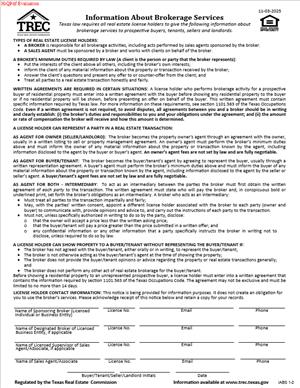
TREC Form IABS 1-2 – Information About Brokerage Services
Fill out nowJurisdiction: Country: United States | Province or State: Texas
TREC Form IABS 1-2 – Information About Brokerage Services is a required disclosure document used in Texas real estate transactions. It explains how a real estate broker or sales agent may represent you in a transaction. If you are about to meet with an agent or discuss buying, selling, or leasing property, you will likely see this form early in the process.
This document is not a contract to buy or sell property. It is an informational notice. Its purpose is to help you understand the different types of representation available and what those relationships mean for you.
If you are self-represented or new to real estate transactions, this form helps you understand the roles involved. It outlines what a broker can and cannot do depending on who they represent. That clarity matters before you share personal or financial information.
You may receive this form in person, by email, or as part of an online document package. It is often presented before you sign any listing agreement, buyer representation agreement, or lease-related paperwork.
Understanding this document helps you make informed decisions. It sets expectations about duties, loyalty, confidentiality, and how the broker works within Texas law.
What is TREC Form IABS 1-2 – Information About Brokerage Services?
Clear definition
TREC Form IABS 1-2 – Information About Brokerage Services is a written notice created by the Texas Real Estate Commission. It describes how licensed brokers and sales agents can represent parties in a real estate transaction.
The form explains the differences between representing a seller, representing a buyer, acting as an intermediary, or assisting without representation. It outlines the broker’s duties in each situation, including honesty, fairness, and disclosure of material facts.
This document focuses on relationships, not property details. It does not include the sales price, closing date, or specific terms of a deal. Instead, it explains the legal framework that applies when you work with a real estate professional in Texas.
Who typically uses this form?
Licensed real estate brokers and sales agents in Texas use this form. They provide it to prospective buyers, sellers, landlords, or tenants at the first substantive discussion about a specific property.
If you are thinking about listing your home, an agent will usually provide this form during the initial meeting. If you are touring homes with an agent, you may receive it before or during that first showing.
Commercial clients may also receive this document. The requirement applies broadly to real estate brokerage activity, not just residential sales.
Why might you need this form?
You may need this form because Texas law requires brokers to provide written information about brokerage services. The goal is transparency. You are entitled to understand who represents whom and what duties apply.
This document helps you compare representation options. For example, you can see how a broker’s duties differ when representing only a seller versus serving as an intermediary between both parties.
It also helps prevent misunderstandings. If you assume an agent is “your agent” but they actually represent the other party, that can affect what information is kept confidential and whose interests are prioritized.
Typical real-life scenarios
- You contact a real estate agent after seeing a “for sale” sign. Before discussing the property in detail, the agent provides this form to explain their role. You review it to understand whether they represent the seller or could represent you.
- You meet with a broker to list your home. As part of the listing appointment, the broker gives you this document. You read about seller representation and the broker’s duties before signing any listing agreement.
- You attend an open house and begin asking detailed questions about making an offer. The hosting agent provides the form to clarify that they represent the seller and to explain what that means for your conversations.
- You are looking for retail space for your business. A commercial broker sends you this form before discussing specific lease terms. It outlines whether the broker represents the landlord, you as a tenant, or may act as an intermediary.
- In each scenario, the form appears early. It is meant to inform you before a brokerage relationship is formally established.
When would you use TREC Form IABS 1-2 – Information About Brokerage Services?
You would use this form at the beginning of a potential real estate transaction in Texas. It is typically provided at the first substantive dialogue about a specific property.
If you are a buyer, you encounter it when you start working with an agent to view homes or discuss offers. It helps you understand whether the agent represents you exclusively, represents the seller, or could act in a limited intermediary role.
If you are a seller, you review it during the initial listing discussion. It explains what seller representation involves, including the broker’s duty to promote your interests and disclose material information to you.
If you are a landlord or tenant, the same principles apply. The form clarifies who the broker represents in lease negotiations and what duties are owed.
Brokers use the form as part of compliance with Texas regulations. It documents that the required information about brokerage services was provided. For you, it serves as a roadmap to the relationship before you move forward with contracts, negotiations, or confidential disclosures.
Legal characteristics of TREC Form IABS 1-2 – Information About Brokerage Services
This document is a mandatory disclosure under Texas real estate rules. It is standardized and issued by the Texas Real Estate Commission. Brokers are required to use the approved version without altering its substance.
For the form to be effective, it generally must be provided at the proper time. That means before detailed discussions about a specific property occur. Providing it too late can create compliance issues for the broker.
Common problems arise when the form is not delivered, is outdated, or is modified. Using an old version or editing required language can lead to regulatory concerns. For you as a consumer, that may create confusion about the nature of representation.
The form describes several brokerage relationships. These often include seller representation, buyer representation, intermediary status, and assistance without representation. Each relationship carries different duties regarding loyalty, confidentiality, and disclosure.
It is important to understand what the document does not do. It does not create a representation agreement by itself. It does not obligate you to work with a particular broker. It does not set commission rates or transaction terms.
While the form is specific to Texas, brokerage disclosure requirements exist in many states. The structure and terminology may differ elsewhere. In Texas, the language and format are standardized to promote consistency.
Is it legally binding?
On its own, this form is generally not a binding contract for representation. It is primarily a disclosure document. It informs you of possible brokerage relationships and the duties associated with each.
If you sign the form, your signature typically acknowledges that you received the information. It does not automatically mean you hired the broker. A separate written agreement, such as a listing agreement or buyer representation agreement, is usually required to establish a formal agency relationship.
However, once you enter into a separate representation agreement, the duties described in this form become relevant. The form outlines the legal framework that applies if a brokerage relationship is created.
In short, the form is legally significant as a required disclosure. It supports compliance and clarifies roles. But the binding relationship comes from a separate written agreement, not from this document alone.
How to fill out TREC Form IABS 1-2 – Information About Brokerage Services
Step 1 – Review the pre-printed content
Most of this form is pre-written and standardized. Start by reading the entire document carefully. Focus on the sections that describe seller representation, buyer representation, intermediary status, and assistance without representation. Make sure you understand the differences before moving forward.
Step 2 – Identify the broker and contact information
The form includes the broker’s name and contact details. Confirm that the information is complete and accurate. This typically includes the broker’s name, phone number, and other identifying details required by the form.
If a sales agent is involved, their information may also appear. Check that you know who you are communicating with and how they are connected to the brokerage.
Step 3 – Confirm how the form is being delivered
The form can be delivered in person, electronically, or by other permitted methods. Take note of when and how you received it. This timing matters because the disclosure is intended to occur before detailed property discussions.
If you receive it by email or as part of an online document package, open and review the full text. Do not assume it is routine paperwork without reading it.
Step 4 – Acknowledge receipt if requested
You may be asked to sign or electronically acknowledge that you received the form. Read any acknowledgment language carefully. Your signature usually confirms receipt of the information, not that you have entered into a representation agreement.
Ensure your name is written clearly and that the date is accurate. This creates a record of when the disclosure was made.
Step 5 – Ask clarifying questions before proceeding
Before signing any listing agreement, buyer representation agreement, or offer, revisit the explanations in the form. If something is unclear about representation or intermediary status, raise those questions during your discussion.
Understanding this document at the start helps you navigate the rest of the transaction with clearer expectations about roles, duties, and confidentiality.
Legal terms you might encounter in TREC Form IABS 1-2 – Information About Brokerage Services
- Broker: A broker is a licensed real estate professional who can represent buyers, sellers, tenants, or landlords. In this form, the broker is the person or business responsible for supervising real estate agents. The broker’s name and contact information are typically listed so you know who ultimately oversees the transaction.
- Sales Agent: A sales agent is a licensed individual who works under a broker. If you are communicating with a specific agent, their name may appear along with the broker’s details. This helps you understand who you are actually dealing with and who supervises them.
- Intermediary: An intermediary is a broker who represents both the buyer and the seller in the same transaction, with written consent from both sides. The form explains this concept so you understand how representation works if one brokerage is involved with both parties. It outlines how the broker must remain neutral in certain situations.
- Subagent: A subagent is a broker or sales agent who works with a party but represents another broker’s client. This can affect whose interests are being promoted. The form introduces this term so you are aware that the person helping you may not represent you directly.
- Client: A client is someone who has signed a written agreement for representation with a broker. This status gives you fiduciary protections, such as loyalty and confidentiality. The form distinguishes clients from customers so you understand the difference in duties owed.
- Customer: A customer is a person who works with a broker but has not signed a representation agreement. Brokers still owe certain duties to customers, like honesty and fair dealing. However, the level of advocacy is not the same as for a client.
- Fiduciary Duty: Fiduciary duty refers to the highest level of responsibility a broker owes to a client. It includes loyalty, full disclosure, confidentiality, obedience to lawful instructions, and accounting for funds. The form explains these duties, so you know what to expect if you become a client.
- Written Agreement: A written agreement is a signed contract that establishes representation. Without it, you are typically considered a customer, not a client. The form highlights this to make clear that representation does not automatically begin just because you speak with an agent.
- Disclosure: Disclosure means providing important information about representation and services. This form itself is a disclosure document. Its purpose is to inform you about how brokerage relationships work before you enter into a deeper business relationship.
- Representation: Representation refers to the broker acting on your behalf in a real estate transaction. The form describes different types of representation arrangements. Understanding this term helps you decide whether you want to sign a separate agreement for representation.
FAQs
Do I have to sign TREC Form IABS 1-2 – Information About Brokerage Services?
In many situations, you are not required to sign this form to move forward, but you must receive it. Some brokers may ask you to acknowledge receipt to document that they delivered the disclosure. Check whether there is a signature or acknowledgment line and confirm whether your signature is required or optional in your situation.
What information should I verify before accepting this document?
Confirm the broker’s name, brokerage name, phone number, and email address. Make sure the sales agent’s name matches the person you are speaking with. If anything is missing or spelled incorrectly, ask for a corrected copy so your records accurately reflect who provided the disclosure.
Does this form create a client relationship?
No. This document explains brokerage services and duties, but it does not create representation by itself. To become a client, you must sign a separate written representation agreement. Check whether you have signed any additional agreement that changes your status from customer to client.
When should I receive this form?
You should receive this document at the first substantive communication about a specific property. That usually means when you start discussing details beyond general advertising. If you did not receive it early in the conversation, ask the broker when and how it was delivered.
What if the names on the form do not match the agent I am working with?
Ask for clarification immediately. The broker listed on the form must supervise the sales agent you are dealing with. If the agent’s name or license status seems inconsistent, request confirmation in writing before sharing sensitive information.
Do I need to file this form with any government office?
No. This form is a disclosure between you and the brokerage. It is not recorded in property records and is not typically submitted to a public office. Keep it in your personal transaction file along with other real estate documents.
What changes after I receive this document?
Receiving this form does not change ownership of property or create contractual obligations by itself. It simply informs you about the broker’s role and possible representation structures. If you later sign a representation agreement, your legal relationship with the broker may change at that point.
Should I keep a copy of this document?
Yes. Keep a copy in electronic or paper form with the date you received it. If there is ever a question about when disclosure occurred or what you were told about representation, your copy will help confirm the timeline and content.
Checklist: Before, During, and After TREC Form IABS 1-2 – Information About Brokerage Services
Before
- Confirm the full legal name of the brokerage.
- Verify the name of the sales agent you are speaking with.
- Check that you are discussing a specific property, triggering disclosure.
- Prepare a folder (digital or paper) for transaction documents.
- Write down any questions about representation or duties.
- Review whether you have signed any prior representation agreements.
During
- Read the entire form without skipping sections.
- Focus on the explanation of client versus customer status.
- Check the broker’s contact information for accuracy.
- Ask how the brokerage handles intermediary situations.
- Clarify whether your signature is required or optional.
- Note the date you received the document.
After
- Save a complete copy in your transaction records.
- Email yourself a backup if you received it electronically.
- Decide whether you want to pursue a written representation agreement.
- Compare this brokerage’s disclosure with others if you are interviewing agents.
- Document the date and method of delivery for your records.
- Follow up in writing with any unanswered questions.
Common mistakes to avoid with TREC Form IABS 1-2 – Information About Brokerage Services
- Mistake: Assuming this form makes the agent your representative, which happens because the language discusses duties, leading to confusion about loyalty; do not forget that only a separate written agreement creates client status.
- Mistake: Ignoring the broker’s name and focusing only on the sales agent, which happens because you interact mainly with the agent, causing oversight about who supervises the transaction; do not forget the broker is legally responsible.
- Mistake: Signing without reading, which happens when you treat it as routine paperwork, potentially leaving you unaware of intermediary roles; do not forget to review how representation can change in dual-party situations.
- Mistake: Misplacing your copy, which happens during busy negotiations, making it hard to confirm when disclosure occurred; do not forget to store both digital and paper backups.
- Mistake: Believing you must sign immediately to view a property, which happens due to time pressure, possibly leading to rushed decisions; do not forget to ask whether acknowledgment is actually required.
- Mistake: Overlooking contact details, which happens when you skim the top section, causing communication issues later; do not forget to verify phone numbers and email addresses.
- Mistake: Failing to ask about next steps, which happens when you assume this form covers everything, leading to gaps about representation agreements; do not forget to clarify what document, if any, comes next.
- Mistake: Confusing this disclosure with a purchase contract, which happens because both are part of a transaction file, potentially causing unnecessary concern; do not forget this document does not transfer property or set price terms.
What to do after filling out TREC Form IABS 1-2 – Information About Brokerage Services
Once you have reviewed and, if required, acknowledged the form, shift your focus to your representation status. This document is informational. Your next actions determine whether you remain a customer or become a client with full fiduciary representation.
Start by organizing your paperwork. Keep this disclosure with any emails, property listings, and notes from conversations. A clear record helps you track who said what and when.
- Step 1: Save a complete copy of the signed or acknowledged form in a dedicated transaction folder.
- Step 2: Record the date and method of delivery, such as email, in-person, or electronic signature.
- Step 3: Confirm in writing whether you are currently considered a customer or a client.
- Step 4: If you want representation, request a written buyer or seller representation agreement.
- Step 5: Review any proposed representation agreement carefully before signing.
- Step 6: Compare the duties described in this disclosure with those promised in the representation agreement.
- Step 7: Update your personal checklist to reflect your current status in the transaction.
- Step 8: Keep communication in writing when possible to create a clear record.
- Step 9: Revisit the disclosure if circumstances change, such as entering an intermediary situation.
- Step 10: Maintain copies of all related documents until the transaction is fully closed and finalized.
If you decide not to enter into a representation agreement, continue interacting with the broker as a customer. Stay aware that the broker’s duties are more limited in that role. Ask direct questions and request confirmation in writing when important details arise.
If you do sign a representation agreement later, keep both documents together. The disclosure explains the framework. The representation agreement defines your specific relationship. Together, they outline how the brokerage will work with you throughout the transaction.
Disclaimer: This guide is provided for informational purposes only and is not intended as legal advice. You should consult a legal professional.