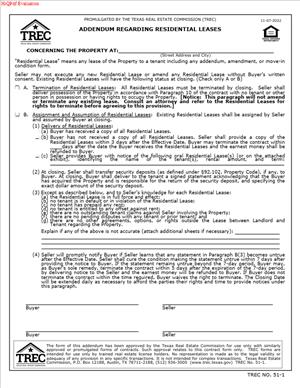
TREC Form 51-1 – Addendum Regarding Residential Leases
Fill out nowJurisdiction: Country: United States | Province or State: Texas
If you are reviewing or preparing a Texas real estate contract, you may come across the TREC Form 51-1 – Addendum Regarding Residential Leases. This document is used in residential real estate transactions when an existing lease affects the property being sold.
The TREC Form 51-1 – Addendum Regarding Residential Leases adds specific lease-related terms to a purchase contract. It helps clarify what happens when a property is occupied by a tenant at the time of sale. Without this addendum, key details about the lease may be unclear.
This form is commonly used by buyers, sellers, and real estate license holders handling transactions involving rental properties. It is not a standalone contract. It modifies and supplements a separate sales agreement.
If you are about to fill it out, you need to understand how the lease impacts possession, rent, security deposits, and obligations after closing. The form is designed to make those points clear before the transaction is finalized.
What is TREC Form 51-1 – Addendum Regarding Residential Leases?
Clear definition
TREC Form 51-1 – Addendum Regarding Residential Leases is an official addendum issued by the Texas Real Estate Commission. It is attached to a residential sales contract when the property is subject to one or more residential leases.
An addendum is not a replacement contract. It changes or adds terms to the main agreement. In this case, it addresses how existing tenant leases will be handled as part of the sale.
The document typically identifies whether the buyer will assume the lease and become the new landlord after closing. It may also address transfer of security deposits and prorated rent.
Who typically uses this form?
This form is commonly used by sellers who are selling rental property that is currently occupied by tenants. It is also used by buyers purchasing homes as investment properties with existing tenants.
Real estate agents often prepare this addendum when listing or selling tenant-occupied properties. Buyers and sellers review and sign it as part of the overall contract package.
It may also be relevant to property owners who temporarily leased their home and now plan to sell before the lease ends.
Why might you need this form?
You may need this form if the property you are buying or selling is not vacant at closing. A tenant’s lease creates legal rights that continue beyond the sale unless properly addressed.
Without a written addendum, the main sales contract may not clearly state whether the lease will continue after closing. That can create confusion about who is entitled to rent and who is responsible for the tenant.
This form helps align expectations. It explains whether the buyer will honor the existing lease and what documents or funds must transfer at closing.
Typical real-life scenarios
- A landlord decides to sell a single-family home that has a tenant with six months remaining on the lease. The buyer wants to keep the tenant in place as a rental investment. The addendum is used to confirm that the lease will remain in effect after closing.
- A homeowner relocates for work and rents out the property for a year. Halfway through the lease, the owner receives a strong purchase offer. The addendum clarifies how the remaining lease term will be handled in the sale.
- An investor purchases a duplex with two separate leases in place. The addendum may reference both leases and address how rent and deposits are transferred at closing.
- A buyer is willing to purchase a tenant-occupied property but wants copies of the lease and records of rent payments before proceeding. The addendum can require delivery of those documents before closing.
When would you use TREC Form 51-1 – Addendum Regarding Residential Leases?
You would use TREC Form 51-1 – Addendum Regarding Residential Leases when negotiating or finalizing a residential sales contract involving a leased property. It is typically prepared at the same time as the main purchase agreement.
The form is most relevant when the tenant will remain in possession after closing. In that case, the buyer generally steps into the position of landlord once the sale is completed.
It may also be used when the lease is set to expire before or shortly after closing. The addendum can clarify whether the seller must deliver the property vacant or whether the buyer accepts the tenant through the end of the lease term.
In transactions involving multiple units, such as duplexes or small multifamily properties, the addendum helps identify each lease that will be assigned to the buyer. It creates a written record of the leases that affect the property at the time of sale.
Both buyers and sellers benefit from addressing lease issues early. The form helps reduce misunderstandings about rent collection, maintenance responsibilities, and tenant rights during the transition.
Legal Characteristics of TREC Form 51-1 – Addendum Regarding Residential Leases
This addendum becomes part of the sales contract once it is properly completed and signed by all required parties. It works together with the main agreement, not separately from it.
For the form to function as intended, it must clearly identify the property and reference the correct sales contract. Missing signatures, incomplete lease information, or conflicting terms between the addendum and the main contract can create problems.
Common issues include failing to attach a copy of the lease, misstating the amount of the security deposit, or overlooking prepaid rent. These details matter because they affect financial adjustments at closing.
In Texas, residential leases are generally enforceable contracts between landlord and tenant. A sale of the property does not automatically cancel the lease. This addendum acknowledges that reality and addresses how the lease continues after ownership changes.
The form does not create a new lease. It does not change the tenant’s rights unless the lease itself allows modifications and proper procedures are followed. It also does not remove obligations that exist under separate landlord-tenant law.
Is it legally binding?
TREC Form 51-1 – Addendum Regarding Residential Leases is generally legally binding when it is properly completed, attached to a valid sales contract, and signed by the buyer and seller.
Its binding effect comes from the mutual agreement of the parties. Once signed, its terms become part of the overall contract governing the transaction.
However, the form’s enforceability depends on accuracy and consistency. If it conflicts with the main contract and the conflict is not resolved, interpretation issues may arise.
It binds the buyer and seller to each other. It does not, by itself, change the tenant’s lease terms unless the tenant separately agrees to a modification where required. The tenant’s rights typically continue under the existing lease, subject to general landlord-tenant rules.
How to fill out TREC Form 51-1 – Addendum Regarding Residential Leases
Step 1 – Identify the property and contract
Begin by confirming the property address and legal description match the main sales contract. The addendum must clearly reference the same transaction. Review the contract date and the names of the buyer and seller for consistency.
Step 2 – State whether the property is subject to a lease
Indicate whether the property is currently under one or more residential leases. If it is, confirm that a copy of each lease has been provided or will be provided. Make sure the lease details match the actual written agreement with the tenant.
Step 3 – Provide lease details
Enter key information from the lease, such as the tenant’s name, lease start and end dates, monthly rent amount, and security deposit. Accuracy matters because these figures affect closing adjustments and ongoing obligations.
Step 4 – Address transfer of security deposits
State how the security deposit will be handled at closing. The form typically reflects that the seller transfers the deposit to the buyer. Confirm the amount matches the lease and any records of receipt.
Step 5 – Clarify rent prorations
Specify how rent will be prorated between buyer and seller as of the closing date. This ensures each party receives the correct portion of rent for the time they own the property. Review the lease to confirm the rent due date and payment status.
Step 6 – Confirm delivery of documents and records
Indicate whether the seller will provide copies of leases, amendments, payment histories, and tenant correspondence. These records help the buyer understand the current status of the tenancy at closing.
Step 7 – Review for consistency with the main contract
Compare the completed addendum with the primary sales agreement. Check for conflicting terms about possession, closing date, or property condition. Resolve any inconsistencies before signing.
Step 8 – Sign and date the addendum
Ensure that all required parties sign and date the addendum. Signatures typically include the buyer and seller. Once executed, the addendum becomes part of the overall contract package governing the sale.
Legal terms you might encounter in TREC Form 51-1 – Addendum Regarding Residential Leases
- Existing Lease: This refers to a written rental agreement already in place between the current owner (landlord) and a tenant. In this document, you must identify whether such a lease exists and confirm its status. The form is designed to address how that lease will be handled when the property is sold.
- Tenant: The individual or individuals who signed the lease and currently occupy the property. You may need to list each tenant’s name exactly as it appears on the lease. Accurate identification avoids confusion about who has legal rights to remain in possession.
- Landlord: The current property owner who entered into the lease with the tenant. When the property is sold, the buyer may become the new landlord. This document helps define when and how that change happens.
- Security Deposit: Money the tenant paid to secure performance under the lease. The addendum addresses whether the seller transfers the security deposit to the buyer at closing. You must confirm the amount and how it will be credited or delivered.
- Proration: A method of dividing rent or other income based on the number of days each party owns the property during a billing period. This form may address how rent is prorated at closing. You should ensure the numbers align with the closing statement.
- Assignment of Lease: The transfer of the landlord’s rights and obligations under the lease from the seller to the buyer. This happens by operation of the sale, but the form clarifies expectations. It ensures the buyer steps into the landlord’s role.
- Possession: The legal right to occupy the property. If a tenant is in place, the buyer typically does not receive immediate vacant possession. This form confirms whether the buyer accepts the property subject to the tenant’s possession.
- Lease Term: The duration of the lease, including start and end dates. You may need to confirm these dates to avoid disputes after closing. The buyer should understand how long the tenant has the right to stay.
- Rent Roll: A summary of rental payments, including monthly rent and payment status. While not always attached, the information in this document should match any rent roll provided. Discrepancies can lead to post-closing disputes.
- Default: A failure to perform under the lease, such as nonpayment of rent. The form may require the seller to disclose whether the tenant is in default. Clear disclosure protects both parties from surprises after closing.
FAQs
Do I need to use TREC Form 51-1 – Addendum Regarding Residential Leases if there is a month-to-month tenant?
Yes. A month-to-month arrangement is still a lease. You should indicate that the property is subject to an existing lease and describe its terms, even if it renews each month automatically. Confirm the current rent amount and when rent is due so the buyer understands what continues after closing.
What lease details do I need to enter on this form?
You need the tenant’s full name as written in the lease, the lease start date, the lease end date (if any), the monthly rent amount, and the amount of the security deposit. You should also confirm whether the tenant has prepaid rent. Make sure these entries match the written lease and any amendments.
What happens to the security deposit at closing?
This document requires you to state the amount of the security deposit and how it will be handled. Typically, the seller transfers the deposit to the buyer, and the buyer credits the seller on the closing statement. You must verify the exact amount held so the accounting is accurate.
Does the buyer automatically become the landlord after closing?
In most transactions, yes. When ownership transfers, the buyer assumes the landlord’s position under the lease. This form confirms that the buyer accepts the property subject to the lease and understands the tenant’s rights continue after closing.
Should I attach a copy of the lease to this document?
It is common to provide a copy of the signed lease and any amendments. While this form summarizes key terms, the full lease controls the tenant relationship. Review the contract instructions to see whether attachments are required and confirm all pages are complete and legible.
What if the tenant is behind on rent?
You should disclose the current payment status before completing this document. If rent is unpaid, clarify how that will be handled at closing. The buyer needs to know whether they are inheriting an active lease in good standing or one with issues.
How do I make sure the dates and names are consistent with the sales contract?
Compare the property address, legal description, and party names on this form with the main purchase contract. Even small differences can create confusion at closing. Confirm that the effective date of the contract and the lease term dates do not conflict.
Can the buyer require the tenant to move out after closing?
That depends on the lease terms. If there is a valid lease in place, the tenant generally has the right to stay until the lease expires or is properly terminated. This document does not cancel the lease; it confirms the buyer accepts the property subject to it.
Checklist: Before, During, and After TREC Form 51-1 – Addendum Regarding Residential Leases
Before
- Obtain a complete copy of the current lease and all amendments.
- Confirm the tenant’s full legal name as written in the lease.
- Verify the monthly rent amount and due date.
- Confirm the exact security deposit amount held.
- Check whether any rent has been prepaid beyond the closing date.
- Review the sales contract for provisions about leased property.
- Confirm the lease start and end dates.
- Determine whether the tenant is in default.
During
- Enter the property address exactly as shown in the sales contract.
- Identify whether the property is subject to a written lease.
- List tenant names without spelling errors.
- Insert accurate lease term dates.
- State the correct monthly rent and security deposit amounts.
- Clarify how rent will be prorated at closing.
- Confirm how the security deposit will be transferred.
- Ensure both buyer and seller sign where required.
After
- Provide a copy of the signed document to all parties.
- Deliver a complete copy of the lease to the buyer.
- Confirm the closing statement reflects rent prorations.
- Verify the security deposit credit is shown correctly at closing.
- Notify the tenant of the change in ownership after closing.
- Update internal records to reflect the new landlord.
- Retain copies with your transaction documents.
- Confirm the buyer has received all keys and lease-related records.
Common mistakes to avoid with TREC Form 51-1 – Addendum Regarding Residential Leases
- Mistake: Listing the wrong security deposit amount because you rely on memory instead of checking records, which can cause disputes at closing and potential reimbursement issues; do not forget to verify the exact amount held.
- Mistake: Misspelling the tenant’s name because you copied it from an informal note, which may create confusion about who holds lease rights; do not forget to match the lease exactly.
- Mistake: Failing to disclose unpaid rent because you assume it will be collected later, which can shift unexpected risk to the buyer; do not forget to confirm the tenant’s current payment status.
- Mistake: Using inconsistent property addresses between this document and the main contract, which can delay closing; do not forget to cross-check every reference.
- Mistake: Ignoring prepaid rent that extends beyond closing, which can result in incorrect prorations; do not forget to review recent rent receipts.
- Mistake: Forgetting to attach lease amendments because you think only the original lease matters, which may leave out key terms; do not forget to include all signed changes.
- Mistake: Assuming the buyer can remove the tenant immediately, which can lead to unrealistic expectations and conflict; do not forget that an existing lease usually continues after closing.
- Mistake: Failing to obtain required signatures because you believe the main contract is enough, which can make the addendum unenforceable; do not forget that all required parties must sign.
What to do after filling out TREC Form 51-1 – Addendum Regarding Residential Leases
Once you complete the form, slow down and review it line by line. Make sure every number matches your lease documents and your sales contract. Small errors create big problems at closing.
- Step 1: Re-read the entire addendum and compare it to the signed purchase contract for consistency in names, dates, and property description.
- Step 2: Attach a full copy of the current lease and all amendments so the buyer has the complete agreement.
- Step 3: Confirm the stated security deposit matches your accounting records and tenant ledger.
- Step 4: Deliver the signed addendum to the other party according to the notice provisions in the purchase contract.
- Step 5: Provide a copy to the title company or closing agent so rent prorations and deposit transfers are reflected on the closing statement.
- Step 6: Review the preliminary closing disclosure or settlement statement to ensure rent and deposits are properly credited.
- Step 7: After closing, notify the tenant in writing of the new owner’s name and where future rent payments should be sent.
- Step 8: Transfer the security deposit to the buyer as reflected in the closing statement and keep proof of transfer.
- Step 9: Organize and store copies of the signed addendum, lease, and proof of deposit transfer with your transaction records.
- Step 10: Update your internal bookkeeping to show the date ownership transferred and that you no longer manage the lease.
Keep your documentation clean and complete. If a dispute arises later about rent, deposits, or lease terms, your records will be your first line of defense. Being organized now prevents confusion months after closing.
Disclaimer: This guide is provided for informational purposes only and is not intended as legal advice. You should consult a legal professional.