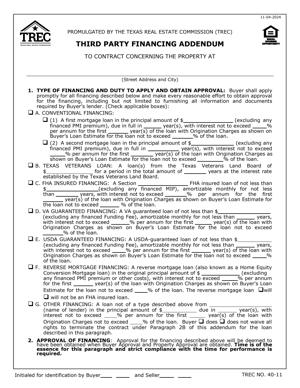
TREC Form 40-11 – Third Party Financing Addendum
Fill out nowJurisdiction: Country: United States | Province or State: Texas
When you are buying property in Texas and plan to use a loan, the TREC Form 40-11 – Third Party Financing Addendum becomes a key part of your contract. It connects your purchase agreement to the details of your financing. Without it, your contract may not clearly address what happens if your loan is not approved.
The TREC Form 40-11 – Third Party Financing Addendum is designed for transactions where a buyer relies on financing from a lender that is not the seller. It lays out the type of loan, approval timelines, and conditions tied to that financing.
If you are about to sign a real estate contract and your purchase depends on getting a mortgage, this form explains your rights and responsibilities around that loan. It can affect whether you keep or lose your earnest money.
Understanding how this addendum works helps you see how financing fits into the larger agreement. It also helps you track deadlines that may impact the entire transaction.
What is TREC Form 40-11 – Third Party Financing Addendum?
Clear definition
TREC Form 40-11 – Third Party Financing Addendum is an addendum to a Texas real estate purchase contract. It adds specific terms that apply when the buyer intends to obtain financing from a third-party lender.
A third-party lender is typically a bank, credit union, or mortgage company. The seller is not providing the loan. This addendum describes the type of loan the buyer seeks, such as conventional, government-backed, or another approved program.
The document also addresses loan approval, property approval, and what happens if those approvals do not occur within the stated time. It works together with the main contract and does not replace it.
Who typically uses this form?
Buyers who need a mortgage to purchase residential property in Texas commonly use this form. It is frequently attached to contracts for single-family homes, townhomes, and condominiums.
Sellers review and sign the addendum as well. It directly affects their timeline and certainty about closing. If the buyer’s financing falls through under certain conditions, the contract may terminate.
Real estate agents often prepare this form as part of the contract package. Both parties then review and sign it along with the main agreement.
Why might you need this form?
If you are not paying all cash, your ability to close depends on a lender’s approval. This addendum sets clear terms for that process. It explains how long you have to obtain credit approval and what happens if the loan is denied.
It also helps define what kind of loan you are seeking. The type of loan can affect appraisal requirements, property standards, and closing timelines.
Without this addendum, the contract may not clearly protect you if financing is unavailable. At the same time, it provides structure for the seller so they understand the financing conditions tied to the sale.
Typical real-life scenarios
- You sign a contract to buy a home and apply for a conventional 30-year mortgage. The addendum states that you must obtain credit approval within a specific number of days. If your lender denies the loan during that period, the contract may terminate under the terms described.
- You apply for a government-backed loan that requires a property appraisal meeting certain standards. The home appraises below the purchase price. The addendum outlines how the appraisal result may affect the transaction.
- You are prequalified but not fully approved. During underwriting, the lender requests additional documents. The timeline in the addendum determines how long you have to secure final approval.
- You are buying a condominium. The lender must approve not only you but also the condominium project. If the project does not meet lending guidelines, the addendum addresses whether the contract can end and how earnest money is handled.
When would you use TREC Form 40-11 – Third Party Financing Addendum?
You use this form when the purchase of property depends on financing from a third-party lender. It is typically signed at the same time as the main purchase contract.
This addendum is common in residential resale transactions. It may also be used in new construction purchases when the buyer is not paying cash.
Both buyers and sellers rely on the deadlines in the document. The buyer tracks the credit approval period. The seller monitors that same period to know when the contract becomes less dependent on financing conditions.
If the buyer later changes loan programs, the original terms in the addendum may no longer match the actual financing. In practice, parties sometimes amend the contract to reflect updated loan terms.
The form is generally not used for seller financing. Separate addenda exist for situations where the seller provides the loan directly to the buyer.
Legal characteristics of TREC Form 40-11 – Third Party Financing Addendum
This addendum becomes part of the binding purchase contract once all parties sign it. It is not a standalone agreement. Its legal effect depends on the main contract remaining in force.
For the addendum to be effective, it must be properly completed and signed by all required parties. Missing signatures, incomplete loan descriptions, or unclear deadlines can create confusion.
Common problems arise when deadlines are not tracked. If the credit approval period expires without action, the buyer’s ability to terminate under that provision may change. Misunderstanding the difference between credit approval and property approval can also lead to disputes.
In Texas, real estate forms issued by the Texas Real Estate Commission are widely used in residential transactions. However, how financing contingencies operate can vary in other states. The structure and terminology in this document reflect Texas practice.
This addendum does not guarantee loan approval. It does not obligate the lender to fund the loan. It also does not replace the lender’s separate loan application and underwriting process.
It does not set the interest rate or final loan costs. Those details are addressed in the buyer’s loan documents with the lender. The addendum focuses on contract rights between buyer and seller.
Is it legally binding?
Yes, once signed by both buyer and seller, this addendum is generally legally binding as part of the overall contract. Its terms become enforceable along with the rest of the agreement.
Its binding effect depends on proper execution. If the main contract is valid and the addendum is correctly incorporated and signed, the financing conditions in the addendum apply.
However, certain provisions operate only within stated timeframes. For example, the buyer’s right to terminate due to lack of credit approval typically exists only during a defined period. After that period, the contract may continue without that contingency.
Because it is tied to financing, its practical impact often depends on communication between buyer, lender, and seller during the approval process.
How to fill out TREC Form 40-11 – Third Party Financing Addendum
Step 1 – Identify the Property and Parties
Begin by confirming that the property address and the names of the buyer and seller match the main purchase contract exactly. The addendum must clearly connect to the correct transaction. Any mismatch can create uncertainty about which contract the financing terms apply to.
Step 2 – Select the Type of Financing
Indicate the type of loan you intend to obtain. This may include conventional financing, government-backed financing, or another specified loan type. The selection should reflect your actual loan application. The choice affects appraisal standards and lender requirements.
Step 3 – State the Loan Amount and Terms
Enter the principal loan amount or percentage of the purchase price, as required by the form. Include any required details about the loan term and interest rate conditions if the form calls for them. These figures set expectations about the scope of financing you are seeking.
Step 4 – Fill in the Credit Approval Period
Insert the number of days allowed for obtaining credit approval. This period begins from the effective date of the contract. The deadline is critical because it defines how long the financing contingency related to credit approval remains active.
Step 5 – Review the Property Approval Conditions
Read the section addressing property approval, including appraisal requirements. Understand how the form handles situations where the property does not meet lender criteria or appraises below the sales price. Complete any blanks related to how appraisal shortfalls will be handled, if applicable.
Step 6 – Confirm Buyer’s Obligations
The form typically states that the buyer must make a good-faith effort to obtain the loan. Review this language carefully. Ensure your loan application has been submitted and that you are prepared to provide the requested documentation within the approval period.
Step 7 – Check for Additional Financing Provisions
Some versions of the addendum allow for additional terms or attachments. If any special financing conditions apply, verify that they are clearly written and consistent with the main contract. Avoid vague descriptions that could lead to different interpretations later.
Step 8 – Sign and Date the Addendum
All required parties must sign and date the document. The effective date of the contract, not the signature date alone, often controls the start of the approval timeline. After signing, ensure the addendum is attached to and retained with the full contract package.
Legal terms you might encounter in TREC Form 40-11 – Third Party Financing Addendum
- Third-Party Financing: This means the buyer is borrowing money from a lender that is not the seller. In this form, it refers to a loan from a bank, mortgage company, credit union, or other institutional lender. The addendum sets out the terms under which that outside loan must be approved.
- Loan Approval: This is the lender’s confirmation that the buyer qualifies for the loan described in the addendum. The approval must usually meet the specific terms listed, such as loan amount, interest rate, and type of financing. If the lender does not approve the buyer within the stated time, certain contract rights may be triggered.
- Credit Approval: This focuses on the buyer’s financial qualification. The lender reviews income, credit score, debts, and assets. The addendum often includes a deadline for obtaining this approval, which directly affects whether the contract continues.
- Property Approval: Lenders do not just approve buyers. They also evaluate the property. This may include an appraisal and review of the title or condition. If the property does not meet the lender’s requirements, the loan may be denied even if the buyer qualifies financially.
- Loan Amount: This is the principal sum the buyer intends to borrow. The amount listed in the addendum must align with the purchase price and down payment. If the buyer cannot secure at least this amount, it may impact their ability to close.
- Interest Rate: This is the cost of borrowing money, expressed as a percentage. The addendum may state a maximum interest rate the buyer is willing to accept. If market rates exceed that limit and the buyer cannot secure financing within it, the contract terms may come into play.
- Loan Type: This describes the specific financing program, such as conventional, FHA, VA, or another loan product. The type selected affects qualification standards, property requirements, and closing costs. The addendum makes clear which type the buyer is pursuing.
- Amortization: This refers to how the loan payments are spread over time. A 30-year amortization means payments are calculated over 30 years. The term listed in the addendum affects the monthly payment and overall cost of the loan.
- Origination Fees and Discount Points: These are upfront charges from the lender. Origination fees cover processing costs. Discount points are prepaid interest to lower the rate. While the addendum does not calculate these fees, they influence whether the buyer can realistically obtain the stated financing.
- Termination Option: Under certain conditions, if financing is not approved within the specified period, the buyer may have the right to terminate the contract. The addendum explains when and how that right applies. Missing deadlines can change the outcome.
FAQs
What date controls the financing approval deadline?
Look at the effective date of the main purchase contract. The number of days stated in this document for credit approval is counted from the effective date. You need to confirm the exact calendar date when the approval period ends and write it down for your own tracking so you do not miss it.
What happens if I am approved for a different loan type than the one listed?
This form ties your approval to the specific financing described. If the lender approves you for a different loan type, a different amount, or a higher rate than stated, you must check whether it still meets the terms written in the addendum. If it does not match, you may not automatically be considered approved under TREC Form 40-11 – Third Party Financing Addendum.
Do I need to attach my pre-approval letter to this document?
The form itself does not require you to physically attach a pre-approval letter when signing. However, the seller may request proof that you have applied for and are pursuing financing. Keep your pre-approval and any lender correspondence organized so you can provide it quickly if asked.
What if my lender asks for more time beyond the credit approval period?
The deadlines written in this document control unless both parties agree in writing to extend them. If your lender needs more time, you must request an extension before the deadline expires. Waiting until after the period ends can affect your rights under this form.
Does this form change the closing date?
It does not automatically change the closing date listed in the main contract. Financing approval deadlines and the closing date are separate timelines. You need to make sure your loan process is on track to meet the closing date, even if you receive approval within the allowed period.
Who must sign this addendum for it to be valid?
All parties who signed the main purchase contract should sign this addendum. Check that names match exactly as they appear in the contract. If a trust, estate, or entity is involved, confirm that the person signing has proper authority and lists their title correctly.
What if I am approved, but the property appraisal comes in low?
Loan approval often depends on the property meeting the lender’s value requirements. If the appraisal is lower than the purchase price, the lender may reduce the loan amount. You must review whether the reduced amount still satisfies the financing terms stated in TREC Form 40-11 – Third Party Financing Addendum.
Is this document recorded in public records?
No. This document is part of the private purchase contract between buyer and seller. It is not filed with the county property records. It does not change the public title record; it only sets financing conditions between the parties.
Checklist: Before, During, and After TREC Form 40-11 – Third Party Financing Addendum
Before
- Review the main purchase contract and confirm the effective date.
- Obtain a current pre-approval letter that matches your intended loan type.
- Calculate your down payment and confirm the loan amount you need.
- Research current interest rates to set a realistic maximum rate.
- Verify the property appears eligible for your selected loan program.
- Confirm your income, assets, and credit information are accurate.
- Note key deadlines in a calendar before signing.
During
- Enter the correct property address exactly as in the contract.
- Select the correct loan type and avoid checking multiple conflicting options.
- Fill in the loan amount that aligns with your purchase price and down payment.
- State a maximum interest rate you are willing to accept.
- Insert the number of days for credit approval carefully.
- Double-check spelling of all buyer and seller names.
- Confirm all blanks are completed or marked as not applicable.
- Ensure all required signatures and dates are included.
After
- Submit your full loan application immediately.
- Provide all requested financial documents to your lender promptly.
- Track the credit approval deadline on your calendar.
- Follow up with your lender weekly for status updates.
- Keep written proof of loan approval or denial.
- Request extensions in writing before any deadline expires.
- Confirm appraisal and property approval requirements are met.
- Store a signed copy of the addendum with your contract records.
Common mistakes to avoid with TREC Form 40-11 – Third Party Financing Addendum
- Mistake: Listing a loan amount that does not match your financial reality, often because buyers estimate instead of calculating; this can lead to loan denial and lost time, so do not forget to base the amount on verified income and assets.
- Mistake: Leaving the maximum interest rate blank because you are unsure what to put; this happens when buyers assume rates will stay low, but failing to set a clear limit can remove flexibility if rates rise, so do not forget to choose a realistic cap.
- Mistake: Miscounting the credit approval days from the wrong start date; this occurs when you confuse the signing date with the effective date, which can cause you to miss your termination window, so do not forget to confirm the contract’s effective date.
- Mistake: Failing to apply for the loan immediately after signing; some buyers delay gathering documents, which can jeopardize approval within the deadline, so do not forget to start the full application process right away.
- Mistake: Assuming verbal approval from a loan officer is enough; this happens when buyers rely on informal updates, but without written confirmation you may not be protected, so do not forget to obtain documented approval.
- Mistake: Not verifying signer authority for entities or trusts; this often occurs when a representative signs without listing their title, which can create enforceability issues, so do not forget to clearly state the signer’s capacity.
- Mistake: Ignoring property-related loan conditions like appraisal or required repairs; buyers focus only on credit approval, but unmet property conditions can still block closing, so do not forget to track both credit and property approval.
What to do after filling out TREC Form 40-11 – Third Party Financing Addendum
Once you complete and sign the addendum, your focus shifts to performance. The document sets expectations. Now you must act quickly and stay organized.
- Step 1: Deliver a signed copy to the other party as required by your contract.
- Step 2: Confirm the effective date of the contract in writing for your records.
- Step 3: Submit your complete loan application if you have not already done so.
- Step 4: Provide all requested supporting documents to your lender within the requested timelines.
- Step 5: Calendar the credit approval deadline and set reminders several days in advance.
- Step 6: Monitor the appraisal process and confirm when it is ordered and completed.
- Step 7: Obtain written confirmation of credit approval that matches the loan terms in the addendum.
- Step 8: Review the approval letter carefully to ensure the loan type, amount, and rate align with what you selected.
- Step 9: If terms differ or approval is delayed, communicate in writing before the deadline.
- Step 10: Keep digital and paper copies of all correspondence, approvals, and signed documents.
- Step 11: Coordinate with the closing agent to ensure financing documents will be ready by the closing date.
- Step 12: Update your personal budget and moving plans based on confirmed loan terms.
Stay proactive. Financing delays usually happen because documents are missing or communication slows down. You can reduce risk by responding quickly, confirming details in writing, and tracking every deadline. This addendum creates conditions. Your follow-through determines whether the transaction closes smoothly.
Disclaimer: This guide is provided for informational purposes only and is not intended as legal advice. You should consult a legal professional.