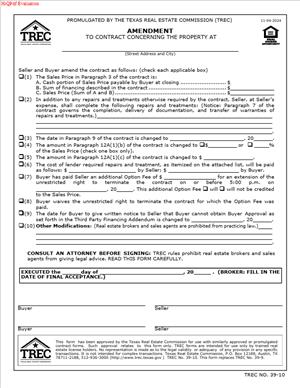
TREC Form 39-10 – Amendment to Contract
Fill out nowJurisdiction: Country: United States | Province or State: Texas
TREC Form 39-10 – Amendment to Contract is a document used in Texas real estate transactions to change an existing purchase contract. It allows the buyer and seller to update specific terms without creating an entirely new agreement.
If you are in the middle of a home sale and something needs to change, this form helps document that change clearly. It keeps both parties on the same page. It also creates a written record that becomes part of the original contract.
You may be about to fill it out because the closing date needs to move, repairs need to be addressed, or financing terms have changed. Instead of rewriting the contract, this amendment adjusts only the agreed-upon parts.
This document matters because real estate contracts are legally binding. Verbal agreements are not enough. If a term changes, it needs to be in writing and signed to avoid disputes later.
Understanding how this form works will help you complete it accurately and avoid common mistakes that delay a transaction.
What is TREC Form 39-10 – Amendment to Contract?
Clear definition
TREC Form 39-10 – Amendment to Contract is a standardized Texas real estate form used to modify an existing residential purchase contract. It does not replace the original contract. Instead, it changes specific provisions while keeping the rest of the agreement intact.
The form identifies the original contract by date and property address. It then lists the exact terms being amended. Once signed by both buyer and seller, the changes become part of the contract.
This document is structured to reduce confusion. Each section targets common areas that may need adjustment, such as closing dates, sales price, repairs, or financing terms.
Who typically uses this form?
This form is commonly used by buyers and sellers involved in a Texas residential real estate transaction. Real estate agents often prepare it as part of their role in managing the transaction.
Attorneys may also be involved, especially in more complex situations. However, the parties themselves are the ones who ultimately sign the amendment.
You might use this form if you are a buyer negotiating new terms after an inspection. You might also use it as a seller agreeing to extend the closing date or adjust the purchase price.
Why might you need this form?
Real estate transactions often change after the original contract is signed. Inspections may reveal issues. Financing approval may take longer than expected. Appraisals may come in below the agreed price.
When a material term changes, it must be documented. This form allows both parties to clearly state what is changing and confirm their agreement in writing.
Without a written amendment, misunderstandings can arise. One party may believe a date or price changed, while the other believes the original contract still controls. This document reduces that risk.
Typical real-life scenarios
- A buyer completes a home inspection and requests repairs. The seller agrees to fix certain items before closing. Instead of relying on emails or text messages, the parties use this amendment to list the agreed-upon repairs and deadlines.
- An appraisal comes in lower than the purchase price. The buyer and seller negotiate a reduced price. The amendment reflects the new agreed amount and confirms that all other terms remain the same.
- A lender needs more time to finalize the buyer’s loan. The original closing date is too soon. The parties agree to extend the closing by two weeks, and the form documents the new date.
- A seller needs extra time to move out after closing. The parties agree to modify possession terms. The amendment states when the buyer will receive possession and under what conditions.
When would you use TREC Form 39-10 – Amendment to Contract?
You use this form after the original purchase contract has been signed but before the transaction is fully completed. It applies during the active phase of the agreement, typically before closing.
It is often used when both parties agree that a specific term no longer works as written. That could involve price, closing date, financing, repairs, or other contract provisions.
Buyers may request an amendment after inspections, financing updates, or appraisal results. Sellers may request changes if timing, possession, or other logistics shift.
This document is not for negotiating from scratch. It assumes there is already a valid contract in place. The amendment builds on that contract and modifies only the sections identified in the form.
In practice, the amendment is signed as soon as both parties agree on the new terms. The timing matters because deadlines in the original contract may continue running unless properly modified.
Legal characteristics of TREC Form 39-10 – Amendment to Contract
This form becomes effective when it is properly completed and signed by all required parties. The amendment must clearly reference the original contract and identify the property.
Clarity is critical. If the amended terms are vague, inconsistent, or incomplete, confusion can arise about what actually changed. Ambiguous language can create disputes later.
The form typically includes language confirming that all other terms of the original contract remain unchanged. This protects the integrity of the overall agreement while allowing targeted modifications.
Common issues include missing signatures, incorrect dates, or failing to specify which section of the original contract is being changed. Inconsistent information, such as mismatched property addresses or party names, can also cause problems.
While the form is standardized for Texas real estate transactions, how amendments are interpreted can depend on general contract principles. Courts generally look at whether there was mutual agreement, clear terms, and proper execution.
This document does not create a new sale contract. It does not replace the original agreement unless expressly stated. It only changes the provisions listed within it.
Is it legally binding?
Yes, an amendment can be legally binding when certain conditions are met. Both parties must agree to the changes. That agreement must be reflected in the written document and signed.
A signed amendment becomes part of the original contract. It carries the same legal weight as the rest of the agreement, provided it is properly executed.
If only one party signs, or if the changes are not clearly stated, the amendment may not be enforceable. Mutual consent is essential.
Timing also matters. If deadlines pass before an amendment is signed, rights under the original contract may already be affected. The amendment generally operates from the date it is fully executed, unless it clearly states otherwise.
How to fill out TREC Form 39-10 – Amendment to Contract
Step 1 – Identify the original contract
At the top of the form, enter the date of the original contract. This connects the amendment to the correct agreement. Make sure the date matches the signed purchase contract exactly.
Include the full property address as stated in the original document. This avoids confusion if either party is involved in multiple transactions.
Step 2 – Name the parties
Write the full legal names of the buyer and seller as they appear in the original contract. Consistency matters. Do not use nicknames or shortened versions if the contract lists full legal names.
Confirm that the names match the signed agreement. Errors in party identification can create questions about who agreed to the amendment.
Step 3 – Specify the amendments
Locate the section of the form that lists possible amendments. Clearly mark or fill in the specific change being made. This may involve checking a box, completing a blank line, or writing additional terms in the space provided.
If you are changing the sales price, enter the new agreed amount. If you are extending the closing date, write the new date clearly and completely.
Be precise. Instead of vague language, state exactly what is changing and, if necessary, reference the paragraph number of the original contract.
Step 4 – Add additional terms if needed
If the standard sections do not fully capture your agreement, use the additional blank space provided. Write the new terms clearly and in complete sentences.
State whether the new language replaces an existing paragraph or adds a new condition. Make it clear how the amendment interacts with the original contract.
Avoid informal wording. This is part of a legal agreement, so clarity and specificity are important.
Step 5 – Confirm unchanged terms
Review the form language confirming that all other terms of the original contract remain in effect. Read this carefully so you understand that only the listed items are being modified.
This section ensures that the amendment does not unintentionally alter other provisions. It preserves the structure of the original agreement.
Step 6 – Sign and date the amendment
Each party must sign and date the form in the designated spaces. The signatures show mutual agreement to the changes.
Check that the dates next to each signature are accurate. The amendment typically becomes effective once all required parties have signed.
After signing, ensure that each party receives a copy of the completed document. Keep it with the original contract so all documents stay together as part of the transaction record.
Legal terms you might encounter in TREC Form 39-10 – Amendment to Contract
- Amendment: A written change to an existing contract. In this document, the amendment modifies specific terms of the original real estate contract without replacing the entire agreement. Only the items listed in the amendment are changed. Everything else stays the same.
- Effective Date: The date the amendment becomes binding. This is usually the date when the last party signs the amendment, unless the form states otherwise. You need to confirm this date because deadlines in the contract may shift based on it.
- Original Contract: The previously signed purchase contract is being modified. This form requires you to identify that contract clearly, often by property address and original execution date. If you misidentify it, the amendment may not attach to the correct agreement.
- Parties: The buyer and seller named in the original contract. The names on the amendment must match exactly as written in the original agreement. If a party signed as a trust, LLC, or other entity, the same structure should appear here.
- Consideration: Something of value exchanged to support the amendment. In many real estate amendments, the mutual agreement to change terms serves as consideration. Sometimes, additional earnest money or option fee changes may also be part of the amendment.
- Earnest Money: A deposit made by the buyer to show serious intent. This amendment may increase, decrease, or change deadlines related to earnest money. If it does, you must state the amount and timing clearly.
- Option Period: A negotiated time frame during which the buyer may terminate the contract, often for inspections. If you extend or shorten this period through the amendment, be precise about the new end date and time.
- Addendum: A separate document that adds terms to a contract. An amendment changes existing terms, while an addendum typically adds new provisions. This form may reference addenda that remain in effect.
- Closing Date: The date when the transaction is scheduled to finalize. Many amendments adjust the closing date. When you change it, confirm that all related deadlines still align with the new schedule.
- Ratification: The act of confirming and approving terms by signature. When both parties sign this amendment, they ratify the changes. Without signatures from all required parties, the amendment is not fully effective.
FAQs
Do both the buyer and seller have to sign this document for it to be valid?
Yes. An amendment to a real estate contract must be signed by all parties who are bound by the original agreement. If even one required signer does not sign, the changes are not fully effective. Check the signature block carefully and confirm that each party signs in the same capacity as in the original contract.
What date should I list as the effective date of the amendment?
Most amendments become effective on the date the last party signs. You do not usually need to write in a separate effective date unless the form specifically asks for one. Keep track of when each party signs so you can determine when deadlines tied to the amendment begin.
How do I properly reference the original contract in TREC Form 39-10 – Amendment to Contract?
You must clearly identify the original contract by including the property address and the date it was signed. Use the exact information shown on the first page of the original agreement. This prevents confusion if there were multiple offers or prior contracts on the same property.
Can this document be used to change the purchase price?
Yes, if both parties agree. You would state the new purchase price clearly in the section that modifies the original terms. Make sure the new amount is written in both numbers and words if required, and confirm that related items like loan amounts and closing costs still make sense with the revised price.
What happens to the terms that are not mentioned in this form?
Any term not specifically changed remains in full force and effect. This document does not rewrite the entire contract. It only updates the sections you list. Always review the full contract to ensure the unchanged terms still reflect your understanding.
Do I need to attach supporting documents or addenda?
If the amendment refers to another document, such as a revised repair list or updated financing letter, attach it and clearly label it. Make sure all referenced attachments are signed if required. Keep copies of everything together with the original contract.
Can I use this form to extend the closing date after a delay?
Yes, that is one of the most common uses of this document. Clearly state the new closing date and confirm whether any other deadlines also need adjustment. If financing or inspection timelines depend on the closing date, review those sections carefully.
Will changes made on TREC Form 39-10 – Amendment to Contract appear in public records?
Typically, amendments to a purchase contract are not recorded in public records. The deed and related closing documents are what usually get recorded. However, the terms in this document will control your transaction, so keep a complete copy with your records.
Checklist: Before, During, and After TREC Form 39-10 – Amendment to Contract
Before
- Review the full original contract, including all addenda.
- Confirm the exact legal names of the buyer and seller.
- Identify the specific sections you want to change.
- Check current deadlines to see what has already passed.
- Verify the property address and original contract date.
- Discuss and agree on the new terms in writing or email.
- Gather any supporting documents you may need to attach.
During
- Enter the property address exactly as shown in the original contract.
- Fill in the original contract date accurately.
- Clearly describe each change in specific, measurable terms.
- Replace old dates with new complete dates, including month, day, and year.
- State any revised dollar amounts clearly and consistently.
- Confirm that unchanged terms remain in effect.
- Ensure all parties sign and date the amendment.
- Double-check spelling of names and numeric figures.
After
- Confirm the date the last party signed.
- Distribute signed copies to all parties.
- Provide a copy to the title company or closing agent.
- Update your calendar with any new deadlines.
- Attach the amendment to the original contract in your records.
- Review related documents to ensure consistency.
- Monitor compliance with the updated terms.
Common mistakes to avoid with TREC Form 39-10 – Amendment to Contract
- Mistake: Vaguely describing changes, which happens when parties rely on informal language; this creates confusion about what was actually modified and can lead to disputes, so clearly restate the exact new term and do not forget to specify full dates and amounts.
- Mistake: Forgetting to update related deadlines, which occurs when only the closing date is changed; this can cause missed contingency periods or financing issues, so review the entire timeline and do not forget interconnected time frames.
- Mistake: Using incorrect party names, often because someone shortens a legal name; this may raise enforceability concerns, so copy the names exactly as written and do not forget titles for entities or representatives.
- Mistake: Failing to obtain all required signatures, which happens when one party signs and assumes that is enough; this leaves the amendment ineffective, so confirm every required signature and do not forget dates next to each signature.
- Mistake: Changing the purchase price without reviewing financing terms, which can disrupt loan approval; this may delay closing or require new underwriting, so coordinate with all stakeholders and do not forget to adjust related figures.
- Mistake: Not keeping the amendment with the original contract, which happens when documents are stored separately; this creates confusion later, so organize your files carefully and do not forget to share copies with everyone involved.
- Mistake: Leaving blanks in the form, often due to uncertainty about a term; blanks can create ambiguity or disputes, so complete every applicable field and do not forget to write “not applicable” where appropriate.
- Mistake: Assuming verbal agreements are enough, which happens when parties trust informal discussions; verbal changes are not enforceable in the same way, so document every modification in writing and do not forget that only signed amendments control.
What to do after filling out TREC Form 39-10 – Amendment to Contract
Once you complete the amendment, your job is not over. You need to make sure the updated terms are recognized and followed by everyone involved in the transaction.
Start by confirming signatures and dates. Look at each signature line. Check that every required party signed. Confirm that each signature is dated. The effective date is usually the date the last person signed.
- Step 1: Verify that all signatures and dates are complete and legible.
- Step 2: Determine the effective date based on the final signature.
- Step 3: Make a clean, complete copy of the fully signed amendment.
- Step 4: Attach the amendment to the original contract and all prior addenda.
- Step 5: Send a copy to the title company or closing agent handling the transaction.
- Step 6: Update your calendar with all revised deadlines.
- Step 7: Notify any lenders if the amendment affects financing terms.
- Step 8: Review inspection, appraisal, and contingency timelines for consistency.
- Step 9: Store digital and paper copies in a secure location.
- Step 10: Monitor performance under the revised terms through closing.
If the amendment changes the closing date, confirm that the title company can accommodate the new schedule. If it changes the purchase price, check whether updated loan disclosures or approval steps are needed. If it extends the option period, make sure you understand the new termination deadline down to the specific date and time.
Keep your records organized. Place the amendment directly behind the original contract in your file. Label your digital copy clearly so you can find it quickly. If questions arise later, you will need to show the full chain of documents.
Finally, act according to the new terms. An amendment only works if both parties follow it. Track deadlines. Confirm required payments. Stay in communication with everyone involved. Clear documentation and careful follow-through will help your transaction move smoothly to closing.
Disclaimer: This guide is provided for informational purposes only and is not intended as legal advice. You should consult a legal professional.