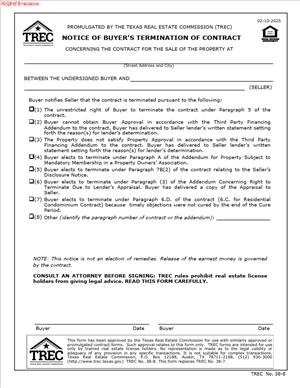
TREC Form 38-8 – Notice of Buyer’s Termination of Contract
Fill out nowJurisdiction: Country: United States | Province or State: Texas
If you are ending a real estate purchase in Texas, TREC Form 38-8 – Notice of Buyer’s Termination of Contract is the document that formally communicates that decision. It is used in residential real estate transactions governed by Texas Real Estate Commission contract forms.
This form gives written notice that you, as the buyer, are terminating the contract. In real estate, timing and written notice matter. A verbal statement is usually not enough to protect your position.
You may be filling this out because of inspections, financing issues, or another contract condition that allows termination. The form helps create a clear record of when and why the contract is being ended.
Understanding how this document works can prevent confusion about earnest money, deadlines, and your obligations. Before you complete it, you need to know what it does and what it does not do.
What is TREC Form 38-8 – Notice of Buyer’s Termination of Contract?
Clear definition
TREC Form 38-8 – Notice of Buyer’s Termination of Contract is a standardized Texas real estate form used by a buyer to notify the seller that the buyer is terminating an existing purchase contract.
It is not a new contract. It does not rewrite the original agreement. It is a notice that the buyer is exercising a right to end the contract under its terms.
The form identifies the property, the parties, and the original contract date. It states that the buyer is terminating and often references the specific paragraph that allows termination.
In simple terms, it is your written confirmation that the deal is over, based on a right already included in the signed agreement.
Who typically uses this form?
This form is most commonly used by homebuyers in Texas who signed a residential purchase agreement drafted on a Texas Real Estate Commission contract form.
A buyer may complete the form personally, or it may be prepared by a real estate agent working with the buyer. The seller receives the completed notice.
In many transactions, a title company or escrow agent is also involved. They may rely on this document to determine how to handle earnest money after termination.
Although it is designed for buyers, it is part of a broader transaction that usually includes agents, brokers, and a title company.
Why might you need this form?
You may need this form if you decide not to move forward with the purchase and you have a contractual right to terminate.
Many Texas contracts include an option period. During that time, you can terminate for almost any reason. To do so effectively, written notice must be delivered within the stated deadline.
You might also terminate if financing is not approved under a financing contingency. The contract may allow termination if certain loan conditions are not met.
Another reason could be the seller’s failure to comply with certain obligations under the agreement. If the contract gives you a termination right in that situation, this form documents your decision.
Typical real-life scenarios
- After a home inspection, you may discover foundation problems or major roof damage. If you are within the option period, you may choose to terminate rather than negotiate repairs. This form communicates that decision clearly and formally.
- Your lender might deny final loan approval before the financing contingency deadline. If the contract allows termination due to lack of financing, this notice is used to end the agreement under that provision.
- An appraisal may come in lower than the purchase price. Depending on the contract terms and any addenda, you may have a right to terminate if the parties do not agree on a new price. The form documents that step.
- You may also decide to terminate for personal reasons during the option period. For example, you might find a different property or experience a change in employment. If the contract gives you a broad right to terminate during that window, this form is how you formally exercise it.
When would you use TREC Form 38-8 – Notice of Buyer’s Termination of Contract?
You use this form after a purchase contract has been signed and before closing, when you are invoking a specific contractual right to end the transaction.
Timing is central. Many termination rights are tied to strict deadlines measured in days. The notice generally must be delivered by a certain date and sometimes by a certain time.
Buyers typically use this form during the option period, under a financing contingency, or in response to a seller’s failure to meet a contractual requirement. The right to terminate must already exist in the signed agreement.
The form is not used to negotiate. It is used after you have made a decision to terminate under an existing clause. If you are still discussing repairs or price changes, termination may not yet be the intended step.
Real estate agents often coordinate the preparation and delivery of the notice. However, the buyer is the party exercising the termination right, and the form reflects that decision.
Legal characteristics of TREC Form 38-8 – Notice of Buyer’s Termination of Contract
This form operates within the framework of the original purchase contract. Its effectiveness depends on whether the termination right is valid under that contract and whether notice is delivered properly and on time.
For the notice to be effective, the contract usually must still be in force. If a deadline has passed, a termination right may have expired. In that situation, simply sending the form may not have the intended effect.
Clear identification of the property and contract date is essential. Mistakes in these details can create confusion about which agreement is being terminated.
Delivery is another key factor. Many Texas real estate contracts specify how notice must be delivered, such as by email, hand delivery, or another agreed method. If the contract outlines specific procedures, those procedures typically control.
Common problems include sending the notice after the option period ends, failing to reference the correct termination paragraph, or not ensuring that the seller actually receives the notice in a manner permitted by the contract.
This form does not automatically release earnest money. It may serve as a basis for requesting its return, but separate instructions or agreements between the parties are often required for disbursement.
It also does not resolve disputes. If the seller disagrees with the buyer’s right to terminate, the disagreement may continue even after the notice is delivered.
Is it legally binding?
The notice itself is not a new contract, but it can have a binding legal effect when it is used properly under the terms of the original agreement.
If the buyer has a valid contractual right to terminate and gives timely and proper notice, the termination is generally effective according to the contract terms. At that point, the parties’ obligations may shift from performance of the sale to matters such as the release of earnest money.
If the buyer does not have a valid right to terminate, or if the notice is late, the termination may not be effective under the contract. In that case, the buyer could still be bound by the original agreement.
Whether the termination is enforceable depends on the specific language of the signed contract and the facts surrounding the notice. The form provides the structure for notice, but the contract controls the outcome.
How to fill out TREC Form 38-8 – Notice of Buyer’s Termination of Contract
Step 1 – Identify the parties and property
Start by entering the full names of the buyer and seller exactly as they appear in the original purchase contract. Accuracy matters because the notice must clearly connect to the existing agreement.
Next, fill in the property address, including street address, city, and any other identifying information required on the form. This ensures there is no confusion about which transaction is being terminated.
Step 2 – Reference the original contract
Enter the date of the original contract. This is usually the date when both parties signed, and the agreement became effective.
The form typically asks you to confirm that you are terminating that specific contract. Double-check that the contract date matches the signed agreement in your records.
Step 3 – State the basis for termination
The form may include checkboxes or blanks to indicate the paragraph under which you are terminating. Carefully review the original contract to find the exact paragraph number that grants the termination right.
Enter or select the correct provision, such as the option period paragraph or financing contingency clause. This ties your notice directly to a specific contractual right.
Step 4 – Confirm timing of the notice
Ensure that the date you sign the notice falls within the allowed termination period stated in the contract. The effectiveness of the form often depends on this timing.
If the contract requires notice by a certain deadline, confirm that delivery will occur before that deadline expires. The form itself may include a date line reflecting when the notice is executed.
Step 5 – Sign and date the form
Sign your name as it appears in the original contract. If there are multiple buyers, each buyer may need to sign, depending on how the property is being purchased.
Include the date of signing next to your signature. This creates a clear record of when the notice was made.
Step 6 – Deliver the notice according to the contract
Review the notice provisions in the original contract to determine acceptable delivery methods. These may include email, hand delivery, or other specified methods.
Provide the completed form to the seller using a method permitted by the contract. Keep a copy of the signed document and any confirmation of delivery for your records.
Step 7 – Address earnest money procedures
After delivering the notice, review how the contract handles earnest money upon termination. The form may reference the return of earnest money, but additional written instructions to the escrow agent are often required.
Ensure that any required signatures or separate release forms are completed if needed for the earnest money to be disbursed.
Legal terms you might encounter in TREC Form 38-8 – Notice of Buyer’s Termination of Contract
- Effective Date: This is the date the original purchase contract became effective. It is usually the date the last party signed and communicated acceptance. On this form, you must reference that date to clearly identify which contract you are terminating.
- Earnest Money: Earnest money is the deposit you paid to show you were serious about buying the property. The form often addresses how that money should be handled after termination. The release of earnest money typically depends on the reason and timing of your termination.
- Option Period: This is a negotiated period during which you can terminate the contract for any reason, often by paying an option fee. If you are terminating under this right, the timing of your notice is critical. The form helps document that you exercised this right within the allowed timeframe.
- Contract Paragraph: The original purchase agreement is divided into numbered paragraphs. When you terminate, you may need to reference the specific paragraph that gives you the right to do so. This makes your reason for termination clear and tied directly to the contract.
- Notice: Notice means the formal communication that you are ending the contract. The contract usually defines how notice must be delivered, such as by email, hand delivery, or another agreed method. This form serves as written notice when properly delivered.
- Termination Right: A termination right is a specific contractual provision allowing you to cancel under certain conditions. Examples include financing approval, property condition, or appraisal. This document records that you are exercising one of those rights.
- Time is of the Essence: This phrase means deadlines in the contract are strict. Missing a deadline can remove your right to terminate without penalty. When using this form, you must be sure you are still within the allowed time period.
- Escrow Agent: The escrow agent holds the earnest money during the transaction. After termination, the escrow agent may require written instructions from both parties before releasing funds. This form can be part of the documentation that the escrow agent relies on.
- Delivery Date: The delivery date is when your termination notice is actually received, as defined in the contract. This may not be the same as the date you signed the form. The delivery date can determine whether your termination was timely.
- Buyer’s Signature: Your signature confirms you are formally ending the contract. It must match the name used in the original agreement. If multiple buyers signed the contract, all may need to sign the termination notice.
FAQs
Do I have to use TREC Form 38-8 – Notice of Buyer’s Termination of Contract to cancel my purchase?
You are not always required to use a specific form, but using TREC Form 38-8 – Notice of Buyer’s Termination of Contract helps ensure your notice is clear and properly documented. The original contract usually requires written notice. This document provides a structured way to identify the property, reference the contract date, and state the reason for termination so there is no confusion.
What date should I enter as the effective date of the contract?
You should look at your signed purchase agreement and find the effective date listed near the signature section. This is often the date the last party signed and communicated acceptance. Do not guess or use the date you are terminating. The form is asking for the original contract’s effective date to identify the correct agreement.
How do I know if my termination is within the allowed time?
Check the paragraph in your contract that gives you the right to terminate. Look for deadlines tied to days after the effective date or specific calendar dates. Then confirm the method of delivery required for the notice. This document records the date you sign it, but what matters is when it is delivered as defined in your contract.
Do all buyers have to sign this document?
If more than one buyer signed the purchase contract, you should review how the buyers are listed. In many cases, all named buyers must sign the termination notice because they are all parties to the contract. Make sure the names and signatures match the original agreement exactly to avoid disputes about authority.
What happens to my earnest money after I submit this form?
The handling of earnest money depends on the reason for termination and whether you met the contract requirements. The escrow agent will usually require written instructions, sometimes signed by both buyer and seller, before releasing funds. This form documents your intent to terminate, but you may also need a separate release related to earnest money disbursement.
Do I need to attach anything when delivering TREC Form 38-8 – Notice of Buyer’s Termination of Contract?
In most cases, you do not need attachments unless your termination right depends on a specific document, such as a lender denial letter. Review the contract paragraph you are relying on. If that paragraph requires supporting documentation, make sure you include it when delivering the termination notice so your file is complete.
What if the seller disagrees with my reason for termination?
This document shows that you exercised a termination right, but it does not force agreement about consequences. If the seller disputes your right, the disagreement often centers on earnest money. Keep proof of delivery and any required supporting documents, as those records will be important if the dispute continues.
Does filing this form change the public record of the property?
This form is typically not recorded in public property records. It is a private contractual notice between buyer and seller. The public record of ownership does not change because the sale never closed. However, you should keep a copy in your personal records to document that the contract was properly terminated.
Checklist: Before, During, and After TREC Form 38-8 – Notice of Buyer’s Termination of Contract
Before
- Review your purchase contract and identify the exact paragraph that allows termination.
- Confirm the effective date of the original contract.
- Check the deadline for giving notice and calculate the last day you can terminate.
- Verify the required method of delivery stated in the contract.
- Gather any required supporting documents, such as a financing denial.
- Confirm the full legal description or property address as written in the contract.
- Check how buyers are named and whether all must sign.
- Locate contact details for the seller and escrow agent.
- Review the earnest money provisions related to termination.
During
- Enter the full names of all buyers exactly as shown in the contract.
- Insert the seller’s name as written in the agreement.
- Write the correct property address and any additional identifying information.
- Fill in the effective date of the original contract accurately.
- Clearly indicate the contractual basis for termination if the form requires it.
- Double-check all dates to ensure they match the contract.
- Sign and date the form using the same name format as the contract.
- Obtain signatures from all required buyers.
- Prepare the notice for delivery in the manner required by the contract.
After
- Deliver the notice using the contract-approved method.
- Keep proof of delivery, such as an email confirmation or receipt.
- Send a copy to the escrow agent if required.
- Follow up to confirm the seller received the notice.
- Begin the process of addressing earnest money release.
- Save a signed copy in both digital and paper form.
- Update your personal transaction file to reflect termination.
- Notify your lender, if applicable, that the contract has ended.
- Track any deadlines related to earnest money disbursement.
Common mistakes to avoid with TREC Form 38-8 – Notice of Buyer’s Termination of Contract
- Mistake: Using the wrong effective date because you confuse it with the signing date of the termination; this happens when you do not review the original contract carefully, and it can create uncertainty about which agreement is being terminated, so do not forget to verify the effective date in the purchase contract.
- Mistake: Missing the termination deadline because you miscalculated the option period; this often occurs when you count calendar days incorrectly, and the consequence can be loss of your right to terminate without penalty, so do not forget to confirm how days are counted under the contract.
- Mistake: Failing to follow the required delivery method because email seems easier; this happens when you overlook the notice provision, and it can result in an invalid or late termination, so do not forget to check exactly how notice must be delivered.
- Mistake: Not obtaining all required buyer signatures because you assume one signature is enough; this often occurs in multi-buyer transactions, and it can delay or invalidate the notice, so do not forget to confirm who must sign.
- Mistake: Leaving property details incomplete because the address seems obvious; this happens when you rush through the form, and it can cause confusion about which property is involved, so do not forget to copy the description exactly as it appears in the contract.
- Mistake: Assuming earnest money will automatically be returned because you terminated; this misunderstanding is common, and it can lead to disputes or delays, so do not forget that separate instructions may be required for disbursement.
- Mistake: Failing to keep proof of delivery because you trust verbal confirmation; this happens when you rely on informal communication, and it can weaken your position in a dispute, so do not forget to retain written confirmation.
- Mistake: Not including required supporting documentation because you think the form alone is enough; this often occurs in financing terminations, and it can jeopardize your claim to earnest money, so do not forget to review the specific contract paragraph for documentation requirements.
What to do after filling out TREC Form 38-8 – Notice of Buyer’s Termination of Contract
Once you complete the form, your next priority is proper delivery and documentation. Termination is not just about signing a paper. It is about making sure your notice is received in the way the contract requires.
- Step 1: Make a complete copy of the signed form for your records before sending it.
- Step 2: Deliver the notice using the exact method allowed in the contract, such as email, hand delivery, or another stated method.
- Step 3: Record the date and time you sent or delivered the notice.
- Step 4: Obtain confirmation of receipt, such as a reply email or signed acknowledgment.
- Step 5: Provide a copy to the escrow agent if the contract or practical circumstances require it.
- Step 6: Review the earnest money section of your contract and determine what additional documents may be needed for the release of funds.
- Step 7: Communicate in writing regarding earnest money disbursement instructions.
- Step 8: Monitor any response deadlines related to the return of earnest money.
- Step 9: Notify your lender, inspector, or other service providers that the contract has been terminated.
- Step 10: Organize all related documents, including the original contract, termination notice, proof of delivery, and any supporting materials, into one file.
Keep your records organized. Save digital copies in a secure location and retain paper copies if possible. If a disagreement arises later about whether your termination was timely or valid, your documentation will be critical.
You should also update any personal timelines or financial plans connected to the transaction. If you were coordinating a move, arranging financing, or scheduling contractors, inform them that the contract has ended. This prevents unnecessary expenses or misunderstandings.
Finally, review the experience. Look at the paragraph you relied on for termination and confirm you followed each requirement. Careful documentation now can prevent future disputes and help you move forward with confidence on your next transaction.
Disclaimer: This guide is provided for informational purposes only and is not intended as legal advice. You should consult a legal professional.