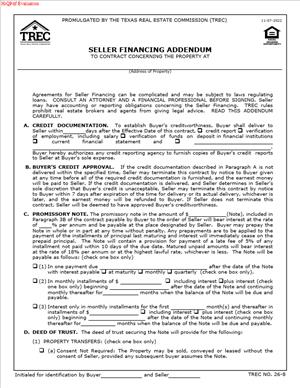
TREC Form 26-8 – Seller Financing Addendum
Fill out nowJurisdiction: Country: United States | Province or State: Texas
The TREC Form 26-8 – Seller Financing Addendum is used in Texas real estate transactions when the seller agrees to finance part or all of the buyer’s purchase. Instead of the buyer borrowing money from a traditional lender, the seller acts as the lender. This addendum attaches to the main sales contract and changes how the purchase will be paid.
If you are about to fill out this document, you are likely either selling property and offering financing or buying property with financing provided directly by the seller. This form outlines the loan terms between you. It becomes part of the overall agreement for the property sale.
Seller financing can make a deal possible when conventional financing is not available or does not fit the situation. The addendum sets out details such as the loan amount, interest rate, payment schedule, and security for the debt. These terms are essential because they control what happens after closing.
This document belongs to the Texas Real Estate Commission and is designed for use with TREC-promulgated contracts. It is structured to cover common seller-financed arrangements, but it still requires careful completion. Every blank matters because it affects payment obligations and rights over the property.
Understanding each section before you sign helps you avoid misunderstandings later. Once signed, this addendum becomes part of a binding agreement tied to the property sale.
What is TREC Form 26-8 – Seller Financing Addendum?
Clear definition
The TREC Form 26-8 – Seller Financing Addendum is a standardized Texas real estate document that modifies a purchase contract when the seller agrees to provide financing to the buyer. It sets the loan terms that will apply between the parties.
It does not replace the main contract. Instead, it works alongside it. The sales contract governs the transfer of the property. This addendum governs the repayment of the financed amount.
The form typically includes provisions about the principal amount of the loan, interest rate, payment structure, maturity date, and consequences of default. It may also address whether the loan will be secured by a deed of trust or other security instrument.
Who typically uses this form?
You may use this form if you are a seller who wants to attract more buyers by offering financing. Sellers sometimes use it to sell property more quickly or to generate income through interest payments.
Buyers use this addendum when they cannot or prefer not to obtain a traditional mortgage. This can happen if a buyer is self-employed, has limited credit history, or needs more flexible terms.
Real estate agents often prepare this addendum when drafting a contract that includes seller financing. Both parties then review and sign it as part of the transaction documents.
Why might you need this form?
You need this form when the payment structure for the property includes money loaned by the seller rather than a third-party lender. Without it, the contract would not clearly describe the financing terms.
Clear loan terms reduce confusion about payment amounts, due dates, and interest. They also help define what happens if payments are late or missed.
This form is also important because seller financing creates an ongoing relationship after closing. The addendum sets expectations for that relationship in writing.
Typical real-life scenarios
- A homeowner selling a rental property may offer financing to a buyer who cannot qualify for a bank loan. The seller agrees to receive monthly payments with interest instead of a lump sum at closing.
- A buyer and seller may agree that the buyer will obtain partial financing from a bank, and the seller will finance the remaining balance. In that case, this addendum describes the seller-financed portion only.
- A family member may sell property to another family member and agree to accept payments over time. Even in informal situations, written loan terms can help prevent disputes.
- An investor selling land may offer short-term seller financing with a balloon payment due after a few years. The addendum can outline that structure clearly, including the due date for the final payment.
When would you use TREC Form 26-8 – Seller Financing Addendum?
You would use this addendum at the time you are preparing or negotiating the purchase contract and you know that the seller will finance all or part of the purchase price. It is typically attached to the contract before the parties sign.
It may be used in residential property sales, land sales, or certain investment properties, as long as the underlying contract allows for addenda. The key factor is that the seller is extending credit to the buyer.
You might also use it when the buyer’s financing falls through but the seller still wants to move forward with the sale. Instead of canceling the contract, the parties may agree to amend it and include seller financing.
The addendum is completed before closing because it affects how funds are handled and what documents must be signed at closing. For example, if the seller is financing the deal, there will typically be a promissory note and a security instrument prepared to reflect the agreed terms.
Buyers and sellers both rely on this document to confirm the exact loan structure. It shapes not only the closing process but also the long-term repayment relationship.
Legal characteristics of TREC Form 26-8 – Seller Financing Addendum
This addendum becomes part of the overall real estate contract once it is signed by both parties. For it to be effective, it must clearly identify the property and reference the underlying contract.
The document generally outlines essential loan terms. These often include the principal amount, interest rate, repayment schedule, maturity date, and whether there is a balloon payment. Clear financial terms help avoid later disagreements.
Common problems arise when key terms are left blank or are inconsistent with the main contract. For example, if the financed amount does not match the agreed purchase price calculations, confusion can occur at closing. Incomplete or unclear payment terms may also lead to disputes.
Seller financing may involve additional legal requirements beyond the addendum itself. For example, the loan is often evidenced by a promissory note and secured by a deed of trust. The addendum does not replace those instruments. It sets out the agreed structure that those documents will follow.
In some situations, federal or state lending laws may apply, especially if the seller finances multiple properties or structures the deal in a way that resembles commercial lending. Requirements can vary depending on the type of property and the number of transactions involved. The form itself does not determine compliance with those laws.
This addendum does not guarantee that the buyer will make payments or that the seller can automatically reclaim the property without following proper procedures. It outlines rights and obligations, but enforcement depends on the terms of the signed agreements and applicable law.
Is it legally binding?
Yes, the TREC Form 26-8 – Seller Financing Addendum is generally legally binding once both parties sign it and it is attached to a valid purchase contract. It becomes part of the overall agreement for the sale.
For it to be binding, there must be a clear offer, acceptance, and mutual agreement on the essential terms. Both parties must sign the document. The addendum must also relate to an enforceable underlying contract for the sale of property.
If important terms are missing or ambiguous, enforcement can become more complicated. Courts typically look at whether the parties clearly agreed on the material loan terms.
The addendum works together with the promissory note and security instrument signed at closing. Those documents reflect the final loan details. If the addendum and closing documents conflict, that can create legal issues that may require interpretation.
How to fill out TREC Form 26-8 – Seller Financing Addendum
Step 1 – Identify the parties and property
Begin by confirming that the buyer’s and seller’s names match the names used in the main purchase contract. The property description should also match the contract exactly. Consistency across documents reduces confusion and helps ensure the addendum is properly connected to the correct transaction.
Step 2 – State the principal loan amount
Enter the amount of money the seller is financing. This is typically a specific dollar amount, not a percentage. Make sure this figure aligns with the purchase price and any down payment described in the main contract. The numbers should clearly show how much the buyer will pay at closing and how much will be financed.
Step 3 – Specify the interest rate
Write the agreed annual interest rate. The form may provide space to indicate whether the rate is fixed or variable. If the rate can change, the terms for adjustment must be clearly described. This section directly affects the total amount the buyer will pay over time.
Step 4 – Describe the payment terms
Fill in the details about how payments will be made. This includes the amount of each payment, how often payments are due, and when the first payment begins. The schedule should be clear enough that both parties can calculate due dates and amounts without guesswork.
Step 5 – Indicate the maturity date and any balloon payment
State the date when the entire remaining balance must be paid in full. If there is a balloon payment, this section will reflect that structure. A balloon payment means regular payments may not fully pay off the loan by the end of the term, leaving a larger final amount due.
Step 6 – Address security for the loan
The form typically refers to a promissory note and a security instrument, such as a deed of trust. Confirm how the loan will be secured against the property. This section connects the repayment obligation to the property itself, which affects what happens in the event of default.
Step 7 – Review default and enforcement provisions
Read the sections that describe what constitutes a default and what remedies may be available. These terms explain what may occur if payments are late or missed. Understanding this section clarifies the risks associated with the financing arrangement.
Step 8 – Confirm consistency with the main contract
Before signing, compare the addendum with the main purchase agreement. Check that financial figures, dates, and property information align. The addendum should not contradict other parts of the contract unless the contract clearly allows for the change.
Step 9 – Sign and date the addendum
Both buyer and seller must sign and date the document. Signatures indicate agreement to the financing terms. Once signed, the addendum becomes part of the overall contract governing the sale and repayment arrangement.
Legal terms you might encounter in TREC Form 26-8 – Seller Financing Addendum
- Promissory Note: This is the written promise you sign to repay the seller. The addendum states that the note will contain specific terms such as the loan amount, interest rate, and payment schedule. The note becomes the primary evidence of the debt once closing occurs.
- Deed of Trust: This is the security instrument that places a lien on the property to secure repayment of the note. In Texas, seller financing is commonly secured by a deed of trust. If you default, the deed of trust outlines the seller’s right to pursue foreclosure.
- Lien: A lien is a legal claim against the property to secure payment of a debt. Under this addendum, the seller’s lien attaches to the property at closing. It remains in place until you pay off the loan, and the lien is formally released.
- Balloon Payment: A balloon payment is a large lump sum due at the end of the loan term. The addendum may state that regular payments are based on a longer amortization schedule, but the full balance becomes due earlier. You must plan for how you will pay or refinance that final amount.
- Amortization: Amortization refers to how your loan balance is reduced over time through scheduled payments. The addendum may specify a set number of years for amortization, even if the loan matures sooner. This affects how much of each payment goes toward interest versus principal.
- Default: Default occurs when you fail to meet a required obligation, such as missing payments or not maintaining insurance. The addendum references the default and ties it to the enforcement rights under the note and deed of trust. Once in default, you may face late fees, acceleration of the debt, or foreclosure.
- Acceleration: Acceleration means the lender can demand the entire unpaid balance immediately. If you default under the terms stated in the addendum, the seller may have the right to accelerate the loan. This eliminates the option to continue making installment payments.
- Prepayment: Prepayment refers to paying off the loan early, either in part or in full. The addendum may state whether prepayment is allowed and whether a penalty applies. You need to check this carefully if you expect to refinance or sell before maturity.
- Late Charge: A late charge is a fee assessed if your payment is not made on time. The addendum outlines how much the fee is and when it applies. These charges can add up quickly if you fall behind.
- Escrow for Taxes and Insurance: The addendum may require you to escrow funds for property taxes and insurance. This means you pay a portion each month, and the seller or servicing party uses those funds to pay the bills when due. Failure to maintain coverage or pay taxes can trigger default.
FAQs
Do I need to attach a promissory note when I sign this document?
You usually do not attach the final promissory note at the time you sign this addendum. Instead, this form outlines the agreed loan terms that will later be placed into a separate note and deed of trust at closing. Before signing, confirm that the principal amount, interest rate, payment schedule, maturity date, and any balloon payment listed here match what will appear in the final loan documents.
What date controls the financing terms if there is a conflict?
You should look at the effective date of the main purchase contract and confirm that this addendum is properly incorporated into it. If terms conflict, the signed addendum typically modifies the original contract terms about financing. Make sure all parties sign and date the addendum so there is no confusion about which version governs.
Who must sign the TREC Form 26-8 – Seller Financing Addendum?
Every party that signed the underlying purchase contract should also sign this addendum. Check that names match exactly, including middle initials or entity designations. If a company or trust is involved, confirm the signer has authority and signs in the correct capacity.
What happens to the public record after closing?
At closing, the deed transferring the property and the deed of trust securing the seller’s loan are typically recorded in the county property records. This document itself is usually not recorded, but it controls what goes into the recorded security instrument. You should verify that the recorded documents reflect the financing terms you agreed to.
Can the financing terms be changed after we sign this form?
Yes, but only through a written amendment signed by all parties. Verbal changes are not enough. If you renegotiate the interest rate, maturity date, or payment structure, make sure the revised terms are clearly written and signed before closing.
What if the buyer plans to refinance before the maturity date?
You need to review the prepayment section carefully. This document should state whether prepayment is allowed without penalty. If you expect to refinance, confirm there is no prepayment penalty and that the payoff process is clearly described.
Do I need to verify tax and insurance requirements before signing?
Yes. Check whether this form requires monthly escrow payments or proof of insurance coverage. Make sure you understand who pays property taxes directly and who holds any escrowed funds, so you avoid accidental default.
How does this form affect closing?
This form provides the blueprint for the loan documents prepared at closing. The closing agent will use its terms to draft the note and deed of trust. Before signing final documents, compare them line by line with this addendum to confirm consistency.
Checklist: Before, During, and After TREC Form 26-8 – Seller Financing Addendum
Before
- Review the main purchase contract to confirm seller financing is permitted.
- Confirm the exact principal amount to be financed.
- Agree in writing on the interest rate and how it is calculated.
- Decide whether payments include escrow for taxes and insurance.
- Clarify whether there will be a balloon payment and its due date.
- Discuss prepayment rights and any penalties.
- Verify both parties’ legal names and signing authority.
- Gather property details exactly as listed in the contract.
During
- Fill in the property address exactly as shown in the purchase contract.
- Enter the principal amount clearly and without rounding errors.
- State the interest rate as a specific percentage.
- Write out the payment amount and frequency.
- Specify the maturity date and balloon payment terms.
- Indicate whether late charges apply and when.
- Confirm default provisions are consistent with the planned deed of trust.
- Check that all blanks are completed or marked not applicable.
- Have all required parties sign and date the form.
After
- Provide a signed copy to all parties immediately.
- Deliver the addendum to the closing agent.
- Review the drafted promissory note for accuracy.
- Review the deed of trust for consistency with the addendum.
- Confirm recording of the deed and deed of trust after closing.
- Store copies of all signed documents securely.
- Calendar payment due dates and maturity date.
- Track tax and insurance obligations to avoid default.
Common mistakes to avoid with TREC Form 26-8 – Seller Financing Addendum
- Mistake: Leaving key financial terms blank because you plan to “work them out later,” which happens when parties rush to secure a deal; this can lead to disputes or failed closings, so do not forget to complete every material term before signing.
- Mistake: Writing inconsistent numbers for principal or interest due to last-minute changes; this creates confusion in the promissory note and can delay closing, so do not forget to double-check all figures against the final agreement.
- Mistake: Ignoring the balloon payment structure because monthly payments look affordable; this can cause financial strain at maturity, so do not forget to plan how the final balance will be paid.
- Mistake: Failing to match legal names exactly as shown on the purchase contract or title documents; this happens when nicknames or abbreviations are used and can affect enforceability, so do not forget to verify full legal names and capacities.
- Mistake: Overlooking prepayment terms when you intend to refinance; this may result in unexpected penalties, so do not forget to confirm whether early payoff is allowed without extra cost.
- Mistake: Not coordinating with the closing agent early enough; this can result in loan documents that conflict with the addendum, so do not forget to provide the signed form well before closing preparation begins.
- Mistake: Assuming property taxes and insurance will be handled automatically; missed payments can trigger default, so do not forget to clarify and document who is responsible for each obligation.
- Mistake: Forgetting to keep a fully executed copy for your records; disputes are harder to resolve without proof of agreed terms, so do not forget to store signed copies in a secure location.
What to do after filling out TREC Form 26-8 – Seller Financing Addendum
Once you complete and sign the addendum, shift your focus to implementation. This document sets the structure for the loan, but the real enforcement power comes from the promissory note and deed of trust prepared at closing. Your job is to make sure those documents match what you agreed to.
Start by organizing your paperwork. Keep the signed addendum with the main purchase contract. You will need both when reviewing final closing documents.
- Step 1: Send a copy of the fully signed addendum to the closing agent or attorney handling the transaction.
- Step 2: Request a draft of the promissory note in advance of closing and compare every financial term to the addendum.
- Step 3: Review the deed of trust to confirm the lien position and default remedies reflect your agreement.
- Step 4: Confirm that the maturity date and any balloon payment appear correctly in the loan documents.
- Step 5: Verify whether escrow for taxes and insurance is required and how payments will be collected.
- Step 6: At closing, read the note and deed of trust before signing, even if you reviewed drafts earlier.
- Step 7: After closing, confirm that the deed and deed of trust were recorded in the county property records.
- Step 8: Create a payment calendar with due dates, late charge triggers, and the final maturity date.
- Step 9: Store digital and paper copies of the signed note, deed of trust, and addendum in a secure location.
- Step 10: Monitor compliance with insurance and tax requirements to prevent default.
Stay organized. Seller financing works best when expectations are clear and documented. Careful review now prevents costly disputes later.
Disclaimer: This guide is provided for informational purposes only and is not intended as legal advice. You should consult a legal professional.